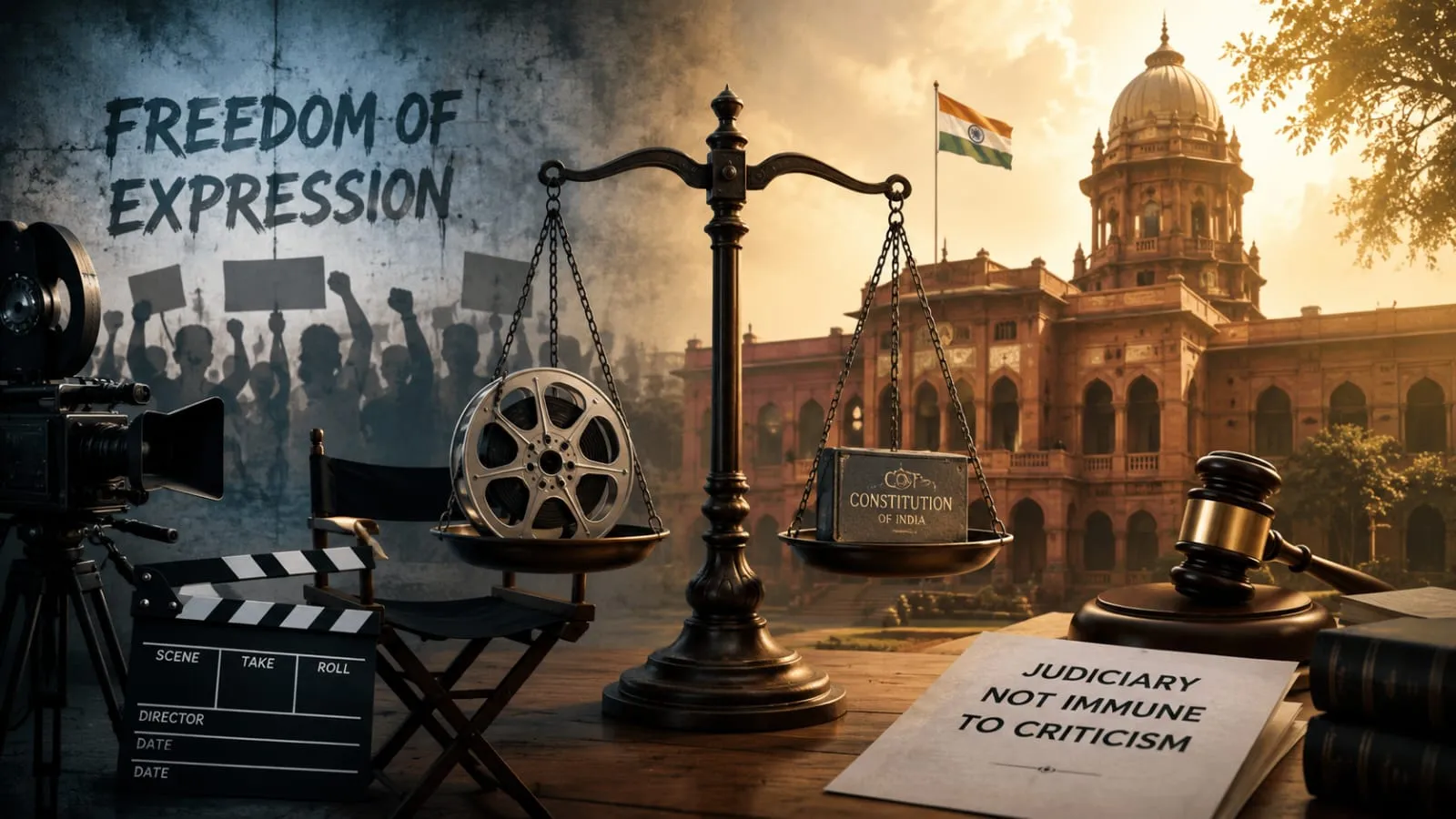
On May 14, 2026, Suriya and RJ Balaji's Karuppu arrived in theaters. Within days, it had grossed over ₹250 crore worldwide, becoming the highest-grossing Tamil film of the year . But the film's success story is not what made headlines. What made headlines was a courtroom drama that unfolded not on screen, but inside the Madras High Court itself .
A lawyer walked in demanding a ban on the film for showing a corrupt judge. The court's response was startling: "None can deny there is corruption in the judiciary. There were and are corrupt judges" . In one extraordinary hearing, the judiciary did not defend itself with outrage. It defended itself with honesty. And in doing so, it turned a film ban petition into a rare moment of institutional self-reflection.
The Petition: 'This Film Is Scandalising the Judiciary'
The trouble began when Advocate RS Tamilvendan filed a Public Interest Litigation (PIL) before the Madras High Court . His target was Karuppu, a film in which Suriya plays a rural lawyer who is also the human avatar of the deity Karuppusamy . The film's plot revolves around a fictional court called "Seven Wells Court" —a name that does not exist in Chennai's real court geography, where courts are named George Town, Egmore, and Saidapet .
Tamilvendan's grievance was specific and serious. He argued that the film showed a judge involved in bribery and drug consumption . It portrayed an "unholy alliance between an unethical lawyer and a corrupt judge" . If the film continued to screen in theaters and on OTT platforms, he claimed, it would lead to the public losing trust in the judiciary . He urged the court to ban or regulate the film under the Contempt of Courts Act, 1971 .
On the surface, it was a familiar story. A legal professional offended by a film's depiction of his profession. A demand for censorship in the name of institutional dignity. But what happened next was anything but familiar.
The Court's Response: 'Judges Are Not Holy Cows'
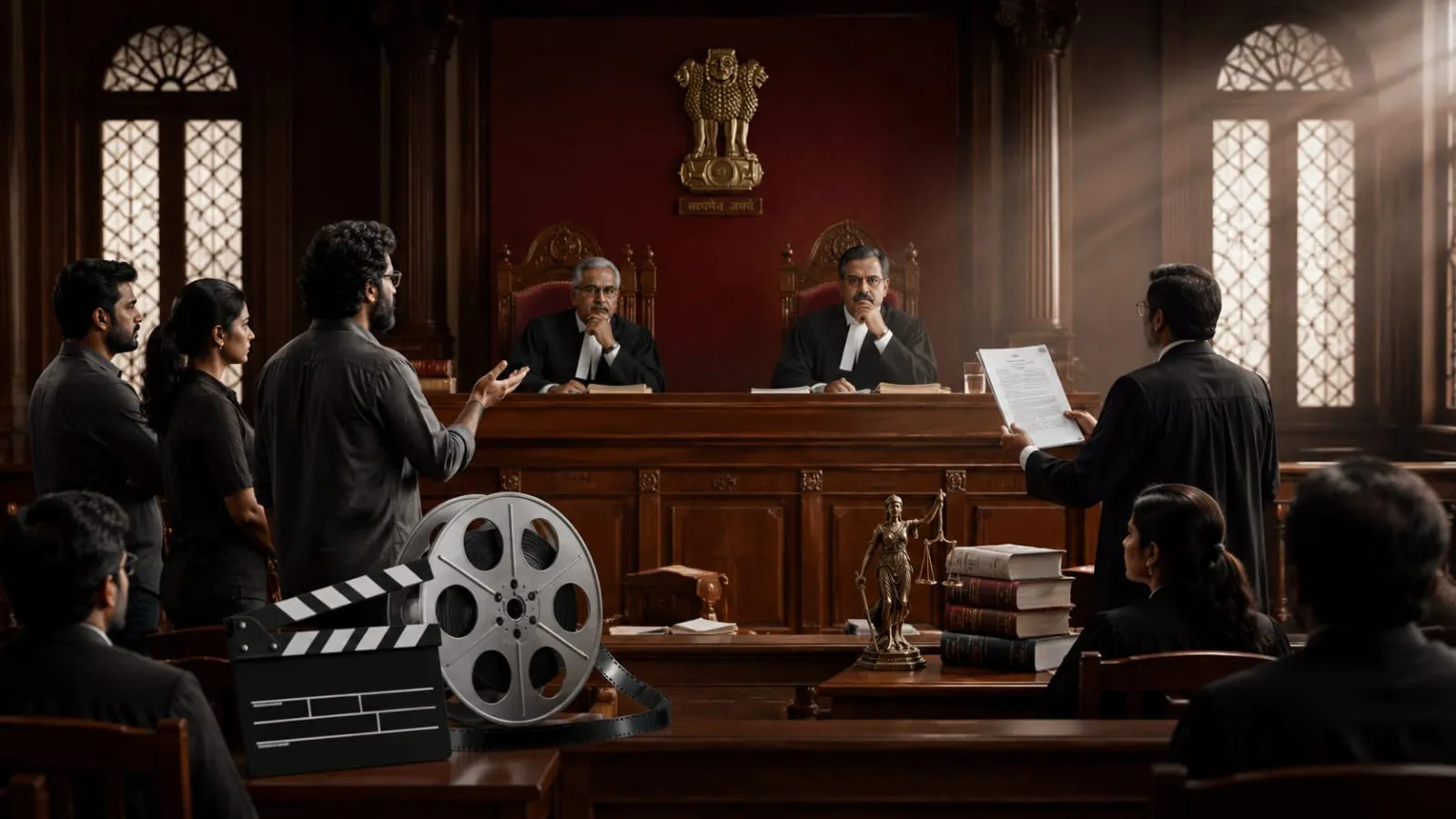
A vacation bench of Justices G.R. Swaminathan and V. Lakshminarayanan heard the petition . And before Tamilvendan could press his case further, the judges made a statement that would ricochet across every news platform in the country.
"None can deny there is corruption in the judiciary. There were and are corrupt judges," the bench remarked .
They did not stop there. The judges pointed out that the Madras High Court's Full Court "regularly shows the exit door to such black sheep" . Corruption within the system, they admitted, was not a fictional invention of a film director. It was a reality that the institution itself was actively trying to purge.
The petitioner's counsel argued repeatedly that the film portrayed judicial officers in poor light. The bench's response was almost weary: "It may be the impression of the director and the producer; what can we do?" .
Then came the line that everyone would remember. Citing Lord Atkin, the bench declared: "Judges need not be treated as holy cows. Justice is not a cloistered virtue; she must be allowed to suffer the scrutiny and respectful even though outspoken comments of ordinary men" .
The 'Seven Wells Court' Defense: Why Malgudi Saved the Film
But the court's most legally significant argument was not about corruption. It was about fiction.
The judges pointed out that the film was set in an imaginary court called "Seven Wells Court" . No such court exists in reality. It was, the bench observed, "just as Malgudi is a fictional village in R.K. Narayan's works" . When a person presiding over an imaginary court is portrayed as corrupt, the court held, it would not attract the penal provisions contained in the Contempt of Courts Act, 1971 .
The bench also noted that the film's director, RJ Balaji, had not portrayed the entire judicial system as corrupt . Only one fictional judge in one fictional court. That distinction, in the eyes of the law, made all the difference.
One of the judges, Justice Swaminathan, had actually watched the film before delivering the order . The producer was not called upon to arrange a special screening. The judge bought his own ticket and sat in a theater like any other member of the audience . His conclusion? The film was exaggerated—but exaggeration is the grammar of Tamil cinema.
"It is true that the portrayal of the system in the movie is grossly exaggerated," the bench wrote. "But that is the way movies are taken in Tamil. The hero will single-handedly vanquish a dozen villains who surround him. Everything is melodramatic in Tamil cinema. Therefore, 'Karuppu' should also be taken as one of a piece" .
'We Are in the Age of Social Media': A Warning to the Judiciary
Perhaps the most striking passage in the judgment was its acknowledgment of changing times. "We are now in the age of social media," the court observed. "Anybody can say anything and get away with it. Therefore, the standards that were evolved in the earlier centuries may no longer hold good. Even if an atrocious statement is made, it would be better to ignore it. The judicial caravan has to move on" .
This was not defensiveness. It was realism. In an era where every citizen with a smartphone can critique institutions, the court argued that the judiciary must develop thicker skin. The question of whether a movie involves contempt of court, the bench said, "should be examined from the perspective of a calm judge with broad shoulders and not that of a touchy character" .
The court also referenced a passage from the Ramayana, in which a frog asks Lord Rama: "When others hurt me, I call your name 'Rama Rama,' but when you are the source of trouble, who else can I call?" . The same applies to courts, the bench observed. Courts are expected to protect people's freedom of speech. They cannot become the very source of its curtailment.
The Role of the CBFC: Why the Court Refused to Interfere
The bench also made a crucial procedural observation. Section 5B of the Cinematograph Act, 1952 empowers the Central Board of Film Certification (CBFC) to deny certification to a film if it involves contempt of court . In the case of Karuppu, the CBFC had already examined the film and found nothing contemptuous enough to deny certification .
"Thus, the censor board can decline to grant sanction," the bench noted. "But when the censor board itself was not of the view that the film involves contempt of court and had issued certificate, the writ court will not substitute its opinion" .
This was a pointed rejection of the petitioner's attempt to use the judiciary as a second-tier censor board. The statutory mechanism had already done its work. The court was not going to undo it simply because one lawyer found the content offensive.
The Irony: A Film About Corruption Survives a Corrupt-Free Legal Challenge
The dismissal of the petition was a victory for Karuppu. The film continued its successful theatrical run without legal hurdles . But the larger story was not about box office numbers. It was about the extraordinary spectacle of a court agreeing with a film's premise while refusing to ban it.
The petitioner had argued that the film would erode public trust in the judiciary. The court's response was effectively: if a fictional film about a corrupt judge erodes public trust, perhaps the problem is not the film. Perhaps the problem is the reality that makes the fiction believable.
As the bench itself noted, corruption in the judiciary cannot happen in isolation. "Corruption in judiciary cannot be committed without some members of the Bar becoming privy to the corrupt," the court observed . The film's portrayal of an unethical lawyer colluding with a corrupt judge was not fantasy. It was a pattern the court itself had witnessed.
What the Karuppu Case Teaches Us
The Karuppu case is not just a legal footnote. It is a business case study in how institutions can respond to criticism without panic. The Madras High Court did not lash out at the filmmaker. It did not demand apologies. It did not use its contempt powers to silence dissent. Instead, it acknowledged the uncomfortable truth at the heart of the petitioner's complaint: yes, corruption exists. Yes, we are working on it. No, that does not mean you can ban every film that makes us uncomfortable.
For filmmakers, the message was clear: artistic license has constitutional protection. For the legal profession, the message was more sobering: the public's perception of judicial corruption is not created by movies. Movies merely reflect what the public already suspects.
And for the rest of us, the Karuppu case offered something rare in Indian public life: an institution that looked at itself in a cracked mirror and did not smash it. Instead, it shrugged, quoted the Ramayana, and said: "The judicial caravan has to move on."