The Biggest Failure in Alzheimer's Care Is Not the Absence of Treatments. It Is That We Find Patients Too Late to Use Them.
Alzheimer's disease has a specific and brutal timeline. The molecular changes that will eventually produce dementia begin accumulating in the brain fifteen to twenty years before the first symptom appears. The amyloid plaques and tau protein tangles that characterise the disease are building — silently, invisibly — while the patient goes about their daily life with no awareness that anything is wrong. By the time the first episode of memory loss appears, the window for meaningful intervention may already have closed.
The reason that window closes without being used is not primarily about treatment. Treatments exist. Clinical trials are ongoing. Some have shown the ability to slow disease progression when administered early enough. The reason the window closes is diagnosis. In the current standard of care, Alzheimer's disease is diagnosed clinically — by a neurologist evaluating a patient who is already presenting symptoms — or by expensive and invasive imaging or laboratory tests that most patients in India and globally will never have access to.
A PET scan for amyloid imaging — the most sensitive current tool for detecting Alzheimer's at the molecular stage — costs between ₹40,000 and ₹1,00,000 in India and requires nuclear medicine facilities that are available in a small fraction of the country's hospitals. Cerebrospinal fluid analysis, which can identify the same biomarkers, requires a lumbar puncture — an invasive procedure that most patients will decline unless they are already significantly symptomatic.
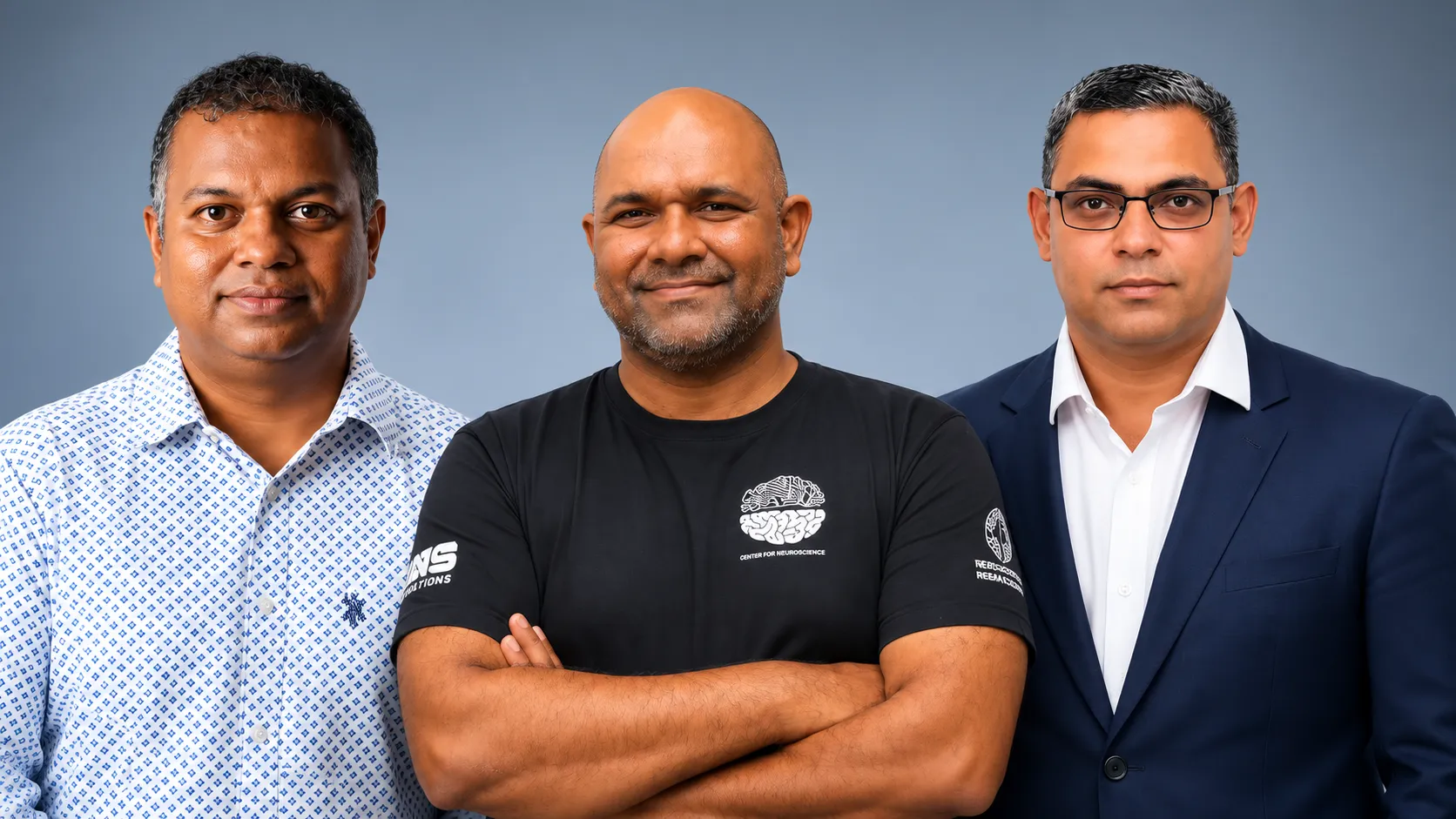
Dr Deepak Kumaran Nair, a professor at the Centre for Neuroscience at the Indian Institute of Science in Bengaluru and co-founder of eNLife Research, articulated the problem with the precision of someone who has spent his academic career in proximity to it. The biggest failure of Alzheimer's care today is not the absence of treatments in trials, he said. It is that we find patients a decade too late to use them.
eNLife Research was built to close that gap.
What eNLife Research Is Building — the Platform and the Science
eNLife Research is developing an AI-powered blood-based biomarker diagnostic platform that screens for the molecular signatures of Alzheimer's disease from a simple blood draw — no lumbar puncture, no nuclear medicine facility, no expensive specialised imaging.
The current version of the test screens for five to seven biomarkers, including amyloid beta and abnormal tau proteins — both of which are well-established indicators of Alzheimer's disease pathology that are detectable in blood at concentrations that have become accessible to highly sensitive assay technologies developed in recent years. The results are delivered within two to five hours and can be processed at routine diagnostic centres rather than at the specialised facilities that PET scans require.
The AI component is the dimension that makes the platform's 15-year early detection claim scientifically credible rather than aspirational. Machine learning algorithms trained on large biomarker datasets can identify subtle patterns and correlations between biomarkers that are not visible to conventional clinical interpretation — the earliest molecular signatures of disease progression that appear years before the accumulation of pathology is sufficient to produce any clinical symptom.
Lt. Col. Jojo Jacob, co-founder of eNLife, described what AI enables in the diagnostic process. What previously took months of laboratory work can now be partially simulated using AI, he said. It allows the company to evaluate many more molecular candidates while significantly reducing both the time and cost involved.
The company's broader ambition extends beyond the five-to-seven biomarker initial panel. The long-term development plan targets a panel of 25 to 100 biomarkers — a comprehensive molecular profile of neurodegenerative risk that would allow the AI platform to identify complex biological patterns associated not just with Alzheimer's but with multiple forms of dementia and other neurodegenerative disorders simultaneously.
eNLife is currently between Technology Readiness Level 3 and 4 — it has demonstrated proof of concept and is focused on integrating its research into a single diagnostic platform that can eventually be deployed in hospitals and laboratories.
The Institutional Foundation — IISc, NIMHANS, TIFR, and CBR
The scientific credibility of eNLife's platform is grounded in its institutional collaborations, which are among the most concentrated in Indian neuroscience research.
The company was incubated at the Foundation for Science Innovation and Development at the Indian Institute of Science in Bengaluru — one of India's premier research institutions and the country's first university dedicated to scientific and engineering research. The IISc incubation provides access to the research infrastructure, the scientific networks, and the institutional validation that early-stage deeptech companies require to build credibility with clinical partners, regulatory bodies, and investors.

Beyond IISc, eNLife is collaborating with the National Institute of Mental Health and Neurosciences — NIMHANS — in Bengaluru, one of India's leading neurological research and clinical care institutions. The collaboration with the Tata Institute of Fundamental Research in Hyderabad brings one of India's most respected basic science research institutions into the biomarker development process. The Centre for Brain Research in Bengaluru — a collaborative research initiative between IISc and international partners — adds depth in population-level brain health research.
The specific purpose of these collaborations is to develop biomarker datasets tailored to Indian genetic and lifestyle risk profiles. This is a dimension of the eNLife platform that distinguishes it from simply deploying Western-developed diagnostics in an Indian context. Genetic polymorphisms that affect Alzheimer's risk, lifestyle factors including diet and exercise patterns, and the specific environmental and metabolic conditions of the Indian population may produce biomarker signatures that differ from those in the European and American populations on which most existing Alzheimer's biomarker research has been conducted.
Building an India-specific diagnostic platform is both a scientific necessity — to ensure the test actually works for its intended population — and a competitive advantage, since international Alzheimer's diagnostics arriving in India will not have been calibrated for Indian genetic profiles.
The Round — Piper Serica VC Fund and the Bharat Tech Fund
The ₹6 crore seed round was led by Piper Serica VC Fund, the venture capital arm of Piper Serica — a Chennai and Mumbai-based financial services firm. The investment was made through Piper Serica's recently launched ₹800 crore Bharat Tech Fund, which focuses on startups building proprietary technologies across artificial intelligence, biosciences, semiconductors, defence technology, spacetech, and cybersecurity.
The investment thesis that Rajni Agarwal, Director at Piper Serica, articulated at the announcement is worth reading carefully because it names both the demographic urgency and the access equity argument simultaneously.
India will have one of the world's largest ageing populations within a generation, she said, and neurodegenerative disease is the burden we are least prepared for. She described eNLife's potential to detect Alzheimer's up to 15 years early from a single blood sample at a price point that can reach Tier 2 and Tier 3 cities as technology designed not for a few, but for Bharat.
The Bharat framing is the specific investment argument that the current diagnostic landscape does not support. A diagnostic that requires a PET scan is, in practice, a diagnostic for the affluent urban patient who has access to a nuclear medicine facility. A diagnostic that works from a blood draw at a routine diagnostic centre — which exist in virtually every Indian town of meaningful size — is a diagnostic that can, in principle, reach the entire population at risk.
In addition to the Piper Serica funding, eNLife has received support from IISc through an Rs 10 lakh CST seed grant and from i-Hub@IIITD Foundation through a deep tech seed grant of Rs 50 lakh — institutional validation that preceded the venture capital investment and that provided the early-stage resources required to reach proof of concept.
What the ₹6 Crore Will Build
The capital deployment plan is sequenced around the specific milestones required to take an early-stage diagnostics platform from research setting to clinical deployment.
Expanding the R&D team means adding the researchers, data scientists, and biomarker specialists required to accelerate the platform's development without being limited by the team size that a bootstrapped academic startup can sustain.
Validating the blood-based biomarker platform means conducting the clinical studies that demonstrate the test's sensitivity and specificity in a population of real patients — the data that will be required for regulatory approval and that will define the commercial case for adoption by hospital networks and diagnostic chains.
Advancing the first diagnostic assay from prototype to clinical-grade validation means meeting the technical standards for a diagnostic product that can be deployed in a healthcare setting rather than in a research laboratory — the transition from proof-of-concept to product.
The patent filing programme — planned to begin over the next nine to eighteen months — covers biomarker binders, diagnostic assays, and the detection platform itself. The intellectual property filing is the commercial moat-building that runs in parallel with the clinical development.
The commercialisation plan, when the product is ready, is technology licensing — eNLife will license its validated diagnostic platform to hospital networks, diagnostic chains, and pharmaceutical companies rather than building its own distribution infrastructure, which concentrates the company's resources on the scientific development where its competitive advantage lies.
Why This Matters — the Scale of the Problem in India
India has more than 44 lakh people living with dementia, according to the Alzheimer's and Related Disorders Society of India. The number is projected to more than double by 2050 as India's population ages. The vast majority of these patients are diagnosed late, when the disease has already progressed beyond the stage where the most promising treatments can meaningfully slow its course.
The cost of this late diagnosis is not primarily financial — though it is also financial. It is the cost to every patient and every family of years of planning, preparation, and informed medical decision-making that they do not have because nobody told them early enough.
eNLife's platform is not a cure. It does not stop Alzheimer's. What it can potentially do — if the clinical validation succeeds and the platform reaches its intended scale — is give patients and families the fifteen-year window between molecular onset and clinical symptom that currently passes without any knowledge that the disease is beginning.
Fifteen years is enough time to enrol in a clinical trial. Enough time to make financial plans. Enough time to say the things that need to be said. Enough time to pursue the lifestyle interventions that evidence suggests can slow progression. Enough time for a family to prepare.
The blood test that delivers that fifteen years is, if it works as intended, not a diagnostic device. It is a gift of time.