Companies are suddenly terrified of signing large office leases. The twin fears — a Middle East war and an AI‑led workforce disruption — have frozen expansion plans across India's top cities.
The deal was supposed to close in April.
A large FMCG company had identified the space — 150,000 square feet in a gleaming new tower on Gurugram's Golf Course Road. The negotiations were done. The terms were agreed. The lawyers were drafting the final document. And then someone in the C‑suite asked a question that nobody had a good answer for.
"What if we don't need this office in two years?"
The deal is now on hold. Indefinitely.
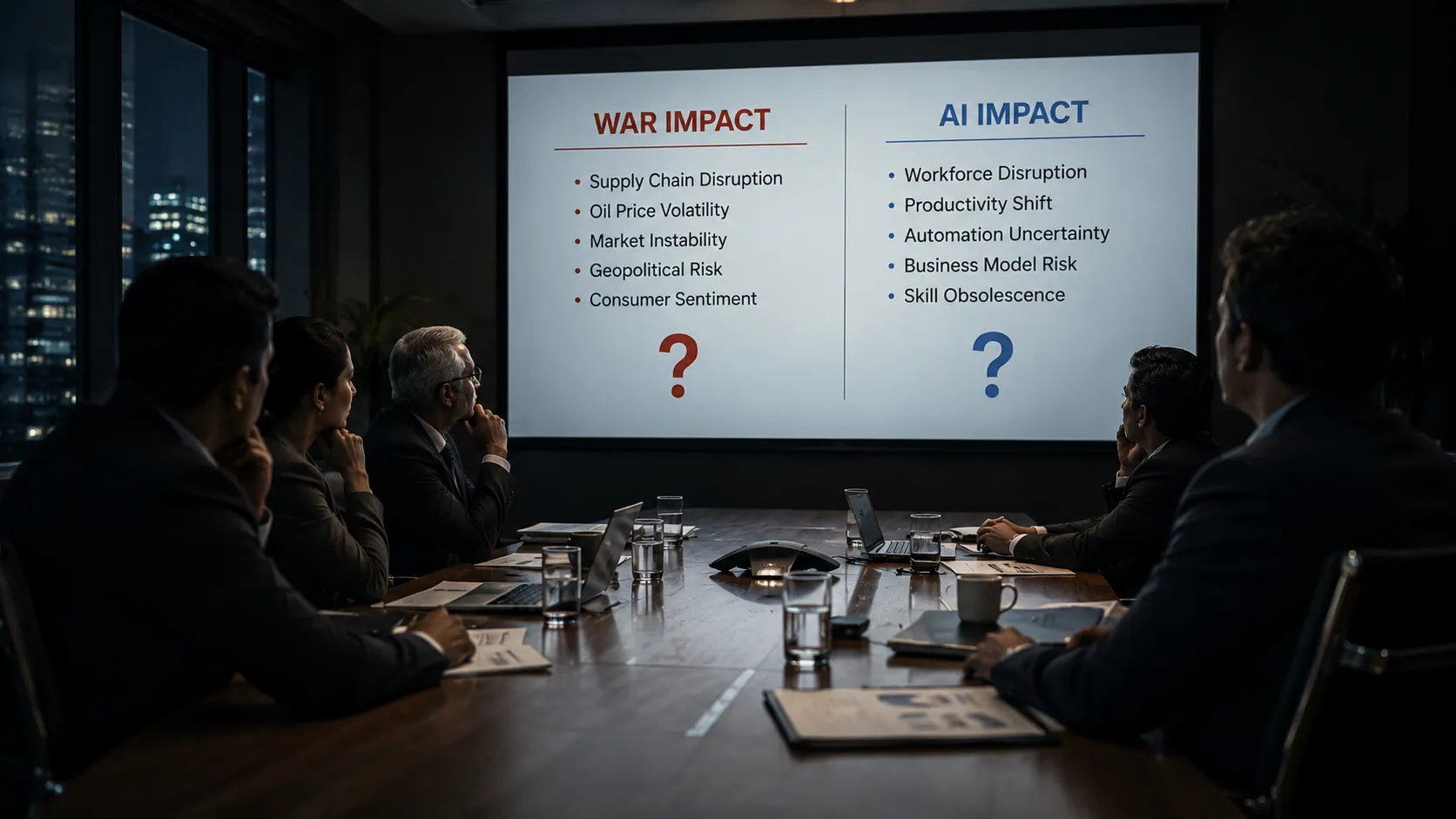
And the same story is playing out across Mumbai, Gurugram, Bengaluru, and Noida. Large office leasing deals across India's top cities are taking significantly longer to close as companies reassess expansion plans amid two unprecedented disruptions: the Iran‑US war that has sent oil prices soaring and a gnawing, unsettling uncertainty about how many employees will still be coming into desks once artificial intelligence fully rewrites the way work gets done.
Welcome to the great office freeze of 2026.
A Lengthening Decision Cycle
The data is still anecdotal, but the pattern is unmistakable. Real estate consultants, property developers, and flexible workspace operators all report the same phenomenon: large occupiers are hitting the pause button.
"We are witnessing a slight lengthening of decision cycles in some markets, but not an outright withdrawal of demand," said Anshuman Magazine, CEO of CBRE India, South‑East Asia, Middle East and Africa. "Large occupiers are recalibrating timelines as their boards take a more measured view of capital commitments amid global volatility."
That's the diplomatic version. The blunter version comes from CG Offices, a carbon‑neutral workspace provider that confirmed that an FMCG transaction was directly impacted by these twin fears.
"Corporate occupiers are clearly becoming more measured in their office space decisions, and larger deals are taking longer to close as companies assess costs, growth visibility and workplace strategy more carefully," said Vibhor Jain, CEO of CG Offices.
The phrase "workplace strategy" is doing a lot of heavy lifting there. What it really means is: nobody knows what the office is going to look like in 2028. And until they do, they're not signing 10‑year leases.
The War Factor
The Iran‑US war, which began in late 2025 and escalated through the first half of 2026, has done more than just push crude oil prices above $120 a barrel. It has injected a level of geopolitical uncertainty into corporate planning that most Indian companies haven't experienced in decades.
For companies with global operations, the war has disrupted supply chains, raised shipping costs, and forced emergency board meetings about contingency planning. For domestic companies, the war has raised the cost of capital, increased input prices, and made every long‑term commitment feel riskier.
Office leases — especially large ones — are among the longest and most expensive commitments a company makes. A typical Grade A office lease in a top Indian city runs 5 to 10 years, with rental escalations built in. Signing one in the middle of a war requires a level of confidence that many boards simply do not have right now.
"Six months ago, the biggest question was 'How fast are we growing?'" said a Mumbai‑based real estate consultant who advises several multinational corporations. "Now the biggest question is 'Will the Strait of Hormuz still be open in six months?' You can't plan office space around that."
The AI Factor
But the war, for all its drama, may not be the longer‑term threat to office demand. That title belongs to artificial intelligence.
The rise of generative AI — tools that can write code, draft contracts, analyze data, and even participate in meetings — has forced every company to ask a fundamental question: how many of our employees actually need to be in an office?
The answer, for many companies, is rapidly changing. Software developers, data analysts, financial modelers, customer support agents, and even some legal and HR functions can now perform much of their work remotely or with AI assistance. The pandemic proved that remote work was possible. AI is proving that it might be preferable.
"We've had four different clients in the last two months ask us to model a 30 percent reduction in their office footprint over the next three years," the real estate consultant said. "Not because they're shrinking — most are growing. But because they think AI will let them grow without adding desks."
The impact is most acute in the IT/ITeS sector, which has historically been the largest driver of office demand in cities like Bengaluru, Hyderabad, and Pune. According to Crisil, Grade A commercial office vacancy is expected to fall to 15.5‑16.0 percent over the next two years, but that projection is now exposed to significant downside risks from AI‑led disruptions that could hit hiring and expansions in the sector.
Gautam Shahi, senior director at Crisil Ratings, put it plainly: "Increased geopolitical uncertainties and tariff‑related issues, too, may impact the leasing plans of GCCs."
Not a Uniform Freeze
To be clear: the office market is not collapsing. Quality assets in prime locations are actually seeing rental growth despite the broader caution.
A building on Gurugram's Golf Course Road — with its premium amenities, blue‑chip tenant roster, and proximity to the airport — continues to attract interest. A tower in Bengaluru's Outer Ring Road, home to several global capability centres, remains fully leased with a waiting list.
The flexible workspace sector, which has become a bellwether for office demand, continues to add large capacities. Companies that are unsure about their long‑term needs are turning to co‑working operators as a hedge — paying a premium for flexibility rather than committing to a 10‑year lease.
"Flexible space is the canary in the coal mine," said the CEO of a national co‑working chain. "When companies are uncertain, they rent from us. When they're confident, they sign their own leases. Right now, uncertainty is winning."
The GCC Question
One of the most closely watched segments is Global Capability Centres (GCCs) — offshore units of multinational corporations that handle everything from IT support to R&D to finance. India is home to more than 1,600 GCCs, employing over 1.6 million people and occupying tens of millions of square feet of office space.
For years, GCCs were the safest bet in Indian commercial real estate. Multinationals set up centres in India for cost arbitrage, and those centres grew steadily, adding headcount and space year after year.
Now, even that segment is showing signs of caution. Some multinationals are asking whether the work done by their Indian GCCs could be partially automated by AI. Others are waiting to see how the war unfolds before committing to new campuses.
"If GCCs pause, that's a significant portion of demand that disappears," the Crisil analyst said. "And right now, they're not pausing, but they're definitely slowing down."
What Breaks the Freeze?
So what would it take for companies to start signing large office leases again?
Three things, according to real estate experts.
First, a resolution of the Iran‑US war. The Strait of Hormuz must reopen, oil prices must stabilize, and geopolitical risk must recede from the front pages. That process has begun — US and Iranian officials agreed on a framework to end the war and reopen the strait by June 19 — but peace is fragile, and trust is low.
Second, clarity on AI's impact on headcount. Companies need to know how many employees will be in offices in 2028. That requires a deeper understanding of which jobs AI will replace, which jobs AI will augment, and which jobs AI will leave untouched. That understanding is still evolving.
Third, a sustained period of economic growth without major shocks. The Indian economy is growing at 6‑7 percent, but that growth has been bumpy — supply chain disruptions, oil price spikes, monsoon uncertainty. Companies need a smoother ride before they commit to long‑term real estate.
"When the war ends, when oil stabilizes, when AI becomes less of a mystery — the freeze will thaw," the CBRE executive said. "The question is when, not if. But 'when' could be six months from now, or it could be two years. Nobody knows."
The Bottom Line
India's commercial office market is not in crisis. Vacancy rates remain manageable. Prime assets continue to lease. Flexible space operators are growing. But the market is undeniably slowing, and the cause is not a single factor but a confluence of two: a hot war in the Middle East and a quiet revolution in artificial intelligence.
Large occupiers are not walking away from office space. They are waiting. They are studying. They are modeling scenarios. And until they have answers to the two questions that froze the FMCG deal — "What if the war spreads?" and "What if AI eliminates half our desks?" — they will continue to wait.
The real estate industry, which has enjoyed a remarkable post‑COVID recovery, is now learning to live with uncertainty. The freeze may be temporary. Or it may be the beginning of a longer, slower adjustment. Either way, the days of easy, rapid office leasing decisions are over — for now, and perhaps for good.