
She Started as Employee Number 25. Now She Is Telling Europe's Governments What Needs to Change.
In 1994, a 29-year-old Italian economist joined Omnitel — the first mobile challenger in Italy's telecoms market — as employee number 25. She mapped the placement of the first network towers across the country. She worked in consumer marketing, digitalisation, operations, and finance. She became CFO of Vodafone Italy, then Group CFO of Vodafone at the FTSE 100 level, then — when the previous CEO departed at the end of 2022 — the first female Chief Executive in Vodafone's history.
Thirty years, one company, one continent, one very large job.
On June 16, 2026, Margherita Della Valle stood on the stage of the Reuters Next Europe summit in London and delivered a message to European governments that was clear, specific, and slightly impatient.
Europe's digital infrastructure is not keeping up. The investment required to build it — 5G networks, fibre backbones, AI infrastructure, cybersecurity layers — is not flowing at the pace or scale the continent needs. And the reason it is not flowing is that European regulators have not yet created the conditions that would make that investment economically rational for the companies asked to fund it.
"I think speed is always the challenge, and the faster the better," she said at the summit, referring to an ongoing EU consultation on merger guidelines.
Three words. The faster the better. From the CEO of one of Europe's most important technology companies, that is not a diplomatic request. It is a warning about what happens if the answer is slow.
The Argument She Made on Stage — and Why It Is More Than Lobbying
Della Valle's core argument at Reuters Next is structurally important and deserves precise explanation, because it goes well beyond standard corporate lobbying for lighter regulation.
The economics of telecoms infrastructure are defined by what the industry calls return on infrastructure. Building a mobile network costs billions of dollars. Running it requires constant capital expenditure — new towers, upgraded equipment, software maintenance, spectrum licensing. The return on that investment comes from the revenue generated by customers using the network. The more customers use the network, the better the return on the capital already deployed.
This is the mathematical reality that Della Valle used to explain why consolidation is not a preference but a necessity.
That sentence contains the entire economic logic of the consolidation argument. One network, 28 million customers. Not two networks, 14 million customers each. The capital expenditure for one network is not half of two — the infrastructure must be built to cover the same geographic area regardless of how many customers use it. But the revenue from serving 28 million customers is double the revenue from serving 14 million. The return on the same infrastructure investment is, in crude terms, doubled by consolidation.
This is why Della Valle has spent three years pushing for Vodafone's merger with Three in the UK — and why that merger has become one of the most closely watched regulatory decisions in European telecoms. The merger, which creates Britain's largest mobile operator by customer count, received conditional government approval after extended regulatory scrutiny. It is Della Valle's proof of concept: this is what the investment case looks like when the consolidation is permitted.

What She Is Asking Europe's Regulators to Do
European telecoms markets have, for decades, operated under a regulatory philosophy that prioritised competition by maintaining four separate network operators in major markets. The theory was that four competitors would keep prices low and service quality high.
The reality has been that four operators competing for the same market have produced fragmented infrastructure investment, squeezed margins, and insufficient capital for the generation of network upgrades required to build genuinely competitive 5G and fibre infrastructure at European scale.
Della Valle's specific ask at Reuters Next is that the EU follow Britain's example when it finalises new merger rules — allowing the number of network operators in major European markets to reduce from four to three. This has been a regulatory red line in Brussels for years. Maintaining four operators was considered essential to competition. What Della Valle is arguing, with the UK merger as evidence, is that three well-capitalised operators building one properly funded network each is better for customers and for Europe's digital competitiveness than four under-capitalised operators building four poorly funded networks.
The France case is the immediate test. Telecoms groups Bouygues, Orange, and Iliad-owned Free are facing a complex antitrust review of their planned $23.5 billion takeover of SFR. That deal — a three-to-two consolidation in one of Europe's largest telecoms markets — will be, in Della Valle's framing, a definitive signal of whether European regulators have internalised the investment argument or are still operating from the old competitive-structure playbook.
Her stated expectation is that the EU will follow the UK's direction. Her message to regulators who might not is contained in the urgency of her language: the faster the better, she said, referring to the EU consultation. Not "we hope for a positive outcome." Not "we look forward to the conclusion of the process." The faster the better.
The Strategy She Has Already Executed
The urgency of Della Valle's public position on regulatory reform is backed by a restructuring of Vodafone that is already largely complete — and that has transformed the company's footprint, balance sheet, and strategic focus in ways that were not assured when she took the interim CEO role in December 2022.
When she became CEO, Vodafone was a sprawling, underperforming conglomerate with operations across multiple European markets where it was neither the largest operator nor generating returns that justified the capital deployed. Its share price was under pressure. Its strategy was unfocused. Its path to growth was unclear.
Three years later: Vodafone sold its Italian business to Swisscom for €8 billion. It sold Vodafone Spain for €5 billion. It merged the UK business with Three to create Britain's largest mobile network. The proceeds and the simplified structure have funded a share buyback programme and reduced the operational complexity that was suppressing performance.
"Della Valle called the sale of the Italian business the 'final step in the reshaping of our European operations,'" as Fortune reported at the time of that deal. The reshaping has produced a company that is bigger in its remaining markets, better capitalised, and more focused on the specific geographies where it can win rather than trying to compete across too many fronts simultaneously.
The parallel commercial strategy — which Della Valle described to the Financial Times in November 2025 — is to grow business customer revenue to approximately 50 per cent of the group total, up from 25 to 30 per cent currently. The growth vehicle is combining traditional connectivity with expanding digital services, specifically AI tools and cybersecurity solutions targeted at small and medium-sized enterprises.
Vodafone's partnership with Microsoft — which Della Valle described at the time of its announcement as positioning Vodafone to "accelerate the digital transformation of our business customers, particularly small and medium-sized companies" — is the commercial infrastructure for that ambition. A €140 billion addressable market, in Della Valle's own estimate, covering the SME digital services opportunity in Vodafone's operating markets.
Why Europe's Digital Gap Is the Context Behind Everything She Said
The specific urgency of Della Valle's Reuters Next message cannot be understood without the broader context of Europe's digital competitiveness position.
Europe lags the United States and Asia — particularly China — in the deployment of 5G infrastructure, in data centre capacity, in AI compute, and in the commercial digital services built on top of that infrastructure. The gap is not primarily a function of talent or ambition. It is, as Della Valle argues, primarily a function of investment — and investment is primarily a function of whether the companies asked to fund it can generate a return on the capital they deploy.
The Draghi Report on European competitiveness, released in late 2024, made the investment gap explicit and alarming: Europe needs approximately €800 billion per year in additional investment to match the productivity and technology trajectory of its major competitors. Telecoms infrastructure is a core component of that gap. A continent that cannot deliver high-quality, pervasive 5G and fibre connectivity at competitive prices is a continent whose businesses are structurally disadvantaged in deploying AI, automation, and digital services at scale.
This is what Della Valle means when she says that investment in digital infrastructure is needed "to help economies grow, but also to ensure security and resilience at a time of geopolitical threat." The security and resilience point is increasingly important in its own right. Europe's dependence on undersea cables, cloud infrastructure dominated by US hyperscalers, and connectivity networks built on equipment from vendors now subject to geopolitical scrutiny has made digital infrastructure explicitly a national security issue, not just a commercial one.
The CEO Who Built Her Career Where Others Started Visiting
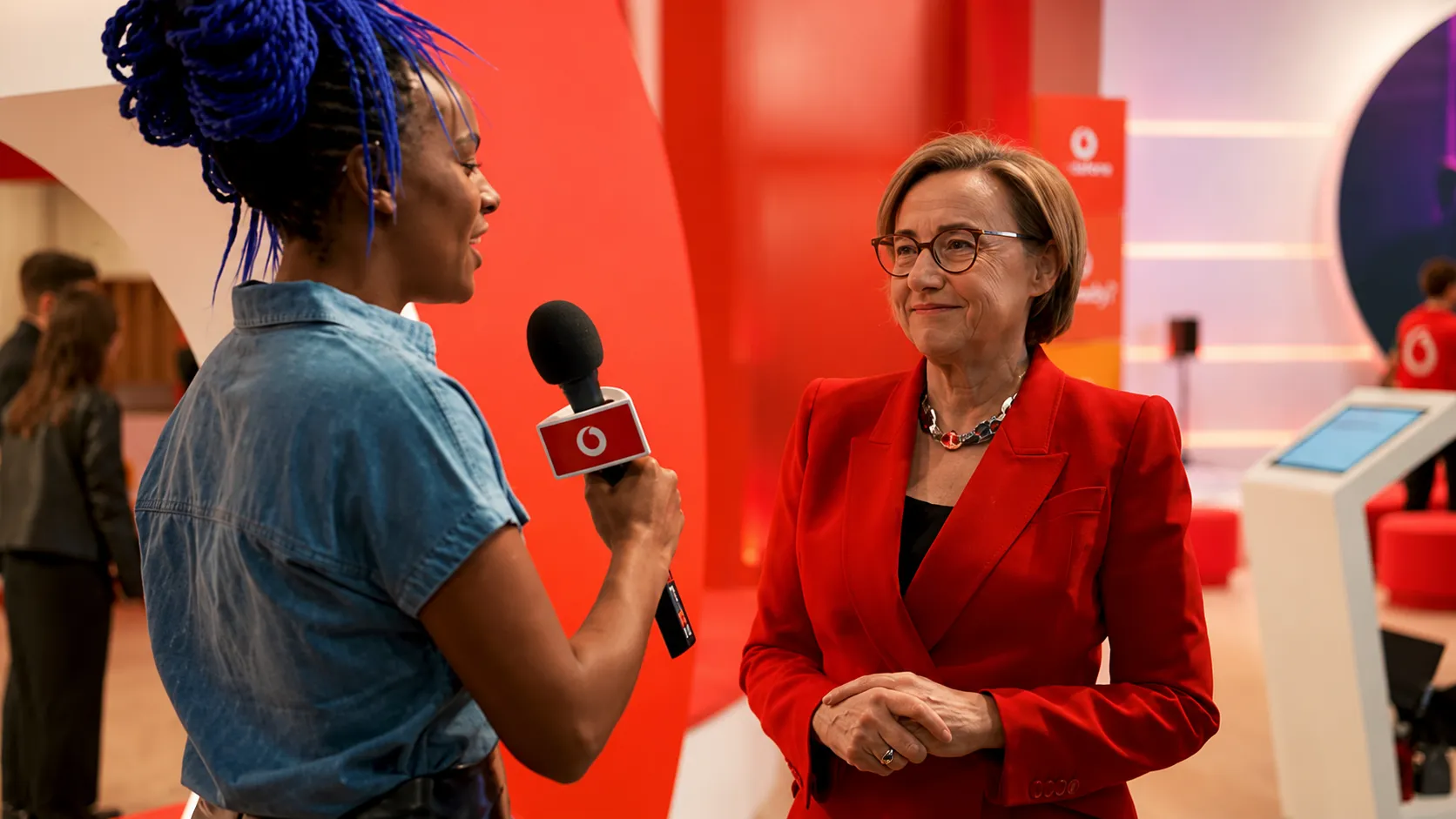
There is something distinctive about Margherita Della Valle's perspective on European digital infrastructure that goes beyond strategy.
She started as employee number 25 of Italy's first mobile challenger. She mapped the placement of that network's first towers. She understands, from thirty years of direct experience, what it takes to build telecoms infrastructure from nothing — the engineering, the commercial logic, the regulatory environment, the capital requirement, the patience.
When she says Europe needs to invest more and consolidate faster, she is not reading from a consultant's deck. She is speaking from the institutional memory of someone who has spent her entire professional life building the infrastructure that the modern economy depends on.
Her position at the IMF Advisory Council on Entrepreneurship and Growth, alongside her role as chair of the 100 Group of FTSE 100 CFOs, gives her a view of the European investment landscape that goes beyond Vodafone's own situation. The message she is delivering is not a CEO advocating for her company's interest, although it is also that. It is a practitioner with thirty years of experience in the industry that matters most to Europe's digital future telling the people who set the rules that the rules need to change.
The faster the better.
If European regulators listen, the continent has a path to competitive digital infrastructure within this decade. If they do not — if the consultation on merger guidelines moves at the pace that European consultations sometimes move — the gap between Europe's digital economy and that of the United States and Asia will widen in ways that compound for years.
Margherita Della Valle has already done her part. She restructured Vodafone, executed the UK merger, sold the underperforming units, built the Microsoft partnership, and went to Reuters Next London to make the case in public. The next move belongs to the regulators she is trying to convince.


