She Noticed Six Ironing Vendors in Her Neighbourhood. She Invented a Solar Solution for 10 Million.
Vinisha Umashankar grew up in a small town in Tamil Nadu. She walked through her neighbourhood, and she noticed what most people notice but do not act on: six ironing vendors, each using charcoal to heat a heavy cast-iron box, pressing clothes for the neighbourhood, and throwing the burnt charcoal away with the garbage when they were done.
She did what very few people do when they notice something. She calculated the scale of it.
There are approximately 10 million traditional ironing carts in India. They collectively burn roughly 50 million kilos of charcoal every day. The CO2 and toxic pollutants that enter the air from that burning are a fraction of the broader air pollution that kills approximately 7 million people worldwide every year. The charcoal is a 300-year-old technology being used in a country that has the solar irradiance to replace it entirely.
Vinisha, who was still a school student when she made these observations, then asked the question that inventors ask: is there a better way? She discovered that solar energy could effectively replace the charcoal, eliminating the fuel cost for vendors, removing the toxic emissions from the air, and replacing a centuries-old pollution source with a renewable one.
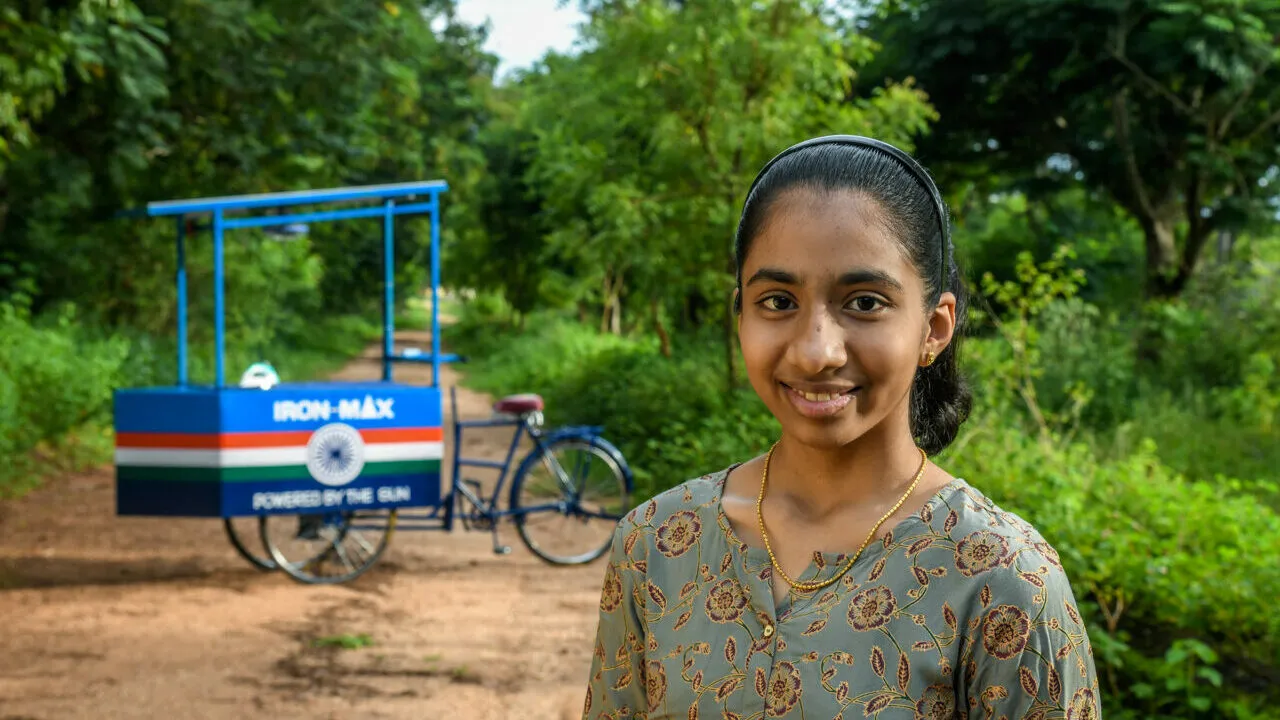
She built the Solar Ironing Cart.
The innovation earned her recognition that would have been extraordinary for anyone and was remarkable for a teenager in Tamil Nadu. In 2020, she received the Children's Climate Prize. In 2021, the EarthDay Network gave her its Rising Star award. That same year, she was selected as the youngest finalist for the Earthshot Prize — Prince William's flagship environmental award designed to find and fund the most promising solutions to the world's greatest environmental challenges.
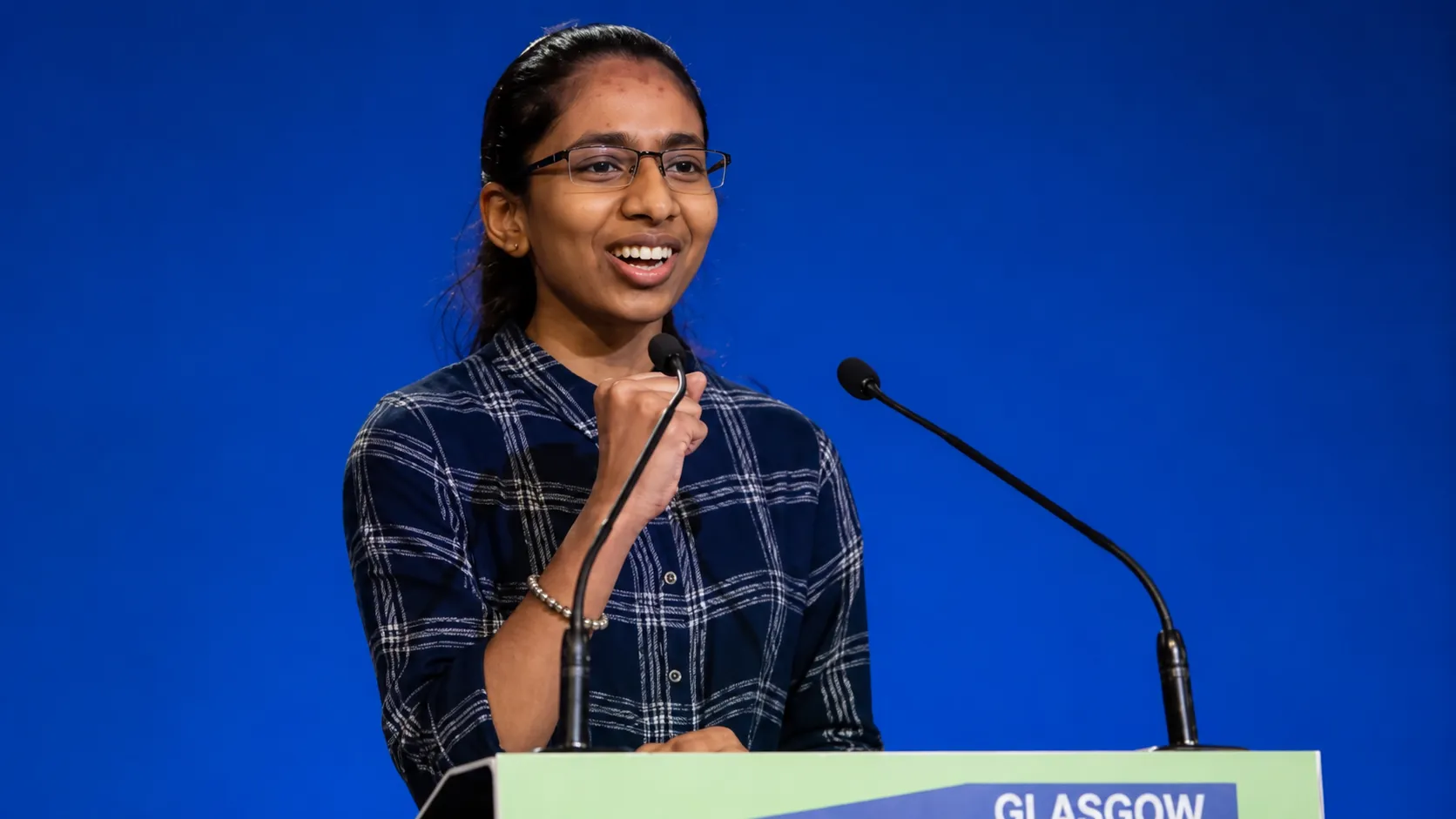
And at COP26, the United Nations Climate Change Conference held in Glasgow in November 2021, Vinisha Umashankar stood on stage alongside Prince William, the Duke of Wales, and delivered a five-minute speech that was subsequently seen more than 30 million times on social media.
What She Said at COP26 — and Why It Travelled
The COP26 speech did what the best advocacy speeches do: it combined personal specificity with moral urgency and refused to let the audience off the hook by making the problem feel distant.
She spoke about the ironing vendors in her neighbourhood. She spoke about the charcoal and the 50 million kilos burned daily across India. She spoke about the seven million people who die from toxic air pollution every year. She spoke about a solution that existed — that she had built — and about what was required to scale it.
The speech was not the work of a professional speechwriter. It was the work of a school student who had done the research, understood the stakes, and decided that saying the thing clearly was more important than saying it elegantly. The clarity is what made it travel.
The Capgemini Research Institute — the research and thought leadership arm of the global technology services company with more than 350,000 employees worldwide — included Vinisha in its Conversations for Tomorrow series on sustainability and climate technology. The interview was published on Capgemini's global platform and made available across its country websites in the United States, India, the United Kingdom, Australia, Belgium, Finland, Sweden, Norway, and many more markets. When a global technology company's research institute chooses a school student from Tamil Nadu as one of the voices defining the future of sustainability, it is a statement about what kind of innovation and what kind of voice the world's largest organisations believe matters.
The Interview — What Vinisha Told Capgemini
The Capgemini Research Institute interview covers four distinct areas: the innovation itself, the role of young people in climate change, the relationship between technology and behaviour change, and what large organisations owe young climate activists. Vinisha's answers across all four are worth reading for what they reveal about how she thinks.
On the innovation and its scale, she was specific about the problem before the solution. The charcoal is not just a climate problem. It is a health problem. It is an economic problem for the vendors who must buy charcoal every day rather than using free solar energy. The Solar Ironing Cart is not an environmental gesture. It is a practical upgrade for millions of people whose livelihood currently depends on a fuel that harms them and the people around them.
On what young people can do, she distinguished clearly between speaking and acting. Being able to express herself through speeches is useful, she said, but the world requires action. She listed specific, accessible actions that anyone can take — using public transport, reducing electricity use, buying locally, eating plant-based meals, planting trees. She did not pretend that speeches alone change systems.
She was notably direct about the limits of protest tactics. Climate change activists are increasingly turning to acts of civil disobedience, she noted, and this can be counterproductive. When governments respond to climate activism by attempting to ban activist organisations, the result is to hinder non-destructive climate activism and negatively affect public support. The argument is not that protest is wrong. It is that certain forms of protest create outcomes that make the underlying cause harder to advance.
On the relationship between technology and behaviour change, her answer was precise: both matter, and neither alone is sufficient. Science can solve many of the problems humanity has created, but some will have to be resolved through changes in behaviour. Consumers need to take responsibility for their own actions. The resources being used are finite. The reckless use of major resources will harm future generations. Technology provides options. Behaviour determines which options people actually choose.
On what large organisations can do, she was specific: engage with young climate innovators, invest in youth-led solutions, work with governments to develop climate action frameworks and green economies, and provide grants, capital, or zero-interest loans to scale innovations quickly. The framing is that young people are already taking the initiative. They need support to develop and scale it, not permission to begin.
Why the Capgemini Interview Matters Beyond the Platform
The Capgemini Research Institute's decision to include Vinisha in its Conversations for Tomorrow series is significant for a reason that goes beyond the reach of the platform.
Large organisations in the technology and services industry have enormous influence over how sustainability is defined, measured, and resourced in the corporate world. When the research arm of a company with $22 billion in annual revenue and operations across 50-plus countries publishes an interview with a young Indian innovator as part of its flagship sustainability thought leadership series, it is not simply amplification. It is a statement about whose ideas deserve to be taken seriously at the level where business strategy and sustainability policy are made.
Vinisha Umashankar is not, in the conventional framing, a global sustainability leader. She is a student from a small town in Tamil Nadu. Her invention addresses a specific, local, seemingly mundane problem — ironing vendors using charcoal. But the invention is both local and universal. The principle — replace an ancient, polluting fuel with a renewable one, at the point of use, for the people who bear the cost of the pollution most directly — is replicable across dozens of applications and hundreds of millions of people.
This is what the Capgemini interview recognises: that the most important climate innovations may not come from global research labs or from the boardrooms of large companies. They may come from someone who walks through her neighbourhood, notices what other people have noticed and dismissed, and decides that the dismissal was a mistake.
What She Believes — and What It Demands of Everyone Else
Vinisha Umashankar's central argument, sustained across the COP26 speech and the Capgemini interview, is that climate change is not primarily a future problem. It is a present one, with present solutions, requiring present action from every person and every institution.
The ironing cart vendors in her neighbourhood cannot wait for a global treaty to stop the charcoal emissions that enter their lungs every day. The seven million people who die from air pollution every year are not waiting for the technology to theoretically exist. The solar ironing cart exists. The charcoal can be replaced. The question is whether the people and organisations with the resources to scale the solution will choose to do so.
Her final answer in the Capgemini interview, to the question of what superpower she would choose, is the most revealing thing she says. She would turn people who cut down trees and pollute soil, water, and air into rock statues. It is a teenager's answer and an honest one. The frustration it expresses is not the frustration of powerlessness. It is the frustration of someone who has done the work, made the invention, given the speeches, and is still watching the world move too slowly.
She has done what she can do. The rest requires the rest of us.


