New Delhi, July 31, 2026 — When the Trump administration unveiled a fresh round of tariffs on goods from more than 60 trading partners in the final week of July, India found itself in an unusual position: neither singled out for punitive treatment, nor entirely spared, but caught within a broad, multilateral tariff action whose stated justification — curbing the use of forced labour in global supply chains — represented a notably different rationale from the reciprocal-trade-balance framing that has characterised much of the administration's earlier tariff actions against individual countries.
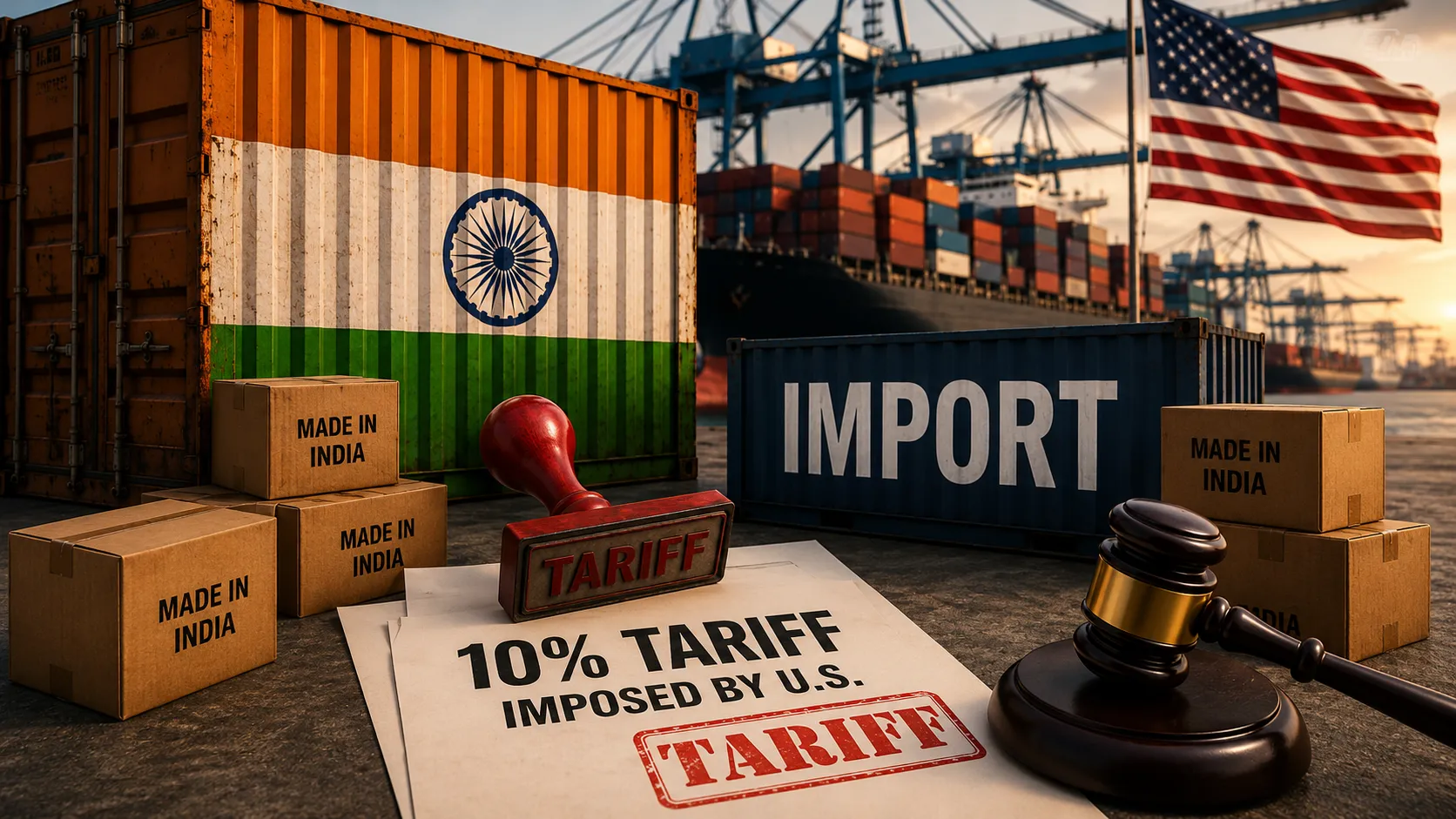
The headline number is a 10% duty on Indian imports into the United States, a rate that took effect in the final week of July as the temporary tariff arrangement that had governed bilateral trade through the preceding months came to its scheduled expiry. Understanding what this new tariff order actually means for Indian exporters, however, requires looking well past that single headline figure — into the specific product exclusions, the comparative treatment relative to other affected countries, and the murkier question of how a forced-labour-focused tariff justification applies to a country like India in the first place.
The forced-labour rationale, unpacked
Unlike the reciprocal tariff framework that dominated much of the Trump administration's trade policy actions through 2025 and early 2026 — which explicitly targeted bilateral trade imbalances and specific market-access grievances — this particular round of tariffs was framed around a different justification: alleged failures by more than 60 trading partner countries, India included, to adequately curb the use of forced labour in the production of goods exported to the United States. This forced-labour framing draws on a longer-standing thread of US trade policy, dating back to provisions in earlier trade legislation aimed at preventing goods produced with forced or exploitative labour from entering American markets, but its application at this scale — across dozens of countries simultaneously, as part of a single coordinated tariff action — represents a novel and considerably more sweeping use of that underlying legal and policy framework.
For India specifically, being grouped within this broader forced-labour-justified tariff action, rather than facing a bespoke, bilaterally negotiated tariff rate tied specifically to trade balance concerns, has been read by trade analysts as reflecting the Trump administration's preference for broad, multilaterally applied tariff tools that avoid the need for country-by-country negotiated settlements, even as separate, parallel bilateral trade negotiations between Washington and New Delhi continue on a different track aimed at a more comprehensive bilateral trade agreement.
The rate itself: lower than initially proposed
Perhaps the most immediately consequential detail for Indian exporters is that the final 10% tariff rate applied to Indian goods came in meaningfully lower than an earlier proposed rate of 12.5% that had been under consideration in the weeks leading up to the order's finalisation. India's commerce ministry was notably quick to highlight this reduction in its public response, framing the lower-than-proposed rate as at least a partial negotiating success achieved through continued diplomatic engagement in the weeks before the order took effect, even as the underlying tariff itself remained a source of concern for exporters in sectors not covered by specific product exclusions.
The carve-outs that matter most
Central to understanding the real-world impact of this tariff order on Indian exporters is the specific list of product categories excluded from the new duty altogether. According to India's commerce ministry, the new tariff explicitly excludes generic pharmaceuticals, smartphones, steel, aluminium and auto parts — a set of exclusions that collectively shield several of India's largest and most economically significant export categories from the new duty's direct impact.
The pharmaceutical exclusion carries particular significance given the scale of India's generic drug export industry, which supplies a substantial share of the generic medicines consumed in the United States and has historically been treated as a sensitive category in US trade policy given its direct relevance to American healthcare costs and drug supply chain resilience. Similarly, the exclusions for steel, aluminium and auto parts reflect, at least in part, the fact that these categories have often been subject to separate, sector-specific US tariff regimes in past trade policy cycles, making their exclusion from this particular forced-labour-justified order less an act of special favour toward India and more a reflection of how these sectors are typically treated as distinct policy categories within the broader US tariff architecture.
Taken together, India's commerce ministry has calculated that roughly 45% of India's total exports to the United States fall outside the new 10% tariff regime once these specific carve-outs are accounted for — a figure the ministry has actively publicised as evidence that the order's practical impact on India's overall export economy is more contained than the headline tariff rate alone might suggest.
Comparing India's treatment to other affected countries
A key dimension of how India's commerce ministry and trade negotiators have chosen to characterise this tariff order publicly involves relative positioning against other major trading partners caught within the same broad action. Officials have repeatedly emphasised that India's effective tariff treatment compares favourably to competitors including Vietnam and other members of the Association of Southeast Asian Nations (ASEAN), several of which have faced comparable or, in some cases, higher effective tariff rates under their own bilateral or multilateral trade arrangements with Washington.
This relative-positioning framing matters considerably for Indian exporters competing directly with Southeast Asian manufacturing hubs for market share in categories such as textiles, garments, footwear and various consumer goods, where price competitiveness in the US market often hinges on relatively small differences in effective landed cost, including applicable tariffs. If India's effective rate genuinely undercuts key regional competitors, even by a modest margin, it could provide a meaningful, if marginal, competitive advantage in the ongoing battle for US import market share across several labour-intensive manufacturing categories where India and Southeast Asian nations compete most directly.
Sectors left exposed
Even accounting for the significant carve-outs described above, a substantial portion of India's export economy remains directly exposed to the new 10% duty. Textile and garment exports, a historically significant and employment-intensive segment of India's export base, do not appear to benefit from the specific exclusions granted to pharmaceuticals, smartphones, steel, aluminium and auto parts, leaving this sector to absorb the tariff's cost directly, either through reduced export competitiveness, compressed margins for Indian manufacturers, or some combination of both, depending on how much of the added cost domestic exporters are able to pass through to American buyers versus how much they must absorb themselves to remain price-competitive.
Gems and jewellery exports, another historically important category for India's trade balance with the United States, similarly appear to fall outside the specific product exclusions, as do a range of agricultural export categories beyond the small set of items — including spices, tea, coffee, cashew nuts and select fruits — that have separately been discussed as candidates for zero-duty treatment under the broader, still-unresolved bilateral trade agreement negotiations running in parallel to this specific tariff order.
How this order relates to the broader trade negotiation
It is important to understand this tariff order as operating on a somewhat separate track from the broader India-US Bilateral Trade Agreement negotiations that have continued, without final resolution, throughout much of 2026. While Indian officials have publicly stated their intention to keep engaging with Washington toward a comprehensive bilateral agreement even after this tariff order took effect, the two tracks — the immediate, broadly applied forced-labour-justified tariff, and the longer-running, bilaterally negotiated comprehensive trade agreement — appear to be proceeding on parallel but distinct timelines, with the current 10% tariff functioning, in effect, as an interim arrangement pending whatever final tariff framework eventually emerges from the broader bilateral negotiation.
This bifurcated structure creates a degree of complexity for Indian exporters attempting to plan medium-term sourcing, pricing and investment decisions, given that the currently applicable 10% rate under this specific order could, in principle, be superseded or modified by whatever final terms eventually emerge from the still-unresolved comprehensive trade agreement — terms that Indian negotiators have publicly indicated they intend to keep pushing to make more favourable than the current interim arrangement, even as the timeline for reaching that final agreement remains genuinely uncertain.
What exporters and industry bodies are saying
Industry associations representing sectors directly exposed to the new tariff, particularly in textiles and gems and jewellery, have called for continued government engagement with Washington to secure either specific sectoral exclusions similar to those already granted to pharmaceuticals and auto parts, or a faster resolution of the broader bilateral trade agreement that could supersede the current interim tariff with more favourable terms. In the meantime, several affected exporters have indicated they are exploring a mix of strategies to manage the added cost burden, including selective price increases to American buyers, deeper cost efficiencies within their own manufacturing operations, and, in some cases, increased focus on alternative export markets less directly affected by the new US tariff regime.
For now, India's exporters, alongside the broader Indian economy, continue to navigate a genuinely complex and still-evolving US trade policy landscape — one in which the specific product-level details of any given tariff order matter considerably more to real-world business outcomes than the single headline percentage figure that typically dominates news coverage of these developments.
The legal architecture behind the forced-labour tariff
To understand how this tariff order came together mechanically, it helps to look briefly at the underlying legal framework the Trump administration invoked. Provisions targeting goods produced with forced or exploitative labour have existed within US trade law for decades, historically enforced primarily through targeted import bans on specific shipments or companies found to have used forced labour in their supply chains, rather than through broad, economy-wide tariffs applied to entire trading partner countries. The decision to apply this forced-labour framework at the scale of a coordinated, multi-country tariff order — rather than through the more targeted, shipment-specific enforcement mechanism historically used — represents a meaningful expansion of how this particular legal tool has been deployed, and trade lawyers have noted that this broader application could face legal or procedural challenges from affected exporters or trading partner governments in the months ahead, even as the tariff remains in effect for now.
How Indian industry bodies have responded
India's major export promotion councils and industry associations have adopted a measured public posture in response to the new tariff order, broadly welcoming the specific carve-outs secured for pharmaceuticals, smartphones, steel, aluminium and auto parts while continuing to press the government for expanded protection for the sectors left exposed. The Federation of Indian Export Organisations and sector-specific bodies representing textile and apparel manufacturers have both issued statements calling for accelerated progress on the broader bilateral trade agreement as the most durable path toward reducing tariff uncertainty for the sectors currently absorbing the full impact of the interim 10% duty.
Currency and pricing dynamics under the new tariff
For exporters directly exposed to the new tariff, a critical operational question involves how much of the added 10% cost can realistically be passed through to American buyers versus how much must be absorbed through margin compression or productivity gains. Industry pricing dynamics vary considerably by product category and buyer concentration; sectors with more differentiated products and less price-sensitive end customers have generally reported greater ability to pass through at least a portion of the tariff cost, while more commoditised categories facing intense price competition from alternative sourcing markets have reported considerably less pricing power, forcing a greater share of the burden onto domestic Indian manufacturers' own margins.
This dynamic has particular relevance for India's textile and garment sector, which competes directly against considerably lower-cost manufacturing bases in Bangladesh, Vietnam and other Southeast Asian countries for price-sensitive segments of the US apparel market. Indian exporters in this category have generally reported limited ability to pass through the new tariff cost to American retail buyers, who typically have ready access to alternative sourcing options less affected by comparable tariff burdens, intensifying the competitive pressure on Indian textile manufacturers' already thin margins in this segment.
The path forward for affected sectors
Government officials have indicated that sector-specific relief for categories like textiles and gems and jewellery remains an active discussion point within the broader, still-unresolved bilateral trade agreement negotiations, even as no specific timeline for such relief has been publicly committed. In the interim, some industry bodies have called for domestic policy support measures — including expanded export incentive schemes and interest subvention programmes — to help cushion affected exporters against the tariff's near-term impact while the broader diplomatic process continues to unfold.