Upasana Taku — The Only Woman Heading a Large‑Scale Fintech Platform in India
From Wall Street to the Slums of Delhi
In 2008, Upasana Taku was living the American dream. She had a bachelor’s degree in engineering from NIT Jalandhar, a master’s from Northwestern University, and a job as a product manager at PayPal in Silicon Valley. She was earning a six‑figure salary, had a green card, and was on track for a comfortable life.
But she was restless. The 2008 financial crisis had exposed the inequalities of the global financial system, and she kept thinking about her home country — where hundreds of millions of Indians had no access to digital payments, no credit history, and no formal financial identity.
She met Bipin Preet Singh (now her husband and MobiKwik’s CEO) at a conference. Both were working in the US, both were IIT/NIT graduates, and both shared a burning desire to return to India and build something that mattered. They discussed ideas for weeks — mobile payments, microloans, digital wallets — and realised that India was on the cusp of a digital revolution.
In 2009, they quit their jobs, moved back to India, and founded MobiKwik with ₹10 lakh of their own savings. The initial office was a tiny room in Gurugram’s Udyog Vihar. Upasana handled product, finance, and fundraising; Bipin handled technology and operations. They had no employees for the first six months.
The timing was prescient. India’s mobile internet was just taking off, and the government was pushing for financial inclusion. But convincing Indians to trust a digital wallet — when cash was still king — was a monumental challenge.
Building India’s First Independent Mobile Wallet
When MobiKwik launched in 2010, the digital payments landscape was barren. Paytm had just started (also as a wallet), but most Indians had never heard of mobile wallets. Flipkart and Amazon were still small. UPI did not exist.
Upasana’s first task was to build a product that was simple, safe, and sticky. She travelled to small towns and observed how people paid for recharges, utility bills, and chai at local stalls. She realised that the wallet needed to work on any phone (including feature phones), accept cash loading through local retailers, and offer instant refunds.
MobiKwik’s breakthrough came through partnerships. Upasana personally negotiated deals with:
Retailers (over 500,000 mom‑and‑pop stores) to become “MobiKwik points” where users could load cash into their wallets.
Utility providers (electricity, water, gas) to accept wallet payments.
E‑commerce sites (Snapdeal, ShopClues, and later Amazon) to add MobiKwik as a checkout option.
By 2015, MobiKwik had 30 million users and was processing $1 billion in annual transactions. It had raised funding from Sequoia Capital, American Express, and Cisco Investments. Upasana, as CFO, had managed to raise over $200 million without diluting control excessively — a skill she learned from her PayPal days.
Surviving the UPI Earthquake
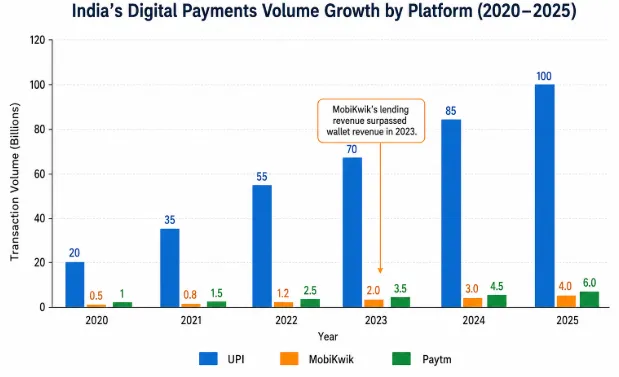
In 2016, the National Payments Corporation of India (NPCI) launched Unified Payments Interface (UPI) — a free, instant, interoperable payment system that made mobile wallets nearly obsolete overnight. Why keep money in a wallet when you could transfer directly from your bank account using any app?
The industry panicked. Paytm pivoted to a payments bank. Many smaller wallets shut down. MobiKwik’s valuation dropped by over 50% in secondary markets.
Upasana’s response was characteristically strategic. Instead of fighting UPI, she decided to embrace it. MobiKwik became the first wallet to integrate UPI, allowing users to pay from their bank account through the MobiKwik app. But more importantly, she pivoted the company from a “wallet” to a “full‑stack fintech platform” with three pillars:
Digital credit — small‑ticket loans (₹5,000–₹50,000) to first‑time borrowers with no credit score.
Merchant cash advance — loans to small businesses based on their digital transaction history.
Wealth management — mutual funds, fixed deposits, and insurance sold through the app.
This pivot saved MobiKwik. By 2020, the company’s lending business was generating 60% of its revenue, with repayment rates above 85%. The wallet business had shrunk to 20%, and UPI integration accounted for the rest.
The IPO Journey — A Historic First for a Woman‑Led Fintech
In December 2024, MobiKwik listed on the BSE and NSE with an IPO that raised ₹1,800 crore. The issue was oversubscribed 12 times, and the stock listed at a 25% premium. Upasana Taku became the first woman in India to lead a fintech company through a successful public listing.
The IPO prospectus revealed a company that had turned profitable in FY2024, with revenues of ₹1,200 crore and a net profit of ₹90 crore. The lending book was ₹2,500 crore, with non‑performing assets under 2% — exceptional for unsecured consumer lending.
Upasana’s role as Chairperson and CFO was critical in the IPO process. She led the due diligence, coordinated with merchant bankers, and conducted over 100 investor meetings across Mumbai, Singapore, and New York. Investors were impressed by her grasp of both the numbers and the product.
“She can debate a valuation model in the morning and a UX flow in the afternoon,” said a Mumbai‑based fund manager. “That’s rare in fintech, where most founders are either finance geeks or tech geeks, not both.”
Navigating a Male‑Dominated Industry
Upasana is often the only woman in the room — whether at fintech industry conferences, central bank meetings, or board rooms. She has spoken candidly about the challenges: being interrupted by male colleagues, having her ideas credited to others, and facing skepticism about her “aggression.”
“If a man is assertive, he’s a leader,” she told a panel at the Global Fintech Fest 2025. “If a woman is assertive, she’s ‘difficult’ or ‘emotional.’ I’ve learned to be difficult anyway. Results speak.”
She has also made diversity a priority at MobiKwik. Over 35% of the company’s workforce and 25% of leadership roles are held by women — well above the industry average of 15%. She personally mentors young women in fintech through the “Women in Payments” initiative.
Challenges and Critiques
MobiKwik has faced its share of storms. In 2021, the company disclosed a data breach that affected 3.5 million users. Upasana took full responsibility, hired a new CISO, and invested ₹50 crore in cybersecurity. The incident dented trust but did not derail the business.
Another critique is that MobiKwik’s lending business targets low‑income, first‑time borrowers — a segment that some argue is vulnerable to over‑indebtedness. Upasana has defended the model, pointing to the company’s responsible lending practices (capping loan amounts based on repayment history) and financial literacy initiatives.
Post‑IPO, the stock has been volatile, reflecting broader fintech sector turbulence. But Upasana remains focused on the long term. “We didn’t build this for quarterly earnings,” she says. “We built it for the next billion Indians who need access to credit.”
Lessons for Entrepreneurs
Pivot before you have to: MobiKwik embraced UPI before it destroyed the wallet model.
Financial inclusion is a business, not charity: Lending to the underserved is profitable when done right.
Being the only woman in the room is exhausting but necessary: Stay and fight.
IPO readiness is a marathon: Upasana spent 5 years cleaning up the balance sheet before going public.
The Road Ahead
As of 2026, Upasana Taku is 44 years old. She continues as Chairperson and CFO of MobiKwik, though she has stepped back from daily product management. The company is expanding into SME lending (loans up to ₹5 lakh) and launching a “credit on UPI” product.
Her net worth is estimated at ₹1,800 crore ($220 million) — a fraction of some tech founders, but entirely self‑made. She is widely expected to become a mentor/advisor to the government’s fintech policy cell.
Her legacy: she proved that a woman can lead a fintech company from garage to public listing in India’s most competitive, male‑dominated sector — and do it with grace, grit, and zero excuses.