
A Career-Ending Injury. A 150 Square Foot Kiosk. And the Beginning of Something Nobody Saw Coming.
In 2003, Kainaz Messman Harchandrai was 24 years old and living what looked like the ideal version of the life she had worked for. She had trained at Le Cordon Bleu in London — one of the world's most prestigious culinary institutions. She had landed a role as a pastry chef at Oberoi Udaivilas in Udaipur, one of India's finest luxury hotels, where her skills were being applied to the kind of work that Le Cordon Bleu training is designed to produce.
And then she sustained a serious back injury that threatened to end her career in the kitchen entirely. Doctors told her she might never stand long enough to chef again.
The injury forced her to rest. And in that period of forced stillness, a different kind of possibility began to take shape. Kainaz's father Farokh and sister Tina had begun talking about opening a bakery — not as a grand business ambition, but as a way for the family to continue doing what they loved. The conversations were practical and passionate rather than strategic. There was no business plan. There was no market research. There was the kitchen knowledge they had grown up around, their mother's recipes, the standards Kainaz had internalised through professional training, and the belief that they could make something good.
On Dussehra in October 2004, Kainaz and Tina borrowed ₹1 crore from their father and opened Theobroma.
The name was Greek for food of the gods. The space was 150 square feet in Mumbai's Colaba Causeway. And the founding commitment was as simple as it was demanding: make only what they loved, and make it exceptionally well.
Six Years. One Store. The Decision Not to Compromise.
What happened in the years immediately following that October opening is not the version of the story that makes for good startup mythology. The mythology version has rapid growth, early investor interest, and a trajectory that rises continuously from the first day.
Theobroma's actual story is more instructive.
For six years, the brand stayed at one store. Not because there was no demand — customer response from the beginning was positive and consistent. Not because Kainaz and Tina lacked ambition. But because the founders understood something that most scaling narratives skip over: the quality of the product depended on the quality of the production process, and the production process was not ready to scale without compromising the thing that made the product worth scaling.
The Theobroma ethos was built around specific commitments that are expensive to maintain at scale. Belgian chocolate. Real butter. Natural flavourings. Small-batch production that allows quality control at the level of each individual item rather than statistical sampling across large batches. Handcrafted desserts whose consistency depends on the knowledge and care of the people making them.
These commitments are easy to articulate. They are difficult to preserve when a business is growing quickly, when the pressure to reduce costs to fund expansion is constant, and when investors are asking about unit economics and standardisation and replicability.
For a decade, Kainaz and Tina found it easier to not raise investment than to accept investment on terms that might compromise the product. In 2014, after years of effort, they finally secured a ₹5 crore business loan — with the specific condition that one founder would remain as CEO until the loan was fully repaid. Much of that capital went directly into expanding their physical footprint. Slowly. Deliberately. In locations where the brand could be experienced at the standard they had set.
What Theobroma Actually Made — and Why People Kept Coming Back
At the heart of any food business, stripped of the funding story and the valuation milestones, is the question of whether the food is good. Whether people would choose it over the alternatives. Whether it creates the kind of loyalty that makes expansion viable rather than just possible.
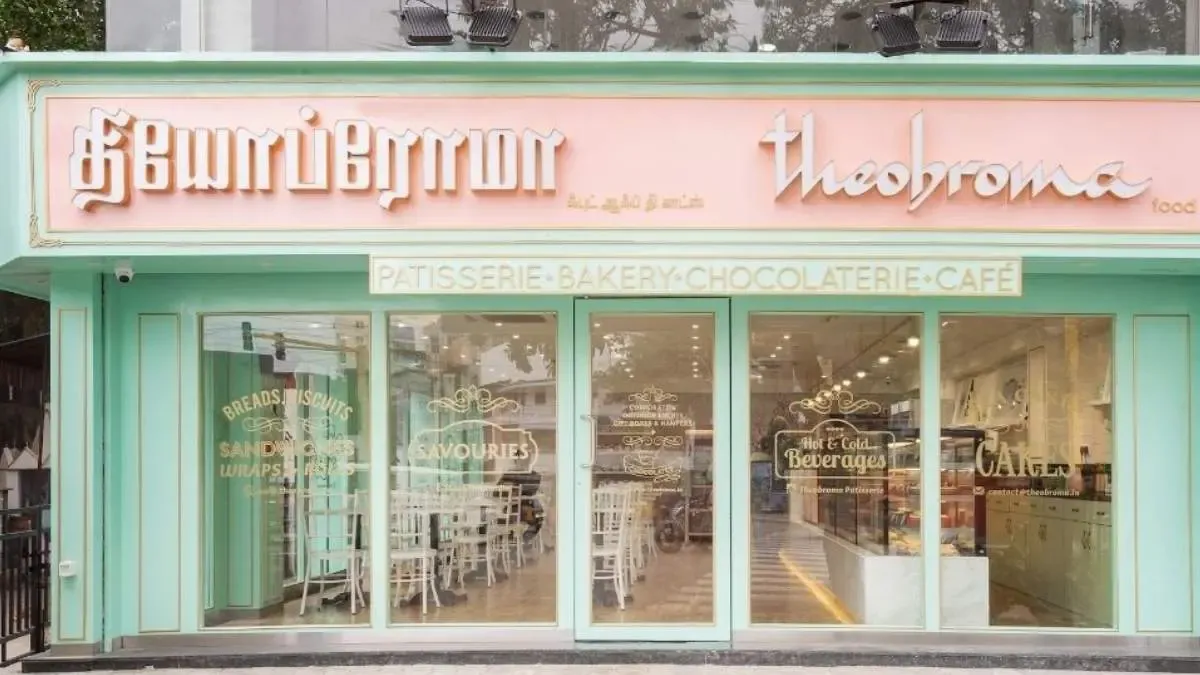
Theobroma's answer to that question is measurable: a 70 to 80 per cent repeat rate, with loyal customers visiting three to five times per month. These are numbers that most restaurant and bakery businesses never approach. They reflect a product experience that has become habitual rather than occasional — a relationship between customer and bakery that resembles the relationship people have with their best local coffee shop, but at a scale that spans 225 outlets across 30-plus Indian cities.
The product range that built those numbers starts with the brownies. Dense, fudgy, made with Belgian chocolate, available in a range of flavours and formats that have become the default answer to the question of what to bring when someone says just get something from Theobroma. The rum truffles. The mousse cakes. The croissants and savories that make a Theobroma visit serve the same function as a neighbourhood bakery in a European city — somewhere for the thing you want for breakfast, for the thing you want to bring to a meeting, for the thing you give someone when you want to demonstrate that you thought about them.
The concept Kainaz and Tina built around was affordable luxury — the specific positioning that makes quality accessible without making it precious. A Theobroma brownie is not cheap. But it is not a special-occasion purchase. It sits at the price point where quality and frequency can coexist, where the person who cares about what they eat can afford to care about it regularly.
This positioning proved remarkably resilient across market cycles, competitive pressures, and the specific crisis of a global pandemic that decimated most food service businesses. Theobroma's pivot during COVID — a robust online delivery channel and packaging innovations that preserved product quality across the last mile — maintained 10 to 20 per cent of revenues through a period when many competitors went to zero.
The Capital Timeline — and the Acquisition That Validated Everything
ICICI Venture eventually invested $20 million for a 42 per cent stake in Theobroma, acquired in 2017. By the time ICICI Venture began marketing that stake in early 2024, the business had transformed materially. Revenue had grown from ₹121 crore in FY21 to ₹254.7 crore in FY22 to ₹351.7 crore in FY23 — a 38 per cent year-on-year jump driven by new outlet openings and product diversification. FY23 also marked the first year of clear profitability: a net profit of ₹19.6 crore, compared to an ₹11 crore net loss in the prior year.
Projected FY25 revenue stood at ₹525 to ₹550 crore, with EBITDA of ₹80 to ₹100 crore — financial metrics that demonstrated both the brand's commercial scale and its operational efficiency.
On July 15, 2025, ChrysCapital acquired a 90 per cent stake in Theobroma for ₹2,410 crore. Kainaz and Tina retained 10 per cent — a stake that, at the acquisition valuation, represents a meaningful personal return on twenty-one years of building. The deal delivered approximately a 3x return to ICICI Venture on their investment. Multiple private equity firms sought CCI approval to acquire the stake, including Infinity Partners, Atreides Management, and Aqua Capital — confirming the competitive interest that the Theobroma brand generated at the institutional level.
The acquisition was described across financial media as potentially one of India's largest food industry cash exits. It was concluded by two sisters who ran a single-store bakery for the first six years of operation, who funded their first decade without institutional equity, and whose most significant early capital event was a ₹5 crore business loan with a condition attached.
The Lesson That the Story Actually Teaches
There is a specific kind of wisdom in the Theobroma story that the acquisition headline can obscure if you are not careful.
The headline is ₹2,410 crore. The story is six years at one store.
Kainaz and Tina's decision to stay at one Colaba location for six years was not a failure to scale. It was a decision about what scaling would require, and a refusal to scale before the product and the process were ready to sustain it. The decade without institutional equity was not an inability to raise. It was a choice to preserve the thing they had built rather than accept terms that might compromise it.
When scaling finally happened — when the outlet count grew from 1 to 225 across 30-plus cities — it happened on the foundation of a product that had earned its reputation over years of consistent quality, and a customer loyalty that no marketing budget could have manufactured.
The brownies did not become good at scale. They were good before scale. Scale is what happened because they were good.
That sequence — product first, then process, then capital, then scale — is the one that the most durable food businesses follow. It is the sequence that ICICI Venture backed, that ChrysCapital paid ₹2,410 crore for, and that 225 Theobroma outlets across India are the physical expression of.
Two sisters, a family loan, a back injury that became a beginning, and twenty years of making only what they loved, exceptionally well.
The food of the gods, it turns out, takes time to make.


