India Built a $26 Billion Women-Led Startup Ecosystem. Then Kept the Door Half Shut.
Here is the version of the story that gets shared at conferences and printed on government press releases.
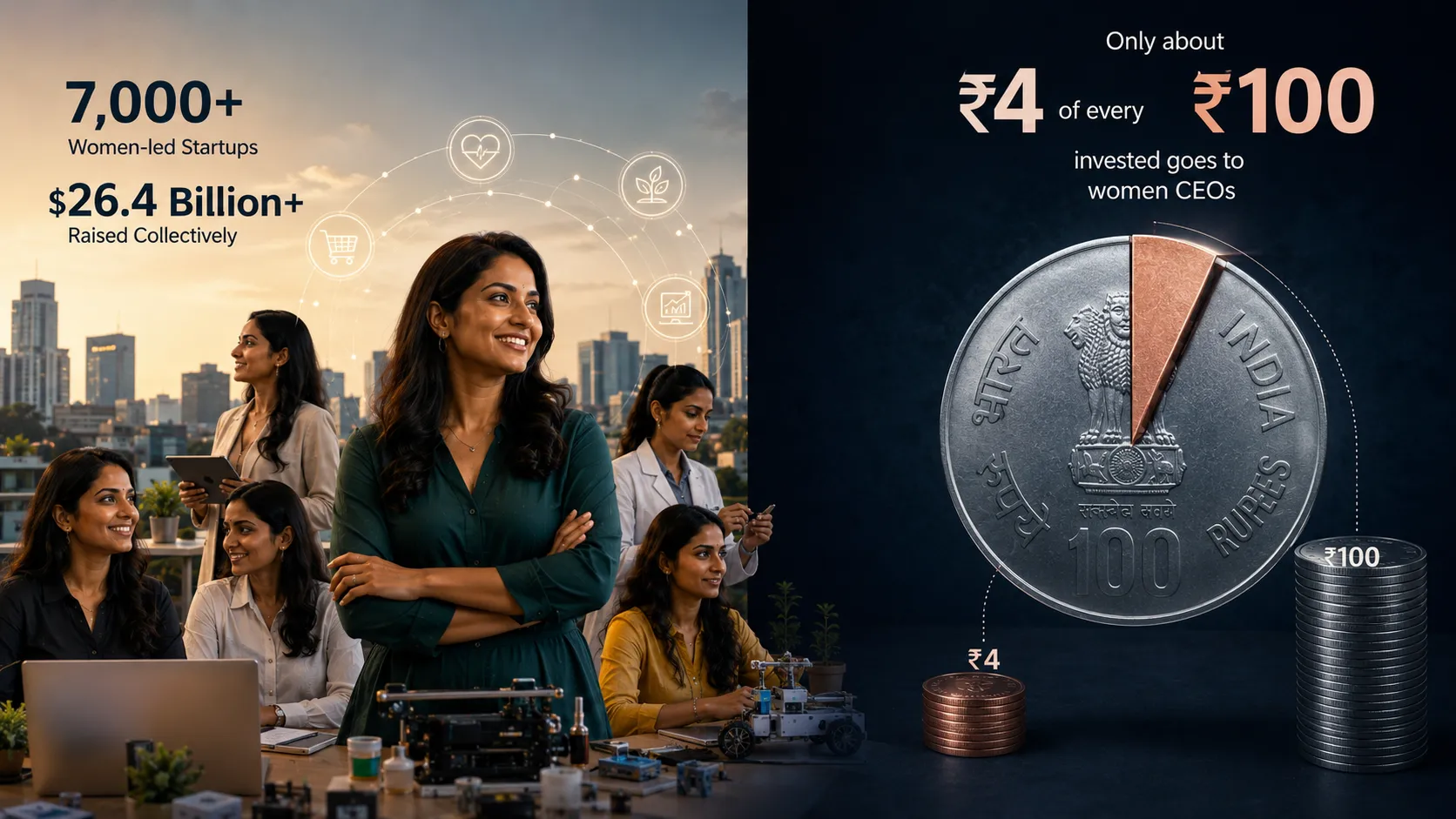
India is home to more than 7,000 active women-led startups. Together, they have raised $26.4 billion — making India the second-largest ecosystem in the world for women-led startup funding, behind only the United States. The year 2021 alone saw $6.3 billion flow into women-led ventures. Eight unicorns emerged that year with women at the helm. Nykaa, Mamaearth, SUGAR Cosmetics, MobiKwik, Zivame, OfBusiness — names that any serious investor in Asia knows. India's representation on the global women-founder map is not peripheral. It is formidable.
Now here is the version of the story that does not make the press releases.
For every ₹100 raised by founders connected to India's most powerful startup networks — the IIT-IIM alumni clusters, the ex-unicorn operator networks, the repeat-founder circles — women founders receive ₹4.
Not ₹40. Not ₹14. Four rupees.
Both numbers come from credible, verified sources. The $26.4 billion figure is from Tracxn's comprehensive report on India's women-led startup ecosystem. The ₹4 figure is from Kalaari Capital's CXXO initiative report, released in March 2026, titled "The ₹4 Problem: Women Founders and the Market Gap Hiding in Plain Sight," built using macro-ecosystem data from AISHE, NIRF, and Tracxn's own funding data, and grounded in insights from over 140 founders, operators, and investors.
One number tells you what women have built despite the system. The other tells you what the system is still doing to them. The distance between these two numbers is the most important unresolved question in India's startup story right now.
What Tracxn's Data Actually Shows
The headline figure — $26.4 billion raised by 7,000-plus active women-led startups — deserves its proper context before it gets qualified.
India's women-led startup ecosystem accounts for 7.5 per cent of all active startups in the country. That number, modest as it sounds, represents an ecosystem that has been built largely without the benefit of equal access to the networks, the institutional backing, or the warm introductions that fuel the majority of venture rounds. The $26.4 billion is not a gift from a generous system. It is the output of founders who built companies good enough to attract capital in spite of structural disadvantage.
The sectoral distribution tells its own story. The retail sector leads with $7.8 billion in all-time funding across women-led ventures, followed by edtech and enterprise applications at $5 billion each. Fintech, health-tech, and cleantech have each attracted over $100 million. These are not niche categories. They are the backbone sectors of India's digital economy.
The company names attached to the largest rounds are equally instructive. Zomato ($1.7 billion), Pine Labs ($1 billion), Lenskart ($1 billion), OfBusiness ($758 million), ($687 million), ACKO ($598 million), LivSpace ($527 million). These are not small bets in overlooked corners of the market. They are category-defining companies that happen to have women in founding or co-founding roles — companies that institutional investors backed because the evidence of traction was too strong to ignore, not because the system was designed to find them.
The 2025 numbers show the texture of a market in selective maturation. Tracxn's March 2026 report found that funding for women co-founded tech startups stabilised at approximately $1.1 billion across 407 rounds — down 9 per cent from $1.2 billion in 2024, but with the median deal size jumping from $2.4 million to $3.8 million. Fewer rounds, larger cheques. The interpretation Tracxn offers is a "disciplined capital phase" — investors concentrating capital in fewer, higher-conviction bets with proven revenue visibility rather than spreading broadly across the category.
Bengaluru led city-wise with $447 million in 2025, followed by Gurugram at $115 million and Mumbai at $112 million. Giva, co-founded by Nikita Prasad, raised $62 million in a Series C in June 2025. Blue Tokai Coffee Roasters, co-founded by Namrata Asthana, raised $25 million in the same month. The growth-stage cohort is real, it is funded, and it is building.
But the $26.4 billion cumulative figure and the $1.1 billion annual figure sit inside a market where women-led startups represent 7.5 per cent of active startups and receive a fraction of the capital proportional to that share — let alone proportional to their returns.
The ₹4 Problem: A Market Failure, Not a Diversity Issue
The Kalaari Capital CXXO report, released on March 5, 2026, did something that most gender-gap reports do not do. It refused to frame the problem as a diversity issue and insisted on framing it as a market failure.
The distinction matters enormously for how the problem gets solved.
A diversity issue implies the solution is representation — more women in the ecosystem, more awareness, more inclusion initiatives. A market failure implies the solution is correcting a mispricing — identifying an asset class that is systematically undervalued and deploying capital to close the gap before others recognise it.
The Kalaari report makes the market-failure case with precision. The commonly cited explanation for the funding gap — that the pipeline of women founders is too thin — does not hold up against the data. India has seen a 1.7x increase in girls enrolled in high school STEM between 2013 and 2024. Women registering for JEE doubled between 2015 and 2025. Women now account for a significant share of STEM graduates. The pipeline is not the problem.
What the report found instead is a structural concentration problem. India's most powerful venture outcomes cluster around "startup mafias" — dense alumni and operator networks from a small number of institutions and companies. These networks act as accelerants: they surface deal flow, provide social proof, and create the warm introductions that bypass the cold screening that most other founders face. Women are significantly underrepresented in these networks. Women remain 0.6 times as likely to emerge as founders from elite institutionally-connected startup networks. Companies with at least one woman co-founder captured only 4.4 per cent of capital within these high-velocity cohorts.
The capital allocation machinery, in other words, is not biased against women in the sense of actively excluding them. It is biased toward familiarity — and familiarity is coded male.
Vani Kola, Managing Director and Founder of Kalaari Capital, has named this mechanism directly:
"Failure of price discovery." That is the most precise description of what the ₹4 figure represents. The asset is underpriced. The market has not corrected because the people doing the pricing are operating from a reference set that excludes the asset class entirely.
The Returns That Make the Mispricing Indefensible
The market-failure framing becomes most damning when you look at returns.
Research from Boston Consulting Group, consistent across multiple studies and cited in both the Kalaari report and global analyses, finds that women-led startups generate 78 paise of revenue for every rupee invested, compared to 31 paise for male-led startups. They burn 15 per cent less capital. They build more efficiently at every stage. They are, by the financial metrics that institutional investors are supposed to optimise for, superior returners on a per-rupee basis.
Women receive ₹4 of every ₹100 flowing through India's most powerful startup networks.
This is not a social problem wearing a business costume. It is a systematic allocation of capital away from its highest-returning category — which means it is leaving money on the table at the exact moment that it is leaving women founders without adequate runway.
The additional dimensions compound the picture. Women-led micro, small, and medium enterprises face a credit gap exceeding $158 billion. Women entrepreneurs in India face a 19 per cent loan rejection rate compared to 8 per cent for men — nearly 2.5 times higher, even when applying with equivalent business proposals. Women account for only 16 per cent of VC partner-level positions, where capital allocation decisions are actually made, even as they represent 38 per cent of analyst-level roles. The pattern-matching problem is self-reinforcing: the people who decide which founders get funded look like the founders who have historically been funded, and that history does not include enough women to break the pattern from within.
The panel at Startup Hub Expo at Bharat Mandapam in April 2026 put a ground-level texture on the numbers. Sarika Saxena, Managing Partner at an investor network, told the audience: "Such bias affects how women-led ventures are evaluated, especially during funding rounds. These challenges are evident and concerning outside metro cities." The bias is not abstract. It shows up in pitch rooms, in term sheet terms, in the questions asked about family plans and availability that male founders in the same room are not asked.
What the Gap Between $26.4 Billion and ₹4 Actually Means
The coexistence of these two numbers — $26.4 billion built, ₹4 received per ₹100 in the most connected networks — tells you something specific about how India's women-led startup ecosystem has grown.
It has grown in spite of the network effect, not because of it. The companies that broke through did so because they built product-market fit so undeniable, customer trust so measurable, and operational efficiency so clear that the investment case became impossible to decline even without network access. Vineeta Singh at 100-plus rejections. Ghazal Alagh with 700 mothers as her proof. Falguni Nayar launching Nykaa at 49, after a 25-year career that gave her the credibility the investors needed before they would look past the pattern.
These are exceptional founders who cleared an exceptional bar. The ₹4 figure tells you that the bar for women is exceptional by design — not because women are less capable of clearing it, but because the system has been calibrated to a different reference point.
What changes the equation is not more exceptional founders. What changes it is investors who are willing to act on the market-failure framing before the consensus catches up. The returns data is unambiguous. The pipeline of educated, ambitious, technically capable women founders is deeper than it has ever been. The only variable that has not moved proportionally is the capital allocation.
Kalaari's CXXO initiative is one structural response — a conviction-led capital platform that identifies women founders at the earliest stages and invests on the thesis that the market has systematically underpriced them. The government's Fund of Funds has deployed ₹2,995 crore into women-led startups since 2020. The Seed Fund Scheme has backed 1,278 women-led startups. These are real catalysts, not symbolic ones.
But a ₹2,995 crore deployment into women-led startups, measured against a market that moves $26 billion cumulatively and still delivers only ₹4 per ₹100 in its most powerful networks, is a beginning — not a correction.

The Honest Reckoning
$26.4 billion is a headline that India's ecosystem is right to be proud of. It represents a generation of women who built without equal access to the rooms where capital decisions get made, who found customers before they found investors, who turned capability into proof because proof was the only currency that crossed the network barrier.
₹4 is a headline that India's ecosystem needs to sit with uncomfortably. It represents a decade of Startup India policy, a doubling of women in JEE, a 1.7x increase in STEM enrollment, and an unbroken pattern of women generating superior returns per rupee — inside a system that still sends most of the money to the people who already look like the people who last got the money.
The founders are there. The returns data is clear. The pipeline has never been stronger.
The question that remains — the only question that matters for what the next $26 billion looks like — is whether the people writing the cheques are paying attention to the market inefficiency or waiting for it to correct itself.
Markets do not correct market failures on their own. They correct them when enough investors decide that the mispriced asset is worth more than the comfort of the familiar pattern. That decision is not made in policy papers. It is made in pitch rooms, term sheets, and the quiet moment when an investor decides whether to make the call.
The ₹4 figure is not an indictment of India's ambition for its women founders. It is a signal — clear, quantified, and on the record — that the ambition and the allocation have not yet found each other.
When they do, the returns will not surprise anyone who was looking at the data.


