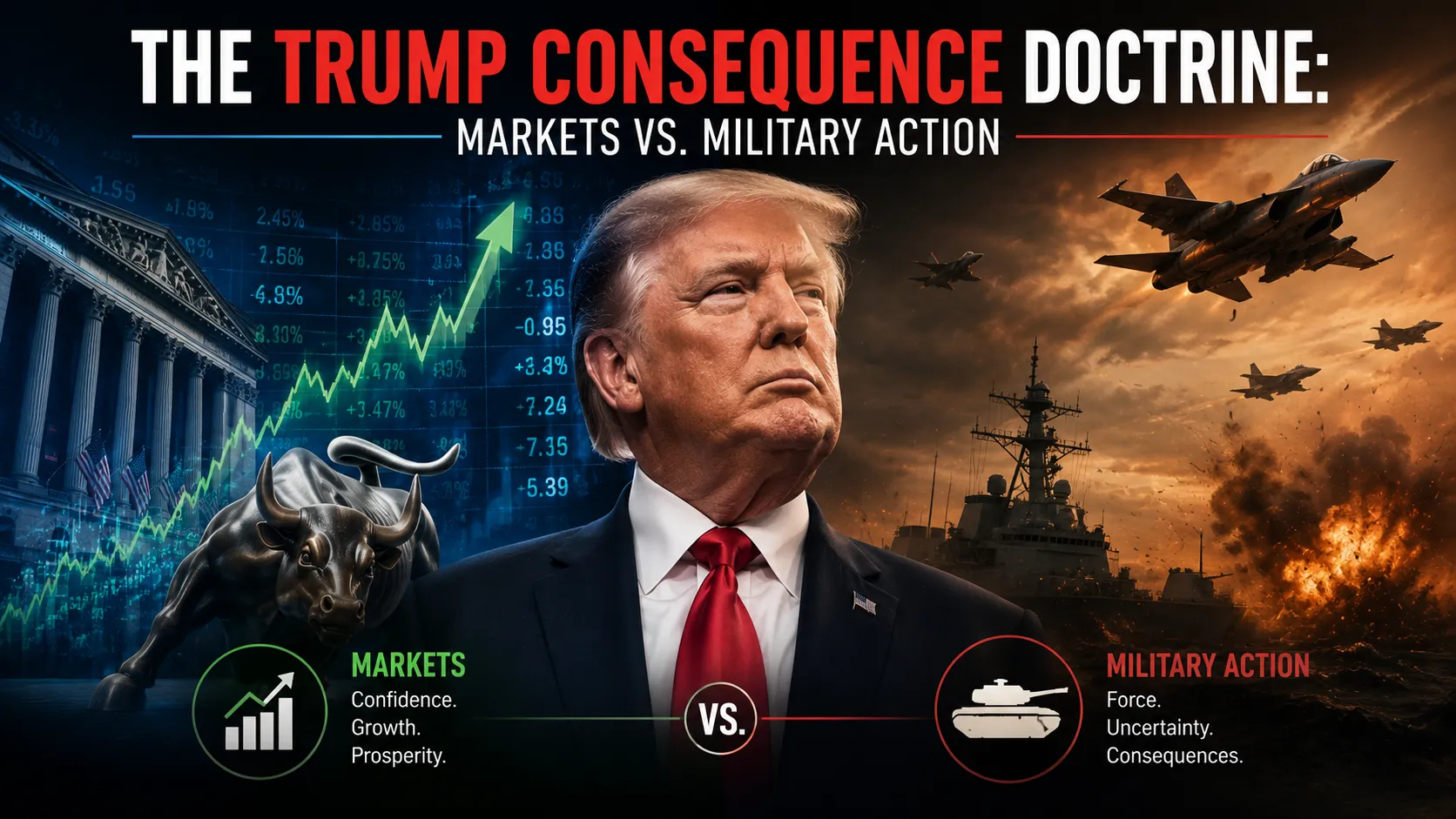
The 953-Point Warning
On June 9, 2026, President Donald Trump delivered a message to Iran that sent shockwaves through global financial markets. "We hit them hard yesterday, and we're going to hit them hard again today," Trump told reporters at the White House. "We're going to be attacking them and attacking them very hard" .
The markets listened. The Dow Jones Industrial Average tumbled 953.33 points, or 1.9 percent, closing below 50,000 at 49,918.78. The Nasdaq plunged 509.32 points, a 2 percent drop, while the S&P 500 slumped 119.66 points, or 1.6 percent .
The selloff was not merely a reaction to military escalation. It was a repricing of risk across every major asset class. Energy and defense stocks initially rose on the news—traders betting on higher oil prices and increased weapons spending. But then even those sectors joined the broader downturn as risk-off sentiment took hold .
What followed was a masterclass in modern geopolitical hedging. Within days, three distinct strategies emerged: direct energy plays, structural defense allocations, and sophisticated derivative instruments that most retail investors have never heard of.
The Oil Spike: $97 and Climbing
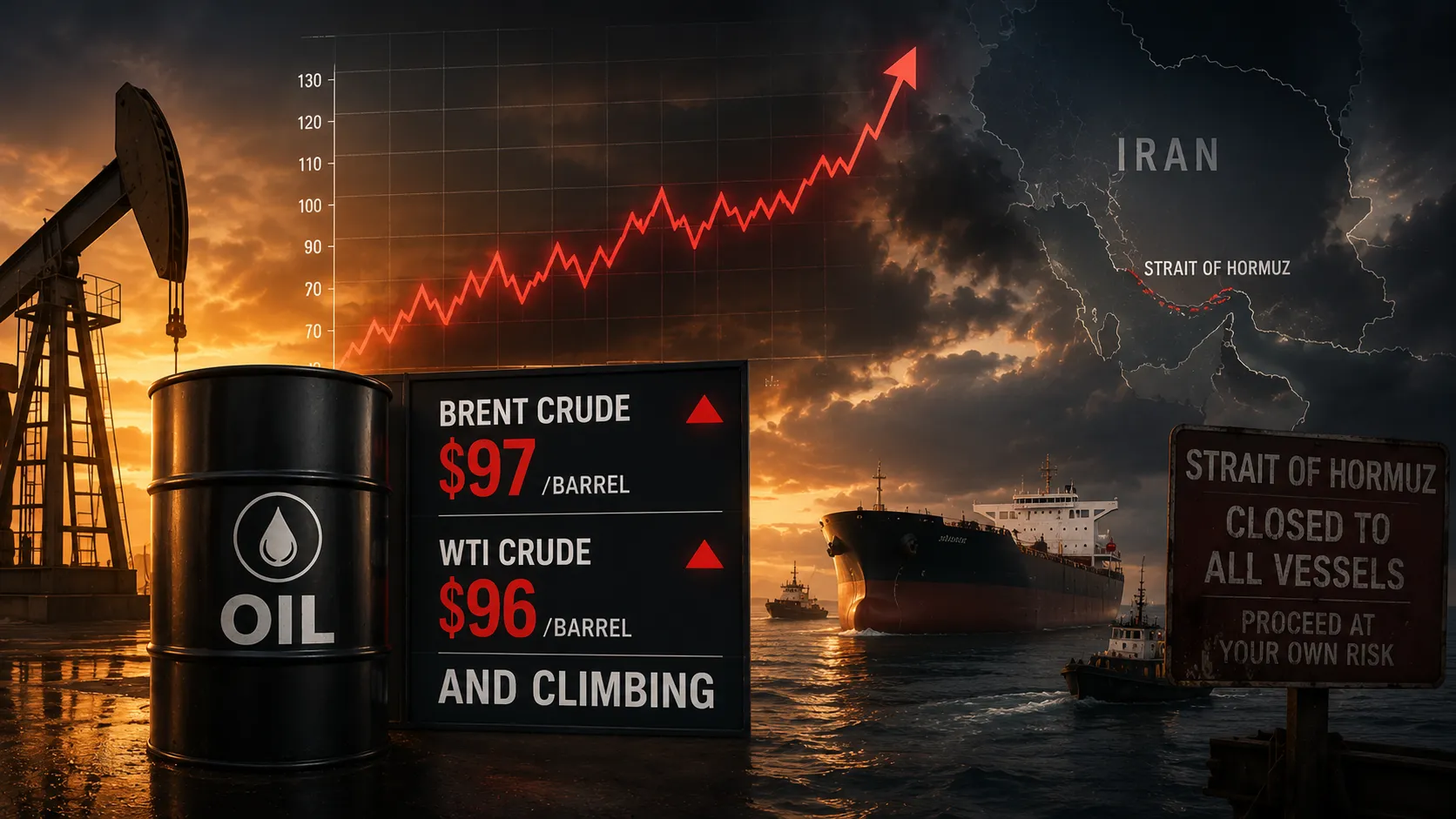
The most immediate market impact was crude oil. Iran's Islamic Revolutionary Guard Corps declared the Strait of Hormuz—through which approximately one-fifth of global oil shipments pass—"closed to all vessels," warning that any ship attempting transit would be targeted .
The physical market told a stark story. Gulf loadings had already fallen dramatically. Since the naval blockade began in April, six commercial vessels had been disabled and 122 redirected . The US Energy Information Administration reported that crude stockpiles fell by 7.2 million barrels to 426.5 million barrels in the week ended June 5—a significant drawdown that reflected genuine scarcity, not just speculative fear .
Brent crude futures surged to $97 per barrel. West Texas Intermediate climbed to $96. At the peak of the conflict in March, prices had touched $120 .
The pattern of oil volatility told a deeper story about how traders were positioning. In early June, the market had briefly priced in optimism about a diplomatic breakthrough. The EFP—the premium of Dated Brent over futures—flipped to a slight discount, suggesting that physical scarcity fears were easing. That optimism evaporated when military exchanges intensified over the weekend. Both benchmarks surged more than 9 percent within days .
Kaynat Chainwala, AVP of Commodity Research at Kotak Securities, observed that the location of risk was crucial. Qeshm Island sits at the mouth of the Strait of Hormuz. Any sustained escalation there would instantly re-tighten flows and reset physical premia higher. And even a successful reopening might not bring prices down sharply. The scale of wartime disruption meant oil could remain elevated in the $80–95 range well beyond any headline agreement .
For investors, the implication was clear: oil volatility was not a short-term trading opportunity. It was a structural feature of the new geopolitical landscape. The old pattern—spike, de-escalation, normalization—no longer held. Each ceasefire was fragile. Each negotiation contained embedded landmines. And each headline threatened to reverse the previous day's price action.
Defense Stocks: The $1 Trillion Backlog
While oil captured headlines, a quieter accumulation was underway in defense equities. The logic was straightforward: war drives weapons spending, and weapons spending drives defense contractor earnings.
The numbers were staggering. Major defense contractors had collectively exceeded $1 trillion in backlog for the first time in history . Lockheed Martin, RTX, General Dynamics, BAE Systems, Rheinmetall—all were sitting on order books that would take years to fulfill. The direction of travel was clear regardless of when the Iran conflict ended.
Europe's rearmament was accelerating. EU defence budgets had nearly doubled from €218 billion in 2021 to a projected €392 billion in 2025, marking the first year all EU-NATO members hit the 2 percent of GDP threshold. Seventeen member states had activated the EU's national escape clause, permitting defence spending above Stability and Growth Pact limits through 2028. Germany alone committed €162 billion by 2029 .
The United States was following suit. Trump's proposed $1.5 trillion defence budget was unlikely to pass in totality, but a defence allocation above $1 trillion was a likelihood—a record discretionary amount .
Yet defense stocks had plateaued. As one analyst noted, the pause had come as investors waited for this spending to turn into earnings. Large government defence contracts came with significant lead times. The strongest indication of future earnings was the backlog, and that backlog had never been larger .
Steve Eisman, the investor made famous by The Big Short, expressed bewilderment at the market's hesitation. "I'm sort of bewildered, given that there's a war going on, why people would be selling defense stocks," he said on a recent podcast .
Eisman's bewilderment pointed to a specific opportunity. The defense sector had corrected, handing retail investors a window that typically did not open twice. The question was not whether defense spending would rise. It was which companies would capture the most value from that rise.
The Silicon Valley Defense Tech Surge
The answer to that question diverged from traditional defense investing. The new war was being fought with drones, autonomous systems, space-based sensors, and artificial intelligence—not just fighter jets and aircraft carriers.
Red Cat Holdings was the small-cap drone pure-play. Its Black Widow ISR drone had won the Army's Short Range Reconnaissance contract. CEO Jeff Thompson openly chased the Pentagon's drone budget line, signaling that Secretary of War Hegseth had proposed budget allocations of up to $74 billion for UAV and USV procurement. The company's Q1 FY26 revenue hit $15.47 million, up 849 percent year over year, and management guided to a $150–180 million annual revenue target .
AeroVironment offered a larger, more established play. Its Switchblade loitering munitions were the weapon the Pentagon actually ordered by the thousand. The BlueHalo acquisition bolted on space, cyber, and directed-energy capabilities. Q3 FY26 produced revenue of $408 million, up 143 percent year over year, with a record funded backlog of $1.10 billion. The COO bought 1,800 shares at $194.89 on April 13, then the stock surged .
Palantir represented the software layer of the new defense stack. Its Maven Smart System, TITAN, and the Army's next-generation battle command stack all ran on Foundry and AIP. Q4 FY25 revenue of $1.41 billion grew 70 percent year over year, with US commercial revenue jumping 137 percent to $507 million. CEO Alex Karp boasted that Palantir's Rule of 40 score was now 127 percent—an extraordinary figure that blended growth and profitability .
The complication was valuation. Palantir traded at a P/E around 203 and was down 19 percent year to date. If AI was the operating system of modern warfare, Palantir was the toll bridge. But the market was demanding proof that the earnings would follow the rhetoric.
Rocket Lab sat on the Austin-to-Southern California defense corridor. CEO Peter Beck confirmed that the company had been selected to support the Department of War's Space Based Interceptor program under Golden Dome for America. Q1 FY26 revenue came in at $200.35 million, up 63.5 percent year over year, and backlog grew 20.2 percent sequentially to $2.20 billion. The $816 million Space Development Agency contract for 18 Tracking Layer Tranche 3 satellites was the largest single award in company history .
Kratos Defense represented the punchline of what one analyst called the "60 primes" thesis—the idea that the defense industry was fragmenting from a few giants into dozens of specialized players. Its Valkyrie XQ-58 was a jet-powered autonomous combat aircraft priced an order of magnitude below a manned platform. CEO Eric DeMarco noted that fiscal 2027 National Security spend was projected to be $1.5 trillion, an approximate $400 billion increase above fiscal year 2026. Valkyrie had just been selected for the Northrop Grumman MUX TACAIR CCA program, with management planning to ramp production to roughly 40 aircraft per year by the end of 2027 .
The Hedge That Worked When Bonds Failed
The most sophisticated response to the Iran conflict was neither oil nor defense stocks. It was a derivative instrument that most retail investors have never traded: swaption straddles.
The Iran war had undermined a long-held assumption of modern portfolio theory—that bonds and equities move in opposite directions during crises, providing natural diversification. During the inflation shock of 2022, both bonds and equities experienced drawdowns at the same time. The Iran war repeated the pattern .
Tony Morris, Global Head of Quantitative Strategies at Nomura, explained why. In a crisis driven by inflation fears, interest rates were more likely to rise than fall. Bonds only profited if interest rates fell. If rates rose, bonds lost money—exactly when equities were also falling .
Swaption straddles worked differently. They were options on interest rate swaps. A long straddle position profited whether interest rates went up or down, as long as they moved significantly. In times of crisis, the implied volatility of interest rates tended to rise as investors bid up swaption prices for protection. Swaption straddles directly benefited from this rise in implied volatility .
The results were striking. From February 27, just before the initial Iran bombing, until March 23, both global equities and global bonds fell. But long positions in euro and US dollar swaption straddles made gains .
Morris noted that long swaption straddles worked not only in inflationary shocks but also during classic deflationary shocks, when government bonds did well. During the global financial crisis, the Eurozone crisis, the oilpatch crisis, and the COVID pandemic, swaption straddles surged while high-yield credit suffered major drawdowns .
The connection between swaptions and broader corporate risk ran deeper than correlation. Robert Merton's 1974 model showed that a future cash flow with default risk was essentially a short put option on the firm's asset value. But most people learned this model assuming constant interest rates. At longer horizons—where most of the future cash flows driving credit and equity valuations existed—interest rate volatility started to dominate corporate asset volatility. Some academic studies estimated that 80 percent of US equity risk derived from cash flows beyond 10 years .
"As time horizons get longer, what looks like FX, equity or credit risk is actually interest rate risk," Morris said. "Most portfolios are materially short interest rate volatility, which is problematic during a market downturn, but long positions in swaptions can help" .
The Three Megatrends Framework
For investors without access to the swaptions market, Betashares laid out a simpler framework: three structural megatrends that would outlast any Iran ceasefire .
The first was defence. Global defence stocks had plateaued, but the likelihood of higher future spending had only increased on the back of the Iran war. The major contractors had exceeded $1 trillion in backlog for the first time in history. Europe's rearmament was accelerating. The direction of travel was clear, and defence contractors could be structural beneficiaries and a potential hedge to geopolitical threats that caused broader equity market disruption .
The second was uranium and energy security. The Iran conflict had re-ignited energy self-sufficiency concerns globally. As governments reassessed their baseload power and sought to reduce dependence on hostile suppliers, nuclear energy had re-emerged as a cornerstone of the solution. Thirty-three countries, including the US, France, UK, Japan, South Korea, Canada, and the UAE, now backed the pledge to triple global nuclear capacity by 2050 .
The third was critical minerals. China controlled over 60 percent of global refined critical mineral supply and 90 percent of rare-earth magnets. After China tightened export controls in April 2025, some rare earth prices outside China rose sharply to multiples of those available within it. In response, ministers from 54 countries gathered in Washington at the inaugural US Critical Minerals Ministerial to discuss reducing dependence on Chinese supply. Both the US and Australia had established strategic mineral reserves, and the latest US defence budget dramatically expanded investment in domestic critical mineral supply chains .
The Diplomatic Fog of War
The complicating factor for all these strategies was the fog of war—not just on the battlefield, but at the negotiating table.
On June 8, Trump announced that the US would declare "complete victory" over Iran within the next two weeks. The next day, he suggested an agreement could be reached within "two or three days" and that the Strait of Hormuz would be reopened immediately .
On June 9, US forces struck multiple targets in Iran. CENTCOM described the operation as "self-defense strikes" in response to the downing of a US helicopter. Iran retaliated by attacking US bases in Kuwait, Bahrain, and Jordan, and vowed it would leave no attack or threat unanswered .
On June 10, Trump ordered the US to continue attacking Iran. Defense Secretary Pete Hegseth announced that planned airstrikes would focus on "critical facilities" and warned that the operation would be "powerful and decisive." CENTCOM reported that attacks would continue through the night and into the following day if necessary .

The diplomatic whiplash was extreme. One day, a deal was imminent. The next day, bombs were falling. For investors, this pattern—negotiation, escalation, negotiation—made traditional directional bets exceptionally dangerous. The three-megatrend framework offered a way out. Defense, uranium, and critical minerals did not require predicting when the war would end. They required believing that regardless of when it ended, the world had permanently changed.
As the Betashares analysis concluded, geopolitics was now a structural driver of asset prices, rather than a short-lived disruption that markets quickly moved past. Russia's invasion of Ukraine accelerated defence spending and European energy diversification. The Iran conflict was now doing the same for global energy self-sufficiency while further fracturing the US security umbrella .
The Bottom Line
The "Trump Consequence" doctrine has rewritten the rules of geopolitical investing. The old playbook—buy oil, sell equities, hide in bonds—no longer works reliably. Bonds failed as a hedge because the crisis was inflationary. Oil spiked but then traded in a volatile range defined by diplomatic headlines. Defense stocks initially rose but then plateaued as investors waited for backlog to convert to earnings.
The new playbook is more sophisticated. It includes direct exposure to drone manufacturers, autonomous systems, and space-based defense. It includes uranium miners and critical mineral producers benefiting from supply chain realignment. And for institutional investors, it includes swaption straddles that profit from interest rate volatility when bonds fail.
Three lessons emerge for the retail investor.
First, geopolitical risk is no longer a temporary disruption to be weathered. It is a permanent feature of the investment landscape, and portfolios should be structured accordingly.
Second, the direction of travel matters more than the timing of headlines. Defense spending, energy security, and critical mineral independence are structural trends that will outlast any ceasefire.
Third, when a crisis involves inflation fears, bonds are not a safe haven. Alternative hedges—including commodities, defense equities, and interest rate derivatives—deserve a place in the portfolio discussion.
Trump's warning that Iran would "pay the price" sent markets reeling. But the real price may be paid by investors who rely on outdated playbooks. The rules have changed. The "Trump Consequence" is not just a military doctrine. It is a market regime.