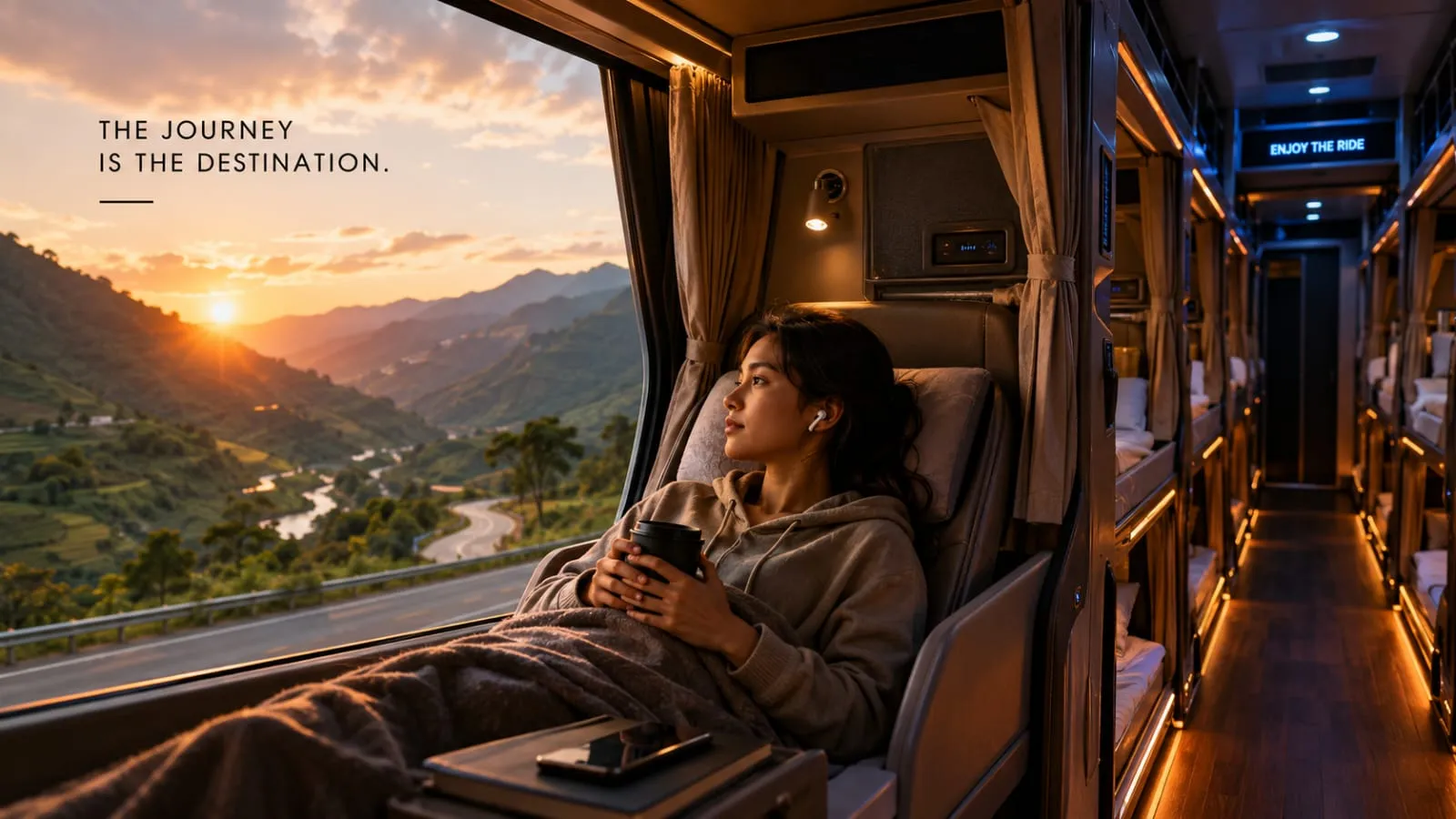
For decades, the cultural blueprint of the youthful traveler or adventurous backpacker was defined by speed and optimization. The goal was straightforward: find the cheapest budget airline ticket, survive the fluorescent-lit purgatory of TSA lines, board a cramped metal tube, and blink yourself into a new time zone. Transit was treated as an inconvenient, sterile tax paid to unlock a destination. The landscape between Point A and Point B was reduced to nothing more than a patchwork of clouds seen through a tiny plastic window.
Today, a profound, generationally driven counter-culture is dismantling this framework. Across the world—from the misty, winding mountain roads of Vietnam to the sprawling, hyper-connected intercity highways of India—a new travel philosophy has taken root. It is called "Slow Travel," and its ultimate vessel is the modernized, high-end luxury sleeper bus.
Gen-Z travelers are actively turning away from budget aviation. Instead, they are choosing to spend twelve, twenty, or even thirty hours on the road. This shift is not a cost-cutting compromise born of economic necessity; it is a deliberate lifestyle choice. By elevating the overnight bus from a gritty transit option to a premium, curated experience, young explorers are proving that the magic of travel lies not in how quickly you arrive, but in how deeply you experience the miles along the way.
The Anatomy of Modern Luxury: Rolling Boutique Hotels
To understand why a generation raised on instant gratification is choosing multi-day bus routes, one must first discard old preconceptions of long-distance coach travel. The days of rigid vinyl seats, broken suspension, freezing or stifling broken air conditioning, and a single, shared television screen playing distorted movies are rapidly fading into history.
The modern luxury sleeper bus is essentially a boutique hotel on wheels. Industry leading manufacturers and boutique transit operators have realized that comfort is the ultimate currency for the modern traveler. Look no further than the market success of vehicles like the Volvo 9600 platform, which has revolutionized long-distance corridors across South Asia. These multi-axle behemoths are engineered for smooth sailing, absorbing highway imperfections to provide a glider-like ride.
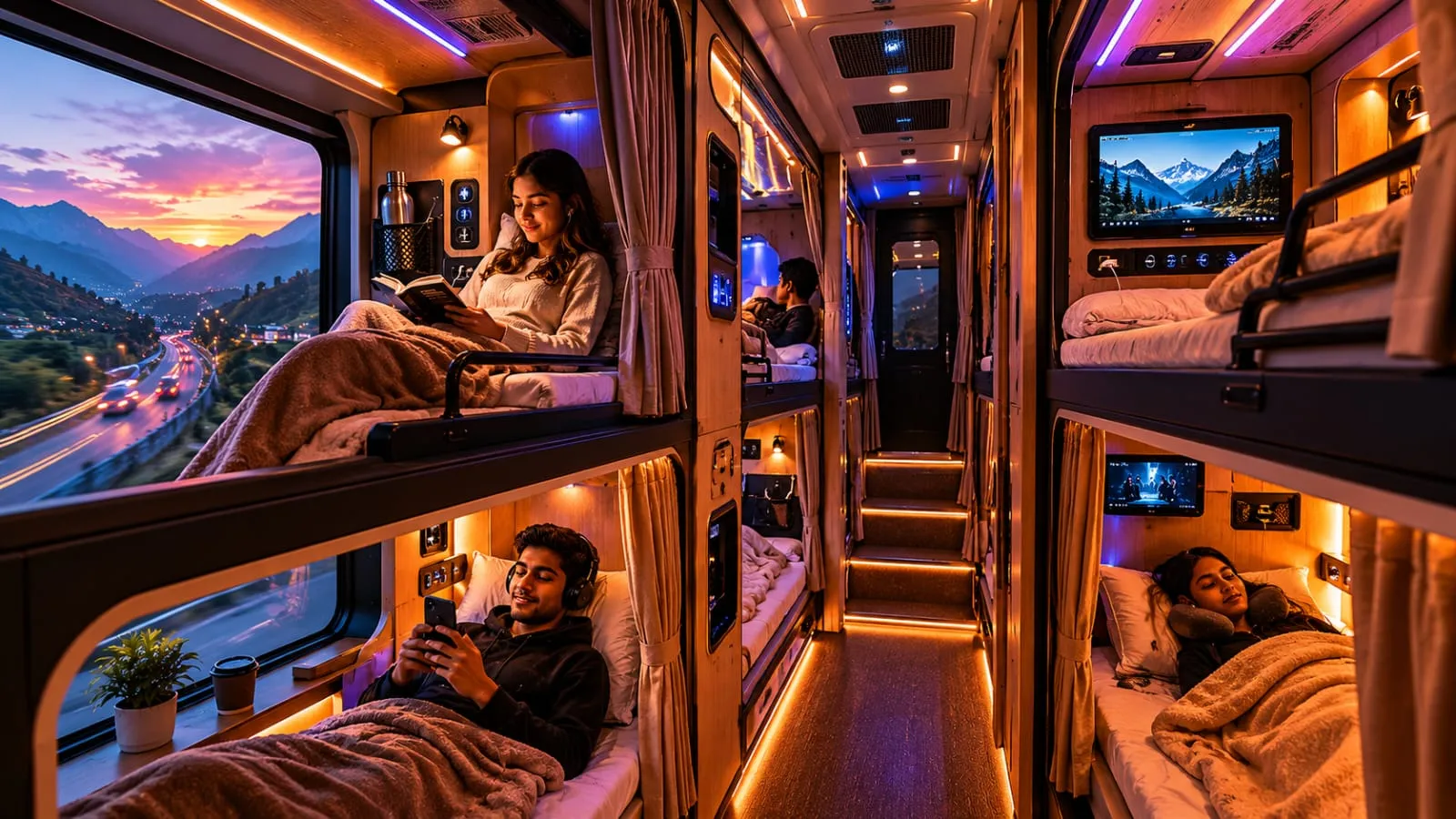
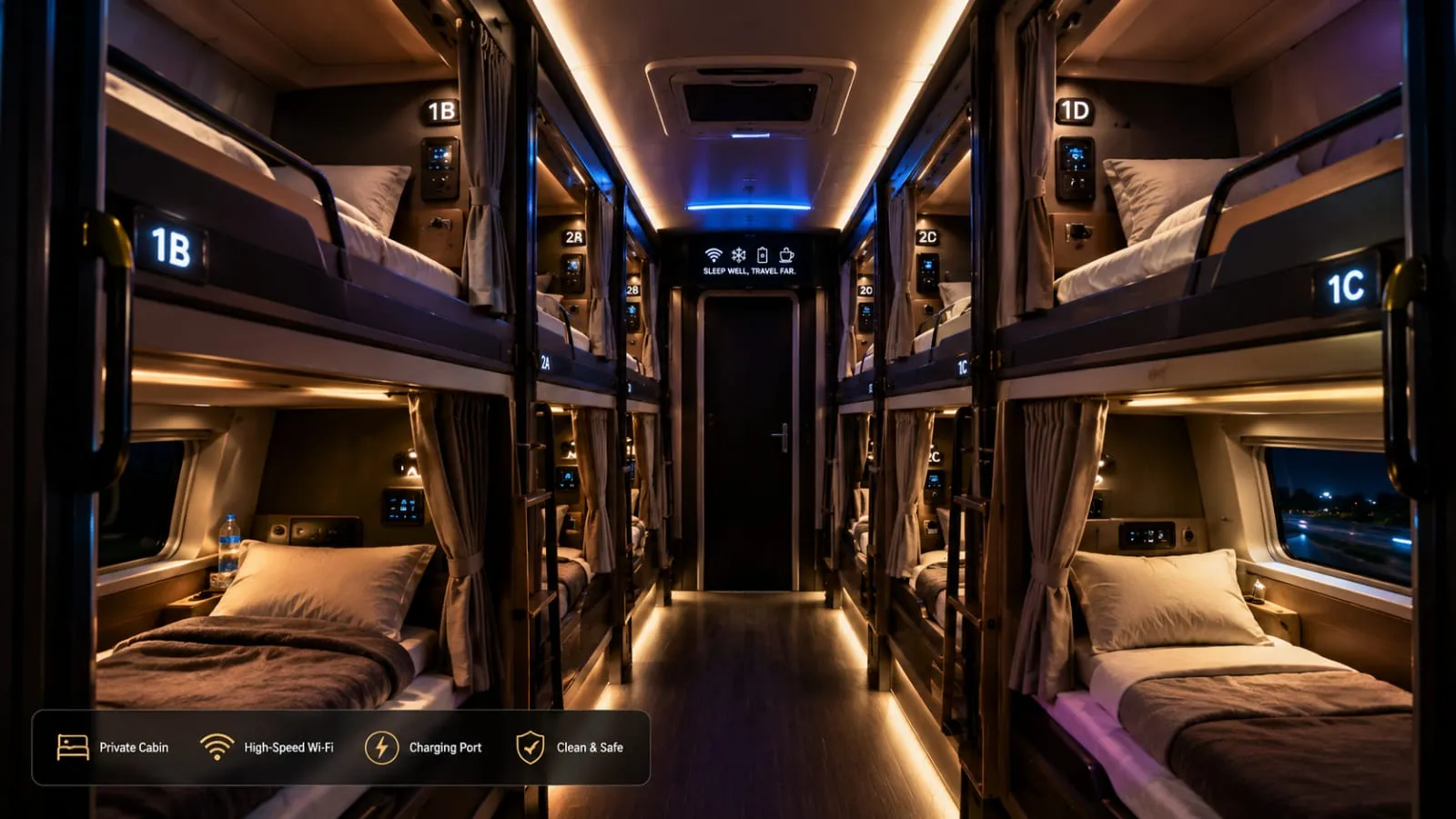
Step inside one of these premium coaches, and the layout looks closer to a first-class airline cabin than a traditional bus. The interior architecture is divided into single or double private pods, often stacked in a two-tier configuration.
Premium Onboard Amenities Include:
Fully Enclosed Berths: Sliding privacy curtains or solid doors turn each berth into a private sanctuary, isolating passengers from the aisle.
Ergonomic Bedding: Memory foam mattresses, plush pillows, and fresh, laundered linens replace standard synthetic fabrics.
Personalized Micro-Climates: Individualized, adjustable climate controls and multi-tiered ambient LED lighting allow travelers to set their own mood.
Digital Connectivity: High-speed onboard Wi-Fi, dedicated USB charging ports, international power sockets, and personal interactive entertainment screens are standard features.
Hygiene and Safety: Many high-end fleets feature integrated, vacuum-flush bio-toilets, active air-purification systems, and 24/7 CCTV monitoring alongside GPS tracking for passenger peace of mind.
For Gen-Z, this design bridges the gap between remote work and adventure. A digital nomad can comfortably prop themselves up against a bank of pillows, open a laptop, take a meeting while coasting down a scenic highway, and then close the blinds to sleep as the sun sets over a changing horizon.
Market Dynamics: The $40 Billion Shift
This behavioral shift is backed by massive economic momentum. The global sleeper bus market has expanded into an industry valued at over $40.96 billion, with the Asia-Pacific region commanding over 46% of the global market share. Driven by an approximate 18% surge in overall demand for long-distance passenger transport, operators are aggressively upgrading their fleets from traditional semi-sleeper seats to premium, full-sleeper configurations.
In markets like India, tech-enabled platforms and premium operators like Zingbus Plus, Intrcity SmartBus, and NeuGo are capturing a massive demographic of young professionals and students. By offering real-time tracking, gender-segregated booking filters, and guaranteed premium lounges at pickup points, they have stripped away the historical anxiety of bus travel.
Similarly, across Southeast Asia, competitive booking ecosystems like 12Go and Baolau have made booking high-end "VIP Cabin" buses as seamless as buying a flight on a smartphone. The market is meeting a massive cultural demand with operational excellence, making overland slow travel highly accessible to international tourists and domestic wanderers alike.
The Eco-Conscious Mandate: Fighting Flight Shame
The rise of slow travel cannot be analyzed without addressing the defining crisis of Gen-Z’s lifetime: climate change. The phrase flygskam (flight shame)—which originated in Scandinavia—has evolved into a global consumer ethos for younger citizens.
Aviation is one of the fastest-growing contributors to greenhouse gas emissions. A single short-haul domestic flight can emit more carbon dioxide per passenger than a person in certain developing nations produces in an entire year. For a generation reporting historic levels of climate anxiety, the cognitive dissonance of flying to an eco-resort or a pristine nature reserve is becoming unbearable.
CO2 Emissions per Passenger-Kilometer (Illustrative Comparison)
===============================================================
[Domestic Flight] ██████████████████████████████ 255g
[Private Car] █████████████████████ 171g
[Sleeper Coach] ████ 28g
===============================================================
Luxury sleeper buses offer an elegant solution to this moral dilemma. High-capacity coaches distribute fuel consumption across dozens of passengers, resulting in a carbon footprint per kilometer that is a mere fraction of a short-haul flight. By opting for a premium sleeper coach, a traveler can cut their transit emissions by up to 80–85%.
Crucially, the luxury aspect removes the element of martyrdom from eco-friendly living. Gen-Z is proving that protecting the planet doesn't require roughing it or arriving at a destination sleep-deprived and aching; sustainability can feel like an indulgence.
Iconic Overland Routes
The magic of the sleeper bus movement is best understood through the legendary travel corridors where these vehicles operate. These are routes where the landscape shifts dramatically between twilight and dawn, offering an immersive geographic transition that a plane ride completely erases.
The Misty Ascent: Hanoi to Sapa (Vietnam)
For travelers navigating the classic Southeast Asian backpacking loop, the journey from the bustling, chaotic streets of Hanoi to the terraced emerald rice fields of Sapa is a rite of passage.
Historically, this meant a bumpy train ride or a nerve-wracking van trip. Today, the route is dominated by ultra-luxury "Cabin Buses." Passengers board in Hanoi late at night, slipping into futuristic, neon-lit pods that resemble spaceship berths. As the bus leaves the urban concrete behind and begins to navigate the steep, winding mountain passes of the Lao Cai province, the engine purrs rhythmically against the incline. Travelers fall asleep looking at the neon city lights and wake up wrapped in thick mountain fog, looking out at the sunrise breaking over the Hoang Lien Son mountain range.
The Cultural Highway: Delhi to Manali / Bangalore to Goa (India)
In India, the scale of intercity sleeper bus travel is monumental. The route from Delhi to the Himalayan hub of Manali takes passengers away from the intense heat and urban sprawl of the plains, climbing steadily into the cool air of the Kullu Valley.
Alternatively, the journey from the tech-metropolis of Bangalore down to the coastal, laid-back paradise of Goa is a favorite for young professionals. On this route, the sleeper bus cuts through the heart of the Western Ghats—a biodiversity hotspot. Traveling via a premium Volvo 9600 coach, passengers can watch the dense forest canopies and rural villages glide past their massive panoramic windows, experiencing the true vastness and cultural diversity of the subcontinental landscape in a way that an airport terminal simply cannot provide.
Reclaiming Romance and Disconnection
Beyond the logistics, economics, and environmental statistics, there is an undeniable romanticism driving the slow travel movement. Gen-Z is a generation that has grown up entirely online, living in a hyper-accelerated digital ecosystem where every interaction is instantaneous and optimized. This constant state of connectivity has contributed to a profound sense of burnout.
Slow travel acts as a psychological circuit breaker. When you board a sleeper bus for a fifteen-hour journey, you are forced to surrender control to the timeline of the road. There are no security announcements every five minutes, no middle seats to fight over, and no pressure to hurry.
The physical experience of the sleeper bus fosters a unique mental state:
The Rhythmic Transition: The gentle rocking motion of the coach and the steady hum of tires on asphalt create a highly meditative space.
Visual Narrative: The journey tells a story. You watch cities dissolve into suburbs, suburbs turn into farmlands, and farmlands transform into wild terrains. You witness the transition of architecture, clothing styles, and natural topography.
Micro-Communities: Shared rest stops at midnight along local highway diners allow travelers to interact with local food cultures, enjoying authentic regional cuisine that is entirely absent from corporate airport terminals.
The sleeper bus turns transit back into an interior monologue. It provides the rare luxury of unstructured time—time to read a book, listen to a full album without interruption, look out the window, or simply daydream.
The Horizon of Travel
The rise of the luxury sleeper bus is not a passing fad; it is a preview of the future of global tourism. As infrastructure continues to improve worldwide—with the expansion of high-speed national highway networks in developing economies—overland travel will only become safer, smoother, and faster.
Gen-Z is rewriting the rules of the road. They have recognized that the collective obsession with optimization has stripped travel of its soul. By trading the stressful efficiency of a two-hour flight for the deliberate, luxurious embrace of a multi-day sleeper coach, they are making an assertive statement about what they value.
They are choosing context over speed. They are choosing sustainability over convenience. Most importantly, they are reclaiming the timeless truth that has always guided the greatest adventurers throughout history: the journey is, and always will be, the destination.