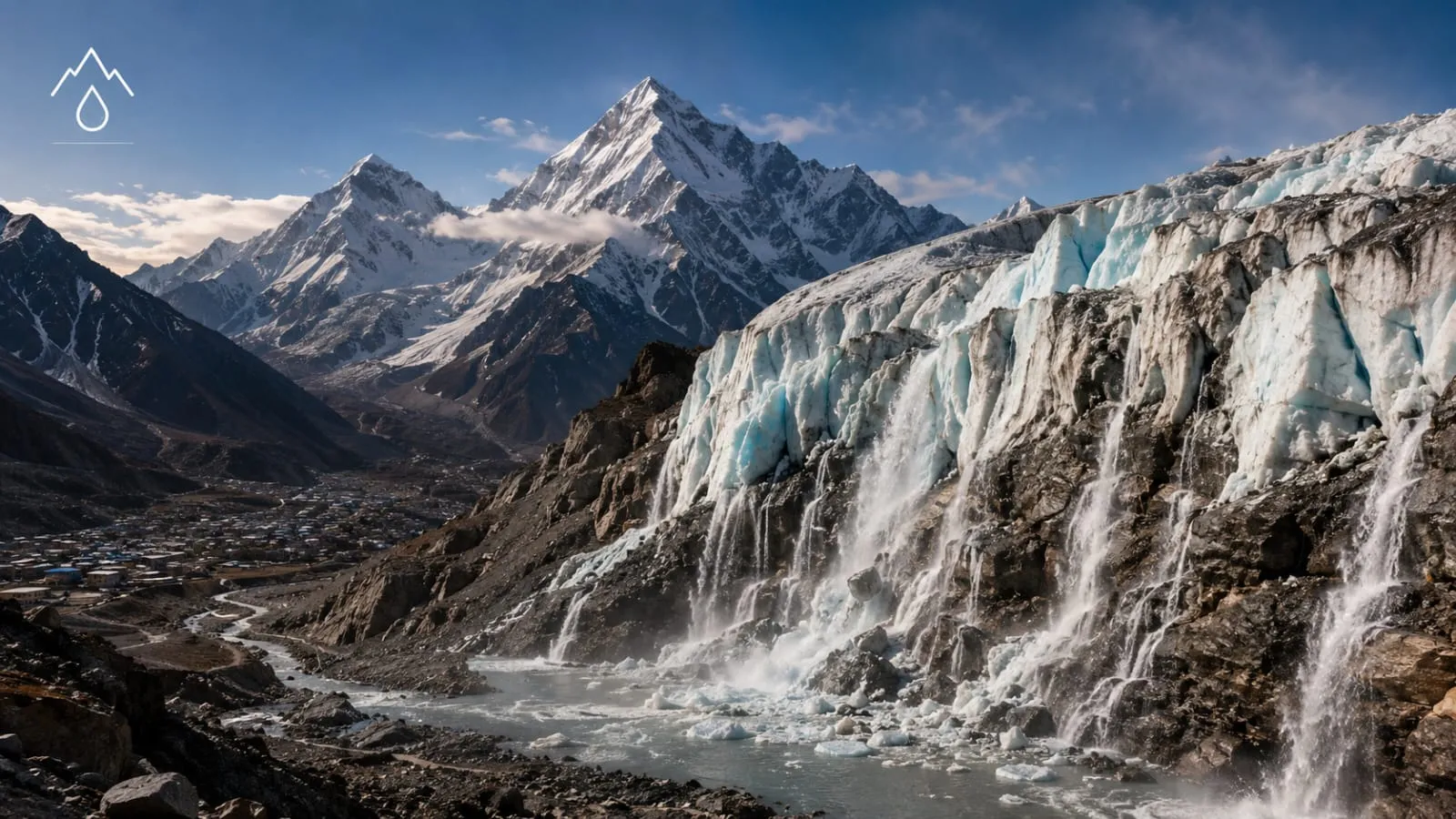
From The Himalayas To Tibet’s Frozen Plateau, One Of Earth’s Most Important Climate Systems Is Losing Ice At A Speed That Is Beginning To Reshape Water, Weather And Human Survival Across Asia
For centuries, the Himalayas and the Tibetan Plateau have been called the “Roof of the World.”
The name was not simply geographical. Stretching across some of the planet’s highest mountains, the region holds the largest reserve of ice outside the Arctic and Antarctica. Its glaciers feed major river systems including the Ganges, Brahmaputra, Indus, Yangtze and Mekong, providing water to nearly two billion people across Asia. Entire civilizations, agricultural systems and economies have developed around water that originates from these frozen mountains. For generations, the ice appeared permanent. Today, that assumption is collapsing. Scientists increasingly warn that one of the world’s most important freshwater systems is melting far faster than expected.
The scale of change is becoming difficult to ignore.
Recent studies show that Himalayan glaciers are now melting nearly twice as fast as they were before 2000. The average rate of ice loss has accelerated dramatically because rising temperatures are preventing glaciers from rebuilding the mass they lose each year. Researchers estimate that parts of the Hindu Kush Himalayan region have already lost up to 27 meters of ice thickness since the 1970s, while glacier retreat continues across large sections of the mountain system. What was once viewed as a long-term environmental concern is increasingly becoming a present-day crisis.
The danger extends far beyond the mountains themselves.
Glaciers function like natural water reservoirs because they store snow and ice during colder months before releasing meltwater gradually into rivers and streams. This process helps stabilize water supplies across vast regions. As glaciers shrink, rivers initially receive more water because melting accelerates. Over time, however, the opposite problem emerges. Once large ice reserves disappear, river systems lose one of their most important long-term sources of replenishment. Communities that depend on glacier-fed water may eventually face shortages affecting agriculture, drinking water and energy production.
The region is already witnessing new forms of climate-related disasters.
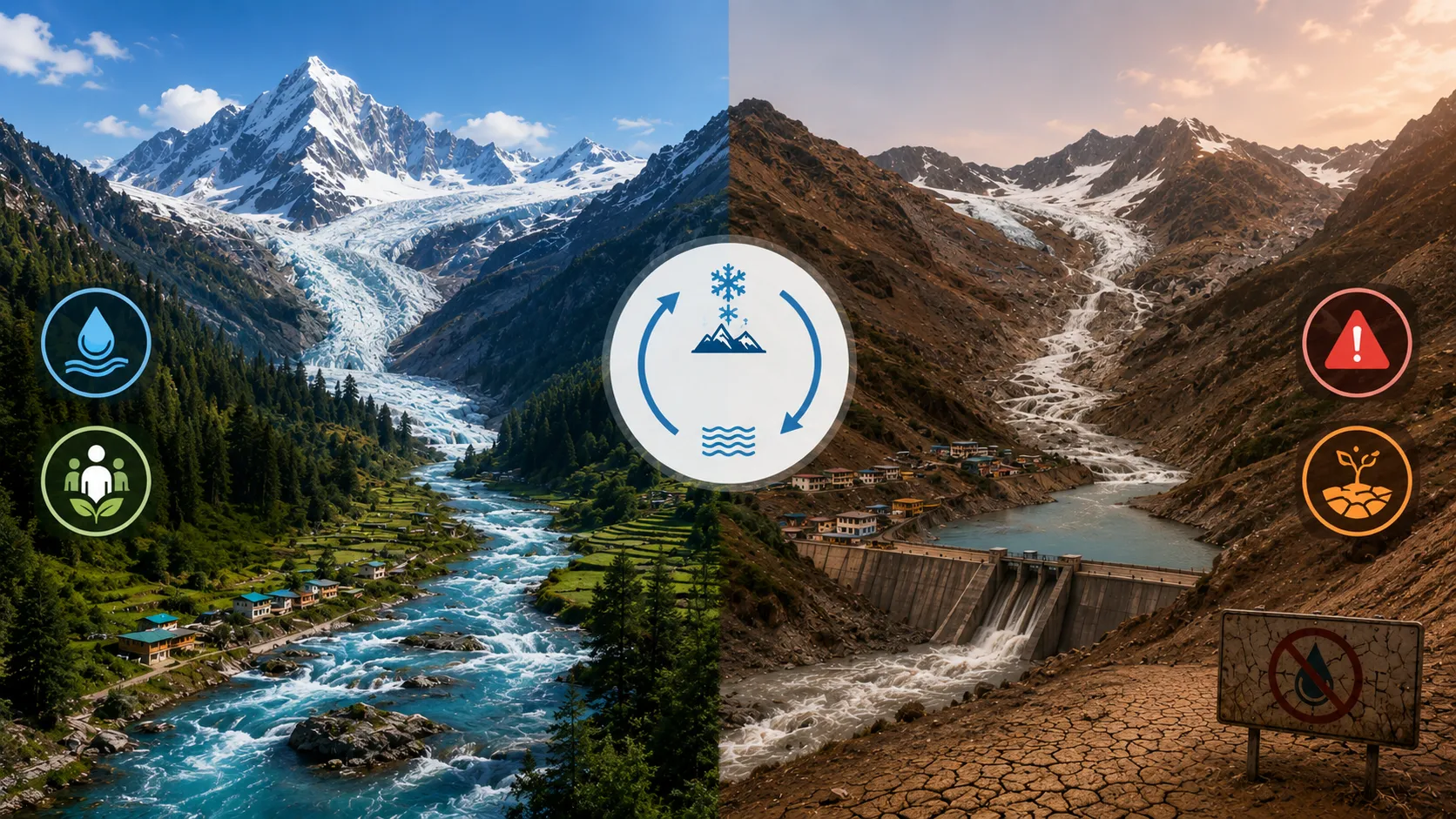
Researchers studying recent Himalayan floods have identified links between rapid deglaciation and increasingly unpredictable mountain hazards. In Uttarakhand, an ISRO-backed study found that a devastating flash flood was triggered by the collapse of an exposed ice patch rather than a traditional cloudburst or glacial lake outburst flood. Scientists described the event as evidence that glacier retreat is creating entirely new categories of risk that existing monitoring systems may not fully capture. As ice disappears, previously stable mountain environments become far more fragile and unpredictable.
One of the most alarming aspects of the crisis is how interconnected the consequences are.
Melting glaciers influence water security, food production, biodiversity and disaster frequency simultaneously because mountain ecosystems support vast populations downstream. Changes occurring at high altitudes eventually affect farms, cities and industries located hundreds or even thousands of kilometers away. This means glacier loss is no longer only an environmental story. It is becoming an economic, agricultural and public-safety story as well.
Scientists increasingly describe the situation as a feedback loop.
As temperatures rise, glaciers lose snow cover and expose darker ice beneath. Darker surfaces absorb more heat, accelerating melting even further. Black carbon pollution from vehicles, industry and biomass burning worsens the problem because particles settle on snow and ice, reducing their ability to reflect sunlight. This creates a cycle where warming speeds up ice loss, which in turn makes glaciers even more vulnerable to future warming.
The global context makes the story even more urgent.
A major international study found that glaciers worldwide lost an average of 273 billion tonnes of ice annually between 2000 and 2023. Researchers reported that glacier melt accelerated by roughly 36 percent during the second half of that period compared to the first. The loss is contributing significantly to rising sea levels while also disrupting freshwater systems across multiple continents. The Himalayas are not facing an isolated problem. They are part of a much larger planetary trend.
Yet the Himalayas matter differently because of the number of people who depend on them.
Few mountain systems influence as many lives as the Hindu Kush Himalaya region. Water originating from these glaciers supports some of the world’s most densely populated areas. If current warming trends continue, researchers warn that a substantial portion of the region’s glacier volume could disappear by the end of the century. Even under less extreme climate scenarios, losses are expected to remain severe.
What makes the crisis emotionally powerful is that glaciers often feel permanent.
Human lifetimes are short compared to geological change, so mountains and ice appear eternal. Entire cultures have grown up believing these landscapes would always exist. Today, scientists, explorers and local communities are documenting environments that may look completely different within a generation. In several regions across the world, glaciers that survived for thousands of years are now disappearing within decades.