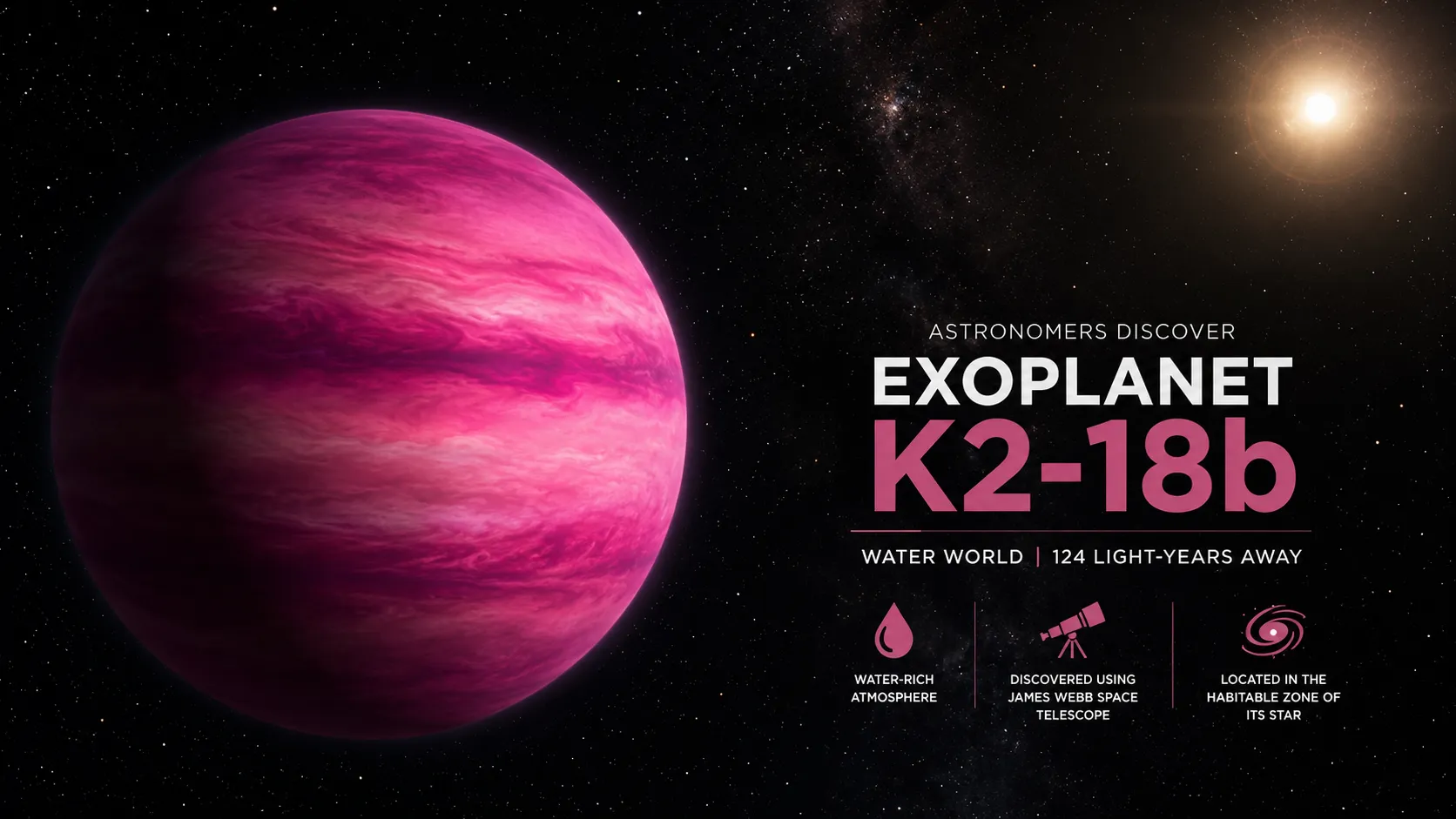
Fifty-Seven Light-Years Away, a Pink World Is Raining Salt.
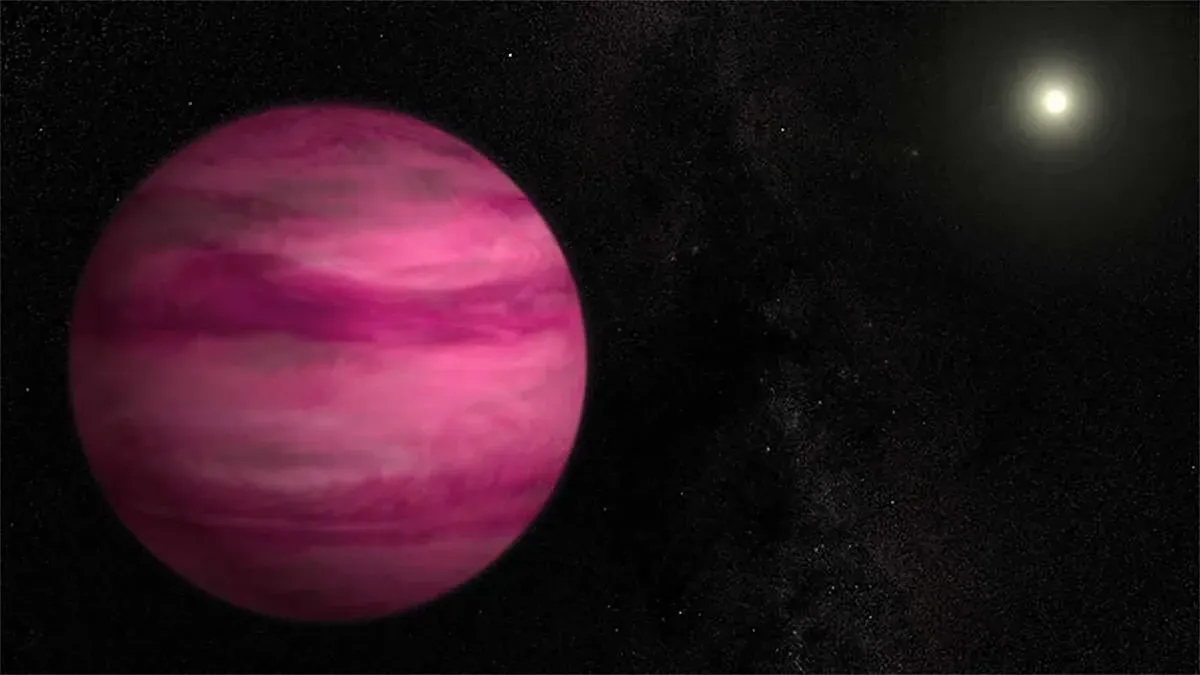
Picture a world the colour of cherry blossoms. Not the pale, washed-out pink of a Valentine's card — a deeper, richer hue, the colour of dark cherry blossom at dusk. A world that has been cooling for up to four billion years, slowly dimming from the furnace of its formation into something ancient and cold, drifting through space at a temperature of 550 degrees Fahrenheit — scorching by any Earth standard, but frigid for a world of its size.
This is GJ504b. The Pink Planet. And what the James Webb Space Telescope just found inside its atmosphere is something nobody quite expected to find.
Clouds. Made of salt.
Not water ice clouds, as on Neptune. Not ammonia ice, as on Jupiter. Not the silicate dust clouds found on hotter exoplanets where temperatures can melt rock. Salt. The same basic chemical family as the sodium chloride you shake over dinner, but in exotic compounds — potassium chloride, sodium sulphide, and related salts — forming deep in the atmosphere of a cherry-blossom-pink world orbiting a sun-like star 57 light-years from Earth.
The discovery, published on June 18, 2026 in the Astronomical Journal by a team led by Aneesh Baburaj, a postdoctoral associate at Northwestern's Center for Interdisciplinary Exploration and Research in Astrophysics, confirms something that planetary scientists have been theorising for more than 15 years — but have never been able to actually observe. And it does something else: it demonstrates, once again, that JWST is doing what no telescope before it could do, in a fraction of the time it would have taken, and producing results that are genuinely reshaping our understanding of what exists beyond our solar system.
What GJ504b Actually Is — and Why It Has Fascinated Astronomers for Over a Decade
GJ504b was discovered in 2013, and its discovery was itself unusual. Most exoplanets are detected indirectly — through the tiny dimming of starlight as a planet passes in front of its star, or the slight gravitational wobble a planet induces in its host. GJ504b was directly imaged. Astronomers actually saw it — a faint, pink-glowing point of light beside its host star.
That direct imaging revealed the object's colour: a dark, cherry-blossom hue that immediately set it apart from the hotter exoplanets that had been directly imaged before it. Most directly imaged exoplanets are hot — between 1,000 and 2,000 degrees Fahrenheit — because they are young, still radiating the heat of their formation. GJ504b is cold by comparison, at just 550 degrees Fahrenheit, because it is very old. The object likely formed between 2.5 billion and 4 billion years ago, which means it has had billions of years to cool from the fierce temperatures of its birth.
Its colour, its coldness, and its age combine to make GJ504b one of the most scientifically interesting objects in the catalogue of directly imaged companions. It represents a class of object — cold, ancient, at the boundary between giant planet and failed star — that astronomers know comparatively little about, partly because such objects are simply very hard to study.
The question of what GJ504b actually is remains genuinely open. At approximately 25 times the mass of Jupiter, it sits in an ambiguous zone. That mass could make it a very massive gas giant planet — the largest known — or it could make it a brown dwarf, a "failed star" that never achieved the mass required to ignite nuclear fusion. Astronomers call it a "planetary-mass companion" to reflect this genuine uncertainty, and resolving that question is one of the ongoing scientific goals of the research programme.
Why Ground Telescopes Failed — and JWST Succeeded in Two Hours
Here is the measurement that best captures what JWST has changed.
"In the past, other astronomers observed the companion for an entire night with some of the biggest telescopes in the world to obtain a spectrum," Baburaj told, "And they could not see the object."
An entire night. With some of the biggest telescopes in the world. Nothing.
"With JWST, our entire observation took around two hours, and we were successful."
The reason for this extraordinary difference comes down to sensitivity, wavelength coverage, and the absence of atmospheric interference. Ground-based telescopes are limited by Earth's own atmosphere, which absorbs and distorts certain wavelengths of light — exactly the infrared wavelengths that cold objects like GJ504b emit most strongly. JWST operates above the atmosphere entirely, orbiting at the L2 Lagrange point approximately 1.5 million kilometres from Earth, where it can detect the faint infrared glow of cold, distant worlds with a clarity that no ground-based instrument can match.
The additional problem is the star. GJ504b orbits its host star at roughly the same distance that Pluto orbits our sun — far enough for direct imaging, but the star is still vastly brighter than the planetary companion. Even at that distance, the star's light overwhelms the object's faint infrared signal in ground-based observations. JWST's combination of a large mirror, extraordinary sensitivity, and coronagraphic instruments that block the star's light made the two-hour observation possible.
The result, when Baburaj's team obtained the spectrum, was immediately striking.
"When we finally obtained its spectrum, it immediately looked interesting. But once we started digging deeper into the data, we realized it was not like anything we have analyzed before," he said.
What JWST Found in the Atmosphere — and the Salt Surprise
The JWST data revealed a rich chemical cocktail in GJ504b's atmosphere. Water. Carbon dioxide. Methane. Ammonia. A diverse set of molecules that told the team they were looking at a complex, chemically active environment quite unlike the simpler spectra typically obtained from hotter objects.
But when the team tried to build models of the atmosphere that could explain the observed spectrum, something was wrong. The molecular signatures did not add up. The relative strengths of different chemical features were inconsistent with any standard atmospheric model they tried.
The solution came from introducing something unexpected: clouds.
"We tried three different types of clouds, and salt clouds fit best," Baburaj explained in the Northwestern press release. "When we accounted for salt clouds, it subdued the signature of molecules hidden deeper in the companion's atmosphere. Then, the results became physically possible."
The mechanism makes chemical sense. At GJ504b's temperature range — 500 to 700 degrees Fahrenheit — theoretical models have long predicted that certain salt compounds, particularly potassium chloride and sodium sulphide, should condense from gaseous form into tiny solid particles that form clouds deep in the atmosphere. These salt cloud particles, sitting in a layer below the upper atmosphere, would absorb and scatter light from the deeper molecular layers — suppressing the strength of the spectral signals from water, methane, and carbon dioxide in exactly the way that the JWST data showed.
"We were very surprised," Baburaj told CBS News, "because people have theorised that salt clouds might exist in the atmospheres of companions at these temperatures of, say, 500 to 700 degrees Fahrenheit, but people in general just don't observe any kind of signatures of clouds in such temperatures, so we were very surprised."
The key phrase is "just don't observe." Not that the theory was doubted — the theoretical prediction of salt clouds in cold substellar atmospheres has been in the literature for more than 15 years. But observational confirmation had remained out of reach, because the objects cold enough to have salt clouds were also too faint and too obscured to study. GJ504b, with JWST, provided the first direct evidence.
Why This Discovery Matters Beyond One Pink Planet
The significance of the GJ504b findings extends well beyond the particular curiosity of a salt-clouded pink world.
First, it validates a theoretical framework that has been waiting for confirmation. Models of cold substellar atmospheres — the physics of brown dwarfs and cold giant planets — have included salt cloud predictions for 15 years. Confirmation that those predictions are physically real, in an actual observed object, strengthens confidence in the entire framework. That matters enormously for studying the dozens of other cold companions and brown dwarfs where direct evidence has been similarly elusive.
Second, it demonstrates the power of JWST for atmospheric characterisation of objects that were simply inaccessible before. The fact that JWST achieved in two hours what ground-based telescopes could not achieve in entire nights is not just a technical footnote. It represents a categorical expansion of the observable universe — a large population of cold, ancient, complex worlds that we previously could not study at all now coming into reach.
Third, it raises the immediate scientific question of what other cold objects have salt clouds. Jupiter, the closest relevant comparison in our own solar system, has clouds of ammonia ice that our current instruments cannot fully characterise at the level of detail that JWST has now achieved for GJ504b. If salt clouds exist in the atmospheres of similar cold objects throughout the galaxy — which the physics suggests they should — then GJ504b is the first entry in a new catalogue of atmospheric phenomena that JWST is uniquely positioned to explore.
The team is already thinking about what comes next. "We are curious about what kind of salt clouds might be present in its atmosphere, but we probably need additional JWST time to answer this question," Baburaj said. Specifically, the type of salt clouds — which particular compounds dominate, at what altitude layers, in what particle sizes — would require more observations. The team also hopes that other ongoing JWST programmes studying GJ504b will be able to resolve the fundamental question of whether it is a giant planet or a brown dwarf.
A World Unlike Anything Analysed Before
There is something genuinely strange about GJ504b that resists easy summary and rewards sitting with it for a moment.
A world that is simultaneously four billion years old and still warm enough to glow faintly pink. A world that orbits a star not unlike our own sun, at a distance not unlike Pluto's, in a system 57 light-years away. A world whose atmosphere contains water and carbon dioxide and methane — molecules that, in other contexts, might prompt immediate questions about habitability — but whose temperature and mass place it firmly in the domain of failed stars and gas giants rather than anything resembling an Earth-like environment.
And somewhere deep in that atmosphere, clouds of salt drifting in chemical equilibrium, just as the physics said they should be, waiting for a telescope sensitive enough to find them.
"The Pink Planet is the coldest companion ever discovered using ground-based instruments," Baburaj said. "Many teams all around the world performed follow-up observations to study its light, but it was too faint for ground-based instruments. That made it a perfect target for JWST."
The two hours JWST spent looking at GJ504b have confirmed what 15 years of theory predicted, expanded the frontier of what is observable in the cold universe, and added a genuinely new entry to the catalogue of atmospheric phenomena that exist on worlds beyond our own.
Somewhere out there, 57 light-years away, a cherry-blossom-pink world is wrapped in salty clouds, slowly cooling as it has for billions of years, indifferent to the fact that a space telescope on the other side of the galaxy just figured out what it is made of.
Science had its two hours. The universe gave up its secret. And the Pink Planet is stranger, and more beautiful, and more real than it was before.