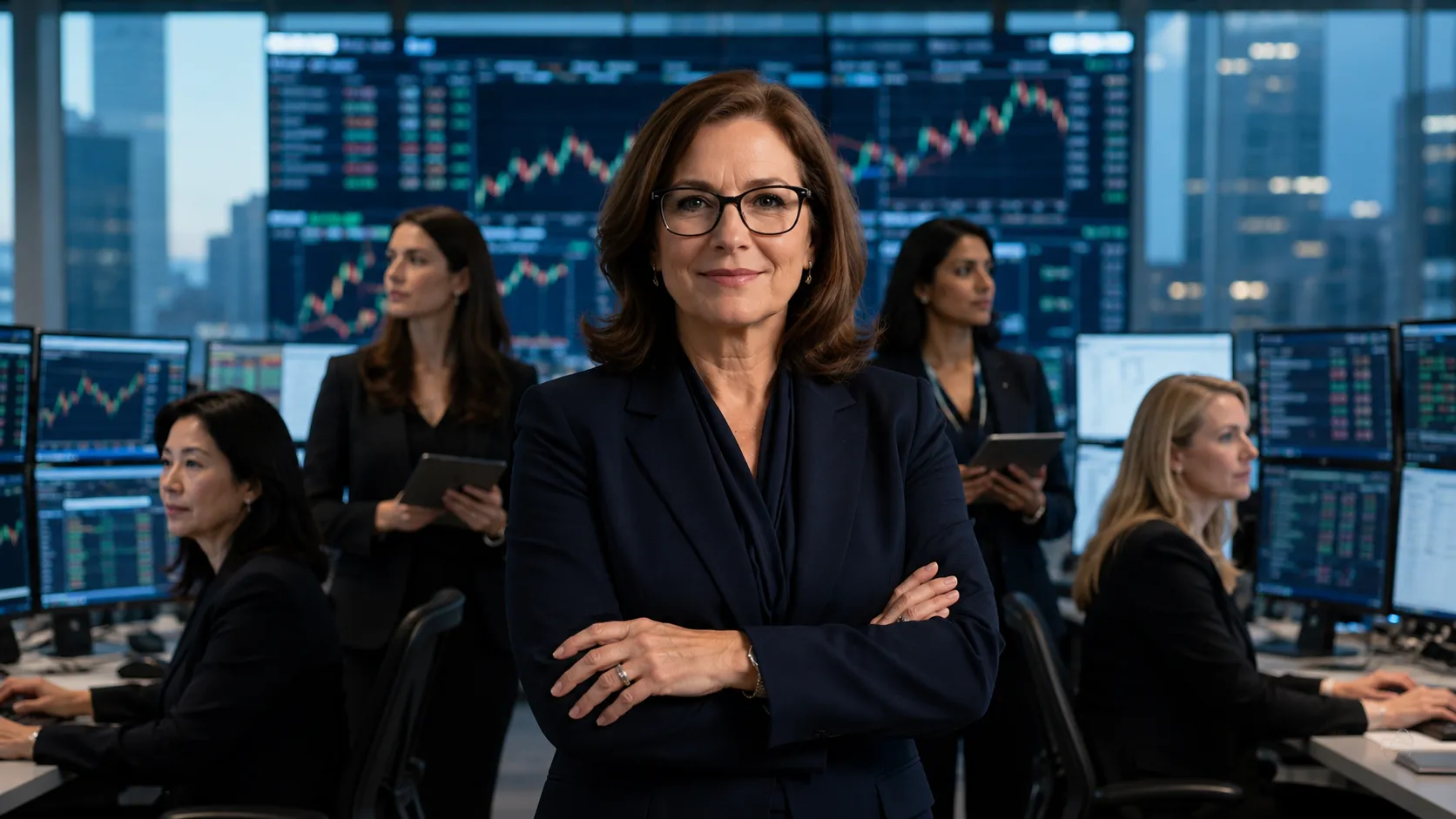
The Headline Says Wall Street Is a Man's World. The Infrastructure Says Otherwise.
Open any financial newspaper on any given morning and the names that appear most often as sources, protagonists, and power brokers are overwhelmingly male. Jamie Dimon. Larry Fink. David Solomon. Ray Dalio. The cast of Wall Street as most people understand it has, for most of financial history, looked like a casting decision from a 1980s drama.
But financial journalism has a visibility problem. It covers the most telegenic power — the investment banking deal, the hedge fund trade, the market-moving quote — and systematically underweights the less glamorous but arguably more consequential layer beneath it: the infrastructure. The exchanges. The clearing houses. The asset management giants. The institutions that process, settle, guarantee, and govern every transaction that occurs in every financial market on earth.
That layer — the plumbing of global finance — is increasingly being run by women. Not in the future tense. Now.
Adena Friedman chairs and leads Nasdaq, the exchange that defines the technology stock market globally. Nandini Sukumar has been CEO of the World Federation of Exchanges since 2015 — the global body that represents more than 250 exchanges and clearing houses, whose member institutions are home to nearly 45,000 listed companies, govern $82.5 trillion in market capitalisation, and process around $81.8 trillion in annual trading. Julie Becker leads the Luxembourg Stock Exchange and founded the world's first platform dedicated entirely to sustainable securities. Mary Callahan Erdoes oversees $7 trillion in client assets as CEO of JPMorgan's Asset and Wealth Management division. Jane Fraser leads Citigroup and has posted 90 per cent stock growth since her appointment in 2021. Yie-Hsin Hung leads State Street Investment Management, the fourth-largest investment management firm in the world, with $5.7 trillion in assets under management.
This is not a list of women making progress toward positions of financial power. This is a list of women who already hold it — across institutions that collectively move more capital than most countries produce.
The WFE: The Body Nobody Writes About That Runs Everything
The World Federation of Exchanges is not a famous institution. It does not generate headlines the way Goldman Sachs does. It does not have a celebrity CEO who appears on television to comment on market movements. It works in the background, setting standards, building consensus across global membership, representing the interests of the institutions that actually make capital markets function.
Its membership includes more than 250 market infrastructure providers. Its member clearing houses collectively require risk takers to post approximately $1 trillion in margin and default fund resources to back their positions. When something goes wrong in a derivatives market, a clearing house is what stands between a counterparty default and a systemic crisis. The WFE is the organisation that governs the norms and practices of those clearing houses, globally.
It has been led by a woman for over a decade.
Nandini Sukumar took the CEO role at the WFE in March 2015. She came to the job after 14 years at Bloomberg, where she built and ran their coverage of market structure, exchanges, and UK regulation. She is also Vice Chair of IOSCO's Affiliate Members Consultative Committee and chairs its DLT Workstream — the body advising on how blockchain and distributed ledger technology intersects with global regulatory frameworks.
In March 2026, Sukumar announced the WFE's sixth annual Women Leaders List — recognising senior women from exchanges, clearing houses, and market infrastructure institutions across the global membership. The list spans the Saudi Tadawul Group, the Kazakhstan Stock Exchange, the Options Clearing Corporation, the National Stock Exchange of India, Cboe Global Markets, and Deutsche Börse Group, among others.
The WFE's Women Leaders initiative is now in its sixth year. The breadth of its 2026 list — drawing from Saudi Arabia, Kazakhstan, India, the United States, and Europe within a single cohort — is its own statement about the geographic distribution of women's influence in global market infrastructure. This is not a trend confined to a single market or a single cultural context. It is structural and global.
Adena Friedman: The Woman Who Runs the Market That Defines Technology Value
Adena Friedman became Chair and CEO of Nasdaq on January 1, 2017. She was not a hired-in outsider parachuted into the role after a career elsewhere. She had been at Nasdaq for over a decade, building its data products, running corporate strategy, serving as CFO. She left for two years as CFO of The Carlyle Group, then returned as President and COO before taking the top job.
That career trajectory — deep internal expertise, willingness to leave and return with new perspective, operational authority before executive authority — is the pattern that most distinguishes the women who are now running financial infrastructure from the more visible but sometimes more transient leaders who make the news for doing deals.
Nasdaq is not simply a stock exchange. Under Friedman's leadership it has become a technology solutions company with operations on six continents — a transformation that involved both organic investment and a series of significant acquisitions that expanded the exchange's reach into regulatory technology, financial intelligence, and market surveillance. The exchange is now as much a technology infrastructure business as a trading venue, and that strategic repositioning has compounded Nasdaq's value as an institution across Friedman's tenure.
She has built a leadership profile that extends well beyond the exchange itself. She is one of the most quoted and most sought-after voices on market structure, financial technology, and the future of capital markets globally — a voice that, if you read the financial press carefully, you will find consistently and substantively informing the industry's direction.
Julie Becker and the Green Exchange That Changed the Architecture of Capital
In 2016, Julie Becker did something that had never been done before in global capital markets: she created the Luxembourg Green Exchange, the world's first platform entirely dedicated to sustainable securities. At the time, sustainable finance was a nascent category — serious investors were interested, but the infrastructure for sustainable debt was fragmented, poorly standardised, and difficult to access at scale.
LGX changed that. It created a dedicated listing environment, transparency standards, and a verification framework for green bonds that the market had not previously had access to in a single, structured platform. Since its founding, LGX has been recognised multiple times as Exchange of the Year for its contribution to sustainable debt markets.
Becker became CEO of the Luxembourg Stock Exchange in April 2021. She had joined the exchange in 2013, worked across capital markets, tax, legal, M&A, compliance, and data protection, been appointed to the Executive Committee as Chief Legal and Compliance Officer — the first woman ever appointed to the company's senior leadership team, a fact she has said meant a great deal to female employees — and then moved through the listing and international primary markets divisions before being named Deputy CEO and then CEO.
That progression — across functions, building breadth before taking depth — is characteristic of how the most operationally effective exchange and infrastructure leaders build their credentials. Becker's career is a textbook case of lateral learning as preparation for vertical leadership.
She attended the 2026 WFE Sustainability Conference and delivered the opening remarks — another data point in the picture of a woman who is not a figurehead of sustainable finance but a principal architect of it.
Mary Callahan Erdoes: The $7 Trillion Question Nobody Is Asking
Mary Callahan Erdoes has been the CEO of JPMorgan's Asset and Wealth Management division since 2009. She manages more than $7 trillion in client assets across one of the oldest and most powerful fiduciary institutions in the world.
Seven trillion dollars. To provide scale: that is larger than the GDP of every country on earth except the United States and China. The decisions made by the institution she runs — about asset allocation, risk management, investment strategy, and capital flows — ripple through markets, companies, and economies at a scale that very few individual actors in global finance can match.
She has been named the most powerful woman in American finance for three consecutive years by American Banker. She has spent thirty years at the firm. She sits on the JPMorgan Operating Committee, the institution's most senior management team, and has been consistently cited as a potential successor to Jamie Dimon as CEO of the entire JPMorgan Chase institution.
That last point deserves its own sentence. The woman running the most powerful financial institution in the world is frequently considered as a plausible next leader of that institution. And yet the media conversation around JPMorgan Chase, and around American banking more broadly, continues to treat male leadership as the default and female leadership as the exception.
Meanwhile, Yie-Hsin Hung runs State Street Investment Management — the fourth-largest investment management firm in the world, with $5.7 trillion in assets under management — and describes her leadership philosophy in terms that cut through the abstraction of asset management to something more fundamental: "There is an element of not only engaging people's heads and their intellect, but also engaging people's hearts," she told American Banker. The combination of technical rigour and relational intelligence that characterises her leadership style is, notably, the same combination that research consistently identifies as producing superior long-term institutional performance.
Jane Fraser and the Glass Cliff She Turned Into a Foundation
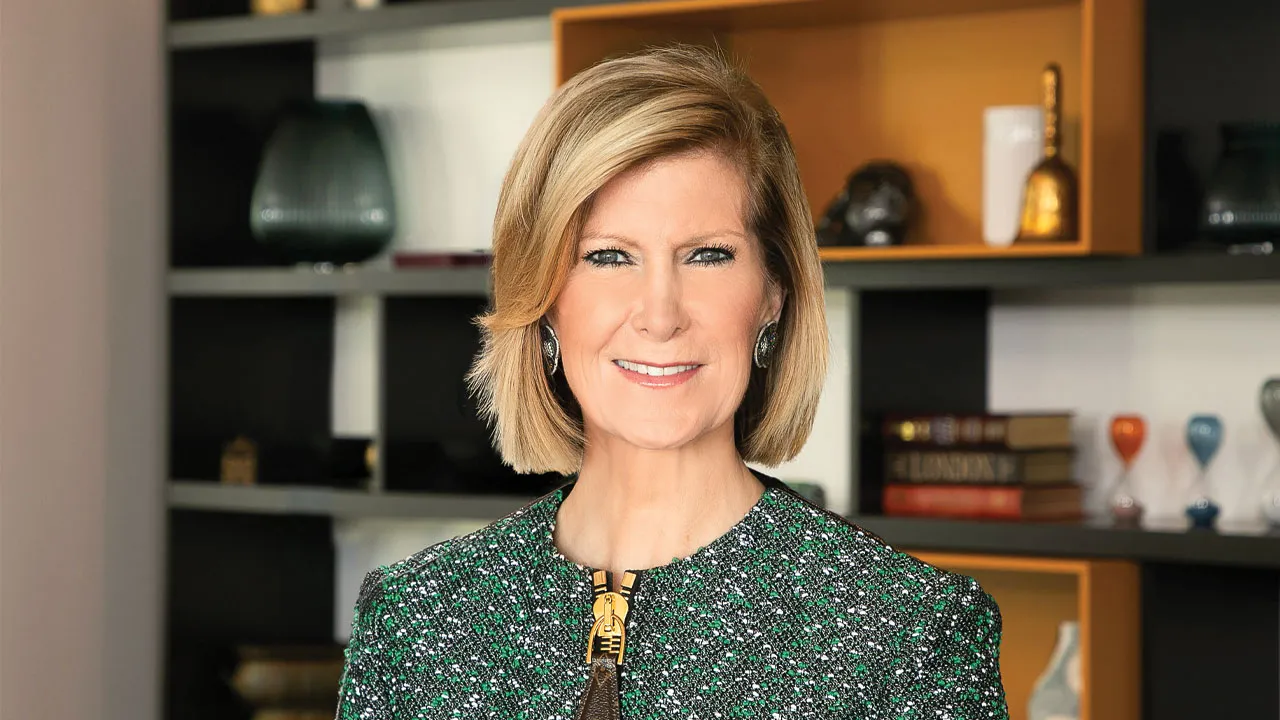
Jane Fraser's story at Citigroup has already been told in headlines. The first woman to lead a major Wall Street bank. The glass cliff appointment — running one of the most complex restructuring challenges in American banking. The scrutiny that comes with being the visible exception in a visible institution.
What is told less often is the performance record.
When Fraser took the role in 2021, Citi was a laggard in the peer group — a bank with extraordinary global reach and deeply disappointing return on equity. She announced a strategic simplification that required years of painful execution: divesting international consumer franchises, restructuring the organisational model, cutting costs, and rebuilding profitability from an institution that had been underperforming its peers for a decade.
Five years later, Citi's stock is up more than 90 per cent since her appointment, including approximately 80 per cent in the 12 months prior to May 2026. The bank's profitability is approaching that of its rivals. Fortune named her the Most Powerful Woman in Business in 2026 — the first time she had taken the top spot.
The glass cliff, for Jane Fraser, became the foundation of a turnaround that her predecessors had failed to execute. That is the outcome data. And outcome data is supposed to be the language that financial markets speak most fluently.
The Pattern — and What Is Hiding It
Across these profiles, a pattern emerges that is consistent enough to constitute a structural finding rather than a series of coincidences.
The women running global financial infrastructure predominantly got there through internal promotion, not outside hiring. They built operational breadth before seeking positional authority. They took on unglamorous, high-accountability roles — restructuring, compliance, risk, clearing, governance — that did not generate profiles in business magazines but did generate the expertise required to run complex institutions at the highest level. And they frequently took those roles in institutions that were not in perfect health, demonstrating exactly the operational and leadership capability that the institutions needed.
The visibility gap is real and structural. Financial journalism tends to cover transactions — deals, trades, fund launches, market movements — rather than the institutions and infrastructure that process those transactions. The people who run that infrastructure are less famous than the people who make the deals, even though the infrastructure is what makes the deals possible. And the people running that infrastructure are, increasingly, women.
What would it mean for the next generation of women in finance to see this clearly — not as progress being made toward power, but as power already held, across the most consequential institutions in the global financial system?
The infrastructure question is the right question. And the answer, for anyone paying attention to the WFE's Women Leaders lists, to Nasdaq's strategic transformation, to LGX's reframing of sustainable debt, to the $7 trillion managed by a woman at JPMorgan's most powerful division, to the Citi turnaround that is outperforming predictions — the answer is that the transition has already happened.
The power brokers are not coming. They are already here. They are running the system.
The only thing that has not yet caught up is the coverage.


