The Mother-Daughter Duo Who Bet ₹25 Crore That Hand-Embroidered Lucknowi Chikankari Belongs on the Global Runway—Not Just in Indian Trousseaus
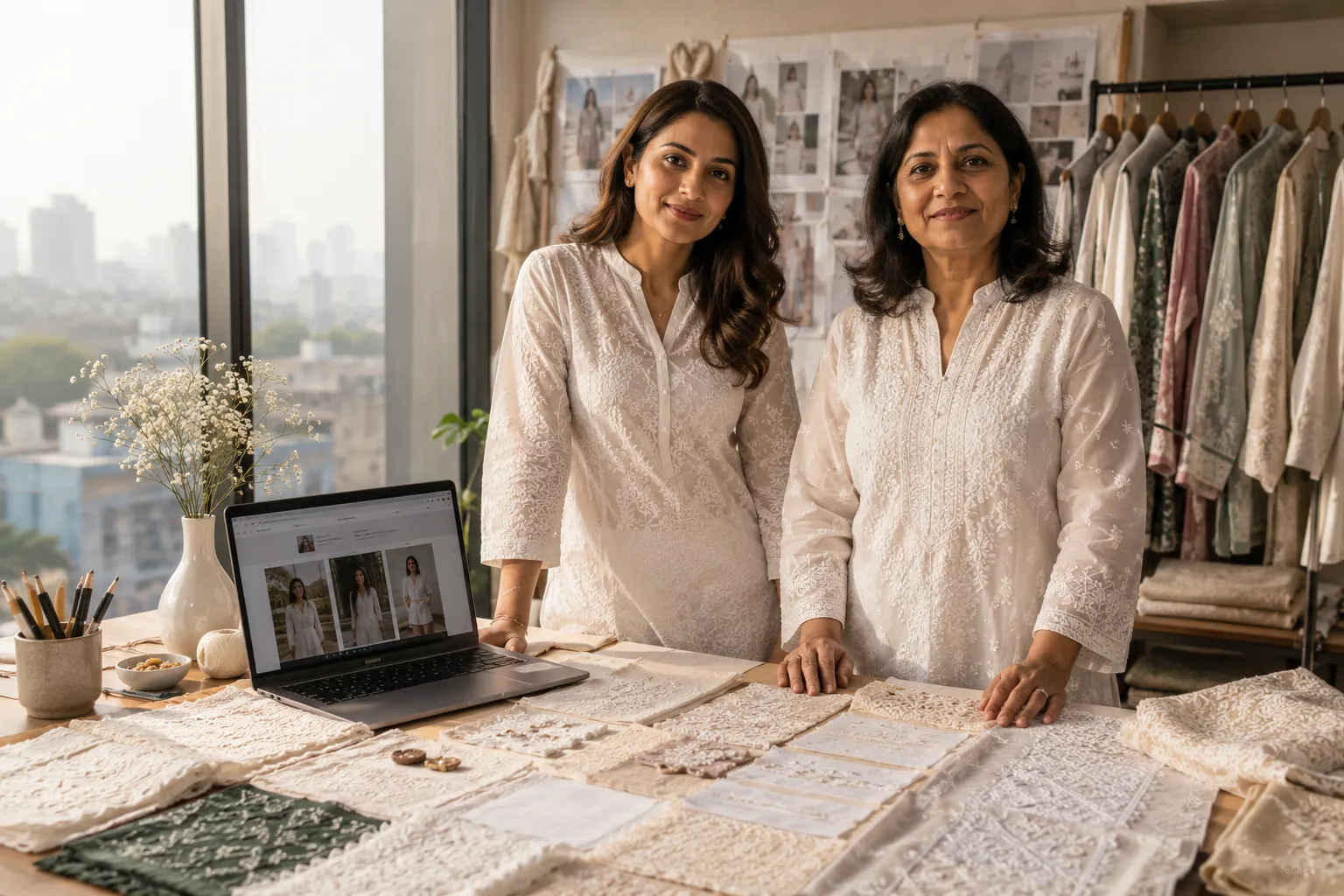
DELHI — May 22, 2026 — Aakriti Rawal was not supposed to be a fashion entrepreneur. She was a business school graduate with the kind of resume that leads to consulting firms and corporate strategy roles, not fabric swatches and artisan villages. Her mother, Poonam Rawal, was not supposed to be her co-founder. She was a homemaker who had spent decades watching the exquisite hand-embroidered chikankari of Lucknow slowly disappear from the world—replaced by machine-made imitations, devalued by middlemen, abandoned by the next generation of artisans who saw no future in a craft that paid pennies and offered no dignity.
In 2020, as the pandemic shuttered India's retail economy, the mother and daughter launched House of Chikankari from their Delhi home. They had no venture backing. They had no fashion industry connections. They had a conviction—shared across generations, tested across lockdowns—that the world's most beautiful hand-embroidery deserved a brand that treated it like the luxury it actually was. "This fundraise marks an important step in our journey of building a brand that brings Indian craftsmanship to a wider audience while remaining relevant to today's consumer," Aakriti Rawal told ETRetail.
Six years later, that conviction is worth ₹50 crore in annual recurring revenue, growing at over 50 percent year-on-year, with products shipped to more than 20 countries including the United States, the United Kingdom, and Australia. The brand serves over 2 lakh customers and generates nearly 80 percent of its revenue from its own website—a direct-to-consumer engine that most legacy fashion brands, with their wholesale-dependent models, can only envy. Its website and app clock over 9 lakh monthly sessions. Its average order value on D2C stands at ₹3,500. And in April 2026, the company closed a ₹25 crore Series A funding round led by Cap Alpha Ventures—the first institutional capital it had ever accepted. "The funds will be utilised towards expanding our product portfolio and channels. While our D2C website will remain a core focus, we will be investing heavily in offline retail over the next 18–24 months," Rawal added.
The 10,000 Women Behind Every Garment
The most significant number in the House of Chikankari story is not the ₹50 crore ARR. It is the 10,000.
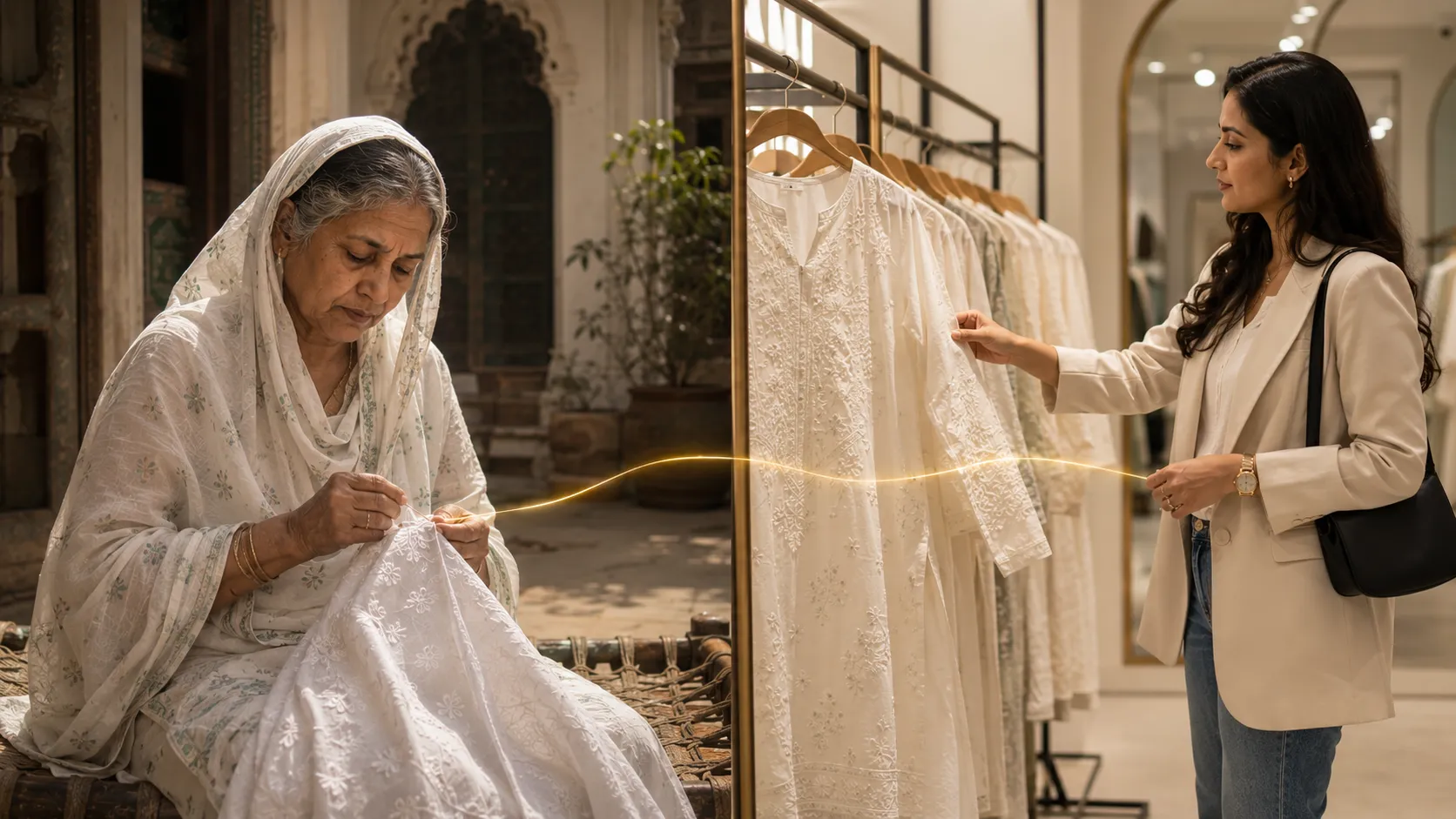
The brand claims to empower more than 10,000 women artisans across India through its supply chain. These are the women who do the actual embroidery—the thousands of individual stitches that transform a piece of fabric into a work of art. They work largely from their homes in and around Lucknow, the historic center of chikankari craftsmanship, where the embroidery tradition dates back to the Mughal era. For centuries, these women were the invisible labor behind India's most celebrated textile tradition. They were paid by the piece, often through multiple layers of middlemen who captured most of the value. They had no brand, no recognition, and no direct connection to the customers who wore their work.
House of Chikankari's thesis is that by organizing this unorganized sector—by building a brand that sources directly from artisan clusters, that pays fairly, that invests in quality control and design collaboration—it can restore sustainable livelihoods while building a commercially viable fashion business. The thesis is not charity. It is supply-chain economics. By eliminating the middlemen and building direct relationships with artisan groups, the company can pay higher wages while maintaining healthy margins. By investing in design and quality control, it can command premium pricing that the wholesale market, with its relentless pressure to cut costs, can never achieve.
The model is resonating. The brand has served over 2 lakh customers, ships to more than 20 countries, and is adding 100 new designs every month across more than 10 categories. It currently has 1,000 SKUs live and plans to expand to over 1,200. The product pipeline is relentless—a fast-fashion approach to a craft that has historically moved at the speed of the individual artisan. The tension between those two speeds is the central operational challenge of the business. You cannot rush hand-embroidery. Each garment takes hours, sometimes days, of painstaking work. And yet the modern consumer, conditioned by Zara and Shein, expects newness every week. House of Chikankari is trying to build a supply chain that honors the first reality while satisfying the second.
The shift toward a formalized, branded supply chain for traditional Indian crafts is not unique to House of Chikankari. Several D2C fashion brands—VivKala, House of Karo, Okhai—are pursuing similar models, each with a different craft tradition and a different brand identity. But the Rawals' mother-daughter partnership gives their company a narrative that none of its competitors can replicate. The mother brings the generational knowledge of the craft, the instinct for what is authentic and what is diluted. The daughter brings the business school training, the digital fluency, the understanding of what the modern consumer wants. The combination is powerful because it spans the divide that has historically separated Indian craft from Indian commerce: the gap between those who make and those who sell.
The Quick-Commerce Experiment and the Offline Bet
House of Chikankari is at an inflection point. The brand has proven it can grow profitably through its own website—a channel that generates nearly 80 percent of its revenue at steady-state break-even. But the next phase of growth, the Rawals believe, requires venturing into unfamiliar terrain.
The first new terrain is quick commerce. The brand is going live with Myntra's M-Now platform, its first experiment with delivering ethnic wear in under 30 minutes. "Apart from this, we are going live with Myntra's M-Now as our first quick commerce experiment. Based on learnings, we will explore other platforms," Rawal said. The idea of ordering a hand-embroidered chikankari kurta the way you order a packet of instant noodles—scrolling, tapping, receiving within the hour—is either a category-defining innovation or a logistical nightmare, depending on whom you ask. Rawal is betting on innovation. The quick-commerce channel, if it works, would allow House of Chikankari to reach customers in a buying mindset that the traditional e-commerce funnel—browse, consider, purchase, wait three days—cannot capture.
The second new terrain is physical retail. The brand plans to open exclusive brand outlets in tier-1 cities—Delhi, Mumbai, Bengaluru, Kolkata, Hyderabad—where its customer base is already concentrated. "This will help us deeply understand offline behaviour before scaling further," Rawal noted. The offline push is a strategic hedge against the marketplace dependence that has defined Indian D2C brands. Currently, 20 percent of revenue comes from third-party platforms like Myntra, Amazon, and Nykaa. As the brand scales its physical footprint, it aims to diversify its channel mix and reduce its exposure to the algorithmic whims and commission structures of the marketplaces.
The economics of the offline expansion are challenging. Physical retail carries fixed costs—rent, staffing, inventory—that the asset-light D2C model avoids. The brand will need to demonstrate that its stores can generate returns that justify the investment. The Rawals are taking a measured approach: open a handful of stores in cities where the customer already exists, learn what works, and only then scale. It is the same disciplined, capital-efficient philosophy that defined the brand's first six years.
What This Signals
The House of Chikankari story is not primarily about fashion. It is about the structural reorganization of Indian craft—a reorganization that is moving the value from the middleman to the artisan and the brand simultaneously.
For centuries, the economics of Indian hand-embroidery followed a predictable and extractive pattern. The artisan was paid a fraction of the final sale price. The middleman captured the margin. The retailer captured the brand premium. The customer never knew who made the garment, and the maker never knew who wore it. The system survived because there was no alternative—no way for an artisan in Lucknow to reach a customer in London or New York without passing through layers of intermediaries who each took their cut.
The internet changed that. Direct-to-consumer e-commerce gave brands a way to bypass the wholesalers and retailers and middlemen, selling directly to customers anywhere in the world. But D2C alone was not enough. Building a brand that customers trust, that commands premium pricing, that generates repeat purchases at high frequency—that requires design, quality control, customer service, and marketing capabilities that artisan cooperatives, on their own, cannot provide. The gap between the craft and the commerce remained.
House of Chikankari is one of a growing number of startups trying to bridge that gap. It is not a cooperative. It is not a non-profit. It is a venture-backed, growth-oriented fashion brand that happens to source its product from thousands of women artisans who have been systematically underpaid for generations. The tension between those two identities—commercial enterprise and social enterprise—is real. The brand must generate returns for its investors. It must also pay fair wages and invest in its artisan supply chain. The Rawals believe the two objectives are aligned: a well-paid, well-trained artisan produces better work, which commands higher prices, which funds higher wages. The virtuous cycle is elegant in theory. The test is whether it works at scale.
The ₹25 crore Series A is a bet that it does. The 10,000 women are the proof. The 2 lakh customers are the market. The 20 countries are the ambition. The mother-daughter duo who launched from their Delhi home during a pandemic have built something that is simultaneously a fashion brand, a supply-chain innovation, and a women's empowerment engine. The chikankari is hand-embroidered. The business model is new.


