The Girl from Jaipur Who Sewed on Her Balcony: How Anita Dongre Built a ₹3,000 Crore Fashion Empire Without a Loan, a Degree, or Permission
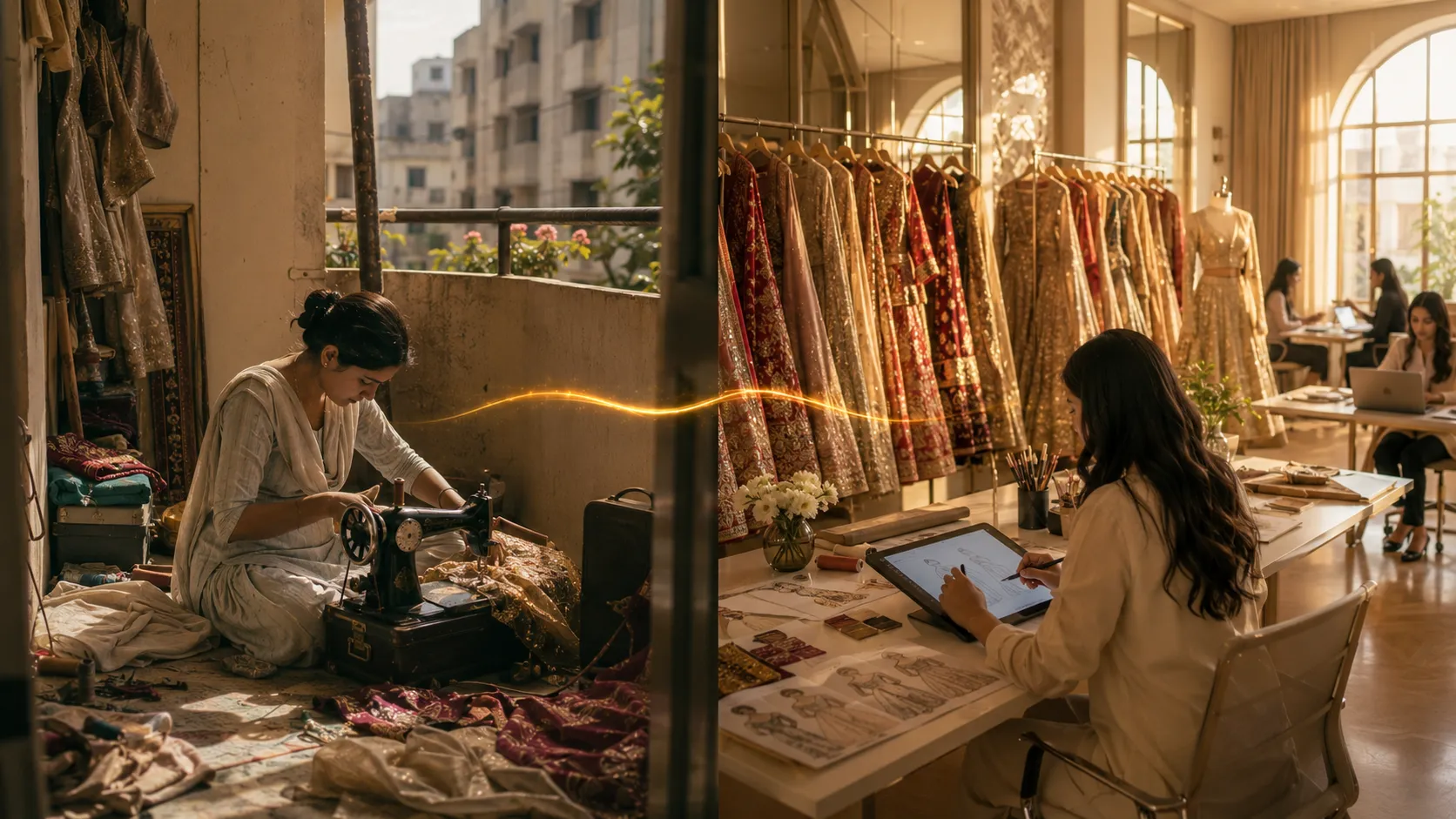
MUMBAI — May 25, 2026 — In 1983, Anita Dongre arrived in Mumbai with ₹11,000, a sewing machine, and a conviction that Indian women deserved clothes that fit their lives. She was 20 years old, the daughter of a garment exporter in Jaipur who had encouraged her to study fashion—an unusual choice for a middle-class Marwari girl in the 1970s—but who could not fund her ambitions beyond the basics. She had no degree from the National Institute of Fashion Technology, which did not yet exist. She had no business plan. She had no connections in Mumbai's tightly guarded fashion industry. She had a small apartment in Navi Mumbai, a balcony that became her workshop, and a belief—quiet, stubborn, and entirely unproven—that if she made clothes women actually wanted to wear, they would buy them.
Forty-three years later, Dongre is the founder and chief creative officer of House of Anita Dongre, one of India's largest and most profitable fashion conglomerates. The company's four labels—AND, Global Desi, Anita Dongre, and the bridal couture line—are sold through more than 300 exclusive brand outlets, over 1,000 shop-in-shops, and digital channels that reach customers across India and the world. Its annual revenue exceeds ₹3,000 crore. It employs more than 5,000 people directly and supports an ecosystem of artisans, weavers, and craftspeople that numbers in the tens of thousands. In 2021, General Atlantic, one of the world's largest private equity firms, invested $100 million in the company—a bet that Dongre's empire, built over four decades of relentless, methodical growth, would continue to compound.
And it was all built without a term loan, without venture capital in the early decades, and without the kind of permission that the world has historically demanded of women who want to build businesses. The girl from Jaipur who sewed on her balcony now dresses Bollywood stars, brides, and boardroom executives. She has put Indian handloom weavers on the global fashion map. She has built a company that competes with the largest international fashion brands in one of the world's fastest-growing apparel markets. And she has done so without ever raising her voice, without ever seeking the spotlight, and without ever accepting the premise that ambition is unbecoming in a woman.
The Marwari Girl Who Refused to Settle
Anita Dongre was born in 1963 in Jaipur, the fifth of six children in a Marwari family—a community known for its entrepreneurial spirit, but not for its encouragement of daughters' careers. Her father ran a garment export business, and from him she absorbed an early understanding of textiles, of what made a garment well-constructed, and of the discipline required to run a business. Her mother, a homemaker, was the anchor of the family, and Dongre has often said that her own ability to balance creative ambition with family responsibility was learned at her mother's knee.
The decision to pursue fashion was not, at first, an entrepreneurial one. It was a creative one. Dongre loved clothes—the way they moved, the way they made a woman feel, the way a well-cut garment could transform not just the body but the spirit. She studied fashion design at SNDT Women's University in Mumbai, one of the few institutions offering such a programme in India at the time. She was not the best student, by her own admission. She was restless, impatient with the theoretical, eager to start making things with her hands.
When she graduated, she faced a choice that many women of her generation faced: find a job, or find a husband. She found neither. She started a business instead. The ₹11,000 she brought to Mumbai was her savings—a small sum, even by the standards of the early 1980s, but enough to buy a sewing machine and some fabric. She began making clothes for friends, then friends of friends, then the women who heard about the young designer in Navi Mumbai who made stylish, affordable Western wear for Indian women. The business grew by word of mouth, one customer at a time. There was no marketing budget, no brand strategy, no growth plan. There was just the product, and the product was good enough to sell itself.
The first label, AND, was launched in 1999—sixteen years after she started stitching on her balcony. The name was simple, modern, and unisex, and the clothes were designed for the Indian working woman: clean lines, comfortable fabrics, professional silhouettes that did not sacrifice style for practicality. The brand found a market that the fashion industry had largely ignored—women who were building careers in the new Indian economy, who had money to spend on clothes, and who wanted to look like they belonged in a boardroom without dressing like a man. AND became the uniform of a generation of Indian women who were making their way in a world that had not been designed for them. The balcony seamstress had found her customer. The customer, it turned out, had been waiting for her.
The Artisan Ecosystem
The most strategically significant decision Dongre made was not a product launch or a funding round. It was a supply-chain decision that transformed her company from a fashion brand into a vehicle for rural economic development—and that created a competitive moat no rival could easily replicate.
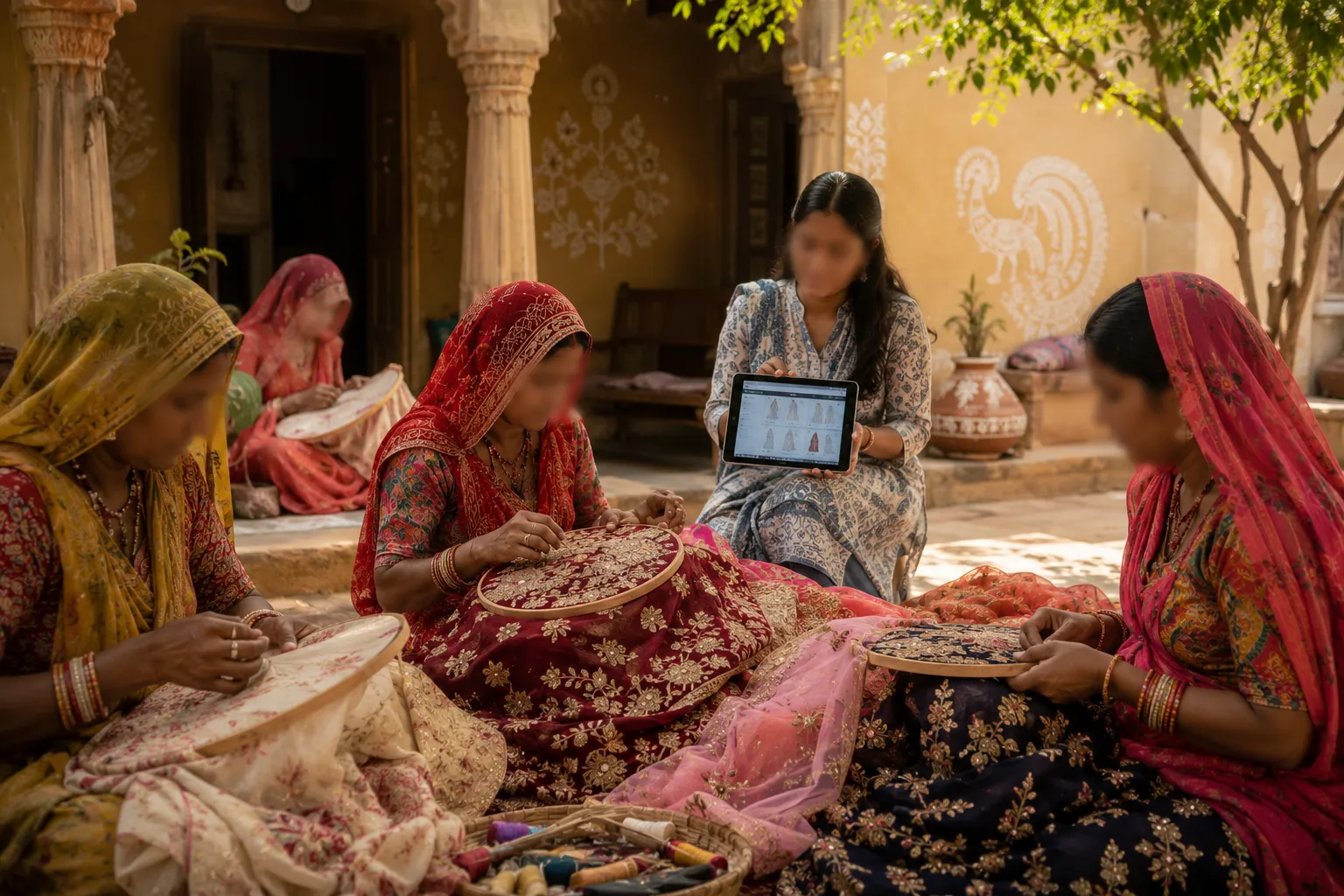
In the late 1990s and early 2000s, as Indian fashion was globalising and most designers were sourcing fabrics and embellishments from industrial manufacturers, Dongre went in the opposite direction. She began traveling to villages in Rajasthan, Gujarat, and Madhya Pradesh, seeking out the artisans and weavers who had preserved India's handloom and hand-embroidery traditions for generations. These were people who had been left behind by the industrialisation of the textile industry—whose skills were dying because there was no market for them, whose children were leaving the villages to find work, and who represented the last generation of practitioners of crafts that had been passed down for centuries.
Dongre saw not a dying tradition but a living supply chain. She began working directly with artisan clusters—Sanganeri block printers, Banarasi weavers, chikankari embroiderers from Lucknow, bandhani tie-dye artisans from Kutch—commissioning work at fair prices, providing design direction that aligned traditional techniques with modern aesthetics, and creating a market for their products that was sustainable because the products were beautiful. The artisans were not charity beneficiaries. They were business partners. And the garments they produced—hand-woven silks, hand-embroidered lehengas, hand-printed cottons—carried a story that no machine-made garment could replicate.
The initiative eventually became formalised as the "Mitti" platform—a technology-enabled supply chain that connects thousands of artisans directly to the House of Anita Dongre's design and production system. The platform digitises the artisan interface, allowing weavers to receive orders, track payments, and communicate with the design team through a mobile app. The technology is simple, but its impact is profound. It eliminates the middlemen who historically captured the lion's share of the value from artisan crafts. It gives the artisans a direct, transparent, and reliable source of income. And it gives Dongre's brands a source of raw materials and craftsmanship that is both ethically sourced and competitively differentiated. A garment that carries a hand-embroidered panel from a women's cooperative in Lucknow is not the same as a garment that carries a machine-embroidered panel from a factory in Guangzhou. The difference is visible, it is valuable, and it is protected by the simple fact that no competitor can replicate Dongre's two-decade relationship with the artisan communities she has cultivated.
The artisan ecosystem now supports tens of thousands of craftspeople, the vast majority of them women. Dongre has been deliberate about designing her supply chain to benefit the women who have been most marginalised by the industrialisation of the textile industry. The women who embroider the bridal lehengas, who weave the handloom cottons, who print the block-printed silks, are not just workers. They are artists, and the company that treats them as such has earned a loyalty that no commercial contract could secure. The artisan who has been paid fairly and treated with dignity for twenty years will not abandon that relationship for a marginal price increase from a competitor. The loyalty, once earned, becomes a structural advantage that deepens with time.
The General Atlantic Bet and the Road to Legacy
The $100 million investment from General Atlantic in 2021 was the most significant external validation of Dongre's business—and a signal that the Indian fashion industry had matured to the point where global institutional capital was willing to bet on it.
General Atlantic does not invest in fashion companies lightly. The firm, which manages more than $80 billion in assets, has backed some of the world's largest consumer brands—Uber, Airbnb, Alibaba, ByteDance—and its Indian portfolio includes Reliance Retail, Jio Platforms, and Byju's. The decision to invest in House of Anita Dongre was a bet that the Indian apparel market, which is among the fastest-growing in the world, would produce a generation of homegrown brands that could compete with the largest international labels. It was also a bet that Dongre's company—with its four distinct labels, its omnichannel distribution, its artisan supply chain, and its four decades of brand equity—was the best-positioned of those brands.
The capital was deployed to accelerate the company's digital transformation, expand its retail footprint, and build out its international presence. Dongre has been deliberate about the expansion, focusing on the markets where the Indian diaspora and the global consumer interested in Indian aesthetics are concentrated: the United States, the United Kingdom, the Middle East, and Southeast Asia. The international strategy is not to compete with Zara or H&M on their terms—fast fashion, global supply chains, trend-driven collections—but to offer something they cannot: authentic, handcrafted, Indian luxury that carries the story of the artisans who made it. A hand-embroidered Anita Dongre lehenga is not a commodity. It is a cultural artifact, and the consumer who buys it is buying more than a garment.
The company now generates revenue in excess of ₹3,000 crore, with a margin structure that reflects the premium positioning of its brands. The bridal couture line, which dresses some of India's most famous women—Priyanka Chopra, Deepika Padukone, Alia Bhatt, Isha Ambani—is the most visible and the most profitable segment of the business. But the workhorse brands—AND and Global Desi—are the foundation on which the empire is built. AND, the label that began with Dongre stitching on her balcony, now has more than 100 exclusive stores and is one of the most recognised women's workwear brands in the country. Global Desi, launched in 2007, taps into the growing market for contemporary Indian wear with a bohemian, folk-inspired aesthetic that has made it a favourite among young women who want to wear their culture without looking traditional.
The competitive landscape is intensifying. Reliance Retail has acquired and scaled a portfolio of Indian fashion brands. Aditya Birla Fashion and Retail owns a stable of labels that compete directly with Dongre's. International fast-fashion giants—Zara, H&M, Uniqlo—continue to expand their Indian footprint. The market is becoming crowded, and the company that wins will be the one that has the deepest brand loyalty, the most distinctive product, and the most defensible supply chain. Dongre's artisan ecosystem gives her a supply chain that is virtually impossible to replicate. Her four decades of brand equity give her a loyalty that no new entrant can match. Her profitability gives her the resources to compete with companies that are far larger, far better-funded, and far more aggressive. The girl who sewed on her balcony is now one of the most powerful women in global fashion—and the company she built is stronger than it has ever been.
The Woman Who Never Raised Her Voice
The most striking dimension of Dongre's career is not the growth or the profitability. It is the silence with which it was achieved.
Dongre is not a celebrity CEO. She does not give provocative interviews. She does not post viral LinkedIn threads. She does not appear on panels declaring that women should lean in or that the future is female. She works. She designs. She runs her company with the same quiet discipline she brought to the balcony in Navi Mumbai—methodical, persistent, and entirely unconcerned with the noise that surrounds the fashion industry. In a world that rewards loudness, she has been a study in the power of quiet.
The fashion industry she entered in 1983 was not welcoming to women entrepreneurs. The designers who got the attention, the magazine covers, and the investment were, overwhelmingly, men. The tailors, the fabric suppliers, and the retailers were men. The industry events, the trade associations, and the backroom deals were conducted by men, in environments that were designed, consciously or not, to exclude women. Dongre navigated this world not by demanding entry, but by building a business that made exclusion irrelevant. The product sold. The customers returned. The revenue grew. The men who once dismissed her as a small-time seamstress were eventually forced to acknowledge that she had built something larger, more profitable, and more enduring than anything they had built themselves. The quietest woman in the room had become the most powerful.
The broader context is an Indian fashion industry that is only beginning to recognise the scale of the opportunity it represents. India's apparel market is projected to exceed $100 billion by 2030, driven by a young population, rising disposable incomes, and a cultural shift toward branded, aspirational clothing. The women who make the majority of the purchasing decisions in that market have been systematically underserved by an industry that has treated them as an afterthought—offering either cheap, mass-produced Western wear or expensive, traditional Indian wear, with very little in between. Dongre's genius was to see that the space in between—modern but rooted, stylish but comfortable, Indian but global—was where the largest and most loyal customer base lived. She built her company to serve that customer. The customer, in return, built her company. The ₹3,000 crore in revenue, the 300 stores, the tens of thousands of artisans, and the $100 million from General Atlantic are all downstream of that single, simple, powerful insight.
Anita Dongre is no longer the girl on the balcony with a sewing machine and ₹11,000. She is the founder of one of India's largest fashion conglomerates, the architect of a supply chain that has revived dying crafts and sustained tens of thousands of rural families, and a quiet, persistent example of what is possible when a woman refuses to accept the limits the world tries to place on her. The balcony is still there, somewhere in Navi Mumbai, but the woman who once stitched on it now dresses brides, builds empires, and transforms the lives of the artisans who weave the fabric of her creations. The ₹11,000 is long gone, invested in fabric and thread and a belief that has been vindicated beyond anything she could have imagined. The work continues. The needle moves. The empire grows.


