The Engineer Who Was Told to "Stay in the Kitchen": How Vimala Raju Built a ₹200 Crore Electronics Empire by Refusing to Listen
HYDERABAD — May 25, 2026 — In 1995, Vimala Raju walked into a bank in Hyderabad to apply for a loan. She was 24 years old, had a degree in electrical engineering from Osmania University, and carried a business plan for a company that would manufacture industrial power supplies—the unsung components that convert electricity into the precise voltages required by everything from factory machinery to medical equipment. The loan officer looked at her, looked at the application, and asked a question she has never forgotten. "Why don't you just stay in the kitchen?"
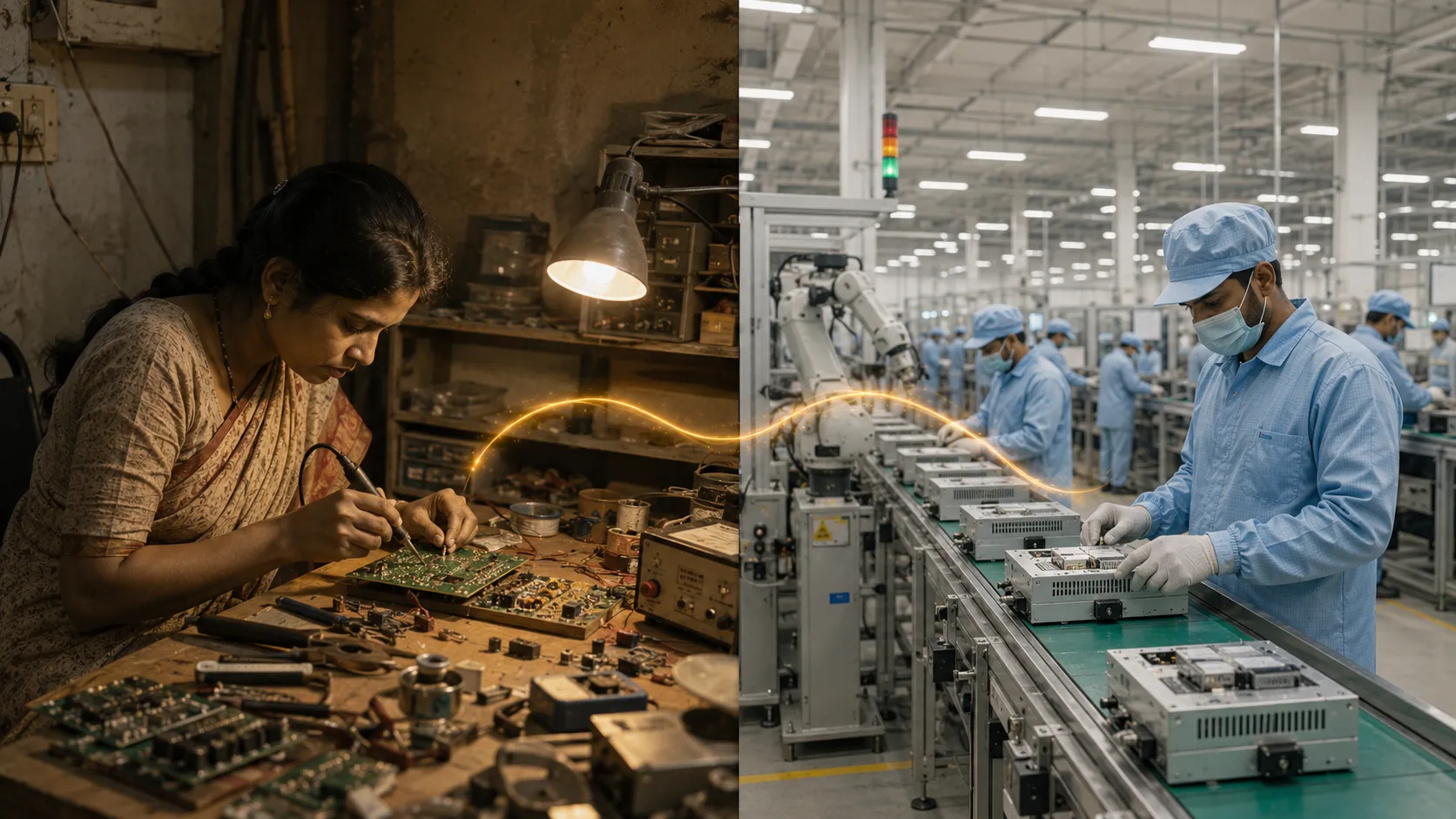
She did not stay in the kitchen. She took a loan from her father instead—₹50,000 against his pension—bought a small workshop in the industrial suburb of Sanathnagar, hired two technicians, and began building power supplies by hand. Today, the company she founded, Vimala Power Systems, is one of India's largest manufacturers of industrial power electronics, with annual revenue exceeding ₹200 crore, a workforce of more than 800 people, and clients that include some of the country's largest defence contractors, railway systems, and industrial automation companies. It has survived three decades of economic cycles, a hostile banking system, and an industry that, for most of its history, treated women engineers as a novelty rather than a norm. And it has done all of this without venture capital, without a famous co-founder, and without the kind of visibility that the consumer-internet economy bestows on its winners.
Raju is 55 now. The loan officer who asked her to stay in the kitchen is almost certainly retired. The company she built in defiance of his question has outlasted hundreds of competitors, weathered demonetisation, GST, and a pandemic, and is now being courted by private equity firms that have finally noticed what the market has known for years: that the woman they told to stay home built something they could not ignore.
The Engineer Who Refused to Leave
Vimala Raju was born in 1971 in a small town in Telangana, the daughter of a government schoolteacher who believed—against the prevailing wisdom of his time and place—that his daughters deserved the same education as anyone else. He pushed her toward mathematics and science. He celebrated her grades. When she announced, at 17, that she wanted to study electrical engineering, he did not flinch. When she was the only woman in her engineering cohort at Osmania University, he did not suggest she switch to something more "suitable." He simply paid the fees and told her to study hard.
The engineering college was not welcoming. The professors were not hostile, exactly, but they were unaccustomed to having a woman in their classrooms, and their expectations reflected that. Raju was not asked to solve the hardest problems. She was not encouraged to pursue the most challenging specialisations. She was tolerated, politely, as an exception to a rule that no one had thought to question. She responded by graduating near the top of her class.
The job market was worse. She applied to more than thirty companies after graduation. Most rejected her before the interview. Several told her, in the polite, elliptical language of corporate India in the early 1990s, that they did not hire women for engineering roles. The few that offered her positions wanted her in administrative or support functions—not designing circuits, not managing production, not doing the work she had spent four years training to do. The message was consistent, unspoken, and unmistakable: you do not belong here.
The decision to start her own company was not, at first, an act of entrepreneurial ambition. It was an act of frustration. If no one would hire her to be an engineer, she would hire herself. The ₹50,000 from her father's pension was supposed to be a bridge—enough to build a few prototypes, land a few clients, and prove that the business was viable. The bridge was shorter than she expected. The first year was a procession of rejections. Clients who were happy to speak with a male sales representative would not take a meeting with a female founder. Factory managers who had spent decades in an all-male industry would not trust a woman with their power-supply specifications. The bank loan officer's question echoed in every closed door.
She survived by being better than the alternatives. When she finally secured a small contract from a local industrial-automation company, she delivered the power supplies ahead of schedule, at a higher specification than the client had requested, and at a price that undercut the competition. The client placed a second order. Then a third. Then referred her to another company. The flywheel that would eventually build a ₹200 crore business began to turn—slowly at first, then with gathering momentum—powered by the most old-fashioned of competitive advantages: she made a better product than the men who had refused to hire her.
The Electronics Industry That Didn't Want Her
To understand what Raju achieved, one must first understand the industry she entered—and the structural barriers that made it, for most of her career, one of the most hostile environments for women in the Indian economy.
Industrial power electronics is a deeply unglamorous business. It involves designing and manufacturing the systems that convert, control, and condition electrical power for industrial applications—the power supplies that keep factory machinery running, the converters that manage voltage for railway signalling systems, the inverters that back up critical medical equipment. The products are essential, complex, and invisible to the end consumer. The customers are procurement managers at large industrial companies, government agencies, and defence contractors. The sales cycles are long. The technical requirements are exacting. The margins, for companies that execute well, are healthy. The barriers to entry, for companies that do not, are formidable.
The industry was, and remains, overwhelmingly male. The engineers who designed the products were men. The factory managers who oversaw production were men. The procurement officers who signed the contracts were men. The bankers who financed the working capital were men. The trade-association meetings where relationships were built and deals were struck were held in environments—late-night dinners, weekend golf games, industry conferences with no women's facilities—that were designed, consciously or not, to exclude the women who were not expected to be there.
Raju navigated this environment not by challenging it directly—she was too busy building her company to fight cultural battles—but by establishing a reputation that transcended gender. Her power supplies did not fail. Her delivery schedules were reliable. Her prices were competitive. Her after-sales service was responsive. The procurement manager who was initially sceptical of a woman-owned supplier became a repeat customer because the product worked, the service was good, and the price was right. The cultural barrier did not disappear. It became irrelevant—bypassed by the simple, relentless logic of commercial competence.
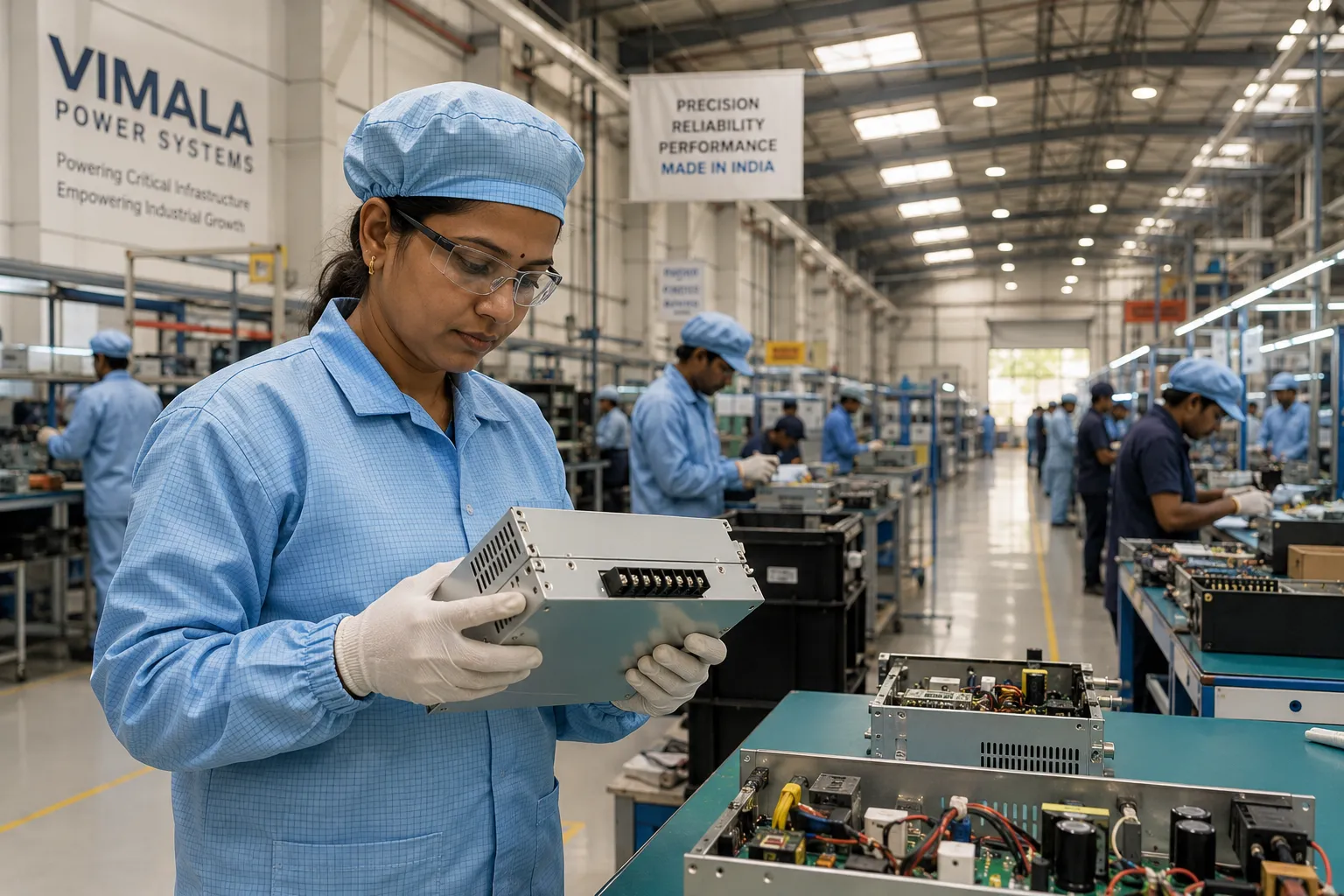
The company's client list now includes some of the most demanding customers in the Indian industrial economy: defence contractors whose specifications are measured in microns, railway systems whose reliability requirements are measured in decades, and industrial automation companies whose production lines cannot afford a single hour of downtime. The company that was once told to stay in the kitchen is now powering the machines that build India's infrastructure. The symbolism is not lost on Raju. "Every time I see a train running, I think: maybe one of our power supplies is in the signalling system," she told an interviewer. "That's a different kind of satisfaction. It's not about the money. It's about knowing that what you built is part of something larger."
The Three-Decade Survival
The most remarkable thing about Vimala Power Systems is not that it grew. It is that it survived.
The Indian economy of the past three decades has been a brutal environment for small manufacturers. Demonetisation in 2016 crushed the cash-dependent supply chains on which many industrial SMEs relied. The introduction of the Goods and Services Tax in 2017 forced companies to migrate from informal accounting systems to formal, digital compliance—a transition that many smaller manufacturers did not survive. The pandemic of 2020–21 shattered demand, disrupted supply chains, and pushed thousands of industrial SMEs into bankruptcy. The cycles of expansion and contraction that define the capital-goods sector—booms when investment is flowing, busts when it stops—have claimed countless companies that were larger, better-capitalised, and more established than Raju's.
Vimala Power Systems survived all of it. The company weathered demonetisation by maintaining conservative cash reserves and strong banking relationships—the same banks that had once refused her a loan were now, decades later, extending her credit lines. It navigated the GST transition by investing early in compliance infrastructure, turning a regulatory burden into a competitive advantage over less-organised rivals. It survived the pandemic by diversifying its client base across sectors—defence, railways, medical equipment, industrial automation—so that no single industry's downturn could threaten the company's survival. The discipline that Raju had learned in the early years—spend carefully, deliver reliably, and never depend on a single customer—became the foundation of the company's resilience.
The company has not raised venture capital. It has not taken private equity. It has grown through retained earnings and bank debt, the old-fashioned way, at a pace that is slower than a venture-backed startup but more sustainable. Raju has been approached by private equity firms in recent years—the same industry that once ignored industrial manufacturing is now, belatedly, discovering that the companies that build the physical infrastructure of the economy are worth owning. She has not said yes. "We are not against outside investment," she told a business publication. "But we are also not in a hurry. The company is profitable. It is growing. We have the capital we need. Why would we dilute now?"
The question reflects the quiet confidence of a founder who has built a substantial business over thirty years—and who understands that the best time to raise capital is when you do not need it. The company's ₹200 crore revenue is a fraction of what it could be if it were funded more aggressively, but Raju does not measure success by revenue alone. She measures it by the company's ability to survive the next crisis, to retain its people through the next downturn, and to keep delivering reliable products to the customers who depend on them. The bank loan officer who asked her to stay in the kitchen would not understand that definition of success. But he is not the one who defines it anymore.
The Quiet Philanthropy
The most underappreciated dimension of Raju's work is not commercial. It is the pipeline she has built for the generation that follows her.
Vimala Power Systems employs more than 800 people. More than 60 percent of them are women—a statistic that is virtually unheard of in the industrial electronics sector. The company's factory floor, its quality-control labs, and its engineering design teams are staffed predominantly by women who, like their founder, were told—implicitly or explicitly—that they did not belong in this industry. Raju has built a company where they do.
The hiring policy is not a diversity initiative. It is a reflection of Raju's conviction that the barriers she faced should not be faced by the women who come after her. She recruits from the same engineering colleges that once made her feel unwelcome. She mentors young women engineers, sponsoring their education and offering internships that often lead to full-time employment. She has funded scholarships for girls pursuing technical education in Telangana. She has built, quietly and without fanfare, a pipeline of female talent in an industry that spent decades pretending that talent did not exist.
The broader context is an Indian manufacturing sector that has one of the lowest female labour-force participation rates in the world. The reasons are complex—social norms, safety concerns, the physical demands of factory work, the absence of supportive infrastructure like creches and flexible shifts—but the result is a sector that draws on barely half the talent pool available to it. Raju's company is a counterexample. It demonstrates that women can not only work in industrial manufacturing, but lead it—and that a company built on the talent that other employers ignore can compete with, and beat, the companies that draw on the full male talent pool.
The recognition has arrived, belatedly but unmistakably. Raju has been honoured with the FICCI Women Entrepreneur of the Year award, the CII Industrial Excellence Award, and a lifetime achievement recognition from the Telangana government. The awards are not merely symbolic. They are a signal that the industry she entered three decades ago—the industry that once refused to hire her—has finally acknowledged that she was right. The woman who was told to stay in the kitchen is now celebrated as a pioneer of Indian manufacturing. The irony is not lost on her. "I don't think about the recognition very much," she told an interviewer. "I think about the next order, the next product, the next challenge. The awards are nice. The work is what matters."
What This Signals
The Vimala Raju story is not primarily about power supplies. It is about the structural exclusion of women from the Indian industrial economy—and about what happens when a woman refuses to accept that exclusion.
For decades, the Indian manufacturing sector has been defined by a set of assumptions that are so deeply embedded as to be invisible. Engineering is for men. Factory floors are for men. The procurement departments that buy industrial equipment are for men. The banks that finance working capital are for men. The trade associations that set standards and build relationships are for men. The industry does not explicitly exclude women. It simply does not imagine them—and the absence of imagination produces the same result as active hostility.
Raju's career is a rebuttal to that absence of imagination. She did not set out to be a symbol. She set out to build power supplies. But in the process of building power supplies—better, more reliably, and more competitively than the men who had refused to hire her—she became a symbol anyway. The ₹50,000 loan from her father's pension, the two technicians in a rented workshop, the decades of rejection and resilience and quiet, methodical growth—all of it adds up to a demonstration that the assumptions that excluded her were wrong. Not morally wrong, though they were that. Factually wrong. Empirically wrong. The woman who was asked why she did not stay in the kitchen built a ₹200 crore company in an industry that said she could not. The question answers itself.
Vimala Raju is 55 now. The bank loan officer is almost certainly retired. The professors who did not ask her to solve the hardest problems are no longer teaching. The procurement managers who refused her meetings have been replaced by a new generation that does not remember a time when women were not in this industry. The company she built is still growing, still profitable, and still largely unknown to the consumer-internet economy that dominates the Indian business press. But the trains that run on time, the factories that keep producing, and the medical equipment that does not fail are powered, in part, by the company she built. The woman who was told to stay in the kitchen has been running an industrial empire for thirty years. The kitchen can wait.


