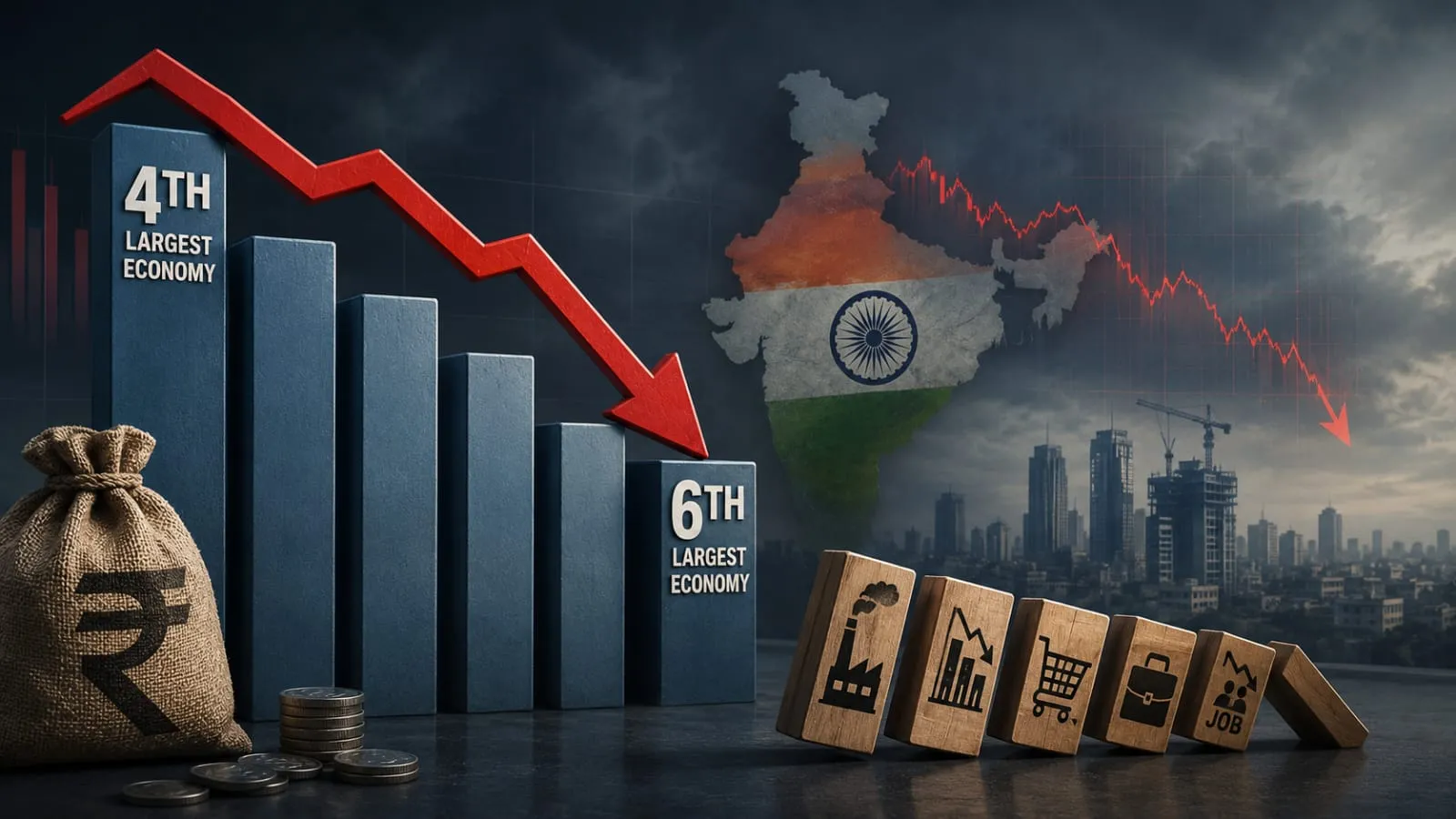
Introduction: The Headline That Shook the Markets
For a nation of 1.4 billion people, economic rankings are far more than abstract figures calculated by distant institutions in Washington or London. They serve as badges of collective pride, tangible proof of a developing nation's hard-fought transition from an agrarian society into a modern, digitized global superpower. When the financial world acknowledged India’s historic climb past global titans like the United Kingdom and Japan, the domestic narrative felt complete. India was no longer just the "country of tomorrow"; it had finally arrived at the global high table as the world’s fourth-largest economy. Then, the international financial ecosystem threw a curveball. A quiet recalibration in global economic output formulas and sudden shifts in the currency markets saw India slip back down to the sixth position. To the casual observer reading the morning news, it looked like a sudden emergency—a sign of a systemic slowdown or a stalling engine. But economic realities are rarely that simple. If you step away from the panic-laden social media feeds and look closely at the underlying mechanics, a completely different picture emerges. This transition isn't a story of domestic failure. Instead, it is a fascinating case study in how global currency dynamics, international trade volatility, and a deeply necessary domestic data cleanup can create a mathematical illusion that completely contradicts the thriving reality on the ground.
Unpacking the Mirage: A Tale of Three Currencies
To understand how an economy can grow rapidly at home while simultaneously dropping ranks on the global stage, one must understand how international organizations compare different nations. When global entities evaluate the relative sizes of economies, they do not measure them in local currencies like rupees, yen, or pounds. They convert everything into a single, universal denominator: the United States Dollar. This reliance on the dollar introduces a massive variable that has very little to do with how many smartphones are assembled in Tamil Nadu or how much grain is harvested in Punjab. It means that global rankings are highly sensitive to the foreign exchange market.
The Strong Dollar and the Rupee Squeeze
Over the past year, macroeconomic policies in the West—particularly aggressive interest rate management by the US Federal Reserve—created an incredibly powerful dollar. This global trend put immense pressure on emerging market currencies, including the Indian Rupee. Even though India’s internal productivity remained remarkably strong, the rupee experienced a planned devaluation against the dollar to keep exports competitive. At the exact same time, the British Pound and the Japanese Yen experienced unique, localized recoveries against the dollar after hitting historic lows. When the final math was done, the conversion rate compressed India’s total output on paper when calculated in USD, allowing its peers to edge back ahead by a razor-thin margin.

The Base Year Recalibration
The second factor behind this statistical shift was entirely internal and completely intentional. In an effort to align more closely with modern international auditing standards, India’s economic analysts undertook a comprehensive review of their domestic gross domestic product calculation models. For years, policymakers realized that certain legacy metrics were failing to accurately capture the exact scale of the informal sector and changing consumer habits. The updated data model introduced a more accurate, slightly conservative baseline for economic output. While this shift temporarily lowered the headline number on paper, it gave the country a far healthier, more transparent, and highly sustainable foundation for future growth.
The Ground Reality: A Fast-Moving Locomotive
While the paper rankings experienced a minor correction, the actual economic engine on the ground tells a radically different story. If India were truly suffering from a structural collapse worthy of dropping two global spots, the indicators of daily life would look bleak. Instead, the domestic landscape reveals a vibrant, hyper-active economy that continues to lead all major global peers in real-world growth.
The Street-Level Digital Revolution
If you want to find the true heartbeat of India's economic resilience, you have to leave the corporate boardroom and walk up to a roadside tea stall or a small neighborhood grocery store. The rapid adoption of instant, mobile-first digital payments has completely transformed how society functions. Millions of micro-entrepreneurs who were once entirely locked out of the formal financial system now operate with a traceable digital footprint. This shift has done wonders for the velocity of money. A street vendor can now use their transaction history to secure a small business loan from a bank within minutes, bypassing traditional bureaucratic hurdles. This bottom-up capitalization is driving private consumption at unprecedented levels, creating a resilient internal market that remains insulated from external global shocks.
The Manufacturing Awakening
For decades, critics argued that India's economy was dangerously lopsided, relying almost entirely on its massive services and IT sectors while missing out on the manufacturing booms that built other Asian superpowers. Today, that narrative is being actively rewritten. Driven by global corporations looking to diversify their supply chains, factory floors across the country are busier than ever. Major electronics giants, automobile manufacturers, and pharmaceutical firms are rapidly scaling up operations on Indian soil. Merchandise exports have consistently touched record monthly highs. This industrial awakening isn't just generating impressive corporate earnings; it is creating sustainable, blue-collar employment opportunities for a young, eager workforce.
The Great Disconnect: Size vs. Individual Wealth
As we analyze India's journey through the global leaderboard, it forces us to confront a vital economic truth: the size of an aggregate economy is a poor measure of individual human welfare. This is where the narrative splits into a profound paradox. Even when India held the fourth spot globally, its massive population meant that the total wealth was distributed across more than a billion people. On a per-capita income basis, the nation still sits significantly lower on the global ladder. When measured through the lens of Purchasing Power Parity—which adjusts for the actual cost of living and what a single unit of currency can buy locally—India remains an undisputed global superpower, holding a secure position far higher than its nominal rank indicates. In local markets, a rupee buys significantly more food, healthcare, and housing than its dollar equivalent would in the West.
"True development cannot be captured by a fluctuating spot on an international spreadsheet. It is measured by the number of families lifted out of poverty, the accessibility of clean energy, and the quality of jobs available to the next generation."
Therefore, this statistical drop from 4th to 6th serves as an incredibly healthy reminder for policymakers. The pursuit of a high nominal GDP ranking must never take precedence over inclusive, equitable growth. The ultimate objective is not merely outperforming other nations on a global chart, but ensuring that economic progress reaches the rural heartlands and agricultural sectors that still sustain nearly half of the country's population.
Looking to the Future: The Road to 2030
Every major international financial body, from the International Monetary Fund to the World Bank, maintains an incredibly bullish long-term outlook on India’s economic trajectory. They view the current shift to the sixth spot as a temporary, currency-driven stabilization rather than a downward trend. The underlying structural advantages that fueled India's initial rise remain completely uncompromised:
The Demography Advantage: While much of the developed world and East Asia confront rapidly aging populations and shrinking workforces, India possesses one of the youngest demographic profiles on Earth, with a median age under 30.
Infrastructure Upgrades: Unprecedented public investment in physical infrastructure—including massive highway expansions, modernized railway corridors, and new deep-water shipping ports—is drastically lowering logistics costs for domestic businesses.
Energy Transition: Rapid scaling of renewable energy projects, particularly solar and green hydrogen, is gradually reducing the country’s dependence on expensive, volatile foreign oil imports. Economic forecasters project that as global currency markets stabilize and the benefits of these massive infrastructure overhauls fully materialize, India is on a definitive path to reclaim and surpass its previous positions. Most models suggest the country will comfortably secure a top-three global position by the turn of the decade, with a projected national output crossing the 7 trillion threshold.
Conclusion: Redefining Success

Ultimately, India’s shift from the 4th to the 6th largest economy is a masterclass in the difference between financial noise and economic signal. The noise is a fluctuating exchange rate that alters numbers on a global leaderboard. The signal is a nation building thousands of miles of highways, bringing millions into the digital banking era, and lifting communities into the middle class. This milestone shouldn't be viewed with discouragement. Instead, it offers an opportunity to look at economic progress through a human lens. The true story of India's growth is not written in Washington spreadsheets, but in the relentless aspiration, innovation, and daily labor of its people who are building the future from the ground up. For an expert breakdown on how global exchange rates and statistical adjustments influenced these latest rankings, you can watch this detailed economic briefing on India's GDP adjustments which outlines the technical shifts reported in the latest international financial updates.