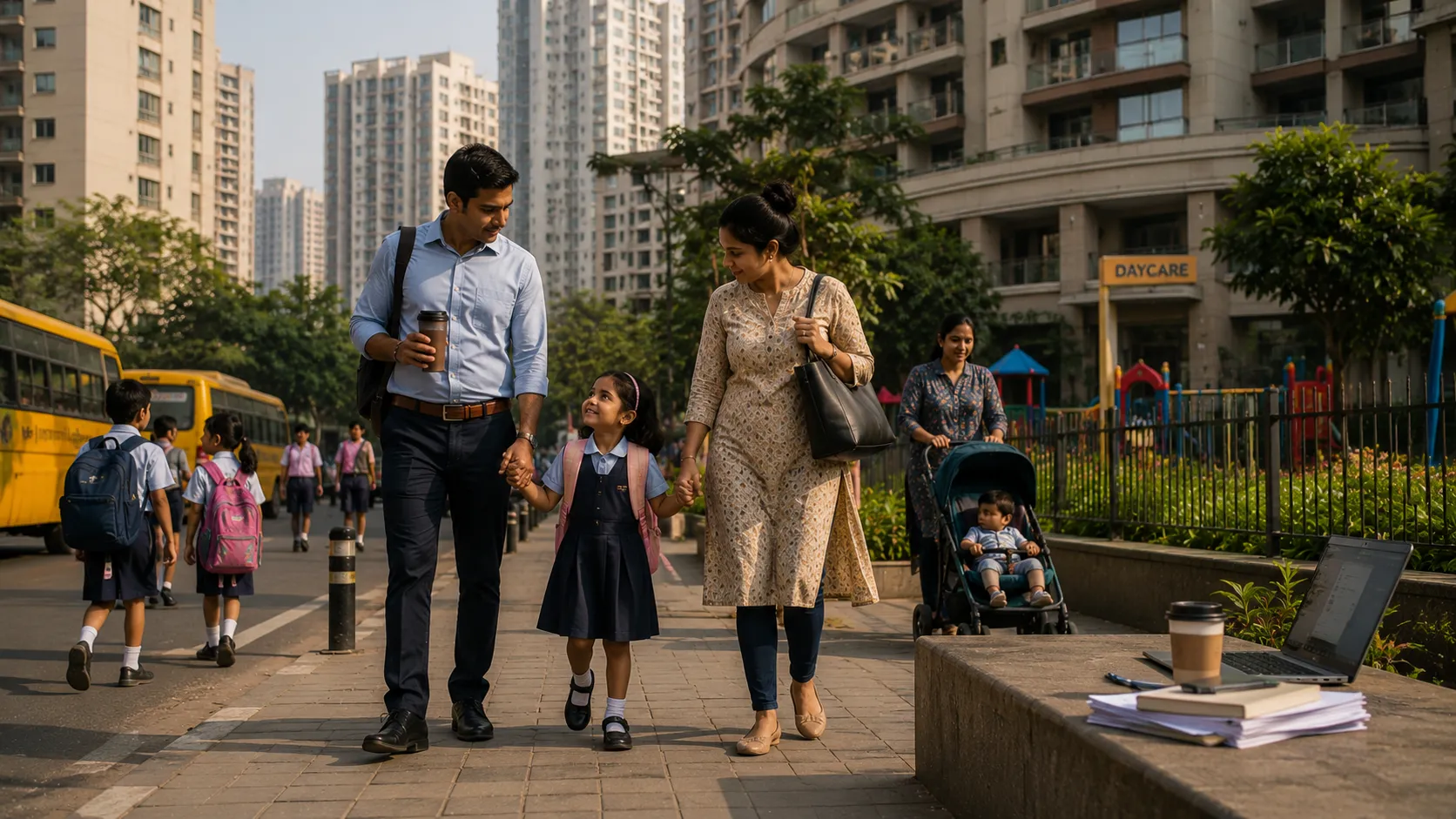
For a long time, conversations around raising children in India usually centered around numbers. Parents spoke about school fees, tuition expenses, healthcare bills and long-term savings plans. The challenge was often seen as financial planning: earn more, save carefully and prepare for future milestones. Raising a child was considered expensive, but the discussion largely remained within household budgets and practical calculations.
Today, that conversation appears to be changing in a much deeper way. Across urban India, parenting is increasingly becoming a story not just about affordability, but about expectations, lifestyle choices and the emotional realities of modern city life. In cities such as Mumbai, Bengaluru, Delhi, Hyderabad and Chennai, many families are beginning to feel that raising a child no longer involves simply meeting needs. It increasingly feels like navigating a complex system of aspirations, pressure and constant decision-making.
Part of the shift comes from how urban life itself has transformed over the last two decades. Cities have become faster, more competitive and significantly more expensive. Housing costs continue rising. Daily commutes consume larger parts of the day. Dual-income households increasingly became the norm rather than the exception. Families are often balancing careers, financial responsibilities and personal wellbeing simultaneously. Within this environment, parenting itself has gradually changed shape.
For many parents today, raising a child no longer feels limited to ensuring good schooling and a stable upbringing. Increasingly, it carries an expectation of creating opportunities at every stage. Families often feel pressure to provide not only education but also extracurricular classes, digital access, sports programs, specialized learning environments and experiences believed to improve future outcomes. Somewhere along the way, childhood itself appears to have become more structured and more performance-driven.
Recent estimates from financial planners frequently suggest that raising a child in urban India through education and early adulthood could require several crores depending on schooling choices, inflation and lifestyle patterns. Yet what many families increasingly describe is not shock around one large expense. Instead, it is the feeling of constant accumulation. School fees rise. Healthcare costs increase. Childcare support becomes necessary. Activity classes become routine. Housing choices increasingly revolve around school proximity and neighborhood infrastructure.
The pressure often arrives gradually rather than suddenly.
What makes this shift particularly important is that it increasingly appears to influence decisions long before children even enter the picture. Conversations among younger urban couples increasingly involve financial readiness, emotional preparedness and long-term sustainability. Questions around when to start a family, whether to have one child or more, and how to balance career growth with family life are becoming more common. In many cases, people are not simply delaying parenthood because of financial limitations alone. They are trying to understand whether they can realistically sustain the kind of parenting experience modern urban life appears to demand.
Social media may also be quietly intensifying these expectations. Parenting today unfolds within environments where milestones, school achievements, vacations and family experiences frequently become visible online. Earlier generations often compared themselves with immediate communities. Today's parents sometimes compare themselves with hundreds of lifestyles simultaneously, often without realizing it.
The pressure created by this visibility can be subtle but powerful.Parents increasingly encounter idealized versions of family life where childhood appears carefully designed and constantly optimized. While social platforms often create inspiration, they can also create expectations that feel difficult to meet. Over time, comparisons surrounding parenting itself may become another layer of emotional weight carried alongside financial responsibilities.
Another important difference involves support systems. Earlier generations frequently raised children within larger family structures where grandparents, relatives and extended communities often shared responsibilities. Urban life increasingly looks different. Nuclear families now dominate many cities, and migration for work frequently places parents away from traditional support networks.

As a result, tasks once handled informally increasingly require formal solutions. Childcare often depends on daycare centers, domestic assistance or paid support systems. Emotional support structures also appear different. Parenting can increasingly feel more individualized and, at times, more isolating.This shift is beginning to influence workplaces as well. Conversations involving flexible schedules, hybrid work environments and parental wellbeing increasingly reflect changing realities around family life. Employers are gradually recognizing that parenting challenges do not remain separate from work experiences. Questions around childcare, time availability and mental wellbeing increasingly affect professional environments too.
Perhaps that is why the larger story extends beyond financial numbers.
The cost of raising a child increasingly appears connected to how cities function, how families are structured and what societies expect parenting to look like. Housing systems, public spaces, school ecosystems and work cultures all increasingly influence family decisions in ways that go beyond economics.Because what initially appears to be a conversation about expenses may actually reflect something much larger.It may reflect how modern urban life itself is changing.
And perhaps the question many families are quietly asking today is no longer simply whether raising a child is becoming expensive.It is whether modern city life is becoming harder to build family life around.