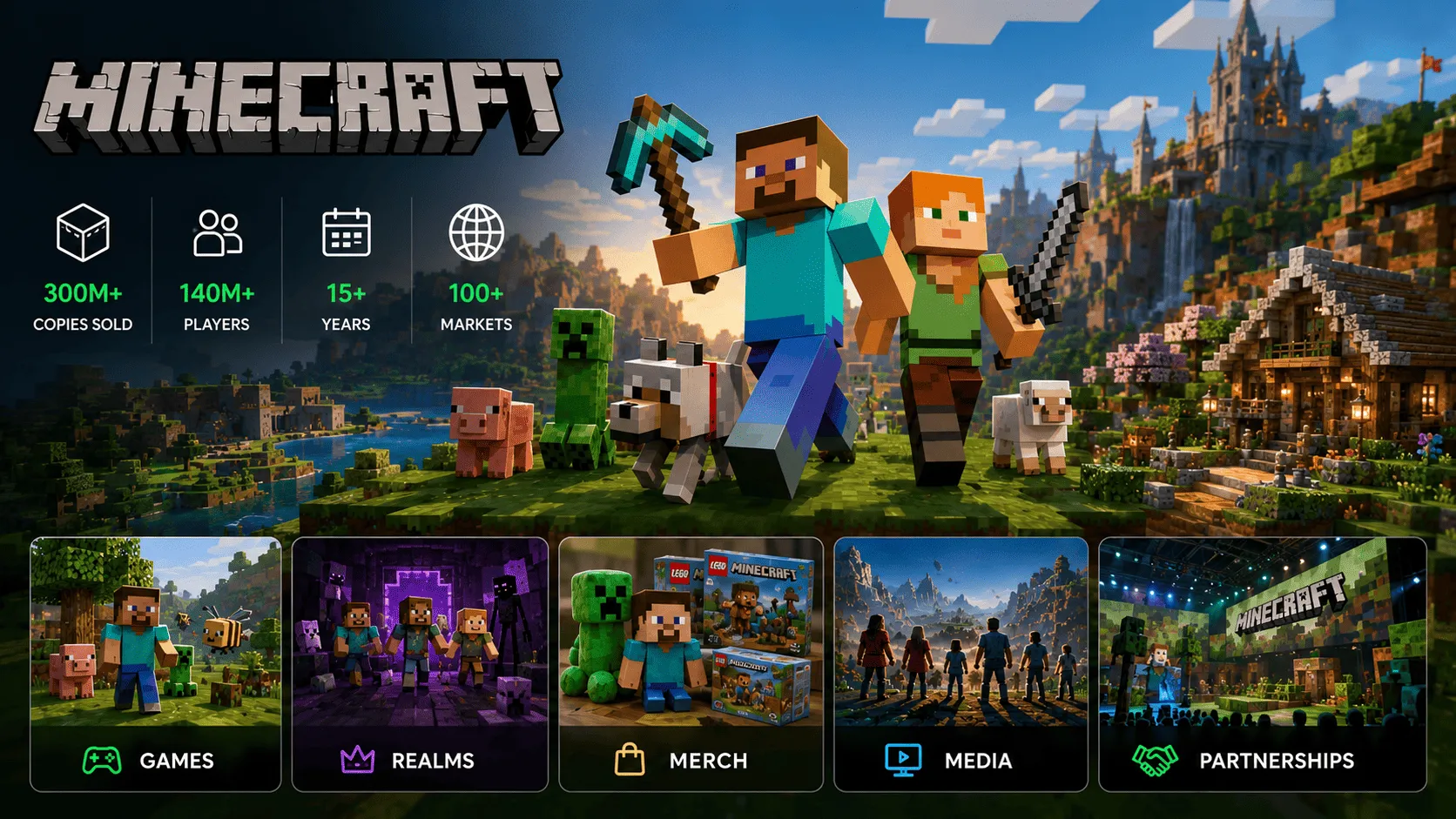
Most Games Fight To Stay Relevant For Five Years. Minecraft Has Spent Fifteen Years Quietly Building An Entertainment Empire Bigger Than Many Hollywood Franchises.
In an industry obsessed with the next big thing, Minecraft's success almost feels unnatural.
The video game business typically moves at extraordinary speed. Hardware generations change. New technologies emerge. Gaming trends rise and fall. Franchises that dominate one decade often struggle to maintain relevance in the next. Companies spend hundreds of millions of dollars producing blockbuster titles that may enjoy only a few years of commercial momentum before audiences move on. Yet while countless gaming giants have risen and fallen, Minecraft continues expanding.
That endurance alone would make it a remarkable business story.
What makes Minecraft even more fascinating is that its success defies many traditional rules of entertainment. It does not rely on photorealistic graphics. It lacks a fixed storyline. It does not feature celebrity actors or cinematic cutscenes. The game's visual style appears almost primitive compared to modern blockbusters. Yet despite all of this, Minecraft has become the best-selling video game in history, generated billions of dollars in revenue, attracted hundreds of millions of players and evolved into one of the most valuable intellectual-property ecosystems in modern entertainment.
Today, Minecraft exists far beyond gaming.
It influences education, publishing, toys, content creation, live events, streaming culture, merchandise, licensing and even Hollywood filmmaking. It has become one of the clearest examples of how modern entertainment companies create value not by selling products but by building worlds people want to inhabit.
The real story is not that Minecraft became popular.
The real story is how a simple game about placing blocks evolved into a business empire that many traditional media companies would envy.
Why Minecraft Never Behaved Like A Traditional Video Game
Most successful games begin with a clear objective.
Players complete missions, defeat enemies, advance through levels or follow a storyline designed by developers. The structure creates engagement because players always know what they are supposed to do next. Minecraft ignored almost all of these conventions.
When new players enter a Minecraft world, they are given remarkably little direction. There are no elaborate tutorials explaining every possibility. There is no central narrative guiding their journey. Instead, players find themselves inside a vast digital landscape where almost everything must be discovered through experimentation. For traditional game designers, this approach appeared risky because audiences often expect guidance. Minecraft succeeded precisely because it removed those constraints.
The game's open-ended nature transformed it from a product into a platform for imagination. Some players built castles. Others recreated entire cities. Many constructed functioning computers, theme parks, educational simulations and architectural projects of astonishing complexity. Every user effectively became both player and creator. This distinction proved enormously important because creators rarely consume entertainment in the same way ordinary audiences do. They become emotionally invested in what they build. Their creations generate stories, communities and reasons to return long after conventional games lose their appeal.
From a business perspective, this dramatically changed customer behavior.
Most entertainment products depreciate with use. Once audiences finish a movie or complete a game, their engagement naturally declines. Minecraft became more valuable the longer people played because each hour invested often resulted in new creations, stronger community ties and deeper emotional attachment to the platform. Few entertainment businesses achieve this dynamic.
The Accidental Genius Of User-Generated Content
Long before Silicon Valley became obsessed with creator economies, Minecraft was quietly building one.
The most successful technology platforms increasingly rely on users to create value for one another. Instagram depends on creators. YouTube depends on creators. TikTok depends on creators. Minecraft embraced this model years before many companies recognized its potential. Every server, modification, custom map and community project expanded the ecosystem without requiring direct investment from Mojang or Microsoft.
The scale of this contribution is difficult to overstate.
Thousands of independent creators have spent years producing content that continuously refreshes the Minecraft experience. New game modes emerge. Communities develop entirely different styles of play. Educational worlds appear. Competitive challenges evolve. The result is a constantly expanding universe of experiences built largely by the audience itself.
Traditional entertainment companies spend enormous sums producing new content.
Minecraft discovered a far more efficient approach. By providing creative tools and flexibility, it encouraged users to generate content voluntarily. This dramatically reduced one of the biggest challenges facing entertainment businesses: the constant need to create fresh experiences. The community effectively became an extension of the development process.
That relationship helped create a self-sustaining growth engine.
The more creators participated, the more attractive Minecraft became. The more attractive Minecraft became, the more creators joined. Over time, this network effect evolved into one of the platform's most powerful competitive advantages.
How YouTube Turned Minecraft Into A Cultural Phenomenon
No discussion of Minecraft's business success is complete without understanding the role of YouTube.
Many popular games attract viewers. Minecraft helped create an entirely new category of internet entertainment. During the 2010s, countless creators built careers around Minecraft videos. Tutorials, survival series, role-playing adventures and multiplayer challenges attracted audiences numbering in the millions. Entire generations of internet users encountered Minecraft through creators before they ever played the game themselves.
This fundamentally altered the economics of growth.
Traditional companies pay for customer acquisition through advertising campaigns. Minecraft often acquired users through content that audiences actively sought out. Every successful YouTuber became an unpaid ambassador introducing new players to the platform. Instead of interrupting consumers with marketing, Minecraft embedded itself within entertainment people genuinely enjoyed watching.
The effect extended beyond visibility.
Viewers developed emotional connections to Minecraft long before purchasing it. They understood its possibilities. They became familiar with its culture. They followed personalities whose careers were intertwined with the game. By the time many consumers eventually became players, they already felt part of the ecosystem.
This is one reason Minecraft's growth proved unusually durable.
The game was not merely attracting customers. It was building communities. Communities create loyalty that traditional advertising rarely achieves.
Why Microsoft's $2.5 Billion Acquisition Looks Cheap Today
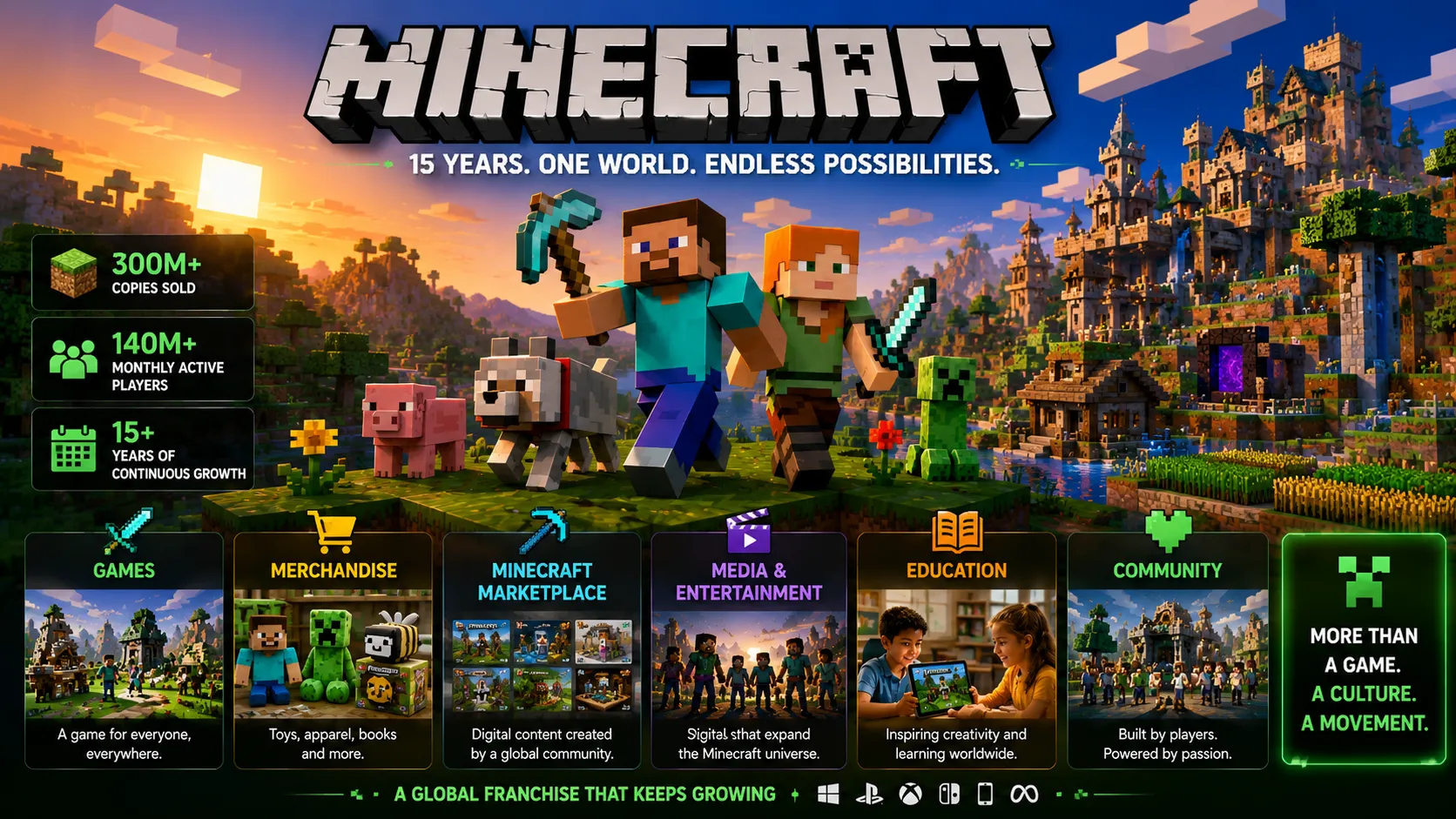
When Microsoft acquired Mojang in 2014 for $2.5 billion, reactions were mixed.
At the time, many observers struggled to justify the valuation. Minecraft was undeniably popular, but gaming trends often change rapidly. Spending billions on a single title seemed risky. Yet Microsoft's decision increasingly appears visionary because the company recognized something many analysts underestimated.
Minecraft was never just a game.
It was a digital world with enormous intellectual-property potential. Microsoft understood that the value of the franchise extended beyond software sales. Merchandise, education, licensing, entertainment and future media opportunities all represented potential growth engines. The acquisition was effectively a bet that Minecraft could become a long-term platform rather than a temporary phenomenon.
That bet has paid off repeatedly.
Years after the acquisition, Minecraft continues generating revenue through multiple channels while maintaining cultural relevance across generations. Few gaming acquisitions have delivered comparable longevity.
The lesson is important because it reflects a broader shift in how technology companies evaluate assets.
The most valuable platforms are often those capable of supporting ecosystems rather than individual products. Minecraft fit that description perfectly.
The Education Business Nobody Expected
One of the most surprising chapters in Minecraft's evolution involves classrooms.
Most entertainment franchises struggle to extend beyond their original purpose. Minecraft succeeded because its flexibility made it useful in entirely different contexts. Educators discovered that the game could help teach coding, mathematics, engineering, collaboration and creative problem-solving. Instead of fighting this trend, Microsoft embraced it through Minecraft Education.
The initiative transformed the franchise's relationship with institutions.
Schools that might never have considered integrating video games into learning environments suddenly found practical applications for the platform. Students became more engaged. Teachers gained new tools for instruction. Minecraft expanded into a market far removed from traditional gaming.
This diversification created significant strategic value.Entertainment trends change. Educational adoption tends to be more stable. By serving both markets simultaneously, Minecraft reduced its dependence on any single audience segment. The franchise became relevant not only to players but also to educators, parents and institutions.Very few gaming properties have achieved this level of versatility.
The Rise Of Minecraft As Intellectual Property
The modern entertainment industry increasingly revolves around intellectual property.
Disney's success is built on characters and worlds. Marvel transformed comic books into a cinematic empire. Harry Potter evolved from novels into a global licensing machine. Increasingly, the most valuable assets are not individual products but universes capable of generating revenue across multiple formats.
Minecraft belongs in that conversation.
Its visual identity is instantly recognizable. Its brand carries global awareness. Its audience spans generations and geographies. These characteristics make it exceptionally valuable for licensing, merchandise and adaptation opportunities. Toys, books, apparel and collectibles have become significant parts of the broader business ecosystem.
The upcoming Minecraft film represents a logical extension of this strategy.Hollywood's interest reflects recognition that Minecraft is no longer simply a gaming property. It is a cultural brand capable of attracting audiences across multiple forms of media. Success in film would further strengthen its position as a global entertainment franchise rather than a gaming product.This evolution mirrors the trajectory followed by some of the world's largest media brands.The destination increasingly resembles Disney more than a traditional game publisher.
The Future Of Entertainment Looks More Like Minecraft
Perhaps the most important lesson from Minecraft's success is what it reveals about entertainment itself.
For much of the twentieth century, audiences consumed content created by professionals. Movies were made by studios. Television shows were produced by networks. Games were developed by publishers. Consumers remained largely passive participants.
The internet changed that model.
Modern audiences increasingly want to create, modify, share and participate. They do not simply consume worlds. They contribute to them. Minecraft understood this dynamic before most entertainment companies recognized its significance. By empowering users rather than controlling every aspect of the experience, it created a franchise capable of evolving organically with its audience.
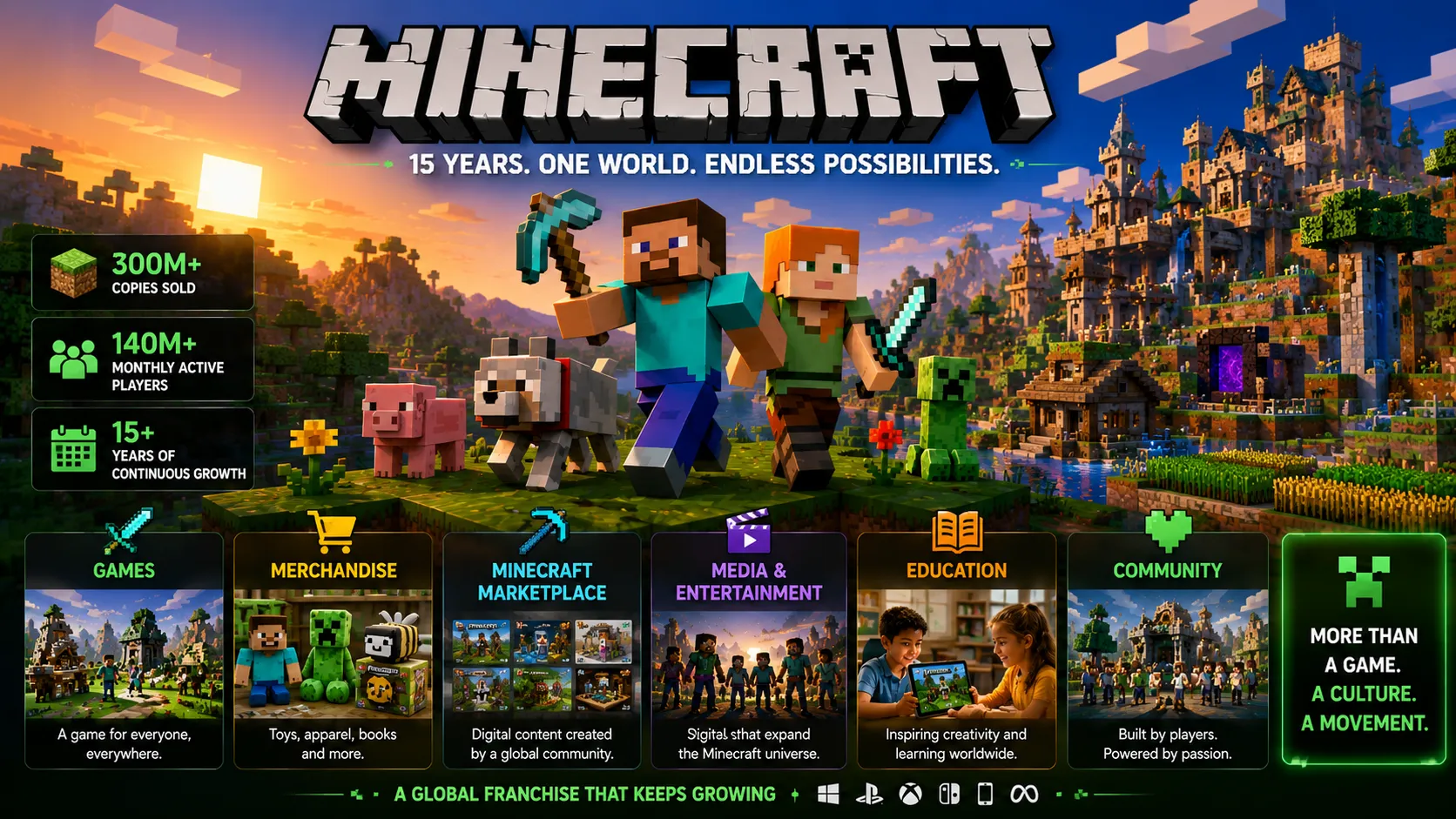
That flexibility explains why the game continues thriving fifteen years after launch.It is not locked into a single story, format or trend. The platform adapts because its community adapts. New generations continue discovering it. New creators continue expanding it. New opportunities continue emerging around it.Many companies spend decades trying to build lasting franchises.Minecraft accomplished something rarer.It built a world that millions of people continue helping create.And in an era where attention is increasingly difficult to hold, that may be the most valuable business model of all.