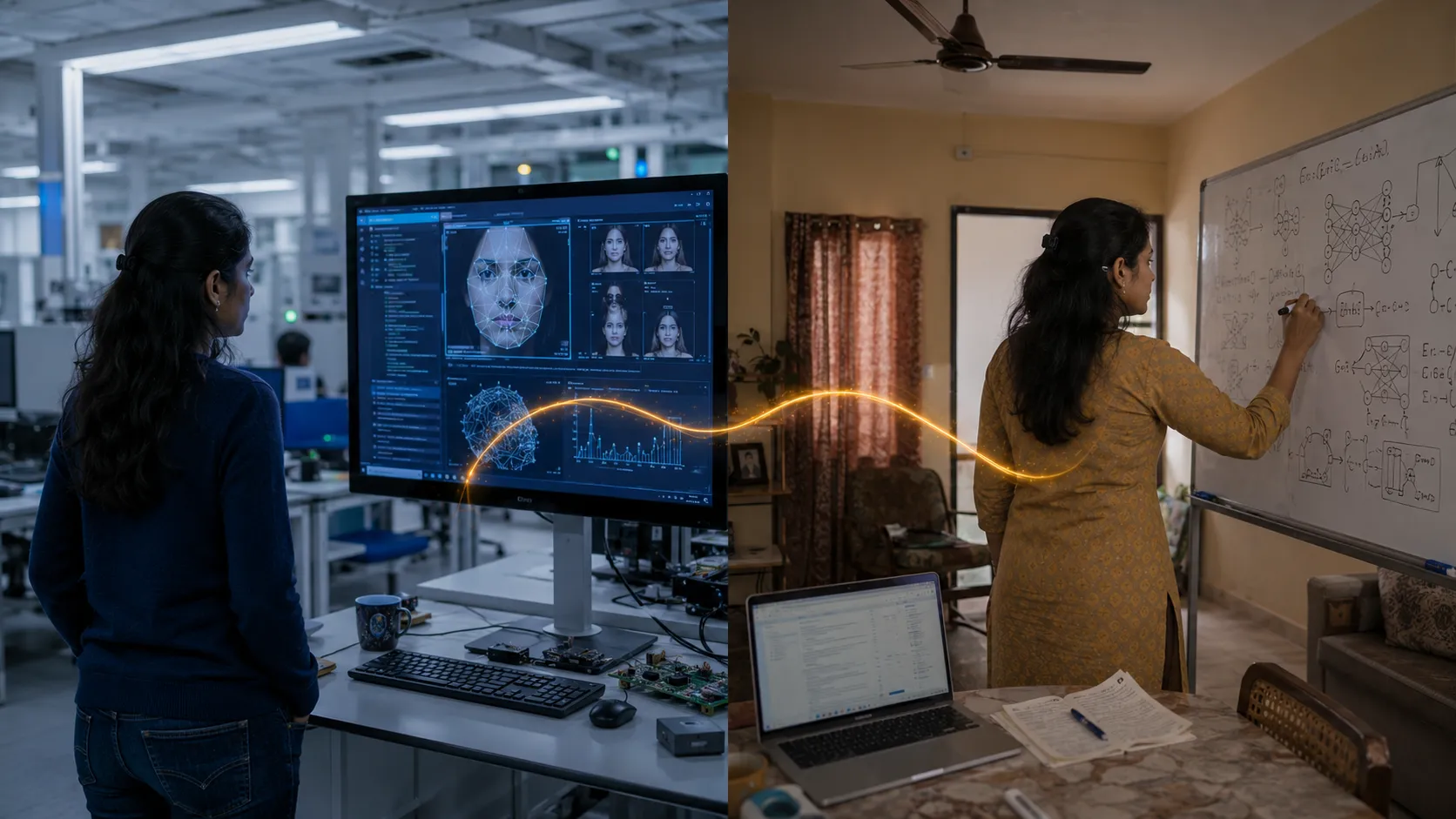
The Artist Who Taught Machines to See: How Ashwini Asokan Left Silicon Valley, Built a Global AI Company from a Chennai Apartment, and Refused to Be the Only Woman in the Room
CHENNAI — May 25, 2026 — In 2012, Ashwini Asokan was living the life she had been trained for. She had a master's degree in interaction design from Carnegie Mellon, one of the world's most selective programmes. She had a research position at Intel Labs in Silicon Valley, where she worked on the frontiers of computer vision—teaching machines to recognise objects, faces, and gestures. She was good at it. She was well-paid. She was, by any conventional measure, on exactly the right trajectory for someone with her credentials and her ambition.
Then she came home to Chennai for her grandmother's funeral. Standing in the heat of a south Indian cremation ground, surrounded by relatives who had lived their entire lives in the same city, she was seized by a question that would not let her go. Why was she building the future for someone else, in someone else's country, while the country she came from was being left out of the AI revolution entirely? "I had this moment," she told a conference years later. "I was working on the most advanced technology in the world, but I couldn't look at my own family and say, 'I built this for you.' I was building it for someone else."
She quit Intel. She and her husband, Anand Chandrasekaran—a neuroscientist who had been studying visual perception at Stanford—moved back to Chennai. They set up a small apartment with a whiteboard, two laptops, and a conviction that the next great AI company could be built from India. In 2013, they founded Mad Street Den, a computer vision and artificial intelligence company that would go on to raise $57 million from Sequoia Capital, Falcon Edge, and a roster of global investors, build a platform called Vue.ai that powers visual AI for some of the world's largest retailers, and become one of the few Indian deep-tech startups to compete credibly on the global stage. The company now serves clients across the United States, Europe, the Middle East, and Asia, and Asokan has become one of the most visible advocates for women in artificial intelligence—a field that is, by almost every measure, the most male-dominated sector in the technology industry.
The Artist Who Found Machines
Ashwini Asokan was not supposed to be an AI researcher. She was an artist.
She grew up in Chennai in a family of academics and civil servants, the kind of household where education was valued but creativity was encouraged. She studied design at the National Institute of Design in Ahmedabad, one of India's premier creative institutions, and then worked as a designer in Mumbai, building products for a digital agency. She was good at it. She could have spent her career designing websites, apps, and brand experiences—the kind of work that is valuable, well-compensated, and entirely removed from the world of artificial intelligence.
But somewhere in the years of designing interfaces for human users, she became fascinated by a deeper question: what happens when the user is not human? What happens when the interface is for a machine that needs to learn, to see, to understand? The question led her to Carnegie Mellon, where she studied interaction design with a focus on human-computer interaction, and then to Intel Labs, where she worked on one of the most advanced computer-vision research teams in the world. The artist had found the machines. The machines, as it turned out, needed her.
At Intel, Asokan worked on projects that were at the frontier of what AI could do: teaching cameras to recognise faces, teaching computers to understand gestures, building the foundational technologies that would later power everything from smartphone authentication to autonomous vehicles. She was one of the few women on her team, one of the few designers in a world dominated by engineers, and one of the few people who understood that the hardest problems in AI were not technical. They were human. A machine that could recognise a face was impressive. A machine that could understand why the face looked the way it did—the cultural context, the emotional state, the social meaning of the expression—was something else entirely. The gap between recognition and understanding was where Asokan believed the next generation of AI would be built.
The Intel job was prestigious. The Silicon Valley life was comfortable. The Indian grandmother's funeral, in 2012, shattered the comfort. "I had been away for years," she told a gathering of women entrepreneurs. "I came back, and I looked at my family, and I thought: what am I doing? All this knowledge, all this expertise, and it's not touching the lives of anyone I actually love." The question did not have an easy answer. So she left the job, convinced her husband to leave his postdoc at Stanford, and moved back to Chennai with no funding, no institutional backing, and no guarantee that the AI revolution she had been part of in Silicon Valley could be replicated from a two-bedroom apartment in Tamil Nadu.
The Garage That Wasn't
The founding story of Mad Street Den does not have a garage. It has a Chennai apartment with a whiteboard, two laptops, and the relentless, oppressive heat of a Tamil Nadu summer. Asokan and Chandrasekaran worked through power cuts, internet outages, and the profound isolation of building a deep-tech company in a city that, in 2013, had no deep-tech ecosystem to speak of. The venture capitalists they approached were sceptical—not of their credentials, but of their geography. Could a world-class AI company really be built from Chennai? Could Indian engineers, working on Indian salaries, produce algorithms that competed with the best labs in Silicon Valley? The questions were reasonable. Asokan's answer was to build something that answered them.
The company's first product was not a retail platform. It was a computer-vision system for a completely different industry: gaming. The founders built a technology that could recognise facial expressions and translate them into game commands—a player could smile to make a character jump, or frown to make it duck. The product was technically impressive. It was also a commercial failure. The gaming industry was not ready for facial-recognition interfaces, and the company burned through its early capital trying to sell a product that had no market.
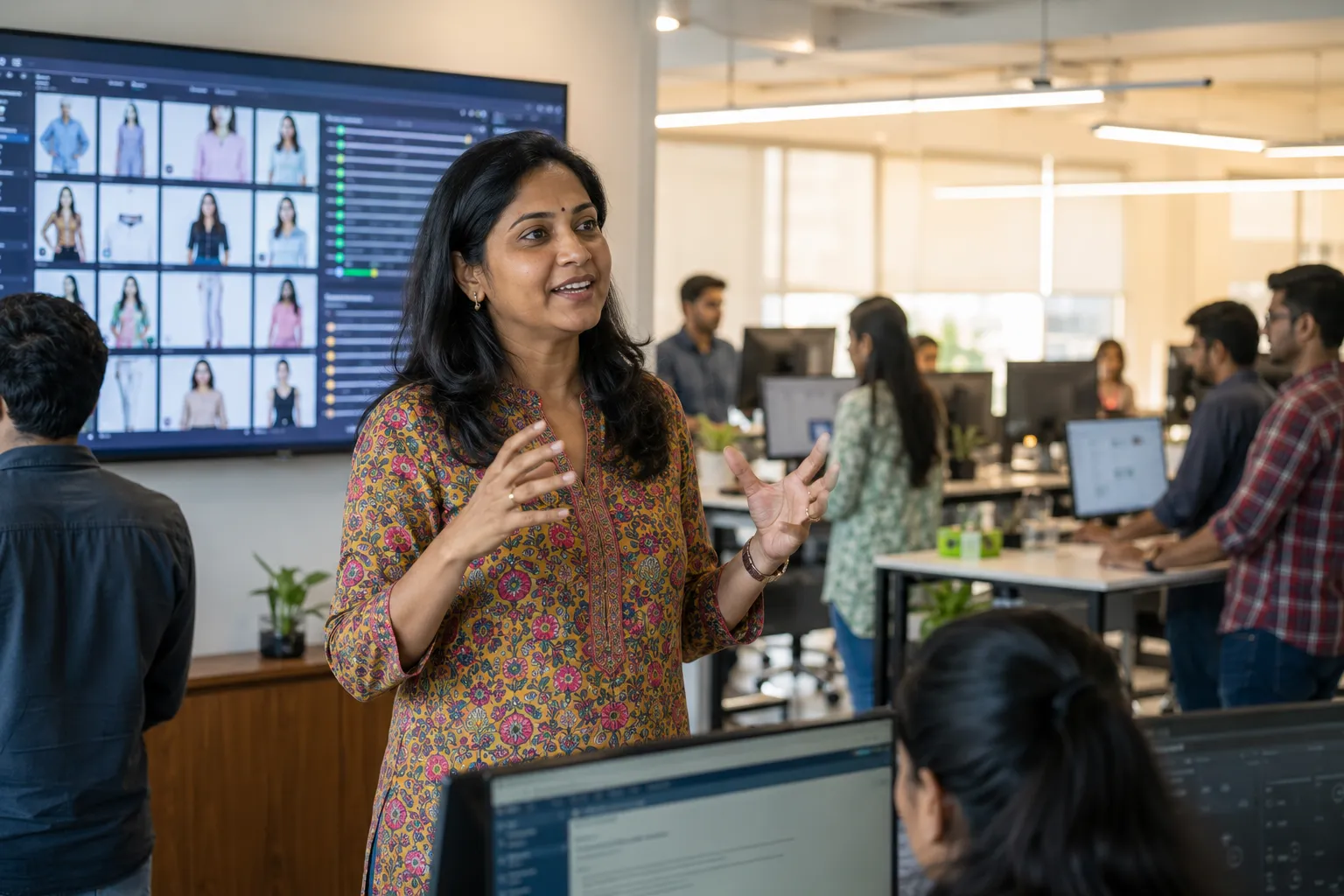
The pivot that saved the company came from a conversation with a fashion retailer. Asokan realised that the same computer-vision technology that could recognise facial expressions could also recognise clothing—the cut of a dress, the pattern of a shirt, the shape of a collar. The global fashion industry was drowning in visual content—millions of product images that needed to be tagged, categorised, and styled—and doing it all by hand, with armies of human workers. A machine that could automate that process, that could understand not just what an item was but what it looked like, how it could be styled, and whom it would appeal to, would save the industry billions of dollars. Vue.ai was born from that insight. The product now powers visual AI for retailers across the world, and Mad Street Den has become one of the few Indian startups to sell enterprise AI software to global brands.
The journey from the gaming pivot to the retail breakthrough was not smooth. The company faced years of near-death experiences, fundraising rejections, and the constant pressure of building a deep-tech product in a market that preferred consumer apps. Asokan has spoken candidly about the isolation of those years—the loneliness of being a woman CEO in a male-dominated industry, the exhaustion of pitching to investors who did not understand the technology, and the quiet, persistent fear that the company would not survive. "There were many times when I thought we wouldn't make it," she told an interviewer. "But I kept thinking about why I came back. I didn't come back to fail."
The Woman in the Room
The most powerful dimension of Asokan's story is not the technology or the funding. It is the structural context in which she has built her company—and the quiet, persistent barrier that she has spent her career naming and fighting.
Artificial intelligence is, by almost every measure, the most male-dominated sector in the technology industry. The researchers who publish the most-cited papers are men. The engineers who build the most widely used models are men. The venture capitalists who fund the AI startups are men. The conference keynotes, the boardrooms, the op-ed pages, and the award ceremonies are dominated by men. The industry does not explicitly exclude women. It simply reflects a set of structural biases—in hiring, in funding, in the design of the technology itself—that produce the same result as active exclusion.
Asokan has been explicit about these biases from the beginning. She has spoken publicly about being the only woman in investor meetings, the only woman on panels, the only woman in the room when critical decisions were being made. She has described the exhaustion of constantly having to prove her technical competence—a burden that her male peers do not carry. She has pointed out, repeatedly, that AI systems trained on biased data will produce biased outcomes, and that the absence of women from the teams building those systems is not a diversity problem but a product-safety problem. A facial-recognition system built entirely by men is more likely to fail on female faces. A hiring algorithm trained on historical data from male-dominated industries will discriminate against women. The bias in the technology is a reflection of the bias in the teams that build it.
Her response has been to build a company that looks different. Mad Street Den's workforce is more than 40 percent women—a statistic that is virtually unheard of in the deep-tech sector. The company's leadership team is gender-balanced. Its hiring practices are designed to counteract the unconscious biases that filter women out of the technical talent pipeline. The company is not perfect—no company is—but it represents a deliberate, sustained effort to build an AI company that does not replicate the structural exclusion of the industry it inhabits.
"I didn't want to be the only woman in the room anymore," Asokan told a conference. "And I realised that the only way to change that was to build the room myself." The statement captures the central thesis of her career. She did not wait for the industry to become more inclusive. She built an inclusive company and competed with the industry on its own terms—and won.
The Global Ambition
The most significant strategic decision Asokan has made in recent years is not a product feature or a funding round. It is a market focus. Mad Street Den has always been a global company—its clients are in the United States, Europe, and the Middle East—but Asokan has been deliberate about resisting the pressure to relocate the company's headquarters to Silicon Valley. The company is based in Chennai. Its engineering team is in India. Its leadership is in India. The decision is not about cost—though the cost advantage is real—but about identity. Asokan believes that the next generation of global technology companies will be built from the places that the previous generation ignored, and that the AI revolution should not be concentrated in a single geography any more than it should be concentrated in a single gender.
The company's technology stack reflects that philosophy. Vue.ai is built to work across languages, cultures, and aesthetic traditions—not just the Western fashion norms that dominate the training data of most visual AI systems. A sari is not a dress. A kurta is not a shirt. A bindi is not a beauty mark. A machine that can only understand Western clothing is a machine that will fail on the majority of the world's consumers. Asokan's team has trained their models to understand the visual language of multiple cultures, and that cultural fluency is a competitive advantage that no Silicon Valley startup can easily replicate.
The global expansion continues. Mad Street Den has opened offices in the United States and the United Kingdom, hired sales teams in multiple geographies, and built partnerships with some of the largest retailers in the world. The company has not disclosed its current revenue, but it has been clear that its ambitions extend well beyond the retail vertical. The underlying computer-vision platform can be applied to healthcare, agriculture, manufacturing, and defence—industries that are only beginning to understand what visual AI can do. The market for computer vision is projected to exceed $80 billion by 2030, and the companies that have built the foundational platforms will capture a disproportionate share of the value.
The funding history tells the story of a company that has survived the cycles of the venture-capital market through a combination of technical excellence and strategic patience. Mad Street Den has raised $57 million to date, from investors including Sequoia Capital, Falcon Edge, and a roster of global venture firms. The most recent round was a Series C in 2019, and the company has been deliberate about not over-raising—a discipline that has become a competitive advantage in the post-ZIRP era, when venture-backed startups that raised too much at too high a valuation are being forced into down rounds, fire sales, and closures. Asokan has said that the company is on a path to profitability and that it will raise more capital when the time is right—not because it needs the money, but because the market opportunity justifies the investment.
What This Signals
The Ashwini Asokan story is not primarily about a computer-vision startup. It is about the structural exclusion of women from the artificial intelligence industry—and about what happens when a woman refuses to accept that exclusion.
For decades, the AI industry has been defined by a set of assumptions that are so deeply embedded as to be invisible. AI is for men. Deep tech is for men. The labs where the foundational research is done, the venture firms that fund the startups, and the boardrooms where the strategic decisions are made are, overwhelmingly, male. The industry does not explicitly exclude women. It simply does not imagine them—and the absence of imagination produces the same result as active hostility.
Asokan's career is a rebuttal to that absence of imagination. She did not set out to be a symbol. She set out to build a computer-vision company. But in the process of building a computer-vision company—leaving Silicon Valley, returning to India, surviving the years of isolation and rejection, building a global enterprise from Chennai, and constructing a workplace that reflected her values rather than the industry's biases—she became a symbol anyway. The artist who found the machines, the woman who refused to be the only woman in the room, and the founder who built an AI company that competes globally without relocating to the valley—all of it adds up to a demonstration that the assumptions that excluded her were wrong.
Ashwini Asokan is no longer the woman at the cremation ground, wondering why her work did not touch the people she loved. She is the CEO of a global AI company, one of the most visible advocates for women in artificial intelligence, and the builder of a workplace that looks like the world she wanted to live in. The machines she taught to see are now used by millions of consumers across the globe. The room she built is full of women who, like her, were told that they did not belong. The cremation ground is still there, in Chennai, where her grandmother's ashes were scattered. But the question she asked there has been answered. She is building the future for her own people, in her own country, on her own terms. The machines are learning. The room is expanding. The work continues.


