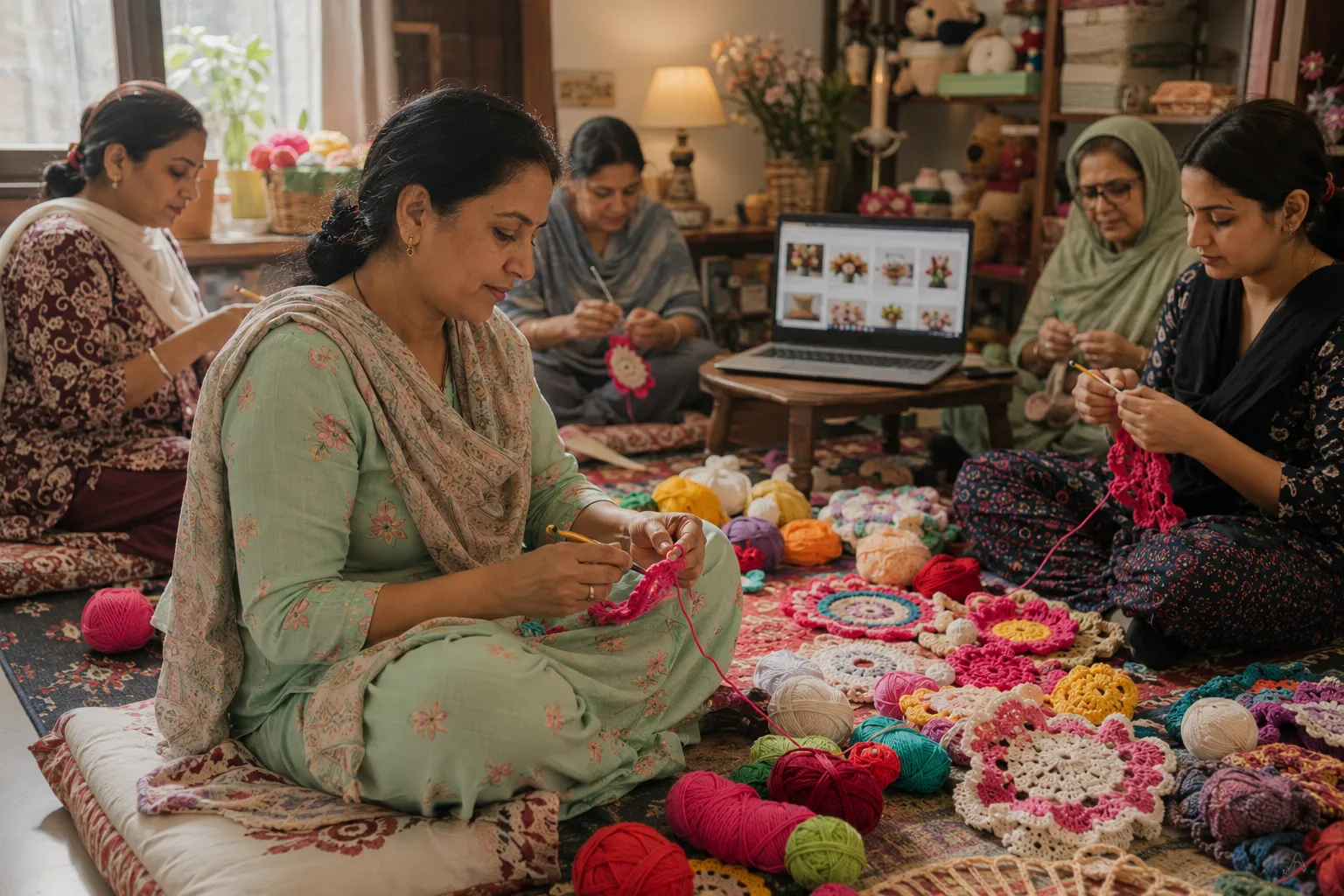
The 20-Year-Old, the ₹1,000 Startup, and the 300 Women: How a Ludhiana Girl Turned Her Grandmother's Crochet Hooks Into a ₹12 Crore Empire
LUDHIANA — May 22, 2026 — Vanshika Mittal was 18 years old when she launched her first business. It failed. She had tried selling paintings—art she had made herself, poured hours into, believed in. Nobody bought them. The rejection was total and, in retrospect, the most valuable thing that ever happened to her. It taught her, at an age when most of her peers were filling out college applications, that the market does not care how hard you worked. It cares whether you made something people want.
She went back to her grandmother's living room. For as long as she could remember, her grandmother had been there, crocheting—turning balls of yarn into intricate flowers, delicate doilies, baby blankets—with the unhurried precision of someone who had been doing it for decades and expected nothing in return. Vanshika had watched her do it a thousand times. This time, she watched with different eyes. "I always wanted to become a businesswoman," she recalled later. "Though I started with selling paintings, but that didn't work out. Then one day, I saw my grandmother crocheting and felt drawn to it."
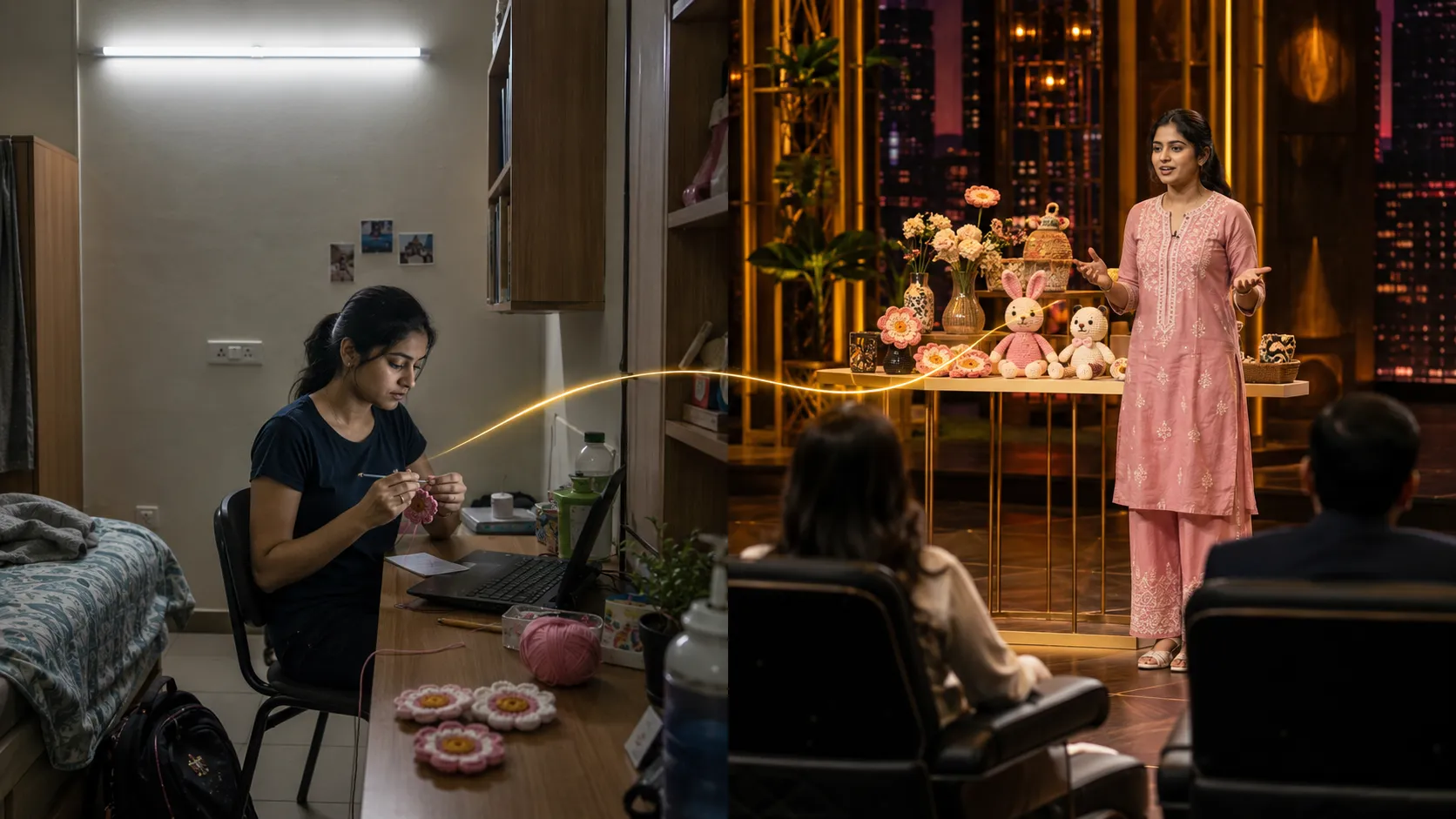
Her first product was a crocheted flower bouquet, made for a friend. Her friends loved it. She made more. She began selling handmade crochet flowers while she was still in college, studying for exams and shipping orders from her dorm room. The initial investment was ₹1,000—roughly $12—enough to buy some yarn, a few hooks, and a belief that was either naive or visionary, depending on whom you asked.
Two years later, Vanshika Mittal is 20 years old. Her company, Floreal, is valued at nearly ₹12 crore. It generates an annual turnover of ₹6 crore. Its products are sold nationwide and available on quick-commerce platforms like Blinkit. Its social media following runs into the millions. And when she walked onto the stage of Shark Tank India in March 2026, the sharks did not see a college student with a hobby. They saw a business—and they invested.
The Shark Tank Moment
The Shark Tank India episode, aired on March 17, 2026, was the inflection point. Before the show, Floreal was a promising but small crochet business, growing steadily through word-of-mouth and social media. After the show, it was a brand.
The sharks were impressed not just by the numbers—₹6 crore in annual turnover from a standing start of ₹1,000—but by the vision. Vanshika did not pitch a hobby business. She pitched a supply chain that could turn crochet, a craft that most of the fashion industry had dismissed as a grandmother's pastime, into a scalable, design-forward consumer brand. The sharks invested. The Rs 12 crore valuation was established. The strategic insights—on manufacturing, on distribution, on brand building—began flowing from investors who had built some of India's largest consumer companies.
"For Vanshika and her family, it was a 'the' moment of reckoning," ETV Bharat reported. The phrase captures something essential about the Shark Tank experience for young founders from non-metro India. It is not just about the money. It is about the validation—the confirmation, from people who have built empires, that what you are building is real. For a 20-year-old from Ludhiana who had been told, implicitly and explicitly, that her crochet business was a nice hobby but not a serious enterprise, that validation was priceless.
The 300 Women
The most important number in the Floreal story is not the ₹12 crore valuation. It is the 300.
Vanshika's business engages around 300 women, most of whom work from their homes, crocheting products that are then sold through Floreal's website and marketplace channels. Another 30 women work at the company's small factory, primarily handling packaging and logistics. The model is deliberately decentralised. The women who crochet do not need to commute. They do not need to leave their families. They do not need to navigate the formal economy with its documentation requirements, its fixed hours, and its often hostile treatment of women who have never held formal jobs.
"Many of these women were previously restricted to homes due to social or personal constraints," Vanshika said. "Now, within the confines of the home, they are working and financially contributing to the family needs. I feel it is my biggest achievement. Over one lakh customers are happy with our products and hundreds of women are earning because of this work. What more can I ask for?"
The statement is not marketing. It is the core operating thesis of the business. Floreal's supply chain is built on a network of home-based women workers who are paid per piece, who can work at their own pace, and who earn incomes that, while modest by urban professional standards, are meaningful in the context of Ludhiana's household economy. The company handles the design, the quality control, the marketing, and the distribution. The women handle the production. The arrangement is not charity. It is a commercial proposition that happens to have powerful social externalities.
The model also solves a structural problem that has bedeviled Indian manufacturing for decades: the underutilisation of female labor. India's female labour force participation rate is among the lowest in the world—hovering around 25 to 30 percent—and a significant portion of the gap is explained not by women's lack of desire to work, but by the absence of work that accommodates their constraints. Home-based piecework, for all its historical association with exploitation, can also be a bridge into the formal economy. Floreal's version of it—digitally connected, fairly priced, design-forward—is a model that other consumer brands, in other categories, could replicate.
What This Signals
The Vanshika Mittal story is not primarily about crochet. It is about the collapsing barriers to entrepreneurship for young Indian women—and about the new models of work that are emerging from that collapse.
Vanshika is part of a generation of Indian women who are building businesses earlier, with less capital, and in more unconventional categories than any generation before them. The internet has given them access to customers, to suppliers, to marketing channels, and to role models that their mothers never had. Social media has given them a platform to build brands without advertising budgets. Quick-commerce platforms have given them distribution channels that reach millions of consumers. The Shark Tanks of the world have given them access to capital and mentorship that was once concentrated in a handful of elite networks.
But the deeper significance of the story is about work. The 300 women who crochet for Floreal are not employees in the traditional sense. They are micro-entrepreneurs, earning income on their own terms, from their own homes, using skills that many of them learned as children. The model is not perfect—home-based piecework has a long and troubled history—but it is a significant improvement over the alternatives available to these women, which in many cases was no paid work at all.
Vanshika Mittal is 20 years old. She started with ₹1,000. She built a business valued at ₹12 crore. She employs 300 women. The crochet hooks are still moving. The orders are still coming in. The grandmother who taught her how to crochet is still there, in the living room, watching her granddaughter build an empire from the craft she passed down. The ₹1,000 is gone, invested in yarn and hooks and a belief that has been vindicated. The business is still growing. The next chapter is being crocheted, one stitch at a time.


