
The Factory Building Apple's Indian Dream Has a Water Problem Nobody Announced
India is on track to manufacture 26 per cent of all iPhones globally in 2026 — up from just 6 per cent four years ago, according to Counterpoint Research. That shift represents one of the most significant supply chain relocations in the history of consumer electronics, driven by Apple's determination to reduce its dependence on China, India's government incentives for electronics manufacturing, and the specific ambitions of Tata Electronics, which has emerged as the dominant Indian player in Apple's production network.
At the centre of that ambition is a factory in Hosur, a manufacturing hub in southern Tamil Nadu approximately 40 kilometres south of Bengaluru. The plant makes back panels and other components for iPhones. It employs thousands of workers, mostly women. It is a flagship of India's Make in India electronics manufacturing push.
And on May 25, 2026, the Tamil Nadu Pollution Control Board sent it a formal warning notice.
The notice, three pages long and first reported by Reuters on June 13, 2026 based on a previously unreported regulatory document, tells a specific and troubling story: that wastewater from the Tata facility has allegedly been contaminating groundwater in open wells on adjacent agricultural land since at least late 2025, that farmland owners had been complaining about this for months, that state authorities had conducted five separate inspections between December 2025 and May 2026, that those inspections found evidence supporting the farmers' complaints — and that Tata had not taken any corrective action on the instructions issued by the pollution board in a prior letter dated December 23, 2025.
In other words: the pollution board told Tata about the problem in December. By May, five more inspections later, Tata had not fixed it.
What the Inspections Found
The specific mechanism described in the pollution board's warning notice is important to understand.
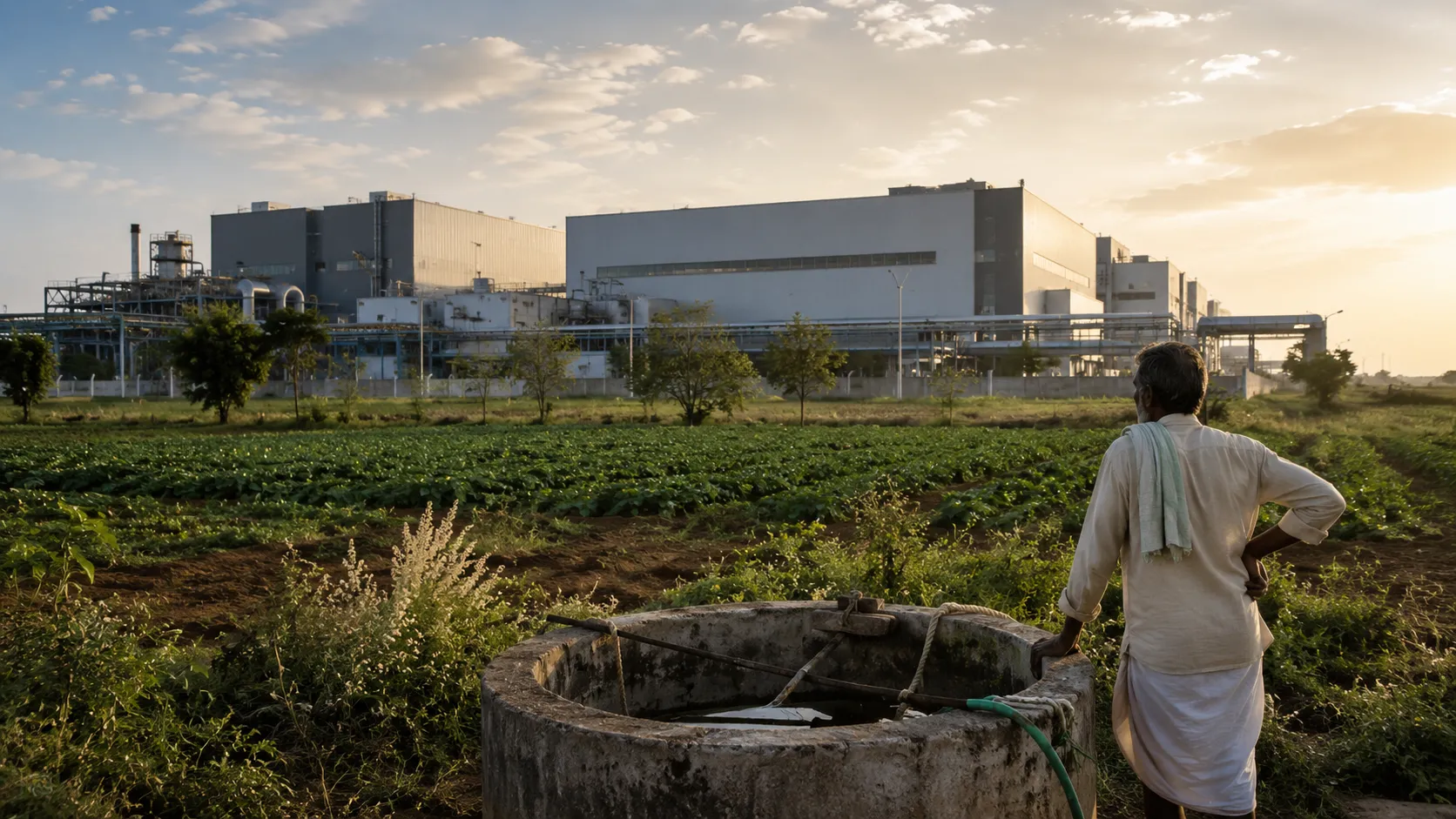
The inspections found that Tata discharged wastewater into a rainwater harvesting pond inside its facility. That pond overflowed, and the overflow allegedly contaminated groundwater in open wells located in the agricultural lands immediately adjacent to the plant — the land owned and farmed by the residents who had been complaining to the Tamil Nadu Pollution Control Board for months.
The board's language in its warning notice to Tata was precise: the discharge had contaminated "groundwater in the open wells located in the adjacent agricultural lands." This is not a disputed allegation from the farmers alone. It is the conclusion of five state inspections conducted by the regulatory body responsible for environmental enforcement in Tamil Nadu.
The consequence Tata now faces is significant. The southern Tamil Nadu state's pollution body has warned Tata of a forced shutdown unless it explains why its inspections found what they found, and why no corrective action was taken after the December 2025 letter.
Following Reuters' publication of the story, Indian officials stepped up government checks on the farmland surrounding the plant. Field investigations were launched on June 15. The situation has moved from an internal regulatory matter to a public accountability one with international visibility.
Reuters reported that it sought comment from Tata Electronics and Apple. As of the time of the Reuters report's publication, neither company had publicly responded to the specific allegations in the pollution board's notice.
The Pattern Behind the Single Incident
The Hosur pollution notice does not arrive in isolation. It is the latest entry in a pattern of supply chain compliance issues that has repeatedly raised questions about the conditions under which India's iPhone manufacturing ambition is being realised.
In September 2024, a fire at Tata's Hosur plant halted iPhone component production briefly. The cause was investigated by Indian authorities. The incident added to the operational risk profile of a facility that had been positioning itself as a reliable alternative to established Taiwanese manufacturers.
Before that, in September 2023, a fire at the Pegatron iPhone assembly plant in India shut production for several days. Pegatron has since transferred its India operations to Tata — which acquired the facility in January 2025, making Tata the operator of three iPhone production sites in India.
And in 2024, a Reuters investigation revealed that major Apple supplier Foxconn had been systematically excluding married women from iPhone assembly jobs at one of its plants in India — a discriminatory practice that violated Indian labour law and contradicted Apple's own supplier code of conduct. Foxconn stated at the time that it complied with all laws.
Each of these incidents is, taken individually, a specific compliance failure at a specific facility. Taken together, they form a picture of an India iPhone supply chain that is expanding rapidly — from 6 per cent to 26 per cent of global production in four years — at a pace that has, in multiple documented instances, outrun the compliance, oversight, and worker protection infrastructure required to sustain it responsibly.
This is not a new problem in manufacturing history. Supply chains that scale faster than their governance infrastructure is a pattern that has recurred across every major manufacturing hub that has ever absorbed large volumes of industrial production in a compressed timeline. What is distinctive about India's situation is that it is happening under intense international scrutiny — from Apple's own supply chain audits, from international human rights and environmental organisations, and now from Reuters' ongoing investigations — in a way that previous manufacturing booms in other countries often did not face.
What Is at Stake — for Tata, for Apple, and for India's Manufacturing Ambition
The Hosur pollution notice is, on one level, a regulatory compliance matter between a Tamil Nadu state body and a Tata subsidiary. On another level, it is a test case for something considerably larger.
India's ambition to become a significant global manufacturing hub for premium electronics depends, over the long term, on demonstrating that production can occur here at international quality and compliance standards — not just at lower cost. Apple's decision to invest in Indian manufacturing is partly strategic (diversification away from China) and partly reputational. If Apple's India supply chain becomes associated with repeated environmental and labour violations, the reputational calculus changes.
Apple has built its consumer brand on a premium positioning that is partly defined by values commitments — environmental responsibility, supplier standards, worker welfare. When its suppliers violate those standards — as Foxconn did with the married women exclusion, and as the Hosur pollution notice now alleges Tata has done with environmental compliance — Apple faces pressure to demonstrate that its stated values extend to the supply chain, not just to the products.
For Tata Electronics, specifically, the stakes are also significant. The company has positioned itself as the Indian corporate champion of the iPhone manufacturing opportunity — acquiring Wistron's India operations and Pegatron's India operations, hiring tens of thousands of workers, and making Hosur one of India's most important electronics manufacturing sites. A forced shutdown at Hosur would be operationally disruptive and reputationally damaging at precisely the moment the company is trying to scale toward higher-value iPhone assembly roles.
The forced shutdown warning from the Tamil Nadu Pollution Control Board is not yet a shutdown. It is a formal legal notice requiring Tata to respond and explain. The regulatory process that follows will determine whether corrective action is taken and accepted, or whether enforcement consequences follow. But the notice itself — and the five inspections that preceded it, and the December 2025 letter that preceded those — represents a documented regulatory record that neither Tata nor Apple can plausibly claim to have been unaware of.
The Farmers in Between
Behind the regulatory language, the supply chain strategy, and the compliance frameworks is a simpler and more immediate story: farmers in Hosur whose open wells are allegedly contaminated.
These are people who did not choose to be adjacent to a global electronics supply chain. They own land that has been farmed, presumably, long before Tata's Hosur plant existed. When wastewater from that plant allegedly overflowed into their groundwater, they did what they were supposed to do: they complained to the Tamil Nadu Pollution Control Board. They complained for months. State inspections were conducted. The inspections found what the farmers said they would find.
And Tata, according to the pollution board's own May 25 notice, took no corrective action.
The Reuters report does not quote the farmers directly — it is an investigation based on the regulatory notice rather than on community testimony. But their presence in the story is the reason the story exists. Without their complaints, there would have been no inspections. Without the inspections, there would have been no formal notice. Without the notice, the pattern of alleged non-compliance would have continued unreported inside the walls of a factory that India's government, Apple's global marketing, and Tata's corporate communications have all been telling a story of success.
The Honest Accounting India's Manufacturing Boom Requires
India's move from 6 per cent to 26 per cent of global iPhone production in four years is a genuine industrial achievement. The jobs created, the foreign investment attracted, and the geopolitical significance of becoming a credible alternative to Chinese manufacturing for the world's most valuable technology company are all real and meaningful.
But that achievement sits alongside a documented set of compliance failures — environmental, labour, safety — that the speed of the manufacturing expansion has generated, and that the accountability infrastructure has sometimes struggled to keep pace with.
The Hosur pollution notice is not, by itself, a reason to conclude that India's iPhone manufacturing ambition is misconceived. It is a reason to ensure that the ambition is accompanied by the regulatory rigour, enforcement capacity, and corporate accountability that allows manufacturing scale and community protection to coexist.
The Tamil Nadu Pollution Control Board is doing what it exists to do: it received complaints, it inspected, it found problems, it issued a notice, and it is now threatening consequences. That is environmental governance working, imperfectly but genuinely.
What it requires next is response — from Tata, from Apple, and from the Indian government agencies responsible for ensuring that the next factory, and the one after that, are built with waste management systems that do not overflow into farmers' wells.
The 26 per cent figure is the headline. The farmers' wells are the accountability test.