
The Largest Japanese Corporate Bet on Rural India Is Not a CSR Initiative. It Is a ₹2,000 Crore Venture Fund.
When most people think of Suzuki's relationship with India, they think of Maruti. The joint venture that defined Indian personal mobility for four decades. The small cars that filled Indian roads from the 1980s onward. The partnership that made Suzuki's relationship with India one of the most commercially consequential foreign corporate commitments in the country's history.
The ₹2,000 crore impact fund that Suzuki is anchoring through Next Bharat Ventures is something different. It is not a product partnership or a joint venture or a capacity expansion. It is a bet — the largest of its kind by a Japanese corporate — on the proposition that India's next generation of commercially significant businesses will be built not in Bengaluru or Mumbai or Gurugram, but in the villages, small towns, farming communities, and informal economies that constitute the majority of India's population and the majority of India's unmet economic need.
On July 6, 2026, Next Bharat Ventures IFSC Private Limited announced the launch of its second fund with a corpus of ₹2,000 crore — one of the largest impact-focused venture funds ever established in India. Suzuki Motor Corporation will serve as the anchor limited partner for the new fund. The announcement was made from New Delhi.
The fund is structured to deploy capital over three years, targeting approximately 50 startups with average investment ticket sizes of $500,000 to $1 million per company, with 50 per cent of the total corpus reserved for follow-on investments in high-performing portfolio companies.
What Next Bharat Ventures Is — and the Track Record That Justified This Scale
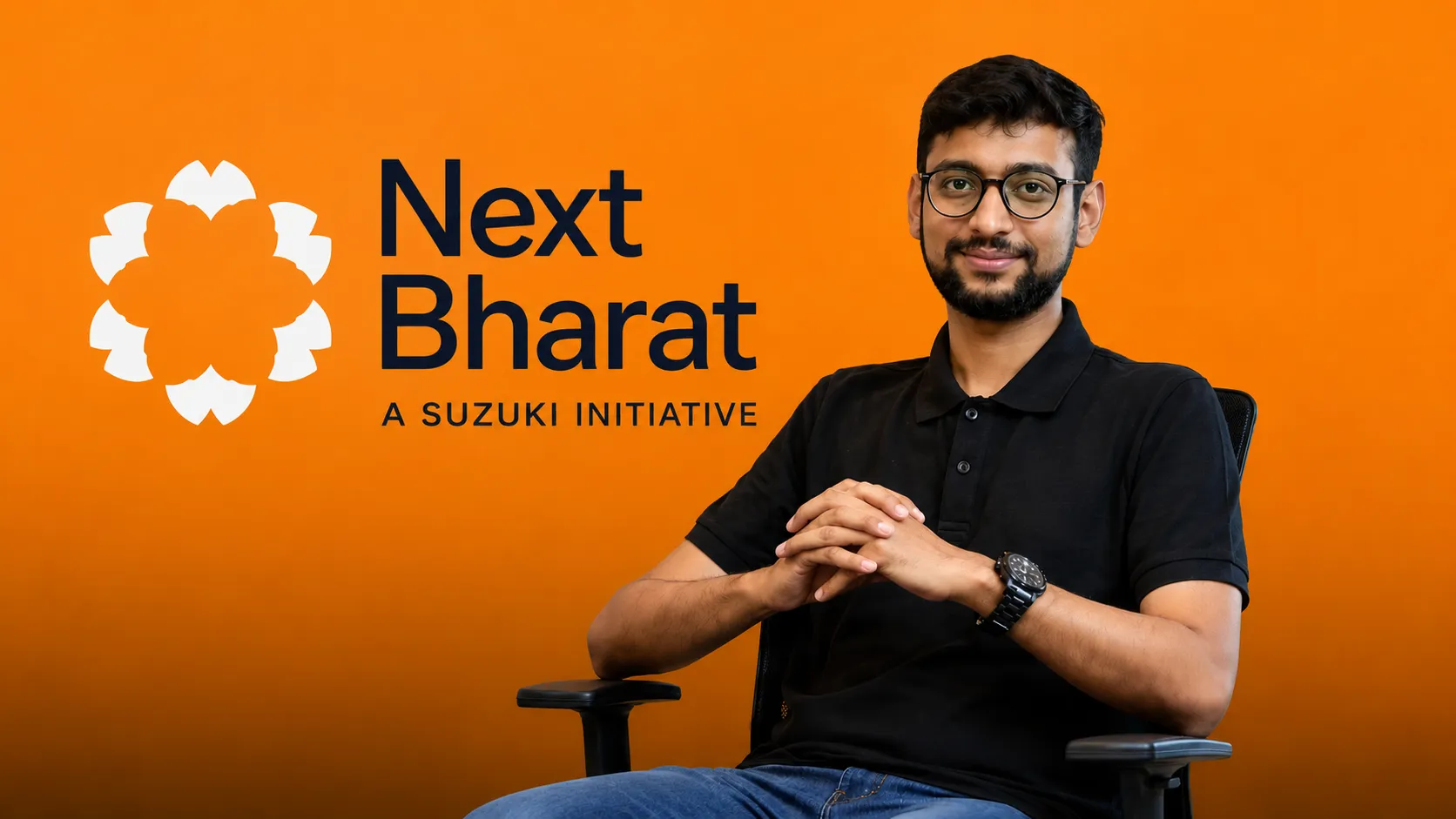
Next Bharat Ventures was founded in 2024 by Vipul Jindal Nath, an IIT Hyderabad alumnus who had built a career at the intersection of rural development, entrepreneurship, and venture capital before establishing the firm as a subsidiary of Suzuki Motor Corporation.
The first fund — ₹340 crore — was the proof of concept. Since its launch, NBV has supported more than 50 impact entrepreneurs and invested in over 20 of them through capital, mentorship, and ecosystem support. Some of those portfolio companies have developed business partnerships with organisations in Japan — an early expression of the Japan-India entrepreneurship corridor that Suzuki's anchorship enables.
The portfolio that Fund I built includes companies that demonstrate what the NBV investment thesis looks like in practice.
MeMeraki is an authentic Indian folk art marketplace — a platform that connects artisans and folk art practitioners from rural communities with consumers who want genuine, culturally rooted handmade products rather than mass-produced replicas. The platform creates market access for artisans whose work has historically been limited to local markets or exploitative middlemen.
E-Bik is a rural mobility brand offering affordable electric mobility kits for cycles and rickshaws — a product that addresses the transport problem of the rural gig worker, the village entrepreneur, and the low-income household that needs daily mobility but cannot afford or access the EV products designed for urban consumers.
SGB Agro provides affordable farm mechanisation for small-holding farmers — the segment that owns the majority of India's agricultural land but has historically been excluded from the mechanisation benefits that larger commercial farms access, because the equipment is too expensive and the business models to make it accessible have not existed.
Atypical Advantage is India's largest livelihood platform for persons with disabilities — a company that creates formal employment pathways for one of India's most systematically excluded populations, working with corporates to build disability-inclusive hiring practices and with disabled individuals to prepare them for professional roles.
These four companies are not similar to each other in sector or business model. They are similar in the founding logic: an underserved population, a structural market gap, and a founding team willing to solve a problem that more conventional capital has not been interested in funding.
Vipul Jindal Nath's statement on the first fund's performance is the most important number in the Fund II announcement: over 90 per cent of the portfolio companies are already heading towards profitability in their early years. In an impact investing context, where the conventional tension between social mission and financial return is often used to explain or excuse poor financial performance, a 90-plus per cent early profitability trajectory across 20-plus portfolio companies is an extraordinary result. It is the evidence that justifies the 6x increase in fund size.
What the ₹2,000 Crore Will Fund — Sectors and Strategy
The Fund II sector focus covers the full range of problems that rural and semi-urban India faces with economic opportunity, access to services, and integration into the formal economy.
Agriculture and rural supply chains address the twin problems of farmer income and market access — the structural fragmentation of India's agricultural economy that keeps farmer gate prices low and consumer prices high simultaneously, with the value capture happening in the intermediary layers that neither producer nor consumer controls. Startups that shorten the supply chain, improve storage and logistics, digitise the procurement process, or give small-holding farmers the market access that aggregation and technology can provide are the natural investments in this category.
Financial inclusion targets the 190 million adults in India who remain outside the formal banking system and the hundreds of millions more who have bank accounts but lack access to credit, insurance, or investment products appropriate to their incomes and risk profiles. The fintech category has made substantial progress on this problem in urban and semi-urban markets. The rural financial inclusion gap remains large.
Healthcare targets the access gap that has been India's most persistent rural development challenge — the shortage of qualified medical professionals in rural areas, the absence of diagnostic infrastructure, the cost barriers that prevent preventive health behaviour in communities where a single serious illness can push a household into poverty.
Rural mobility addresses the transport dimension of rural economic exclusion — the connectivity that allows a rural entrepreneur to access urban markets, allows a rural worker to reach employment opportunities, and allows rural communities to integrate with the broader economic system.
AI for social good is the newest category in the NBV mandate — the application of artificial intelligence tools to the specific problems of rural communities and underserved populations in ways that create access to information, services, and economic opportunity that geography and economic status have historically denied them.
Why Suzuki Is the Right Anchor for This Fund
Toshihiro Suzuki, Representative Director and President of Suzuki Motor Corporation, endorsed the fund's thesis with a directness that reflects more than a standard corporate statement about investment strategy.
Japan's investment in India, he said, has always been rooted in a shared belief in India's potential, and nowhere is that potential more evident than in the entrepreneurial energy of the people working to improve lives at the grassroots level. Next Bharat Ventures embodies this spirit by supporting founders who are building businesses that create real value for rural communities.
The Suzuki-India relationship, through Maruti, was built on the insight that the mass market in India is not the premium market. That the largest opportunity in Indian mobility was not the luxury consumer but the family that wanted reliable, affordable personal transportation. The same logic, applied to the startup ecosystem, produces the NBV thesis: the largest opportunity in Indian entrepreneurship is not the urban consumer of premium digital services, but the rural household, the smallholder farmer, the informal worker, and the underserved community that needs products, services, and economic opportunities that the mainstream startup ecosystem has not built for them.
Suzuki understood the first version of this insight in 1983. They are backing the second version with ₹2,000 crore in 2026.
The Japan-India Corridor — a Strategic Dimension That Matters
Beyond the capital, the Suzuki anchorship creates a specific and valuable strategic dimension that most impact funds cannot offer their portfolio companies: access to Japanese corporate networks, Japanese technology partnerships, and the possibility of commercial relationships with Japanese companies that share Suzuki's engagement with India and rural development.
Several Fund I portfolio companies have already developed business partnerships with organisations in Japan — an early signal that the Japan-India corridor that Suzuki's anchorship opens is real and commercially useful rather than a theoretical benefit of the corporate LP relationship.
For Indian rural startups building in categories like agricultural technology, mobility, and manufacturing — all areas where Japanese corporate expertise is deep and Japanese corporate interest in India is genuine — the ability to access Japanese partners through the NBV network is a meaningful differentiator from other impact fund investments.
What the Fund Is Asking Founders to Do
Vipul Jindal Nath's call to aspiring founders in the Fund II announcement is the clearest statement of what NBV is looking for — and what India's next generation of entrepreneurs has an opportunity to build.
He asked founders to build their next startup in a way that not only creates commercial value but also deeply solves a social problem of rural and informal communities, because that is the heart of India. If you are able to create a big enough impact, he said, the commercial returns will follow.
The 90-plus per cent profitability trajectory of Fund I's portfolio is the evidence that he is right. The ₹2,000 crore of Fund II is Suzuki's statement that it is worth betting on.
The heart of India is not in its malls and its metro stations. It is in its villages and its small towns and its farming households and its informal workers. ₹2,000 crore says: that is where the next generation of great Indian companies will come from.