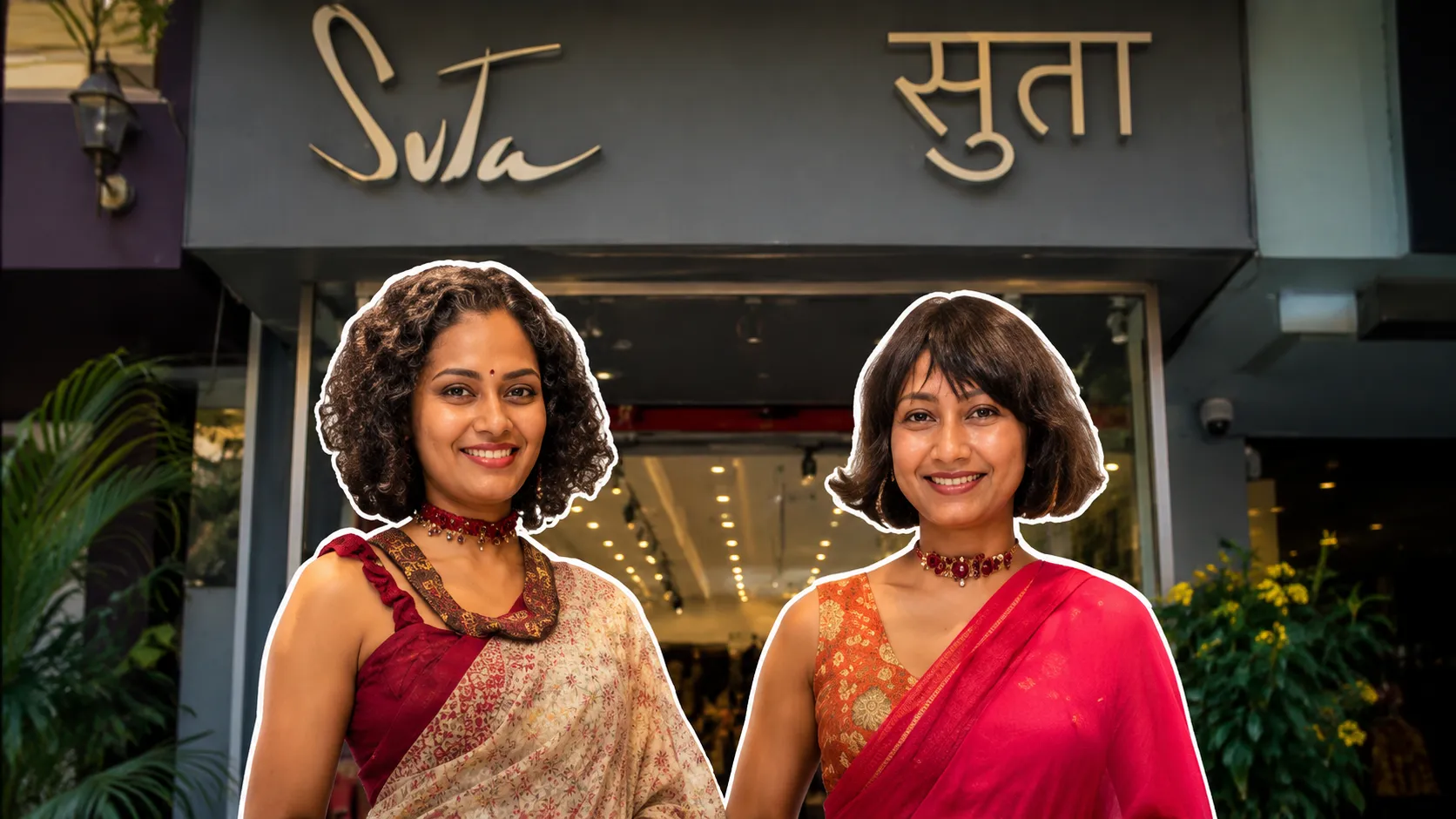
The Day Two Corporate Sisters Walked Into the Unknown
On April 1, 2016, Sujata and Taniya Biswas did something that would make most finance directors wince. They quit their stable, well-paying corporate jobs — Sujata from stints at Essar Group, Jindal Group, and IIT Bombay, and Taniya from Tata Group and IBM — pooled together ₹6 lakh in personal savings, and decided to sell sarees on the internet.
No external investors. No fashion industry background. No plan B.
Most people would call that reckless. Nine years later, those same people would call it a masterclass.
Today, Suta — a name stitched from the first two letters of each sister's name, also meaning "thread" in Sanskrit — has crossed ₹75 crore in annual revenue, employs over 170 people, works with more than 17,000 weavers and artisan families across India, and operates 18 stores with an IPO squarely in the founders' sights. All of it built without a single rupee of venture capital.
This is not a fairytale. It is a field manual.
Where It All Began: A Childhood Stitched in Handloom
To understand Suta, you have to understand where Sujata and Taniya grew up — not geographically, but emotionally.
Their father worked with Indian Railways, which meant the family moved constantly across the country. They spent most of their formative years in eastern India, in Bhubaneswar, cycling through cultures, communities, and textiles. The constant in every household they lived in? Their mother's sarees.
"Handloom wasn't just fabric; it was a part of our family's story. Seeing our mother work with weavers gave us a deep appreciation for traditional crafts," Sujata has reflected in interviews.

That appreciation never left. Even as both sisters went on to build impressively credentialed careers — Sujata graduating from CET Bhubaneswar and IIFT Delhi, Taniya with an engineering degree from NIT Rourkela and an MBA from IIM Lucknow — something kept pulling them back to the loom.
The tipping point came during visits to weaver villages in West Bengal. Watching artisans pour hours of skill into fabric that the market had largely abandoned was not inspiring to them in a romantic sense. It was infuriating in a problem-solving sense.
"We spent a year brainstorming different ideas. Ultimately, we settled on sarees because of our love for them and our desire to bring them back into the spotlight," Sujata has said.
They were not romanticising the past. They were identifying a market gap that the industry had missed entirely.
The Problem Nobody Was Solving
Here is the gap they saw: an entire generation of young Indian women loved sarees culturally but found them practically inaccessible.
"Sujata and I started Suta in 2016 when we noticed a significant gap — people loved sarees but found them difficult to wear. Many struggled to find matching blouses or petticoats, and sarees were often seen as inconvenient," Taniya told Fibre2Fashion in a detailed interview. "We wanted to make sarees fun, easy to wear, and relevant again, especially for the younger generation who were moving away from them."
The market was dominated by traditional, occasion-wear retailers. The entire category had been parked at weddings, festivals, and funerals. Nobody was positioning the saree as everyday wear for a 24-year-old woman who pairs it with sneakers.
That was the white space Suta walked into — and they did it with cotton, linen, mulmul, and jamdani weaves that were washable, lightweight, and affordable. Sarees that you could wear to a college campus or a Bangalore startup office without planning your morning around them.
"We do a lot of college talks and campus activations. We catch the customers very young so that they don't grow up complaining that they don't know how to drape a saree!" Taniya has explained in media interviews.
The Instagram Playbook Nobody Taught Them
Here is where the Suta story gets genuinely instructive for any business builder.
With ₹6 lakh and no marketing budget to speak of, the sisters turned to Instagram — not as an advertising channel, but as a community-building tool. The distinction matters enormously.
Most brands use Instagram to push product. Suta used it to share stories. Stories of weavers, of fabric origins, of the sisters themselves draping sarees in parking lots and airport departure lounges and on the go — the way real women actually wear them.
"One of our strategies is to make the brand look and feel like how we are — a small, homegrown and achievable brand. We don't have models or drape artists. We drape it ourselves and on the go, just how it should be," the founders told YS Life.
That decision — founders as the face, zero professional models, raw authenticity over polished production — built something more durable than an ad campaign. It built trust.
"We had to explain to people why we do what we do," Sujata told Sambad English. "We want people to remember our sarees with a story." And Taniya added: "A lot of people have bought a saree because they loved the story associated with it. We want people to mindfully buy things."
The result? An Instagram community of over 550,000 engaged followers, a Pinterest presence that led a renowned Indian filmmaker to organically discover and endorse the brand, and a customer base where the second-largest demographic buying Suta sarees is young women aged 18 to 25.
The brand's inclusivity extended further still. Suta ran campaigns celebrating sarees as gender-fluid. "We are also telling people that whoever you are — binary, non-binary, whoever you are — we are a community and we are together," Taniya told Social Samosa.
The Artisan Commitment That Became a Competitive Moat
While the Instagram strategy built the brand outward, there was a harder promise being made inward — to the weavers themselves.
When Suta started, convincing artisans to work with them was not straightforward. Making plain, minimal sarees without heavy embellishment — Suta's aesthetic signature — was counterintuitive to craftspeople trained to add as much as possible to raise perceived value.
But the sisters made a commitment early on that became the backbone of their entire supply chain strategy.
"When we started Suta, we decided that even if we work with just two weavers, we will give them 365-days work. Even if the collections did not work out or something went wrong, we made sure that we give them work. That is the only assurance that they need," Sujata said in an interview with Sambad English.

This wasn't just an ethical stance. It was a smart business one. Artisans who know they have consistent income work with more care, more creativity, and more loyalty. Suta eventually embedded even the artisans' family members into their process — wives putting on tags, sisters arranging tassels, mothers helping with pre-washing — creating an economic unit around the household, not just the weaver.
"We engage the entire family, not just the weavers in the house," Taniya told Shopify Masters. "There's like a community feeling now."
"Craft thrives when the hands behind it are supported with dignity, not just admiration," Taniya said to Fibre2Fashion. "Reviving traditional crafts is not about romanticising the past; it is about building systems where both artisans and customers recognise the worth of handmade work."
Today, Suta works with over 17,000 artisan families, with 60 per cent of them being women.
The Numbers That Tell the Real Story
Suta's growth trajectory is not the hockey-stick curve of a VC-fuelled startup. It is something arguably more impressive — deliberate, profitable, and entirely self-funded.
From two employees and a single weaver in 2016, the brand has grown to over 170 full-time employees. Revenue crossed ₹75 crore in FY2024-25, representing 1,200 per cent-plus growth from their earliest years. "We didn't set out to build a ₹75 crore company," Sujata told YourStory. "We just wanted to create something meaningful, and we grew step by step."
Their revenue split is built on three pillars: 50 per cent from their own website, 15 to 20 per cent from e-commerce platforms like Myntra, Ajio, and Nykaa Fashion, and 30 to 35 per cent from physical retail. They now operate 18 stores across India — a mix of two brand-owned outlets and 16 franchise stores running on a FOCO (franchise-owned, company-operated) model, which requires ₹30 to 35 lakh from the franchise partner with a revenue share back to Suta. This model allows offline expansion without massive capital outlay from the company itself.
Their next ambition? Their first international store in Mauritius, a targeting of global Indian diaspora markets, and a revenue goal of ₹85 to 90 crore in FY26. The IPO conversation is already underway.
"We grew slow, but we grew right," Taniya told Fibre2Fashion.
What Founders Can Actually Take From This
The Suta story gets told as an inspiration piece. It deserves to be studied as a business case.
Several things they did that most founders avoid:
They did not raise money when they could have. Staying bootstrapped forced discipline — every rupee reinvested had to earn its place. "We are a bootstrapped company and while in the future we may seek a VC route, we don't want to be a brand that opens and closes stores in a blink of an eye," Taniya told Business Today.
They made their brand look like themselves, not like a brand. No models, no drape artists, no polished ad shoots. The founders were the content. That authenticity built a community that advertising cannot buy.
They solved for artisan consistency before scaling product. Most fashion startups think about customer acquisition first and supply chain second. Suta did the reverse.
They used storytelling as a sales mechanism. Every product launched with a narrative. Every weaver had a name. This made customers into advocates.
And they stayed patient. The ₹75 crore mark took nine years to reach. Most venture-backed competitors would have burned through three funding rounds and pivoted twice in that time.
The Thread That Holds It All Together

There is a line Sujata shared with YourStory that stays with you: "We just wanted to create something meaningful."
That sounds soft. But meaning, when it is operationalised correctly, is one of the hardest competitive moats to copy. You can copy a saree. You cannot copy 17,000 artisan relationships, nine years of community trust, and a brand that genuinely looks like the people who built it.
Suta is what happens when two women with elite educations and zero industry experience decide that the thing the market is undervaluing is not a product category — it is a culture.
They did not disrupt the saree market. They reminded it of its own value.
What made it all hold together was not capital or clever marketing — it was three commitments they never broke: consistency to artisans, authenticity to customers, and clarity of purpose. They got those three right before they chased growth. The revenue followed. And if that sounds too simple to be a business strategy, look at the numbers: ₹6 lakh in, ₹75 crore out, zero investors, zero compromises.
And if you are building something right now — whether it is a brand, a business, or a belief — the most expensive thing you can invest is not money. It is the decision to make something that lasts. Get your purpose right first. Earn your revenue second.
The thread, as Suta has proven, never breaks if you weave it with enough intention.


