Shreya Prakash — Building a ₹100,000‑Woman Talent Pool for Flexible Work
The Problem That No Policy Has Solved
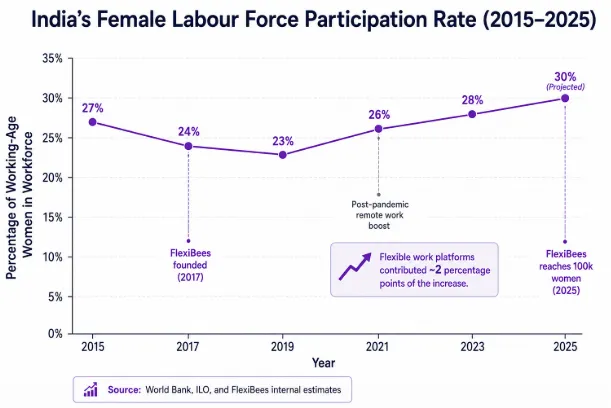
India has a women’s workforce participation problem. According to World Bank data, only about 25% of Indian women of working age are employed or actively seeking work — compared to 75% of men. Among married women with children, the rate drops to below 15%. This is not because Indian women lack education or ambition. India produces more female STEM graduates than most Western countries. The problem is structural.
Shreya Prakash saw this problem up close. After completing her MBA from the Indian School of Business (ISB), she worked in corporate strategy at a large Indian conglomerate. She watched talented women colleagues quit after marriage or childbirth — not because they wanted to, but because the workplace refused to accommodate their need for flexibility. Part‑time work was stigmatized. Remote work was rare. “Returnships” were non‑existent.
At the same time, as a consultant, she saw startups and SMEs desperately needing skilled professionals — but unable to afford full‑time hires or unwilling to commit to permanent headcount. They needed project‑based, part‑time, or remote experts.
The mismatch was obvious: thousands of talented women were sitting at home, willing to work but unable to find flexible opportunities. And thousands of businesses were struggling to find skilled talent on a flexible basis.
In 2017, Shreya quit her job and, along with two other women co‑founders (both former colleagues), launched FlexiBees — a platform that connects women professionals with flexible work opportunities in marketing, finance, HR, content, and technology.
Building an All‑Woman Founding Team
From the start, Shreya made a conscious choice: FlexiBees would be built by women, for women. Her co‑founders — Rashi Goel (a chartered accountant) and Manjula Raju (an HR professional) — brought complementary skills. Together, they bootstrapped the company with ₹25 lakh of their own savings.
The early days were grueling. They had no office, no website, and no clients. Shreya personally reached out to women on LinkedIn and Facebook groups, asking if they would be interested in flexible work. She built the first talent database manually — a spreadsheet with 500 names, skills, and availability.
The first client came through a referral: a small e‑commerce company needed a part‑time finance manager. Shreya matched them with a woman who had left her corporate job after her second child. The engagement lasted two years, and both parties were delighted.
From there, word spread. By 2019, FlexiBees had 5,000 registered women professionals and 50 clients. The company built its own matching algorithm — an AI that considered not just skills and experience but also availability (hours per week), time zone preferences, and family constraints (e.g., school pickup times).
The platform also offered something unprecedented: job carving. If a client needed a full‑time role that no single woman could take on because of timing constraints, FlexiBees would split the role into two or three part‑time jobs — morning, afternoon, and evening — allowing multiple women to share the responsibilities. This “job sharing” model became a unique selling point.
The Pandemic Accelerator
When COVID‑19 hit in 2020, remote work went from a niche perk to a global necessity. Businesses that had never considered flexible hiring suddenly embraced it. Women who had been forced to quit due to lack of remote options suddenly found themselves in demand.
FlexiBees grew 300% in 2020–2021. The talent pool expanded from 5,000 to 50,000 women. Clients grew from 50 to 500. The platform added new categories: virtual assistants, customer support, social media management, and even software development.
Shreya’s biggest challenge during the pandemic was not demand — it was supply. Thousands of women were eager to join, but many lacked updated résumés, portfolios, or confidence after a career break. FlexiBees launched free reskilling workshops in digital marketing, Excel, and communication. Over 10,000 women attended. The company also offered interview coaching and mock sessions.
By the end of 2021, FlexiBees had placed over 5,000 women in flexible roles, with an average monthly earning of ₹30,000–₹50,000. For many, it was their first income in years. For some, it was their first job ever.
Recognition and Awards
In 2022, Shreya Prakash received the Aurora Tech Award — a global prize for women founders of impact‑driven tech startups. The award came with a $50,000 grant and global visibility. She used the funds to improve the AI matching engine and launch a mobile app.
In 2023, FlexiBees was recognized by NITI Aayog’s Women Entrepreneurship Platform as one of the “Top 20 Women‑Led Startups in India.” The company also received investment from Ankur Capital — a rare for‑profit investment in a social enterprise focused on women’s workforce participation.
Today, FlexiBees has over 100,000 registered women professionals across 300+ cities in India, and over 950 client businesses ranging from startups to mid‑cap companies. The platform has facilitated over 25,000 work engagements, with an average duration of 8 months.
Shreya’s vision has expanded beyond just matching. She now advocates for policy changes — such as tax incentives for companies offering flexible work, and the creation of a national “returnship” certification — through industry bodies like NASSCOM and CII.
The Economics of Flexibility
One of Shreya’s key insights is that flexible work is not charity — it’s good business. Her data shows that women on FlexiBees are:
More productive (self‑reported 25% higher focus due to fewer workplace distractions)
More loyal (average tenure 2.5x longer than full‑time industry averages)
Cost‑effective (no office space, no commute subsidies, no paid leave)
For businesses, the value proposition is clear. A full‑time marketing manager in a metro city costs ₹8–12 lakh per annum including overheads. A FlexiBees professional with similar skills, working 20 hours a week, costs ₹3–5 lakh per annum. And because the platform handles payroll, compliance, and replacement guarantees, the administrative burden is minimal.
Shreya has also pioneered a “pay as you go” model: clients pay only for hours worked, with weekly invoicing. This is particularly attractive to startups with uncertain cash flows.
Challenges and Critiques
FlexiBees is not a perfect solution. Critics point out that flexible work, while empowering, often lacks the benefits (health insurance, paid leave, retirement contributions) that full‑time employment provides. FlexiBees does not employ the women on its platform; they are independent contractors. This means no statutory benefits.
Shreya acknowledges this limitation and is working on a pilot programme with an insurance partner to offer affordable health coverage to women who complete 500+ hours on the platform. She also advocates for a national portable benefits system for gig workers.
Another challenge is the quality of opportunities. While many women are happy with ₹30,000–₹50,000 per month, others with senior‑level experience (e.g., former VPs, directors) find that the platform lacks high‑paying, strategic roles. Shreya is building a premium tier (“FlexiBees Pro”) targeting women with 10+ years of experience.
Finally, some have criticized the all‑woman focus as exclusionary. Shreya’s response: “We started with women because the gap is largest there. Men with flexible work needs are also welcome — but our mission remains women first.”
Lessons for Entrepreneurs
Start with a spreadsheet: Before building tech, Shreya manually matched 500 women. Validate demand first.
Solve for both sides of the marketplace: FlexiBees succeeded because it served businesses as well as women.
Flexibility is not a perk, it’s a productivity tool: Her data proved that flexible workers outperform.
Don’t wait for policy — build the solution: Shreya didn’t lobby for 10 years; she built a platform that works within the existing system.
The Road Ahead
As of 2026, Shreya Prakash is 38 years old. FlexiBees has expanded into the UAE (Dubai) and Singapore, tapping into the large South Asian diaspora of women seeking flexible work. The company is also piloting a “corporate returnship” programme with three large Indian companies, where women on a 5‑year career break are hired for 6 months with a guaranteed full‑time offer at the end.
Her net worth is estimated at ₹50 crore — modest for a founder of a platform of this scale, but she has prioritised impact over personal wealth. She has given 10% of FlexiBees’ equity to the FlexiBees Foundation, which provides free training and placement to underprivileged women.
Shreya Prakash’s quiet revolution is proof that the future of work is not just about technology — it’s about humanity. And sometimes, the most powerful innovation is simply giving women the choice to work on their own terms.
Visual Assets
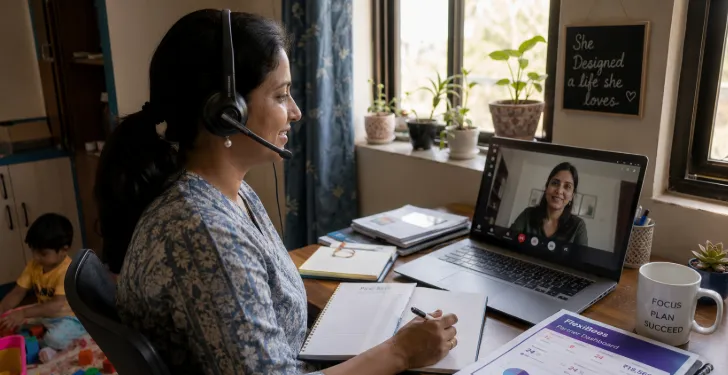
Image Prompt 1 (16:9): Shreya Prakash in a vibrant co‑working space in Pune, standing in front of a whiteboard with “Flexible Work = Productive Work” written in colourful markers. She is animatedly facilitating a workshop for 15–20 women professionals of diverse ages (25 to 55) — some taking notes, others on laptops. Warm ambient lighting, energetic and inclusive atmosphere. Shreya wears a simple kurta and jeans, no designer labels. Photorealistic, documentary style.