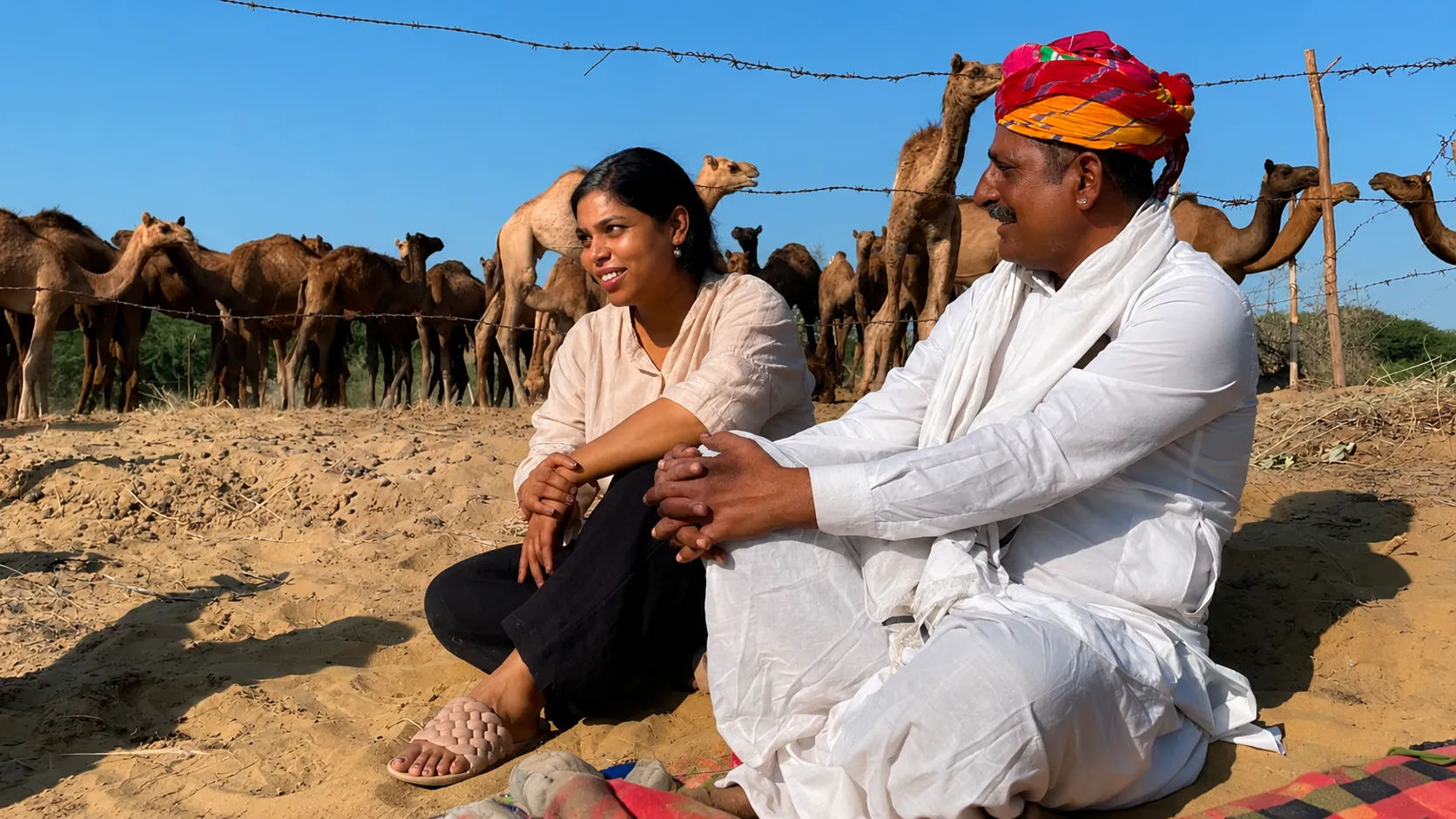
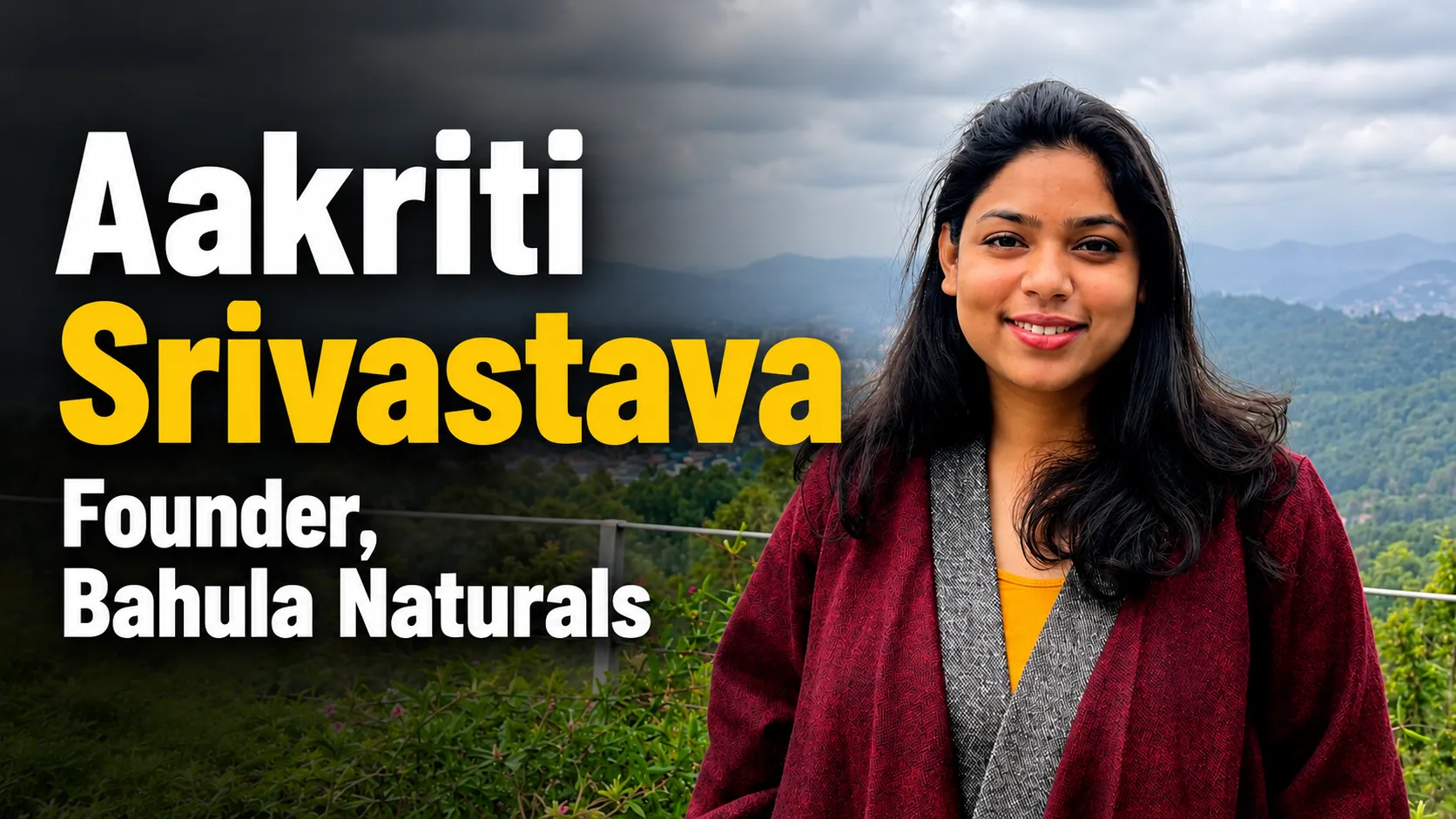
Bajju, Rajasthan, June 18, 2026: In June 2017, a young documentary filmmaker named Aakriti Srivastava took a train to Bikaner and a bus deeper into the Thar Desert, headed for a remote village called Bajju on the India-Pakistan border. She was there to film the stories of 71 migrant families for a non-profit and a Delhi media house. She expected to stay a few weeks. As detailed in a feature published this week by YourStory's HerStory, that visit turned into a four-month stay, and the four months eventually became nine years — and a company, Bahula Naturals, that today works with more than 4,000 pastoralist households across Bikaner, Jaisalmer and Jaipur.
From the Newsroom to the Dunes
Srivastava grew up in Gorakhpur, Uttar Pradesh, where pursuing journalism was, by her own account, an unusual choice for someone in her household. She made the move to Delhi anyway, building a career filming environmental documentaries before that 2017 assignment pulled her into the Thar.
What she found in Bajju unsettled her in ways she hadn't anticipated: a desert village of 8,000 households living a dual existence, spending part of the year in the village and the rest scattered across farmland dwellings called dhaanis during sowing and rearing seasons. That dispersed settlement pattern meant government schemes and services routinely failed to reach people simply because, for months at a stretch, nobody was where the paperwork said they should be.
For the next five years, Srivastava kept returning, documenting the region through video, articles, academic research and policy work. The COVID-19 pandemic became a turning point. She noticed a pattern: government schemes existed, academic papers had been written, NGOs had mobilised communities, and funders had written checks — yet none of it added up to lasting change, because the efforts were disconnected from each other and rarely sustained. What was missing, she concluded, was something that gave pastoralist communities an income stable enough to let them advocate for themselves.
Building Bahula, Stage by Stage
That conclusion became Bahula Naturals, launched in May 2022 with co-founders Romal Singh and Suraj Singh, both of whom Srivastava met during her years working in the desert. The name comes from the Sanskrit word “bahulata,” meaning plurality — an idea Srivastava describes as bringing different communities, organisations and markets onto a single platform.
The company operates across three linked stages. The first works directly with agro-pastoralist producers, connecting them to better-quality seeds and animal feed, and installing household biogas units that supply clean cooking gas while their slurry by-product replaces chemical fertiliser. The second stage is manufacturing, spanning three product lines: camel milk and value-added camel products, indigenous Rathi cow's milk products, and desert-grown agricultural produce. The Rathi cow line includes Bilona ghee and a desi paneer made using only chhaach and milk, with no coagulants or other additives, while the camel milk range runs to three varieties of artisanal cheese and a freeze-dried nutraceutical supplement. Beyond dairy, Bahula also sells black wheat atta, black wheat porridge, and cold-pressed mustard and groundnut oils. The third stage is distribution: a premium B2B channel that currently accounts for the bulk of revenue, a doorstep delivery service for households across Bikaner, and a direct-to-consumer e-commerce arm.
Srivastava is based in Bajju, where the bulk of the milk collection happens, while a Bikaner city office handles warehousing and dispatch. Roughly 95 percent of Bahula's team are young people drawn from the same villages the company sources from.
Putting Women at the Centre
If there's a single idea that defines Bahula Naturals beyond its product line, it's the deliberate decision to route payments directly into women's bank accounts. Srivastava arrived at that decision after watching, up close, who actually did the work in pastoralist households: waking before sunrise to tend animals, managing the household, returning to the animals, negotiating milk sales, arranging feed, sending children out to graze livestock in the evenings, milking again, handling veterinary needs. Despite carrying that load, the income from milk sales went into a husband's bank account, often leaving women with no visibility into whether a dairy payment had even been made, dependent instead on being given money for feed, household costs or their children's schooling.
That decision, which Bahula has since made standard practice across its network, has produced visible shifts in confidence and decision-making power within households, Srivastava says.
One example she points to is Devika, a 16-year-old roughly 25 kilometres from Bahula's plant who took over her household after losing her mother, caring for animals, cooking, and looking after her father and three brothers, even as the income from the milk she managed went to the men in her family. After her household joined Bahula's network and payments began flowing directly to her, Devika approached the company's delivery staff with a proposal: help her secure a Rs 40,000 loan to buy two more cows, and she would commit to supplying milk for a fixed period. Bahula's team visited her home, was won over by her business sense, and approved the loan. Devika has since enrolled in a distance-learning BSc Chemistry programme, inspired in part by one of Bahula's own lab technicians, with an eye on becoming one herself.
Where Bahula Stands Today
Four years into operations, Bahula Naturals is breaking even and covering its costs, funded by a mix of private and institutional grants and debt. Srivastava counts the creation of a real, sustained market for camel milk, in a country whose dairy habits run overwhelmingly toward cow and buffalo milk, as the venture's biggest achievement so far. Operating roughly 40 kilometres from the Pakistan border, where water, electricity and medical access are far from guaranteed, the company has built decentralised renewable energy into its supply chain from the outset and trained local community members for technical roles rather than waiting for outside professionals willing to relocate.
The next phase, as Srivastava describes it, runs along three tracks: moving beyond its core B2B business into offline experiential retail, starting in Rajasthan before expanding nationally; growing the camel milk export business it began last year into additional international markets; and building out e-commerce in parallel, with the long-term goal of making the Bahula name synonymous with trustworthy, traceable food. Along the way, the venture has leaned on support from the TechnoServe Greenr Sustainability Accelerator Program for mentorship and market connections, alongside early ecosystem partners Urmul Seemant Samiti and the Desert Resource Centre.
The Bigger Picture
Bahula Naturals' story sits at an intersection that gets relatively little attention in India's startup conversation: climate-resilient livestock, gender equity in informal rural economies, and the slow work of building markets for foods most Indians have never tasted. Srivastava's own arc, from documentary filmmaker to founder, suggests the company's real innovation may be less about camel cheese than about insisting that the people doing the most invisible labour in a value chain are also the ones who get to see the money first.