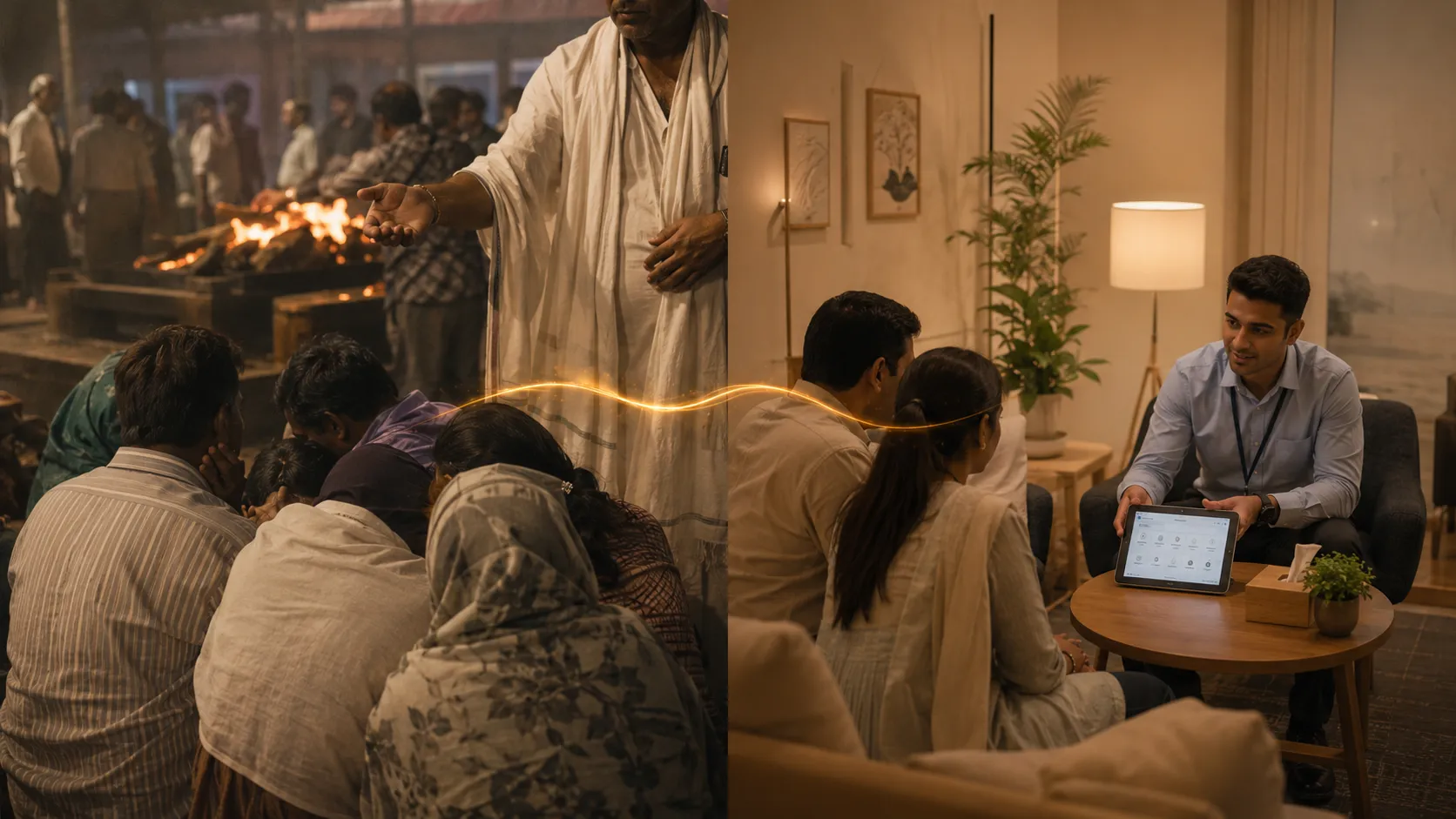
She Watched Her Family Get Exploited After Her Grandfather Died. So She Built India's First Dignified Death-Care Platform—and Changed How Millions Say Goodbye.
BENGALURU — May 25, 2026 — In 2015, Nidhi Agarwal's grandfather died. He was 82, a retired civil servant who had lived a quiet, upright life, and his death—expected, peaceful, surrounded by family—was as gentle a passing as anyone could hope for. What followed was not gentle. The family was charged ₹18,000 for an ambulance that should have cost ₹2,500. The priests at the crematorium demanded fees that had never been discussed, escalating with each ritual until the family, paralysed by grief and the cultural obligation not to argue at a funeral, paid whatever was asked. The paperwork required to obtain a death certificate, close bank accounts, transfer property, and notify government agencies was a labyrinth of forms, waiting periods, and petty bribery that consumed months of her family's time and tens of thousands of rupees in "fees" that were never officially recorded. Her grandfather's death, like the deaths of millions of Indians before him, had become an opportunity—not for mourning, but for extraction.
Agarwal was 27 at the time, a software engineer with a degree from BITS Pilani and a comfortable job at a Bengaluru startup. She had never thought of herself as an entrepreneur. She had certainly never thought of death as a business opportunity. But standing in the chaos of the crematorium, watching her mother sob while a stranger demanded another thousand rupees for a ritual that may or may not have been required, something shifted. "I remember thinking," she told a conference years later, "that this was the last thing my grandfather deserved. He had lived with dignity. He deserved to die with dignity. And instead, we were being robbed—not because we were poor, but because we were grieving, and grief makes you vulnerable."
She returned to Bengaluru, quit her job, and spent the next two years researching the Indian death-care industry. What she found was a market failure of staggering proportions. India has approximately 8.5 million deaths per year—more than any country in the world except China—and the infrastructure for handling those deaths is almost entirely unorganised. Ambulance services are fragmented and unregulated, with prices that vary by a factor of ten depending on the desperation of the caller. Crematoriums are run by municipal bodies, religious trusts, or private operators, with no standardisation of pricing or service. The paperwork required to settle a deceased person's affairs—death certificates, probate, asset transfers, pension closures—is spread across dozens of government departments, none of which communicate with each other. The entire system, such as it is, is designed around the assumption that grieving families are in no position to negotiate, compare prices, or assert their rights. The assumption is usually correct.
Agarwal decided to fix it. In 2017, she launched Antim—the name means "final" or "last" in Hindi—a platform that provides end-to-end death-care services, from ambulance booking to cremation arrangements to legal paperwork to grief counselling, with transparent pricing, dignified service, and a conviction that death, like birth, deserves to be handled with compassion rather than exploitation. The company has since served more than 200,000 families across 12 Indian cities, built a network of over 5,000 verified service providers, and raised ₹85 crore from investors including Elevation Capital, Accel, and a roster of angel investors who understood, earlier than most, that the death-care market was not niche—it was universal. The company is profitable, with revenue that has grown at a compound annual rate of more than 50 percent over the past five years. And it was built by a woman who, until her grandfather died, had never given death a second thought.

The Market Failure That Nobody Wanted to See
To understand what Antim has built, one must first understand the peculiar architecture of the Indian death-care industry—and the structural reasons it has resisted formalisation for so long.
India has the second-largest number of deaths annually of any country on Earth, and the death-care market—including ambulance services, mortuary facilities, cremation and burial, religious rituals, legal paperwork, and grief support—is estimated at over ₹50,000 crore. And yet, for most of the country's history, the industry has been almost entirely unorganised. The ambulance that takes a body to the crematorium is typically a private vehicle, unregulated and unlicensed, whose driver charges whatever the family can be made to pay. The crematorium that performs the last rites is operated by a municipal body, a religious trust, or a private contractor, with pricing that is opaque and variable. The priests who conduct the rituals are self-appointed, with no standardisation of fees or practices. The paperwork required to close a deceased person's legal existence—death certificates, inheritance claims, pension closures, bank account transfers—is spread across multiple government agencies, none of which coordinate with each other, and all of which are susceptible to the kind of low-level corruption that thrives in the absence of transparency.
The reasons this industry has remained unorganised are not accidental. Death is culturally sensitive in ways that make commercial intervention feel taboo. The families who are the customers for death-care services are, by definition, in the worst emotional state of their lives—grieving, exhausted, and uniquely vulnerable to exploitation. The entrepreneurs who might have built businesses in this space have been deterred by the cultural taboo, the regulatory complexity, and the simple, visceral discomfort that death provokes. The venture capitalists who fund startups have been sceptical that a death-care platform could generate the kind of returns that justify investment. The result is an industry that has been frozen in place for generations—large, essential, and almost entirely untouched by the digital revolution that has transformed every other sector of the Indian economy.
Agarwal's insight was that this market failure was not inevitable. It was a function of neglect—and neglect could be addressed with the same tools that had transformed other fragmented, trust-intensive industries. The platform model that had worked for Uber in transportation, for Urban Company in home services, for Practo in healthcare, could work for death care. The key was standardisation: vetting service providers, publishing transparent prices, and guaranteeing a level of service that grieving families could trust. The family that needed an ambulance at 3 a.m. should be able to book one through an app, see the price before confirming, and know that the vehicle would arrive within a specified time window. The family that needed a death certificate should be able to track its progress through a dashboard, rather than making repeated visits to a government office where the file had been misplaced. The technology was not the hard part. The hard part was building trust in a market where the existing providers were exploitative, and the customers were too vulnerable to fight back.
The early years were spent building the provider network—recruiting ambulance drivers, crematorium operators, priests, and legal assistants, and vetting them through a process that was far more rigorous than anything the industry had seen. Each provider was rated, reviewed, and held to service-level agreements that included transparent pricing and dignified treatment of families. The platform did not employ the providers directly—it functioned as a trusted intermediary, connecting families to verified services and guaranteeing the quality of the experience. The model was asset-light, scalable, and built on the same trust infrastructure that had powered the platform economy in every other sector. The difference was that this platform was not delivering food, or rides, or beauty services. It was delivering the last moments of a human life, and the first moments of a family's grief. The stakes were higher. The margin for error was zero.
The Paperwork That Devours Grief
The most innovative dimension of Antim's platform is not the ambulance booking or the cremation services. It is the legal and bureaucratic support—the piece of the death-care puzzle that most families find most maddening, and that Agarwal has spent years systematising.
When an Indian citizen dies, the legal aftermath is a bureaucratic labyrinth that can take months or years to navigate. The family must obtain a death certificate from the municipal corporation—a process that requires multiple visits, supporting documents, and, often, informal payments. They must close bank accounts, transfer property, settle loans, claim insurance, cancel pensions, and notify a dozen government agencies, each of which requires a separate set of forms, a separate proof of identity, and a separate waiting period. The process is so complex, and so poorly documented, that an entire industry of touts and agents has emerged to navigate it—charging fees that are unregulated and often extortionate.
Antim's legal-services platform has digitised this process. The company has mapped the requirements for death-related paperwork across every major municipal corporation in India, built a database of the forms and procedures required for each type of asset transfer, and trained a team of legal assistants who guide families through the process step by step. The platform tracks each application, alerts families when documents are ready, and provides a single point of contact for a process that previously required navigating a dozen different government offices. The service is not free, but the pricing is transparent, and the cost is a fraction of what families previously paid to touts—or lost to delays, penalties, and missed deadlines.
The legal piece is the most defensible part of Antim's business. A competitor can build an ambulance-booking platform or a crematorium-aggregation service. Building a legal-services platform that spans the regulatory complexity of India's death-care bureaucracy is far harder—and once built, it creates a switching cost that is difficult for competitors to overcome. The family that has used Antim to obtain a death certificate and close a bank account will use Antim again when they need to transfer property or claim insurance. The platform becomes not just a service provider, but a permanent record of the deceased person's legal affairs—a digital executor, in effect, that families can access whenever they need to navigate the aftermath of a death.
The grief-counselling dimension of the platform is the newest and, in some ways, the most important. Agarwal has been clear that Antim is not just a logistics company. It is a care company. The families who use the platform are in mourning, and the logistics of death—the ambulances, the cremations, the paperwork—are only one dimension of what they need. They also need someone to talk to. The platform now offers access to trained grief counsellors, both in the immediate aftermath of a death and in the weeks and months that follow. The counselling service is not a profit centre—it is subsidised by the revenue from the logistics and legal services—but it reflects Agarwal's conviction that a platform that handles death has a responsibility to handle grief as well. "The ambulance takes the body," she told an interviewer. "But who takes the grief? That's the question we're trying to answer."
The Woman Who Chose Death
The most striking dimension of Agarwal's journey is not the business metrics. It is the reaction she received when she told people what she was building.
For the first several years of Antim's existence, Agarwal had to navigate a wall of discomfort, scepticism, and outright hostility. Friends asked her why she would want to work in "such a depressing industry." Investors told her that death care was "not scalable" or "not a venture-backable category." Potential hires declined offers because their families were uncomfortable with them working in a company associated with death. The cultural taboo that surrounded death extended to the people who worked with it, and Agarwal had to build a company while simultaneously convincing the world that the work was not just necessary, but noble.
She did it by refusing to accept the premise that death was depressing. "Death is not depressing," she told a conference. "The way we treat death is depressing. The exploitation, the chaos, the lack of dignity—that's what's depressing. Death itself is just a part of life. The last part. And it deserves the same care, the same attention, the same respect as every other part." The reframing was not just a rhetorical device. It was the foundation of the company's brand. Antim's marketing materials do not feature sombre imagery or elegiac language. They feature calm, professional, reassuring messages about transparency, dignity, and care. The platform's colour palette is warm, not mournful. Its language is direct, not euphemistic. The company has built a brand around the idea that death is not something to be hidden or feared, but something to be prepared for and handled with respect.
The market, over time, has come around to her view. The pandemic was, for Antim, the moment the market caught up to the mission. The scale of death during the second wave of COVID-19—the overwhelmed crematoriums, the desperate families, the ambulance shortages, the price-gouging that reached levels of grotesque exploitation—exposed the failure of India's death-care infrastructure to the entire country. The platform's usage surged. Families who had never imagined using a technology platform to handle a death found themselves with no alternative. The stigma that had surrounded death-care planning began to erode, replaced by a grim but pragmatic recognition that death was inevitable, and that preparing for it was not morbid—it was responsible.
The company's growth since the pandemic has been driven by a structural shift in consumer behaviour. Families who used Antim during the crisis have continued to use it for subsequent deaths—parents, aunts, uncles—because the platform had proven its value in the worst possible circumstances. Corporate partnerships have expanded, with companies offering Antim's services as part of employee wellness programmes. The investor scepticism that Agarwal faced in the early years has been replaced by inbound interest from venture capitalists who have belatedly recognised that death care is not niche—it is universal, recurring, and recession-proof. The woman who chose to work in death when no one else would has been proven right. The market she entered when it was considered uninvestable is now one of the fastest-growing sectors in Indian health-tech.
The Road Ahead
Antim is at an inflection point. The company has served 200,000 families, built a network of 5,000 verified providers, and established a brand that is synonymous with dignified death care in the 12 cities where it operates. The next phase of growth will require expanding into new cities—a process that is more complex than simply replicating the existing model. Each city has its own crematorium infrastructure, its own municipal bureaucracy, its own religious and cultural practices around death. The platform must be adapted to local conditions, and the provider network must be built from scratch in each new market. The expansion is expensive, but the barriers to entry it creates are formidable. A competitor who wants to challenge Antim in a city where the company already operates must not only build a better app. They must build a better network of ambulance drivers, crematorium operators, priests, and legal assistants—a network that took Antim years to assemble.
The company is also expanding its product portfolio. The latest addition is a pre-planning service that allows individuals to arrange their own death care in advance—choosing an ambulance provider, a crematorium, and a legal-services package, and paying for them upfront, so that their families do not have to make those decisions in the midst of grief. The service is modelled on the pre-need funeral industry in the United States, where millions of people plan and pay for their own funerals years before they die. The concept is new to India, where cultural taboos around discussing death have historically made pre-planning unthinkable. But Agarwal believes the taboo is weakening—that the same consumers who have embraced insurance, estate planning, and digital wills are ready to embrace pre-planned death care. The service is in its early stages, with a small but growing number of customers, and it represents the logical endpoint of Agarwal's vision: a world in which death, like birth, is prepared for with dignity, transparency, and a plan.
The path to a public listing is visible, though Agarwal has been deliberately vague about the timeline. The company is profitable, with revenue that has compounded at more than 50 percent annually, and the brand is the strongest in its category. The IPO, when it comes, will be a signal—not just about the commercial viability of death care, but about the maturation of a sector that the startup ecosystem spent years ignoring. The woman who watched her grandfather's death become an opportunity for exploitation will ring the bell at the National Stock Exchange, and the company she built in response to that experience will be valued by the public markets at a multiple that reflects its growth, its profitability, and the uniqueness of its competitive position. The grandfather is still dead. The grief is still there. But the platform she built in his memory has served 200,000 families—and the dignity that was stolen from her grandfather is being restored, one death at a time.
What This Signals
The Nidhi Agarwal story is not primarily about death. It is about the structural neglect of the most universal human experience—and about what happens when someone who has experienced that neglect decides to fix it.
Death is the only certainty in life. And yet, for most of Indian history, the infrastructure for handling death has been broken, exploitative, and resistant to reform. The reasons are cultural, economic, and political—a toxic combination of taboo, fragmentation, and the vulnerability of the consumer that has deterred every previous attempt at formalisation. Agarwal's achievement is not that she built a profitable company in a difficult sector. It is that she demonstrated that the sector was not intrinsically difficult. It was simply ignored—by entrepreneurs who found it unglamorous, by investors who found it uninvestable, and by policymakers who found it easier to neglect than to reform. She ignored all of those signals and built a company anyway. The 200,000 families she has served are the proof that the market was real. The revenue growth is the proof that the business model works. The investor interest that has replaced the scepticism of the early years is the proof that the startup ecosystem was wrong—and that the woman who chose to work in death when no one else would was right.
Nidhi Agarwal is no longer the 27-year-old at the crematorium, watching her mother cry while a priest demanded more money. She is the founder of India's largest death-care platform, the builder of a business that has turned the most dreaded experience in human life into something dignified and transparent, and a quiet, persistent advocate for a cause that the world has spent centuries avoiding. The grandfather who died in 2015 is still dead. But the exploitation that followed his death—the inflated ambulance bills, the extortionate cremation fees, the bureaucratic nightmare that consumed months of her family's life—will never happen to another Antim customer. The platform has seen to that. The grief is still there. But it is no longer compounded by exploitation. The woman who chose death has made dying easier—not for the person who dies, but for the people who are left behind. And that, in the end, is the point.


