
She Was Told Real Estate Was No Place for a Woman. So Meghna Agarwal Built a ₹1,200 Crore Coworking Empire—and Made the Office a Destination Again.
BENGALURU — May 25, 2026 — In 2015, Meghna Agarwal was a senior executive at a large Indian technology company, and she had a problem that her employer could not solve. The company was growing fast—hiring hundreds of engineers every quarter, expanding into new cities, competing for talent in a market where the best people could choose their employers—and the office infrastructure was a bottleneck. Leases took months to negotiate. Build-outs took months more. The spaces, when they were finally ready, were conventional, uninspiring, and disconnected from what the young, ambitious workforce actually wanted. The company needed offices that were flexible, scalable, and designed for the way people actually worked—not the way they had worked in 1995. The real estate industry, Agarwal discovered, had no answer.
She did not have a background in real estate. She was an engineer by training, a graduate of IIT Delhi, with a career that had spanned technology, operations, and corporate leadership. She had never negotiated a commercial lease. She had never managed a construction project. She had never built anything physical in her life. But she had the same conviction that drives every founder who sees a broken system and refuses to accept that it cannot be fixed: if the market would not provide the solution, she would build it herself.
In 2015, Agarwal and her co-founder, Rishi Das, launched IndiQube. The company's proposition was simple: provide fully managed, ready-to-move-in, design-forward office spaces that companies could scale up or down as their needs changed. No leases to negotiate. No build-outs to manage. No furniture to buy. No IT infrastructure to install. Just an office that worked, from day one, in a space that made people want to come to work. Eleven years later, IndiQube manages more than 8 million square feet of office space across 14 Indian cities, serves more than 800 corporate clients, and generated revenue of approximately ₹1,200 crore in FY26. The company has raised over $40 million from investors including WestBridge Capital and the Family Office of Ashish Dhawan, and it has been profitable at the operating level for multiple consecutive years—a feat that is almost unheard of in the co-working and managed-office sector, where most companies have burned through billions of dollars in venture capital without ever reaching sustainability. The woman who was told—implicitly and explicitly—that real estate was no place for a female founder has built one of India's largest and most profitable workplace platforms. The offices she builds are not just places to work. They are the physical infrastructure of India's new economy—and she built them from scratch.
The IIT Engineer Who Chose Bricks Over Code
Meghna Agarwal was not supposed to be a real estate entrepreneur. She was supposed to be a technology executive—a graduate of IIT Delhi, one of India's most elite engineering institutions, with a degree in computer science and a career that had taken her through some of the most respected technology companies in the country. She had spent years in operations and corporate leadership roles, managing large teams, optimising complex processes, and building the kind of institutional knowledge that makes someone invaluable to an organisation. She was good at it. She was well-compensated. And she was increasingly frustrated by a problem that seemed simple but had no solution: the offices where Indian companies worked were terrible.
The insight was not complex, but it was profound. The Indian economy was being transformed by technology—by startups, by global capability centres, by the rapid digitisation of every industry. The companies driving this transformation needed offices that reflected their culture: flexible, scalable, designed for collaboration, and capable of expanding or contracting as business needs changed. The real estate industry, which had spent decades building conventional office towers for conventional tenants, was structurally incapable of meeting this demand. Landlords wanted long-term leases, large floor plates, and predictable tenants. Startups wanted short-term commitments, flexible spaces, and the ability to grow without being locked into a ten-year contract. The mismatch was enormous—and it represented a market opportunity that was measured in the millions of square feet and the billions of dollars.
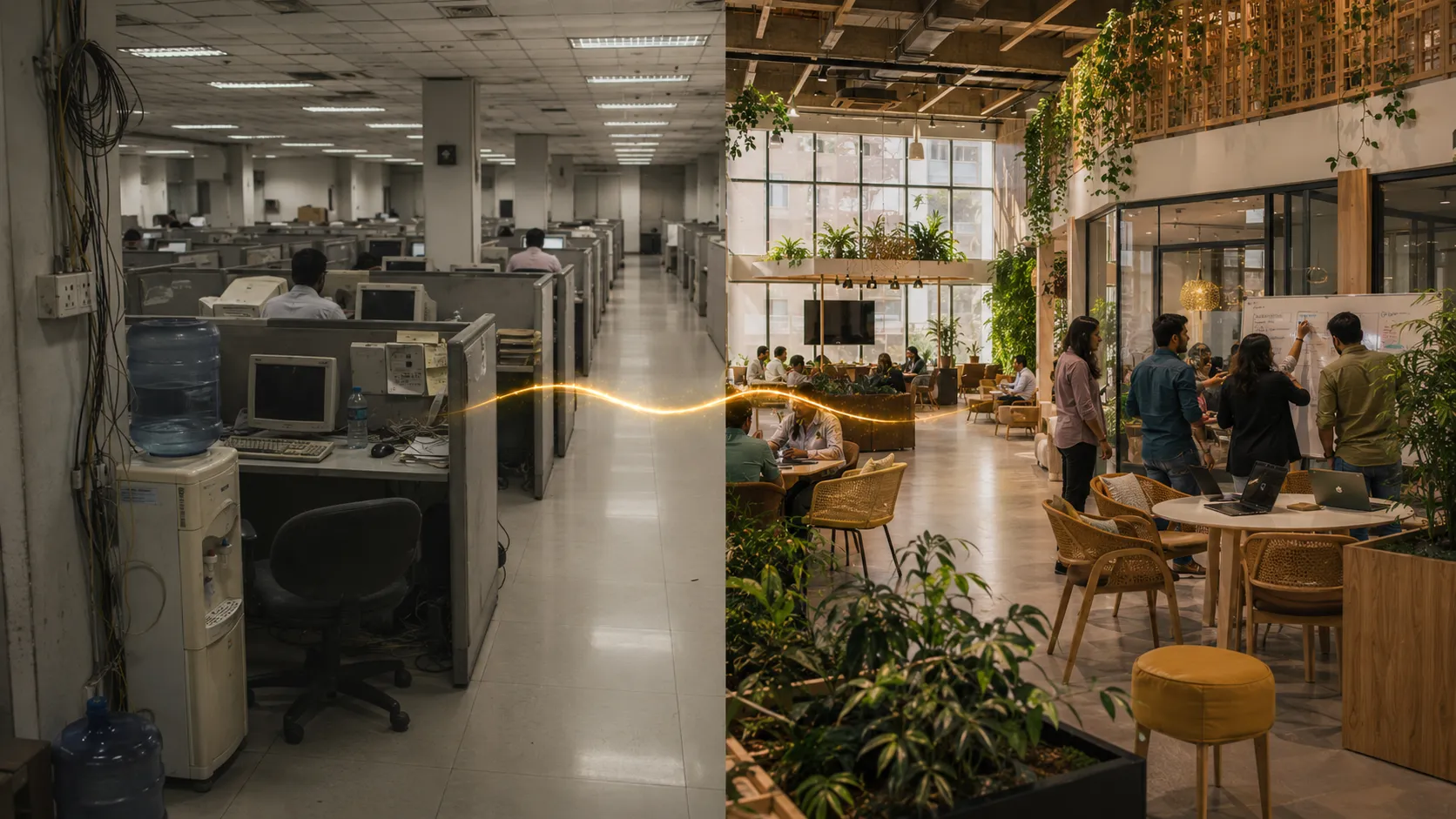
Agarwal's background gave her an unusual advantage. She was not a real estate insider, which meant she was not burdened by the industry's assumptions about how things were "supposed" to work. She was an operator, which meant she understood—at a granular level—what companies actually needed from their office spaces. And she was a customer, which meant she had experienced the frustration of the existing system firsthand. The combination of operational expertise, customer empathy, and freedom from industry orthodoxy was, in retrospect, the perfect foundation for building a company that would disrupt the commercial real estate market. At the time, it was just Agarwal and her co-founder, a small team, and a conviction that the Indian office was ready to be reinvented.
The early years were defined by the same challenge that faces every platform business: the chicken-and-egg problem. Landlords would not give their properties to a startup with no track record. Companies would not sign up for office space that had no other tenants, no proven model, and no brand recognition. Agarwal solved the problem the way every successful marketplace founder solves it: by doing whatever it took to get the first few deals done. She personally negotiated with landlords. She personally designed the first few office spaces. She personally managed the relationships with the first few clients, ensuring that their experience was good enough that they would stay—and good enough that they would tell other companies. The early years were exhausting, unglamorous, and deeply unprofitable. They were also the foundation on which the company was built. The first few offices worked. The first few clients renewed. The word spread. The pipeline began to fill. The company that had started with a few thousand square feet in Bengaluru began to grow—slowly at first, then with accelerating momentum—until it was managing millions of square feet across the country.
The Profitability That Defied the Sector
The single most remarkable thing about IndiQube is not its scale. It is its profitability. The co-working and managed-office sector is littered with the wreckage of companies that raised billions of dollars in venture capital, expanded aggressively, and collapsed when the funding dried up. WeWork, the most famous example, went from a $47 billion valuation to bankruptcy in less than five years, brought down by a combination of unsustainable lease commitments, excessive spending, and a business model that was never profitable at the unit level. The Indian co-working market had its own casualties, with several well-funded startups shutting down or being acquired at distressed valuations.
IndiQube survived and thrived by doing the opposite of what the venture-backed co-working companies did. Agarwal did not raise hundreds of millions of dollars. She did not sign long-term leases for massive, expensive properties in the hope that tenants would fill them. She did not spend lavishly on marketing, on branding, or on the kind of office design that looks good in photographs but costs more to build than it ever generates in revenue. She built the company on a simple, old-fashioned principle: every square foot had to pay for itself. The company signed leases only when it had tenants lined up to occupy the space. It invested in design and amenities at a level that was attractive to clients but not extravagant. It focused on operational efficiency—the unglamorous, back-office work of managing electricity bills, maintenance contracts, and cleaning crews—that determined whether a real estate business made money or lost it. The discipline was not exciting. It was effective.
The financial result is a company that has been profitable at the operating level for multiple consecutive years, with revenue that has grown at a compound annual rate of more than 50 percent, and a client roster that includes some of the most prestigious names in Indian and global business. The company now serves more than 800 corporate clients across 14 cities, managing over 8 million square feet of office space. The clients range from early-stage startups that need a few desks to Fortune 500 companies that need entire floors, and the platform is designed to serve them all—scaling up as they grow, scaling down if they contract, and handling every aspect of the office experience so they can focus on their core business.
The WestBridge Capital investment, which brought in significant growth capital in the later years, was a bet that IndiQube's model—asset-light, operationally intensive, and profitable at the unit level—was more sustainable than the venture-funded, growth-at-all-costs model that had defined the co-working sector. The bet has been vindicated. The company is growing, it is profitable, and it is well-positioned to benefit from the structural shift toward flexible, managed office spaces that the pandemic accelerated. The post-pandemic world, in which companies of all sizes are rethinking their office strategies—moving away from long-term, capital-intensive leases toward flexible, scalable, service-rich alternatives—is exactly the world that Agarwal built IndiQube to serve. The market has come to her. She was ready when it arrived.
The Woman in the Room
The most striking dimension of Agarwal's journey is not the financial metrics. It is the industry she chose—and the quiet, persistent way she has navigated an environment that was never designed for her.
Commercial real estate is, by almost any measure, one of the most male-dominated sectors in the Indian economy. The landlords who own the buildings are men. The brokers who negotiate the leases are men. The contractors who build the offices are men. The facility managers who maintain them are men. The investors who finance the projects are men. The trade associations, the industry conferences, the backroom deals, and the informal networks that determine who gets access to the best properties are, overwhelmingly, male. The industry does not explicitly exclude women. It simply does not imagine them—and the absence of imagination produces the same result as active hostility.
Agarwal navigated this environment not by demanding that it change, but by being too competent to ignore. The landlords who were initially sceptical of leasing to a woman-led startup changed their minds when the spaces filled up, the tenants renewed, and the rent was paid on time. The investors who were initially uncertain about backing a female founder in a male-dominated industry were persuaded by the unit economics, the client retention rates, and the profitability that most of their other real estate investments could not match. The industry that once did not imagine her now seeks her out—not because it has become more inclusive, but because the business she has built is too successful to dismiss.
The broader context is an Indian startup ecosystem in which women founders are systematically underfunded, underestimated, and excluded from the networks that determine who gets capital and who does not. The barriers are particularly acute in sectors like real estate, construction, and manufacturing—the "hard" industries that are furthest from the consumer-internet model that has produced the most visible women founders. Agarwal has navigated these barriers with the same operational discipline she brings to managing 8 million square feet of office space: methodically, persistently, and without the expectation that the world would make it easy for her.
She has been deliberate about building a company that reflects her values. IndiQube's workforce is gender-diverse at every level, from the corporate leadership to the facility management teams that keep the offices running. The company has implemented policies—flexible work, parental leave, safe working environments—that are designed to retain women in an industry where they have been systematically excluded. The culture is not a diversity initiative. It is a reflection of Agarwal's conviction that the people who build and manage offices should reflect the people who use them—and that the best way to change an industry is to build a company that demonstrates, through its own success, that the old ways were wrong. The industry that once did not imagine her now has her as one of its most successful operators. The woman in the room is now the one who built the building.
The Road Ahead
IndiQube is at an inflection point. The company has the scale, the profitability, and the client base to dominate a market that is in the early stages of a structural transformation. The Indian office market—millions of square feet of commercial real estate, concentrated in a handful of urban centres, and managed by a fragmented ecosystem of landlords, brokers, and facility managers—is being reshaped by the same forces that transformed hospitality, transportation, and retail. The companies that own and manage the physical infrastructure of the new economy will capture a disproportionate share of the value it creates. IndiQube is positioned to be one of those companies.
The competitive landscape is intensifying. WeWork India, backed by the Embassy Group, is the largest player in the managed-office segment. Awfis, which went public in 2024, competes for overlapping segments of the market. Traditional developers like DLF and Prestige are launching their own flexible-office brands. The market is becoming crowded, and the company that wins will be the one that has the deepest operational expertise, the strongest client relationships, and the most sustainable unit economics. Agarwal's bet is that IndiQube's profitability, its client retention rates, and its asset-light model give it a structural advantage that competitors will struggle to match. The market will judge that bet, quarter by quarter, in the company's growth and profitability numbers.
The path to a public listing is visible, though Agarwal has been deliberately vague about the timeline. The company is profitable, the growth trajectory is strong, and the market opportunity is large. The IPO, when it comes, will be a signal—not just about IndiQube's commercial viability, but about the maturation of a sector that the startup ecosystem spent years misunderstanding. The woman who was told that real estate was no place for a female founder will ring the bell at the National Stock Exchange, and the company she built will be valued by the public markets at a multiple that reflects its growth, its profitability, and the uniqueness of its competitive position. The landlords who once doubted her will be invited to the listing. The brokers who once ignored her will watch from the sidelines. The woman who built the office of the future has been building it all along. The market is only now catching up.


