She Was Sleeping on the Floor Nine Months Ago. Today, the 23-Year-Old Who Pitched a Silicon Valley Titan for 20 Minutes Just Doubled Her Startup's Valuation to $200 Million.
BENGALURU — May 25, 2026 — In February, Anjali Sardana flew to San Francisco with a backpack and a pitch. She was 23 years old, had been running a company for roughly eight months, and had secured a twenty-minute meeting with Lachy Groom, one of Silicon Valley's most closely watched solo investors, through a mutual connection. Groom had backed Stripe, Figma, and Zepto. He co-founded Physical Intelligence, the robotics startup valued in the billions. He did not take meetings with just anyone. Sardana had prepared intensively, the way a former Bain Capital analyst prepares for anything — thoroughly, methodically, leaving nothing to chance.
Groom interrupted her pitch within minutes. He had heard enough. He was in.
What followed was among the fastest valuation escalations in Indian startup history — a compressed, almost gravitational, accumulation of capital and confidence around a 23-year-old founder and an idea that the market had spent decades failing to take seriously. In March, Pronto raised $25 million at a $100 million valuation from General Catalyst, Epiq Capital, Glade Brook Capital, and Bain Capital Ventures. In April, Groom finalised his $20 million commitment. By May, the round had closed at $45 million, and Pronto's valuation had doubled to $200 million — twice what it was just over a month earlier, and roughly eight times what it was when the company raised its Series A in late 2025. "We were excited to have Lachy on board as a thought partner given who he is and his experience," Sardana told Moneycontrol. "There wasn't necessarily a pressing need for capital, but we are growing very fast, and more capital is always helpful when scaling at this pace."
The growth numbers explain why Groom invested after twenty minutes. Pronto now processes approximately 26,000 bookings a day, up from 18,000 a month ago — a 44 percent jump in thirty days. Its network of trained and background-verified workers has expanded from 1,440 in January to more than 6,500 professionals in four months, operating across 15 Indian cities. The company employs over 10,000 workers and is targeting 70,000 daily bookings by June. Despite the ramp, Sardana says the platform remains "heavily supply constrained," with utilisation exceeding 65 percent and worker acquisition now "significantly more competitive" than customer acquisition.
But the story behind the numbers is not primarily about capital or growth rates. It is about a 23-year-old woman who slept on the floor of her Bengaluru apartment nine months ago, who left an elite career in finance to solve a problem that most investors had dismissed as unglamorous and uninvestable, and who has built, in roughly thirteen months, a company that is trying to do for household labour what Uber did for transportation: make it formal, reliable, dignified, and available on demand. "While the home services market is broken for customers, it is even more broken on the supply side," she told NDTV Profit. The statement captures the central thesis of the company — and the reason it has attracted capital at a pace that has startled even optimistic observers.
The Biology Major Who Chose the Hard Problem
Anjali Sardana did not study computer science. She did not go to IIT. She graduated from Georgetown University in 2024 with a degree in biology — a discipline that, on its surface, bears no obvious connection to instant home services. But the thread that connects the degree to the company is a way of thinking: the scientific method, applied to markets. She spent her undergraduate years learning to observe systems, identify variables, and isolate the points of intervention where a small change could produce a large effect. Then she took that training into the most elite corners of American finance.
Before founding Pronto in 2025, Sardana worked at Bain Capital, one of the world's largest private investment firms, and at 8VC, a venture capital firm where she gained early exposure to high-growth startups and the mechanics of building companies. She was good at it. She was on the path. But somewhere in the years of evaluating other people's businesses, she began to see a problem that no one in her orbit was addressing — a problem so large, so structurally broken, and so resistant to the kind of financial engineering she was being trained in, that it was almost invisible to the investment community.
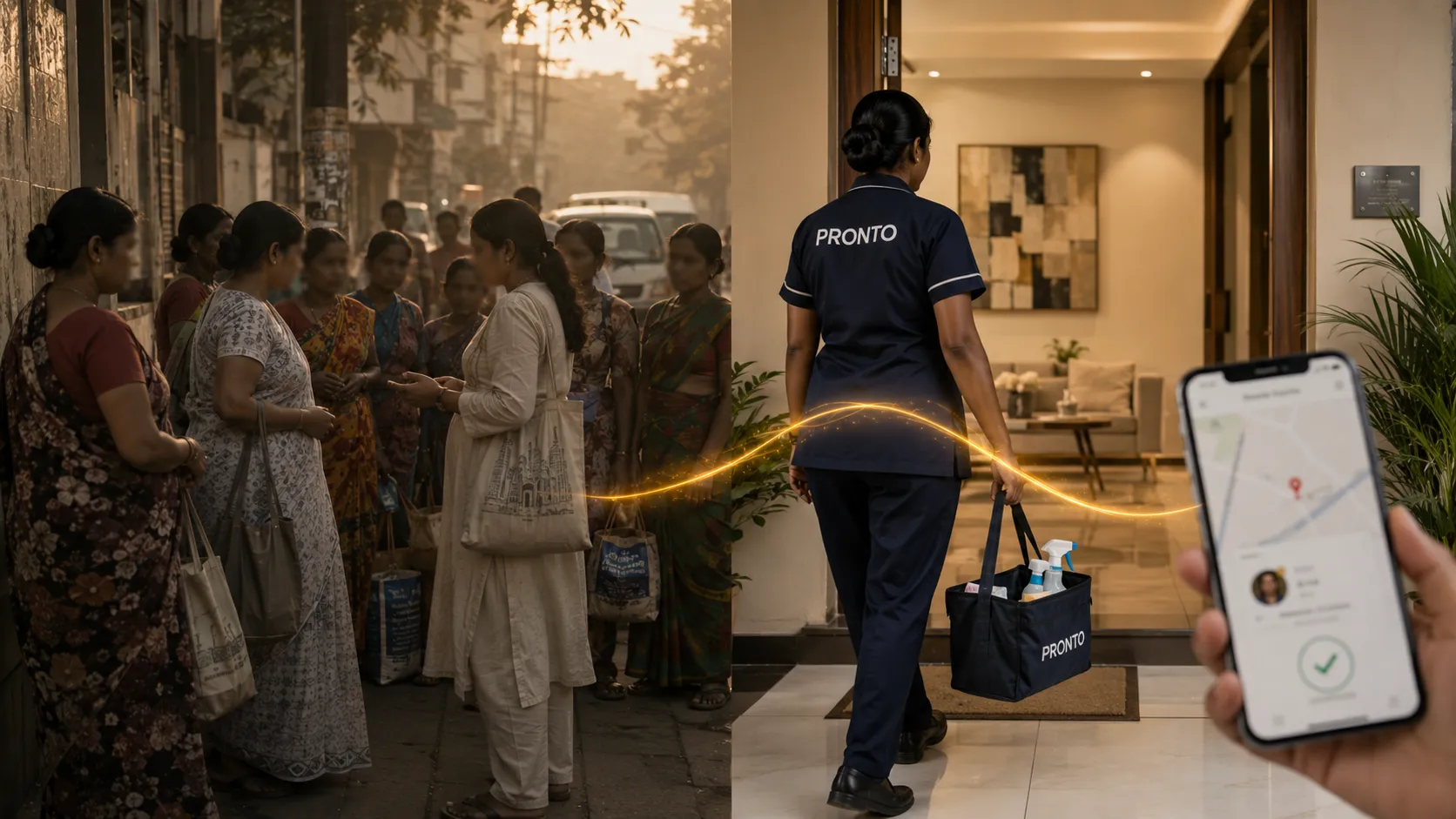
India's domestic-help economy is estimated to employ somewhere between 50 million and 100 million workers, making it one of the largest labour markets in the world. It operates almost entirely through informal neighbourhood networks, referrals, and building WhatsApp groups. Workers have no contracts, no benefits, no guaranteed hours, and no recourse if they are exploited or unpaid. Customers have no way to verify a worker's background, no guarantee of reliability, and no alternative when their regular help fails to show up. The market is vast, fragmented, and almost entirely unorganised — a $15 billion to $18 billion industry, according to Bank of America estimates, that has resisted every previous attempt at formalisation.
The previous attempts failed, Sardana believed, because they approached the problem as a marketplace problem. They built platforms that connected customers with freelancers, took a commission, and stepped back. The approach worked for Urban Company in the planned-services segment — book a beautician, a plumber, an electrician — but it failed for instant, daily household tasks like cleaning, utensil washing, laundry, and kitchen prep. The difference was not the task. It was the reliability requirement. A customer who books a plumber for Thursday afternoon can tolerate a cancellation. A customer who needs their kitchen cleaned at 8 a.m. on a Tuesday cannot. The instant-fulfilment layer that quick commerce had built for groceries — dark stores, shift-based workers, algorithmic dispatch — had never been applied to household labour. Sardana believed it could be. She launched Pronto in April 2025 to prove it.
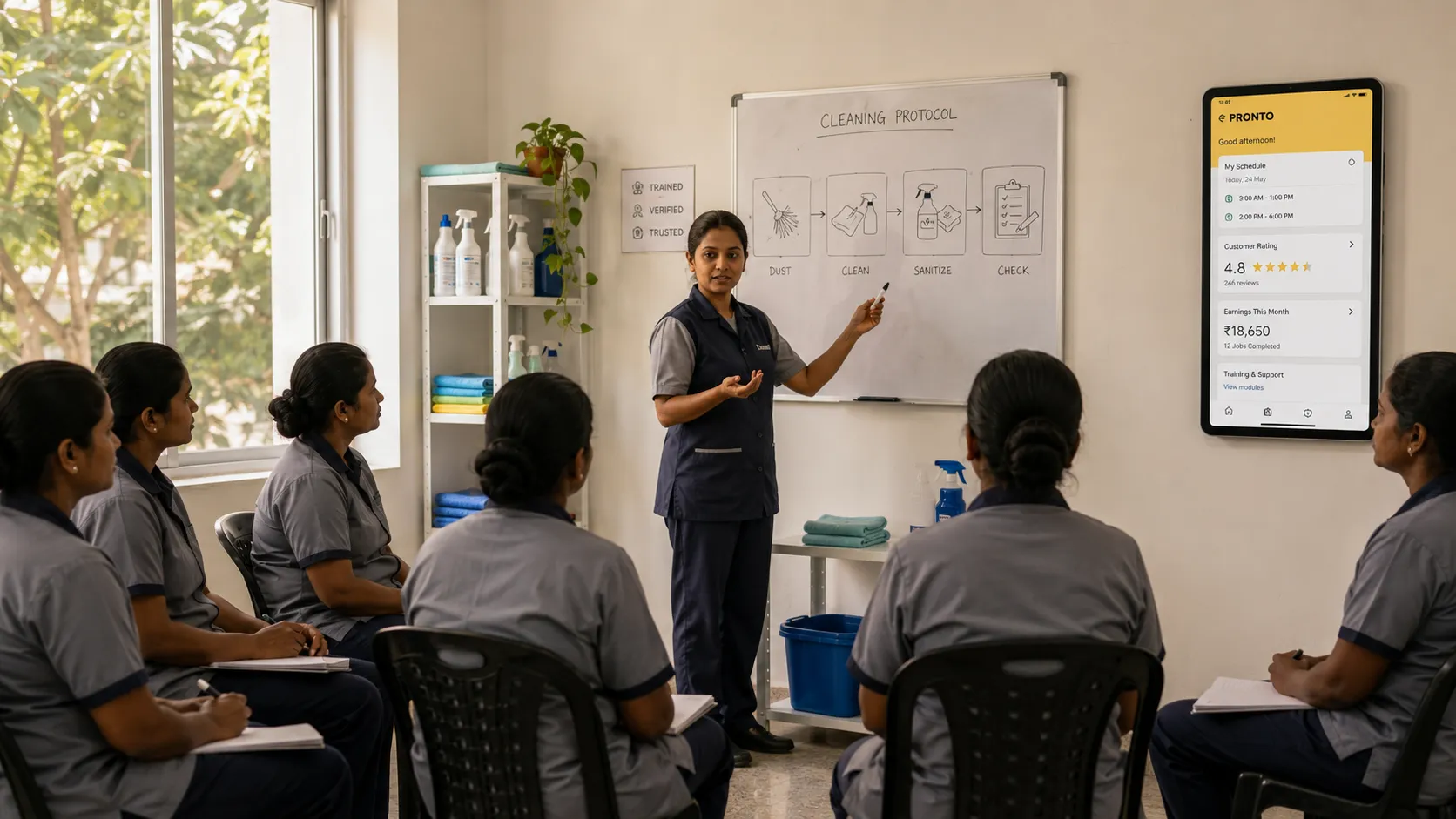
The first few months were brutal. Sardana slept on the floor of her Bengaluru apartment, as she later told the Hindustan Times, building the operational infrastructure of a company that was growing faster than her living situation could accommodate. She recruited workers directly — not through agencies, not through middlemen — training them, conducting background verification, and scheduling them through a shift-based system designed to improve reliability and service quality. The model was more expensive to build than a pure marketplace, but it produced something a marketplace could not: trust. A customer who knew that every Pronto worker was verified, trained, and managed by the company was a customer who would rebook. A worker who received stable income, predictable hours, and the dignity of formal employment was a worker who would show up. The flywheel began to turn.
The 20-Minute Pitch
The meeting with Lachy Groom was not Sardana's first encounter with Silicon Valley capital. Her Series A, raised in late 2025, had brought in General Catalyst and Bain Capital Ventures — elite firms that do not write cheques to unproven founders on a whim. But Groom was different. He was a solo investor, not a fund manager, which meant he could move faster, commit larger amounts, and make decisions based entirely on his assessment of the founder rather than on a committee's consensus. He had backed Zepto when it was still a pandemic-era experiment. He had co-founded Physical Intelligence, a robotics company that had raised hundreds of millions of dollars. His reputation in Silicon Valley was that of a picker — someone who bet on people, not on pitch decks.
The introduction came through Paul Hudson, founder of Glade Brook Capital, who had backed both Pronto and Physical Intelligence. Hudson arranged the meeting during Sardana's trip to San Francisco earlier this year. She walked in with a prepared presentation. Groom stopped her before she was halfway through. "He indexes two things," Sardana told TechCrunch. "One is the founder, and that's 95 percent of it. If he loves the founder, then he will invest." The remaining 5 percent, she said, came down to the scale and potential of the business. Groom had seen enough of both.
"He indexes two things. One is the founder, and that's 95% of it. If he loves the founder, then he will invest," she told TechCrunch, adding that the rest comes down to the scale and potential of the business. The deal came together within weeks. Groom committed $20 million, valuing the company at $200 million — double its valuation from March, and roughly eight times its valuation from late 2025. The round brought Pronto's total funding to approximately $60 million, with a cap table that now includes General Catalyst, Bain Capital Ventures, Glade Brook Capital, Epiq Capital, and one of the most respected solo investors in Silicon Valley.
Groom's own explanation for the bet was characteristically direct. He said he was drawn to Pronto's ambition to build what he called the world's largest platform for organising domestic labour, starting with India's vast and largely unstructured workforce. "The work underneath that is genuinely hard, and most attempts in adjacent categories have struggled with the operational discipline," he said. Sardana and her team, he added, were operating "at a level I haven't seen elsewhere in this space."
The Supply-Side Revolution
The most strategically significant decision Sardana has made is not the funding rounds or the technology stack. It is the decision to treat worker supply, not customer demand, as the binding constraint on growth.
In the conventional startup playbook, demand is king. Companies raise capital, spend it on marketing, acquire customers, and then — eventually, perhaps — figure out how to serve them. Pronto inverts the logic. Sardana has been explicit, in every interview and investor conversation, that the company is "much more supply constrained even today than we were a month ago." The bottleneck is not customers. The bottleneck is trained, verified, reliable workers. The company that solves the supply problem first will capture the market, because customers will flock to the platform that can actually deliver on its promises. The company that chases demand first will fail, because it will promise a service it cannot fulfil.
The operational model reflects that philosophy. Pronto does not function as a marketplace connecting customers with freelancers. It recruits workers directly — currently over 10,000 professionals across 15 cities — and employs them through a shift-based system. The company trains each worker, conducts thorough background verification, and schedules them through a proprietary dispatch algorithm designed to maximise utilisation while minimising travel time between jobs. The model is more expensive to operate than a pure marketplace, but it produces something that marketplaces cannot: reliability. A customer who books a Pronto cleaner at 8 a.m. knows that a trained, verified professional will arrive at 8 a.m., not sometime between 8 and 10, and not at all if the worker finds a better-paying job on a competing platform.
The worker-acquisition challenge has become, as Sardana puts it, "significantly more competitive" than customer acquisition. Pronto currently sources approximately 60 percent of new workers through referrals — a channel that Sardana describes as the company's "most scalable and sustainable supply onboarding channel." The company has been experimenting with variable referral incentives, milestone-linked payouts, gifts, and gamified leaderboards to drive worker onboarding. The supply crunch has been exacerbated in recent weeks by cyclical disruptions, including migrant workers temporarily returning to their home states during election season, but the underlying dynamic is structural: the demand for reliable, formalised household labour is growing faster than the supply of workers willing to be formalised.
The competitive landscape is intensifying. Urban Company, which helped formalise India's home-services market over the past decade, has scaled its instant-services vertical rapidly. Snabbit, a direct competitor, raised $56 million in April from Susquehanna Venture Capital, Mirae Asset, and Bertelsmann India Investments. A clutch of smaller startups are racing to build instant home-services platforms in what is increasingly looking like the next great consumer internet battlefield — a category that could replicate the trajectory of quick commerce, which barely existed five years ago and is now a multi-billion-dollar industry.
Pronto's differentiation is its operational discipline. Unlike platforms that largely function as marketplaces, Pronto is attempting to build a tightly managed operations-led model that controls the entire value chain — recruitment, training, scheduling, dispatch, quality assurance, and payments. The distinction is becoming central to the company's pitch. "Urban Company largely optimised planned services where consumers book appointments in advance," said Chandramouli Nilakantan, CEO of TRA Research. "Pronto is trying to build an instant-fulfilment layer for household services, which fundamentally changes the operating model and the value proposition."
The Dignity Gap
The most powerful dimension of the Pronto story is not the valuation or the growth rate. It is the problem that Sardana identified — a problem that the market had spent decades failing to see, because the people who design markets are rarely the people who suffer from their failures.
The domestic-help economy in India is broken for customers. It is even more broken for workers. The workers — predominantly women, predominantly migrants, predominantly from the most economically vulnerable segments of Indian society — have no contracts. No benefits. No guaranteed hours. No protection against arbitrary dismissal, wage theft, or exploitation. The informality of the market is not an accident. It is a feature — one that benefits the intermediaries and the employers at the expense of the workers who are least able to absorb the cost.
Sardana's insight was that the demand side and the supply side of the market were two faces of the same structural failure. The customer who cannot find reliable help and the worker who cannot find stable employment are not separate problems. They are the same problem, seen from different angles. The solution — formalisation — addresses both simultaneously. A worker who is employed by a company, trained, verified, scheduled, and paid through a formal system is a worker who shows up. A customer who trusts that the worker will show up is a customer who rebooks. The economics of trust, once established, compound.
"Quality, safety and reliability" are the three words Sardana uses most frequently when describing Pronto's focus areas. The quality comes from training and standardisation. The safety comes from background verification and formal employment records. The reliability comes from the shift-based scheduling system and the dispatch algorithm that matches workers to jobs in real time. None of these is individually revolutionary. The combination — applied to a market that has never experienced any of them — is.
The company has been deliberate about its service categories, focusing on the high-frequency, repeat-use tasks that generate the kind of habit formation that drives retention: general cleaning, washing utensils, laundry, kitchen cleaning, and bathroom cleaning. The categories are unglamorous. They are also universal. Every household in urban India generates demand for these services, and the demand is daily, not occasional. The frequency is what makes the economics work: a customer who books cleaning three times a week is worth vastly more than a customer who books plumbing once a year.
The Road Ahead
Pronto is still an infant. The company was founded barely thirteen months ago. It has raised $60 million, built a network of 10,000-plus workers, and achieved a valuation that has doubled in a month — but it has not yet proven that the model can sustain profitability at scale. The unit economics of instant home services are brutal: worker wages must be competitive enough to attract supply, customer prices must be low enough to drive adoption, and the company's margin — the spread between the two — must cover training, verification, dispatch, quality control, marketing, and overhead. The path to profitability is visible, but it is not yet travelled.
The competitive landscape is intensifying rapidly. Urban Company is a well-funded, established incumbent with a decade of brand equity. Snabbit has raised $56 million and is scaling fast. The quick-commerce platforms — Zepto, Blinkit, Swiggy Instamart — could, in theory, extend their dark-store and delivery infrastructure into home services, leveraging their existing customer bases and operational expertise. The barriers to entry in the marketplace model are low. The barriers to entry in the operations-led model that Pronto is building are higher — but they are not insurmountable for a competitor with sufficient capital and patience.
Sardana's response to the competitive threat is to double down on what she believes is the only sustainable competitive advantage in the category: trust. A customer who has had a reliable, professional, safe experience with a Pronto worker will not switch to a competitor to save ₹50. A worker who receives stable income, predictable hours, and dignified treatment from Pronto will not abandon the platform for a competitor that offers marginally higher pay but no benefits, no training, and no security. The trust moat, once established, is extraordinarily difficult to breach — because it is built on thousands of individual, repeated interactions between workers and customers, each one a small deposit in a compounding account of reliability.
The company is currently building infrastructure to penetrate Tier 2 and Tier 3 cities — markets where the demand for formalised household help is growing as dual-income households proliferate and urbanisation accelerates. Sardana has identified technology as the foundation for capacity management and service improvement — the dispatch algorithms, the training modules, the quality-assurance systems that must scale with the worker base. The $45 million Series B provides the runway to build that infrastructure. The 26,000 daily bookings are the evidence that the demand exists. The 6,500 workers are the foundation of the supply. The 10,000-plus total network is the pipeline. The 70,000 daily bookings target is the near-term ambition.
What This Signals
The Pronto story is not primarily about a startup raising $45 million at a $200 million valuation. It is about the structural formalisation of one of the world's largest labour markets — and about the 23-year-old who saw the opportunity before anyone else.
For decades, India's domestic-help economy was treated as a cultural given — an informal, largely invisible network of workers and households that operated outside the formal economy and that resisted every attempt at organisation. The market was too fragmented, the trust requirements too high, the margins too thin, and the operational complexity too daunting for any company to solve. The previous generation of home-services startups — Urban Company, Housejoy, TaskBob — had succeeded in building marketplaces for planned, occasional services, but none had cracked the instant-fulfilment layer for the daily, repeat-use tasks that constitute the vast majority of household labour demand.
Sardana's insight was that the instant-fulfilment layer could be built — not by adapting the marketplace model, but by building an entirely different kind of company. A company that recruited, trained, and employed workers directly. A company that treated worker supply, not customer demand, as the binding constraint. A company that understood that the trust required to let a stranger into your kitchen at 8 a.m. could not be generated by a rating system — it had to be built through verification, training, scheduling, and the accountability that comes from formal employment. The model was more expensive to build than a marketplace. It was also the only model that would work.
The 23-year-old who slept on the floor of her Bengaluru apartment nine months ago is no longer sleeping there. The company she built in thirteen months is now valued at $200 million, backed by some of the most respected investors in Silicon Valley and India, and processing 26,000 bookings a day in 15 cities. The biology major from Georgetown who worked at Bain Capital and 8VC before deciding to build has built something that the market had spent decades failing to take seriously: a platform that treats household labour not as an informal, unorganised, low-status activity, but as a formal, professional, dignified occupation — and that treats the people who perform it not as interchangeable commodities, but as valued employees whose reliability and professionalism are the foundation of the business.
The $45 million is fuel. The 10,000 workers are the engine. The 26,000 daily bookings are the proof that the market exists. The 70,000 target is the next checkpoint. The $15 billion to $18 billion addressable market is the destination. The 23-year-old who pitched a Silicon Valley titan for twenty minutes and walked out with a $20 million commitment is just getting started. The floor is no longer where she sleeps. It is where the company is built.


