She Lost Her Father and Couldn't Find Help. So She Built India's Largest Mental Health Platform—and Spent a Decade Proving That Healing Can Scale.
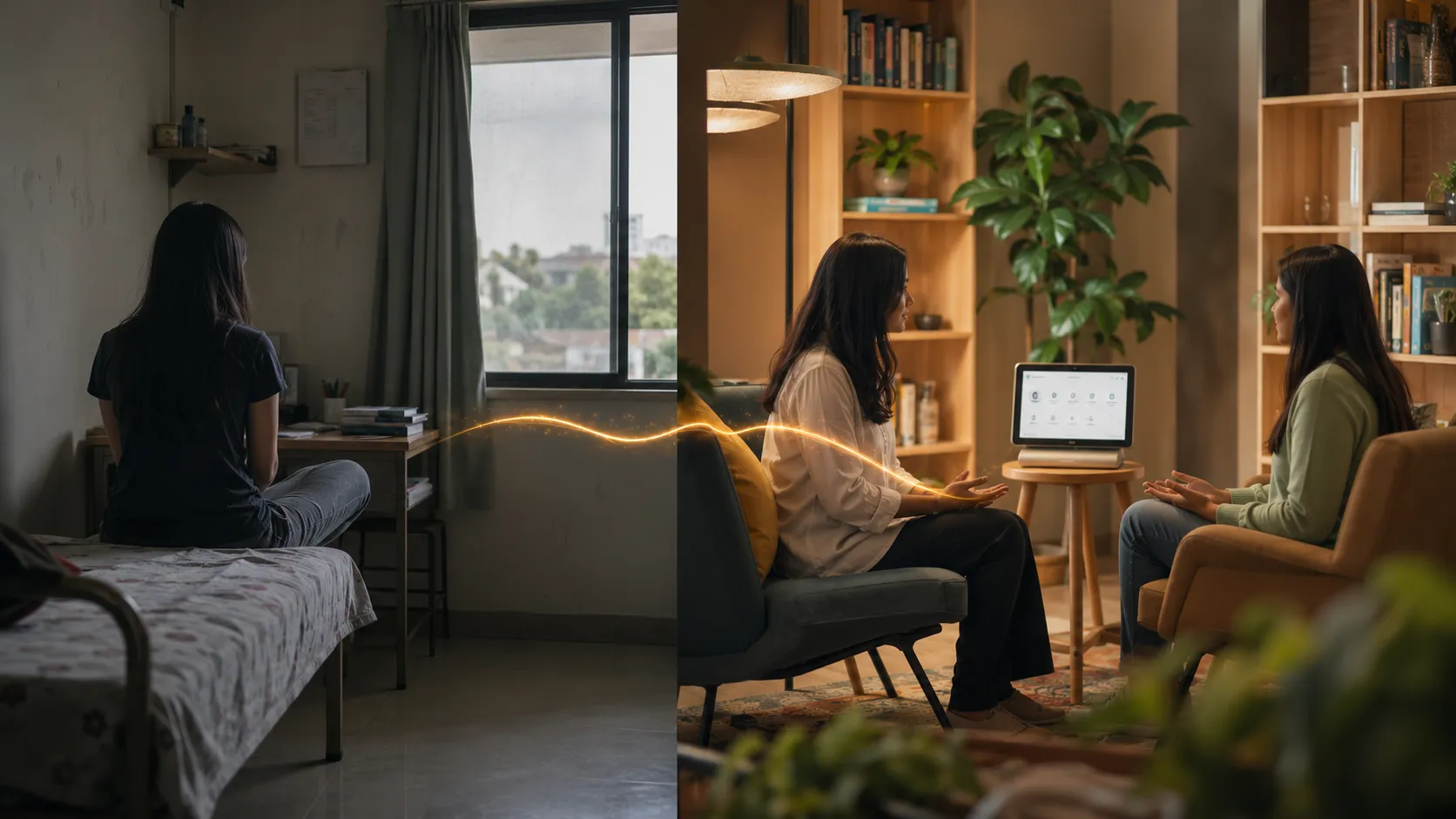
BENGALURU — May 25, 2026 — In 2008, Richa Singh was a first-year engineering student at IIT Guwahati, and her father was dead. He had been struggling with depression for years—a quiet, private battle that no one in the family knew how to talk about, that no doctor in their small town seemed equipped to treat, and that ended, as so many such battles do, without warning and without goodbye. Singh was 18 years old. She had just lost the most important person in her life. And in the months that followed, as grief settled into the spaces where her father used to be, she discovered something that infuriated her almost as much as the loss itself: there was nowhere to go for help.
The college counselling centre was understaffed and overburdened. The psychologists in Guwahati were expensive, hard to find, and came with the kind of stigma that made seeking help feel like an admission of weakness. The friends who might have listened were themselves unprepared for the weight of what she was carrying. The mental health infrastructure that she needed—therapists, support groups, a community of people who understood—did not exist in any form that was accessible, affordable, or free of judgment. She was, in the most literal sense, alone with her grief. And she decided, with the clarity of someone who has nothing left to lose, that she would build the thing that was missing.
Six years later, in 2014, Singh launched YourDOST—an online platform that connects people struggling with mental and emotional health to psychologists, therapists, coaches, and peer mentors. The name means "your friend" in Hindi, and the architecture of the platform reflects the insight that drove its creation: most people who need mental health support do not need a psychiatrist. They need someone to talk to—someone who will listen without judgment, who will offer practical strategies for managing anxiety or grief or workplace stress, and who will not charge a fee that requires a month's salary. YourDOST built exactly that. A decade after its launch, the platform has served more than 10 million users across India, built a network of over 2,000 mental health professionals, and become one of the largest and most trusted mental wellness platforms in the country. The company has raised funding from Lumis Partners, Alteria Capital, and a roster of institutional investors, and it has been profitable—a word that is almost never associated with mental health startups, the vast majority of which burn through venture capital and disappear. The woman who lost her father and found no help has built the help that millions of others have found.
The IIT Engineer Who Chose Care Over Code
Richa Singh was not supposed to build a mental health platform. She was supposed to become an engineer. She graduated from IIT Guwahati with a degree in mathematics and computing—the kind of credential that leads to high-paying jobs at software companies, consulting firms, or investment banks. She did exactly that for several years, working at an analytics startup and building the kind of career that her family had expected of her.
But the grief did not leave. It settled, as grief does, into something quieter and more persistent—a question that followed her through every job, every city, every conversation. Why was there no easy way for someone in emotional distress to find help? Why were therapists so expensive, so hard to find, so wrapped in stigma? Why had the internet—which had democratised access to information, to entertainment, to commerce—failed so completely to democratise access to mental health support? The questions accumulated. The answers did not. In 2014, she quit her job, assembled a small team, and began building the platform that would become YourDOST.
The early years were defined by a challenge that no technology could solve: stigma. India has one of the highest rates of mental illness in the world—the World Health Organisation estimates that nearly 150 million Indians need mental health interventions—and one of the lowest rates of treatment-seeking. The reasons are complex. Mental illness is often understood as a moral failing rather than a medical condition. Psychologists and psychiatrists are often seen as a last resort, reserved for people who are "crazy." Seeking help is perceived, particularly among men and in smaller towns, as a sign of weakness. The barriers to care are not just economic. They are cultural, and they are deeply embedded.
Singh's insight was that the platform itself could be designed to reduce those barriers. YourDOST is not a clinical service. It is a wellness platform—a framing that makes it easier for users to seek help without the weight of a psychiatric diagnosis. The counsellors are called "experts." The sessions can be anonymous, conducted over chat or voice call, so the user never has to walk into a therapist's office or be seen entering a mental health clinic. The pricing is deliberately accessible—far cheaper than traditional therapy—and the platform offers a range of services, from one-on-one counselling to group workshops to self-help content, so users can engage at whatever level feels comfortable. The design philosophy is simple: meet people where they are, not where the mental health establishment expects them to be.
The approach worked. University students, who had been among the most underserved populations for mental health support, became one of the platform's largest user segments. Corporate employees, whose stress and burnout had been normalised as part of professional life, began using the platform through employer-sponsored wellness programmes. Individuals in Tier-2 and Tier-3 cities, where the density of mental health professionals is a fraction of what it is in the metros, found access to counsellors who spoke their language and understood their cultural context. The platform that Singh had built to solve her own problem was solving the same problem for millions of others—at a scale that no physical mental health clinic could match.
The COVID-19 pandemic was, for YourDOST, the moment the market caught up to the mission. The lockdowns, the isolation, the fear, the loss—the entire country was suddenly experiencing the kind of emotional distress that Singh had experienced alone in her IIT dorm room. The platform's usage surged. Corporate partnerships expanded. The stigma around mental health, which had been slowly eroding for years, collapsed almost overnight as millions of people admitted—publicly, on social media, in conversations with friends and colleagues—that they were struggling and needed help. The pandemic was a tragedy. It was also, for YourDOST, a validation of everything Singh had been building for the previous six years. The platform was ready. The users arrived. The grief that had once been private became a public conversation, and YourDOST was at the centre of it.
The Profitability That Nobody Expected
The most remarkable thing about YourDOST is not the number of users or the scale of its counsellor network. It is the business model. The company is profitable—a word that is almost never associated with mental health startups.
The global mental health startup landscape is littered with the wreckage of companies that raised significant venture capital, pursued growth at any cost, and collapsed when the funding dried up. The unit economics of mental health care are punishing: the cost of recruiting, training, and retaining qualified therapists is high, and the price that consumers are willing to pay is constrained by the same stigma that makes them reluctant to seek help in the first place. The result is a sector that has burned through billions of dollars in venture capital with very little to show for it in terms of sustainable, profitable businesses. YourDOST has navigated this landscape with a discipline that is unusual for a mission-driven startup. Singh was clear from the beginning that the company would not subsidise growth with investor capital. It would charge for its services. It would build a revenue model that was sustainable from the start. And it would grow not by chasing the largest possible user base, but by serving the users who valued the service enough to pay for it.
The revenue comes from three streams: direct-to-consumer subscriptions, corporate wellness programmes, and educational institution partnerships. The corporate channel, in particular, has been the engine of growth. Companies across India—IT services firms, banks, manufacturing companies, startups—have begun offering YourDOST as an employee benefit, recognising that the mental health of their workforce is not just a moral obligation but a productivity imperative. The corporate partnerships provide a stable, recurring revenue base that insulates the company from the volatility of the consumer market.
The profitability milestone is significant not just for YourDOST, but for the broader mental health ecosystem. It demonstrates that a platform built on compassion and clinical rigour can also be built on sustainable economics. It demonstrates that the Indian consumer will pay for mental health support—not at luxury prices, but at a level that supports a viable business. And it demonstrates that a woman founder who was driven by personal loss can build an institution that outlasts the funding cycles and the market crashes that have claimed so many of her competitors. Singh has not disclosed the company's exact revenue or profit figures, but she has been clear about the philosophy: "We didn't want to build a company that would die when the venture capital dried up. We wanted to build a company that would still be here in twenty years, still helping people, still growing, because it earns its own keep."

The Decade of Quiet Persistence
The most striking thing about Richa Singh's journey is not the dramatic moments. It is the absence of them. She did not have a viral launch. She did not raise a headline-grabbing funding round. She did not appear on Shark Tank or become a LinkedIn celebrity. She spent a decade building, quietly and persistently, in a sector that the startup ecosystem has consistently undervalued and misunderstood. The mental health space in India is not considered "venture scale" by most investors—the exits are unclear, the regulatory environment is evolving, and the path to a billion-dollar valuation is obscure. The companies that get the most attention in Indian health-tech are the ones building surgical robots, AI diagnostics, or pharmaceutical platforms—technologies that can be protected by patents and scaled through hospitals. A platform that connects people to counsellors, that relies on human empathy rather than machine learning, and that serves a market that has been systematically ignored by the formal healthcare system, does not fit the template. Singh built it anyway.
The company has raised approximately $10 million to date—a modest sum by startup standards, and a fraction of what has been poured into Indian edtech, fintech, and consumer internet companies. The investors who backed YourDOST—Lumis Partners, Alteria Capital, and a roster of angel investors—are not the names that dominate the front pages of the business press. They are patient capital providers who understood, earlier than most, that the mental health market in India was larger than the venture-capital consensus believed, and that the company that built the most trusted brand in that market would have a durable competitive advantage. The patience has been rewarded. YourDOST is one of the largest mental health platforms in India. It has survived a decade of scepticism, of stigma, and of the brutal economics of healthcare delivery. It is still growing. It is still helping people. The woman who lost her father and found no help is still at the helm, still building, and still convinced that the grief she carried at 18 was not just a wound. It was a compass.
What This Signals
The Richa Singh story is not primarily about a mental health platform. It is about the structural failure of the Indian healthcare system to address the most common form of human suffering—and about what happens when someone who has experienced that failure decides to fix it.
Mental health is the most neglected dimension of Indian healthcare. The country has roughly 0.75 psychiatrists and 0.07 psychologists per 100,000 people—among the lowest ratios in the world. The national mental health budget is less than 1 percent of total health expenditure. The stigma that surrounds mental illness is pervasive and cuts across class, education, and geography. The result is a population in which an estimated 150 million people need mental health interventions, and fewer than 10 percent receive them. The gap between need and provision is not a gap. It is a chasm.
YourDOST has not closed the chasm—no single company could. But it has demonstrated that a technology platform can make a meaningful dent. The 10 million users who have accessed the platform, the 2,000-plus counsellors who have been trained and deployed, and the corporate and educational partnerships that have normalised mental health support in environments where it was previously taboo—all of it adds up to a structural intervention in a system that has failed its people for generations.
Richa Singh is no longer the 18-year-old in the IIT Guwahati dorm room, alone with a grief that had no outlet. She is the founder of India's largest mental wellness platform, the builder of a profitable business in a sector that has claimed most of its peers, and a quiet, persistent advocate for a cause that the startup ecosystem has spent a decade underestimating. The father she lost is still gone. The system that failed him has not been fully rebuilt. But the platform she built in his memory has served 10 million people—and the grief that once had no place to go has become the foundation for something that is helping others find theirs


