Richa Kar — The Woman Who Normalized Lingerie Shopping in India and Built a ₹1,600 Crore Business
The Problem That No One Was Talking About
In 2011, Richa Kar was working as a retail analyst at Spencer’s Retail in Kolkata. In her role, she noticed a striking pattern: women would walk into the store, pick up lingerie after only a cursory glance, pay quickly, and leave — almost furtively. There was no consultation, no trying on, no discussion of fit or fabric. The lingerie section was often tucked away in a corner, staffed reluctantly by salespeople who had little training.
Richa understood why. Growing up in Jamshedpur in a conservative Marwari family, she had experienced the same awkwardness herself. Lingerie was a “shameful” purchase — something to be hidden, not discussed. Women wore ill‑fitting bras because they had no access to expert advice, no way to try multiple sizes, and no safe space to ask questions.
She also saw the data. India’s intimate‑wear market was growing at 15% annually, but 90% of sales still happened through unorganized retail — small shops where bras were stacked in dusty cardboard boxes, with no brand differentiation, no size inclusivity beyond 32B/34B, and zero post‑sales support.
Richa, who held an MBA from NMIMS Mumbai and had previously worked at SAP, realized that e‑commerce could solve this problem. An online platform could offer privacy (no judgmental shopkeeper), selection (dozens of brands), fit guidance (through content and algorithms), and home delivery (no awkward checkout).
The idea for Zivame was born. The name, derived from the Persian word Ziv meaning “light” and the Hindi word Zameen meaning “earth,” was meant to signify a grounding light for women.
Bootstrapping Through Social Taboos
Richa quit her job in 2011. She had no venture capital, no co‑founder, and no tech team. She used her savings — approximately ₹15 lakh — to build a basic website. She personally visited lingerie manufacturers in Bengaluru’s Peenya industrial area, convincing them to list their products on a platform that didn’t yet have a single customer.
The early days were brutal. Family members asked why she was wasting her MBA on “underwear business.” Manufacturers laughed at her. Even some women she interviewed for market research were too embarrassed to discuss their size.
But Richa persisted. She launched Zivame.com in late 2011 with 500 SKUs from 10 Indian brands. To solve the fit problem — the single biggest barrier to online lingerie purchase — she created a Fit Guide: a step‑by‑step tutorial with illustrations explaining how to measure band size, cup size, and sister sizes. It was the first time an Indian website had published such content in plain Hindi and English.
Customers responded. Within six months, Zivame was shipping 1,000 orders a month. Richa personally wrote thank‑you notes for the first 500 orders. She also introduced a “try at home” policy — a risky move given the hygiene concerns, but one that built trust. Customers could order multiple sizes, try them in privacy, and return the ones that didn’t fit.
The return rate was 15–20%, which she absorbed as a learning cost. But the data from returns taught her which brands had inconsistent sizing, which fabrics women preferred, and which styles (minimizer bras, sports bras, strapless) had the highest demand.
Breaking Through the Funding Barrier
In 2012, Zivame raised a seed round of $1 million from IDG Ventures and India Quotient. The investors were predominantly male, and Richa famously had to explain the difference between a padded bra and a push‑up bra in a pitch meeting. But she also showed them something more compelling: unit economics.
Unlike other e‑commerce companies that were burning cash on discounts, Zivame’s average order value (AOV) was ₹1,200, with gross margins of 40% (higher than fashion). Customer acquisition cost was under ₹300, thanks to organic traffic from the Fit Guide content. Repeat purchase rate was 35% — unusually high for a D2C brand.
By 2014, Zivame had raised a Series B of $6 million led by Unilazer Ventures (Ronald Perelman’s fund). The funding valued the company at $50 million. Richa used the capital to expand the product range to 5,000 SKUs across 50+ brands (including international names like Triumph, Wacoal, and Jockey) and to launch a mobile app.
The biggest innovation, however, came in 2015: Zivame Size Finder. Using a proprietary algorithm, customers could enter their current bra size, answer a few questions about fit issues (“straps slipping,” “band riding up,” “spillage”), and receive a recommended size and style. The tool reduced returns by 8 percentage points and increased conversion by 22%.
The Omnichannel Pivot: Zivame Studios
By 2016, Richa realized that some women would never buy lingerie online — no matter how good the Fit Guide. The need to touch fabric, see colour accurately, and, most importantly, speak to a trained fit expert was too strong.
So she opened the first Zivame Studio in Indiranagar, Bengaluru — a physical store that looked nothing like a traditional lingerie shop. It had well‑lit changing rooms, non‑judgmental staff trained to measure and advise, and a “woman‑only” policy during certain hours. Most importantly, the store integrated with the app: customers could scan a QR code to see online reviews, check availability in other sizes, and order home delivery if the store was out of stock.
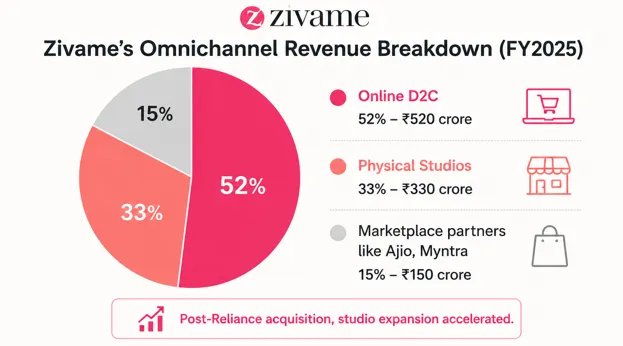
The model worked. By 2018, Zivame had 35 studios across 12 cities. The omnichannel customer had a 3x higher lifetime value than online‑only customers, and physical stores were profitable within 12 months of opening.
Richa also launched private labels — Zivame Classic and Zivame Luxe — which offered better margins and exclusive designs. By 2019, private labels accounted for 30% of revenue.
Acquisition by Reliance Retail and Richa’s New Role
In 2020, despite the COVID‑19 lockdown, Zivame’s online sales surged 70% as women working from home sought comfortable loungewear and sports bras. The company was on track to hit ₹350 crore in annual revenue, with contribution margin positive.
In September 2020, Reliance Retail acquired a majority stake in Zivame for an estimated ₹1,600 crore (~$215 million). The deal gave Reliance a strong foothold in the fast‑growing intimate‑wear market and access to Zivame’s proprietary fit technology and customer data.
Richa Kar stayed on as Director and a significant shareholder. Under the Reliance umbrella, Zivame has expanded to over 100 studios inside Reliance’s shopping malls, integrated with Ajio (Reliance’s fashion platform), and launched exclusive collections using Reliance’s textile manufacturing capabilities.
As of 2026, Richa is no longer involved in day‑to‑day operations, but she remains an active board member and brand ambassador. Her personal stake in the company is estimated at ₹200–300 crore, making her one of the wealthiest self‑made women in Indian consumer tech.
The Cultural Impact
Beyond the business metrics, Richa Kar’s greatest contribution has been cultural. Zivame normalized conversations about women’s bodies and lingerie in a country where such topics were taboo. Through campaigns like “Free the Girls” (no padding, no push‑up), “My Size, My Choice,” and “The Perfect Fit is You,” she challenged the notion that lingerie is only about male gaze.
She also forced the industry to become more size‑inclusive. Before Zivame, most Indian brands stocked only sizes 32B–36C. Zivame’s data showed that 30% of women need sizes outside this range (28A, 38DD, 42E, etc.). She worked with manufacturers to expand production — a move that major brands eventually followed.
In 2023, the Indian government recognized her as one of the “Women Transforming India” under the NITI Aayog’s Women Entrepreneurship Platform.
Challenges and Critiques
Richa’s journey was not without missteps. In 2017, Zivame faced a data breach where customer order details (though not payment information) were exposed. The company was criticized for slow response and poor communication. Richa personally apologized and invested ₹5 crore in cybersecurity upgrades.
Another criticism was that Zivame’s initial marketing overly relied on “shame‑based” messaging (e.g., “Don’t suffer in silence”) — which some felt perpetuated the very taboo it was trying to break. Richa later acknowledged this and shifted to more empowering campaigns.
Post‑acquisition, some employees felt that the startup culture was lost under Reliance’s corporate structure. Richa, however, has defended the acquisition as the right move for scale. “We couldn’t have built 100 stores on our own. Reliance gave us distribution and logistics. That’s how you win.”
Lessons for Entrepreneurs
Solve a taboo problem with dignity: Richa didn’t sensationalize lingerie; she professionalized it.
Content before commerce: Her Fit Guide was the real MVP — it educated, built trust, and drove SEO.
Omnichannel for sensory products: Some categories need physical touch; denying that is arrogance.
Acquisition is not failure: A ₹1,600 crore exit is a win, even if you don’t go public.
The Road Ahead
As of 2026, Richa Kar is 46 years old. She invests in early‑stage women’s health and wellness startups through her family office, Kar Capital. She is also writing a book on “Building Brands in a Taboo Economy.”
Zivame, now part of Reliance Retail, continues to dominate the Indian intimate‑wear market with over 40% online market share. The brand has launched sustainable lingerie made from recycled polyester and bamboo fibre, a nod to changing consumer preferences.
Richa’s legacy is secure: she is the woman who taught India to speak freely about bras, bodies, and fit — and built a ₹1,600 crore business along the way.