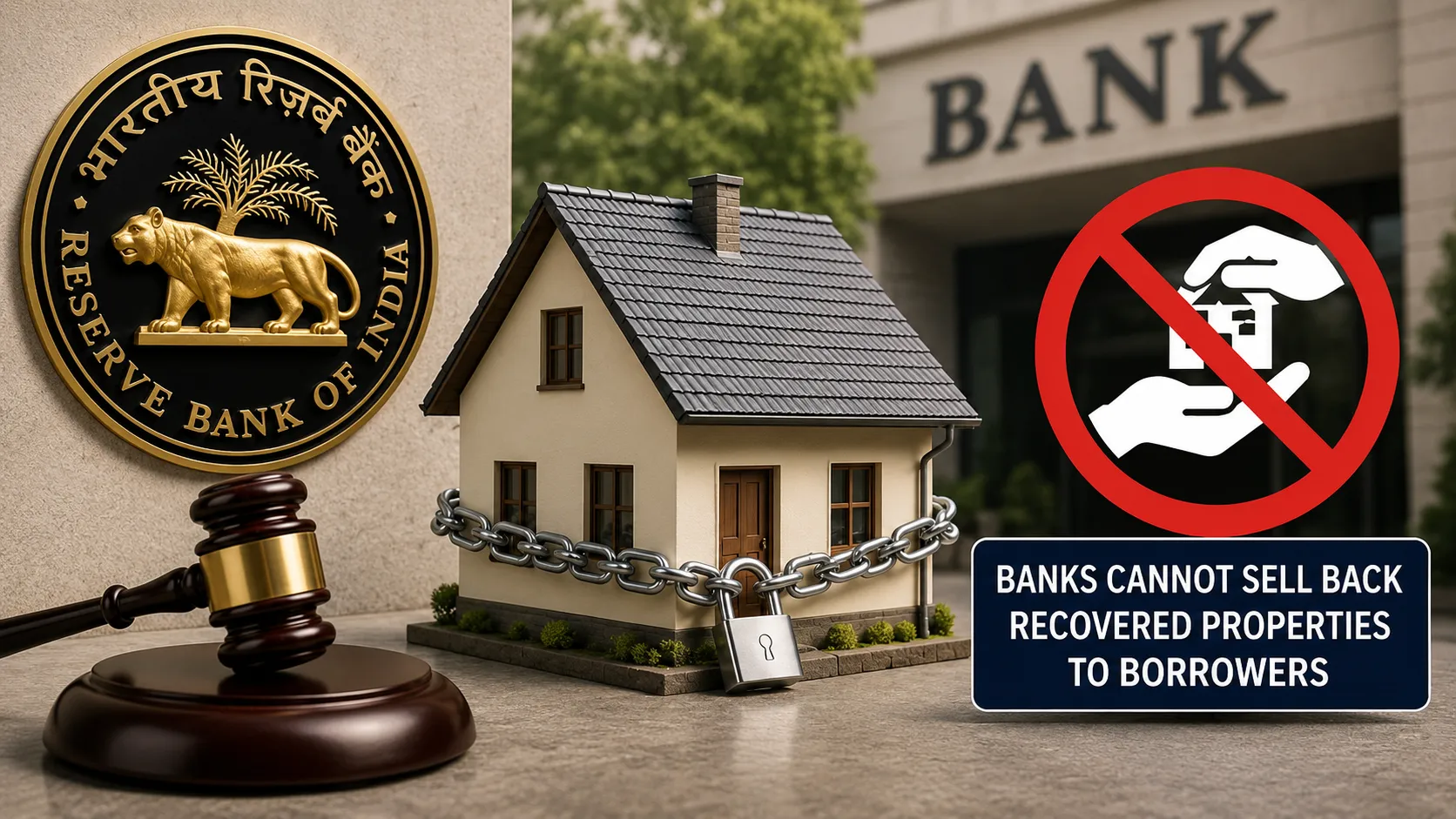
The Reserve Bank of India has introduced a comprehensive new framework governing how banks should acquire, value, and dispose of properties taken over from defaulting borrowers — a set of rules aimed at bringing greater transparency and strengthening prudential standards around a part of the banking business that, while less visible than everyday lending and deposit-taking, plays a meaningful role in how efficiently banks recover value from bad loans and how quickly distressed assets return to productive economic use.

Why This Framework Exists
When a borrower defaults on a secured loan — most commonly a home loan, commercial property loan, or business loan backed by real estate collateral — banks in India have long had legal mechanisms, most notably under the SARFAESI Act (Securitisation and Reconstruction of Financial Assets and Enforcement of Security Interest Act), to take possession of the underlying collateral and eventually sell it to recover the outstanding loan amount. In practice, however, the process of taking possession, valuing, holding, and eventually disposing of these seized properties has historically been marked by inconsistency across different banks, occasional delays that leave properties sitting on bank balance sheets for extended periods without generating value, and, in some cases, valuation practices that lacked the transparency needed to ensure fair outcomes for all parties, including the defaulting borrower, who typically retains a residual claim to any sale proceeds exceeding the outstanding loan amount plus recovery costs.
The new RBI framework appears designed to address these longstanding inefficiencies by standardizing practices across the banking sector — establishing clearer expectations for how quickly banks should move from taking possession of a property to formally valuing it, what valuation methodologies and independent assessment standards should apply, and how the eventual disposal process (typically through auction or negotiated sale) should be conducted to maximize recovery value while remaining fair and transparent to all stakeholders.
The Problem of 'Zombie' Properties on Bank Balance Sheets
One of the specific problems the new framework appears aimed at addressing is the phenomenon of banks holding seized properties for extended periods without disposing of them — sometimes referred to informally as "zombie" assets that sit on bank balance sheets generating no economic value, tying up capital that could otherwise be redeployed toward productive lending, and, in the case of physical real estate, often deteriorating in condition or losing market value the longer they remain unsold and unmaintained. From a macroprudential perspective, a banking system with a large stock of slow-moving, undisposed seized assets represents a form of inefficiency that can weigh on overall banking sector profitability and capital efficiency, even if the underlying loan losses have already been recognized and provisioned for on paper.
Implications for Banks
For banks, the new framework likely introduces both operational obligations and, potentially, new disclosure or reporting requirements around their stock of seized properties, encouraging (or in some respects mandating) faster timelines from possession to disposal. This could have several downstream effects on bank financial performance: faster disposal of seized assets could improve capital efficiency by converting non-performing, non-income-generating assets into cash more quickly, which can then be redeployed into new lending. It could also affect how banks report and provision for these assets on their balance sheets, potentially requiring more frequent or standardized revaluation exercises that could, in some cases, surface previously unrecognized value erosion if properties have been held for extended periods without adequate maintenance or market-value tracking.
Banks with historically larger stocks of slow-moving seized assets — often correlating with banks that have faced higher historical non-performing asset (NPA) ratios, including several public sector banks that went through significant asset quality stress in the years following India's mid-2010s banking crisis — may face more significant operational adjustments to comply with the new framework's timelines and standards compared to banks with historically leaner, faster-moving asset recovery processes.
Implications for Borrowers and the Broader Real Estate Market
For borrowers whose properties have been or may be seized following loan default, the new framework's emphasis on standardized, transparent valuation practices carries direct relevance: clearer valuation standards should, in principle, reduce the risk of properties being undervalued during the seizure and disposal process, which matters directly to defaulting borrowers since any sale proceeds exceeding the bank's outstanding claim (loan balance plus recovery costs) are typically required to be returned to the original borrower. More transparent, standardized valuation and disposal timelines could also benefit the broader real estate market by increasing the predictability and pace at which distressed properties re-enter the market, potentially improving price discovery in segments of the real estate market where seized or distressed properties represent a meaningful share of overall transaction volume.
For prospective buyers interested in purchasing bank-seized or auctioned properties — often perceived, rightly or wrongly, as a potential source of below-market-value real estate deals — a more standardized, transparent, and faster-moving disposal process could, over time, increase the overall volume and predictability of such auction opportunities, though it may also reduce the pricing inefficiencies that some opportunistic buyers have historically sought to exploit in a less standardized system.
The Bigger Picture: Prudential Standards and Banking Sector Health
This new framework arrives as part of a broader, ongoing pattern of RBI regulatory refinement aimed at strengthening prudential standards across India's banking sector, an effort that has spanned everything from stricter provisioning norms for stressed assets to enhanced governance requirements for both public and private sector banks in recent years. While the specific mechanics of property acquisition, valuation, and disposal may seem like a narrow, technical corner of banking regulation, the cumulative effect of these kinds of prudential refinements is a banking system that, over time, becomes more resilient, more transparent, and more efficient at recycling capital tied up in non-performing assets back into productive economic use — a meaningful, if often under-appreciated, contributor to overall financial system stability and credit availability for India's broader economy.