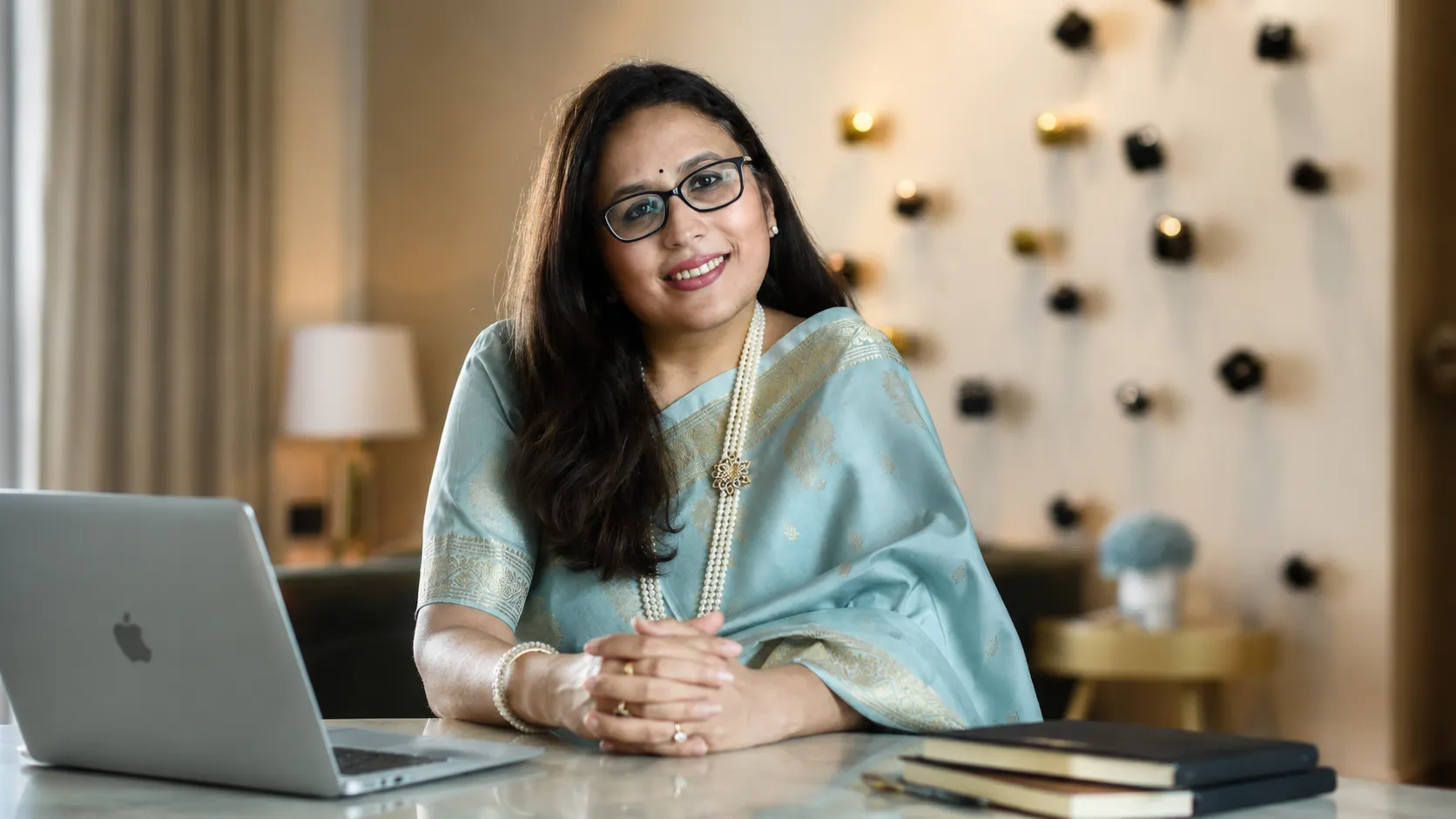
Radhika Gupta was born in Pakistan to an Indian diplomat. She grew up on four continents — India, Pakistan, Nigeria, the United States, and Italy — adapting to new cultures, new languages, and new schools before she had finished growing up. She arrived at the University of Pennsylvania, completed a dual degree from the Jerome Fisher Program in Management and Technology, graduated summa cum laude from the Wharton School in Economics alongside a BSE in Computer Science Engineering, and went to Wall Street.
She applied to thirteen jobs. She received thirteen rejections.
The rejections were not about her qualifications. She was, by every formal measure, among the best-qualified candidates in her cohort. The rejections were partly about something else: the tilt in her neck, a consequence of a childhood medical complication that she has described in a TEDx talk watched by millions, titled "The Girl With a Broken Neck." The talk is not primarily about her neck. It is about what happens when the world tells you that a visible difference is a disqualification — and what it requires of you to decide that it is not.
She eventually landed at McKinsey, moved to AQR Capital Management, returned to India, co-founded Forefront Capital Management (India's first domestic hedge fund), and when Edelweiss Financial Services acquired Forefront in 2014, she joined the company she would transform.
In 2017, at 34, Radhika Gupta became MD and CEO of Edelweiss Mutual Fund — the youngest person and the only woman to lead one of India's major asset management companies. In the industry that manages the savings of crores of ordinary Indians, she was, and remains, the only woman in the CEO's chair.
What She Built
The numbers tell the transformation story clearly. When Radhika took over, Edelweiss Mutual Fund had assets under management of approximately ₹6,700 crore and was ranked 30th among Indian fund houses. By January 2023, AUM had crossed ₹1 lakh crore. By 2026, it exceeds ₹1.2 lakh crore. The ranking moved from 30th to top 13.
That growth was not the product of a bull market alone. It was the product of a specific and deliberate strategy: a relentless focus on product innovation alongside investor education, in a country where the majority of household savings still sit in fixed deposits and gold rather than in equity or debt mutual funds.
The Bharat Bond ETF, launched in 2019 as India's first corporate bond ETF, is the product innovation that most concisely captures Radhika's approach. It solved a specific and important problem: individual retail investors in India could invest in government bonds, but access to high-quality corporate bonds — the bonds issued by PSU companies that carried implicit sovereign backing but paid better yields than government securities — was largely restricted to large institutions. Bharat Bond ETF made that access democratic. Anyone with a demat account and a few thousand rupees could own a basket of AAA-rated PSU bonds through a transparent, low-cost exchange-traded product.
The acquisition and seamless integration of JP Morgan Mutual Fund in 2016-2017 added institutional scale and credibility. The emphasis on digital platforms, accessibility, and investor education positioned Edelweiss as a brand that spoke to first-time investors rather than assuming they already knew what a NAV was.
On Financial Literacy — and What India Still Needs
Radhika Gupta's public communication about financial literacy is distinguished by its consistency and its simplicity. She has the credentials to speak in jargon. She consistently chooses not to.
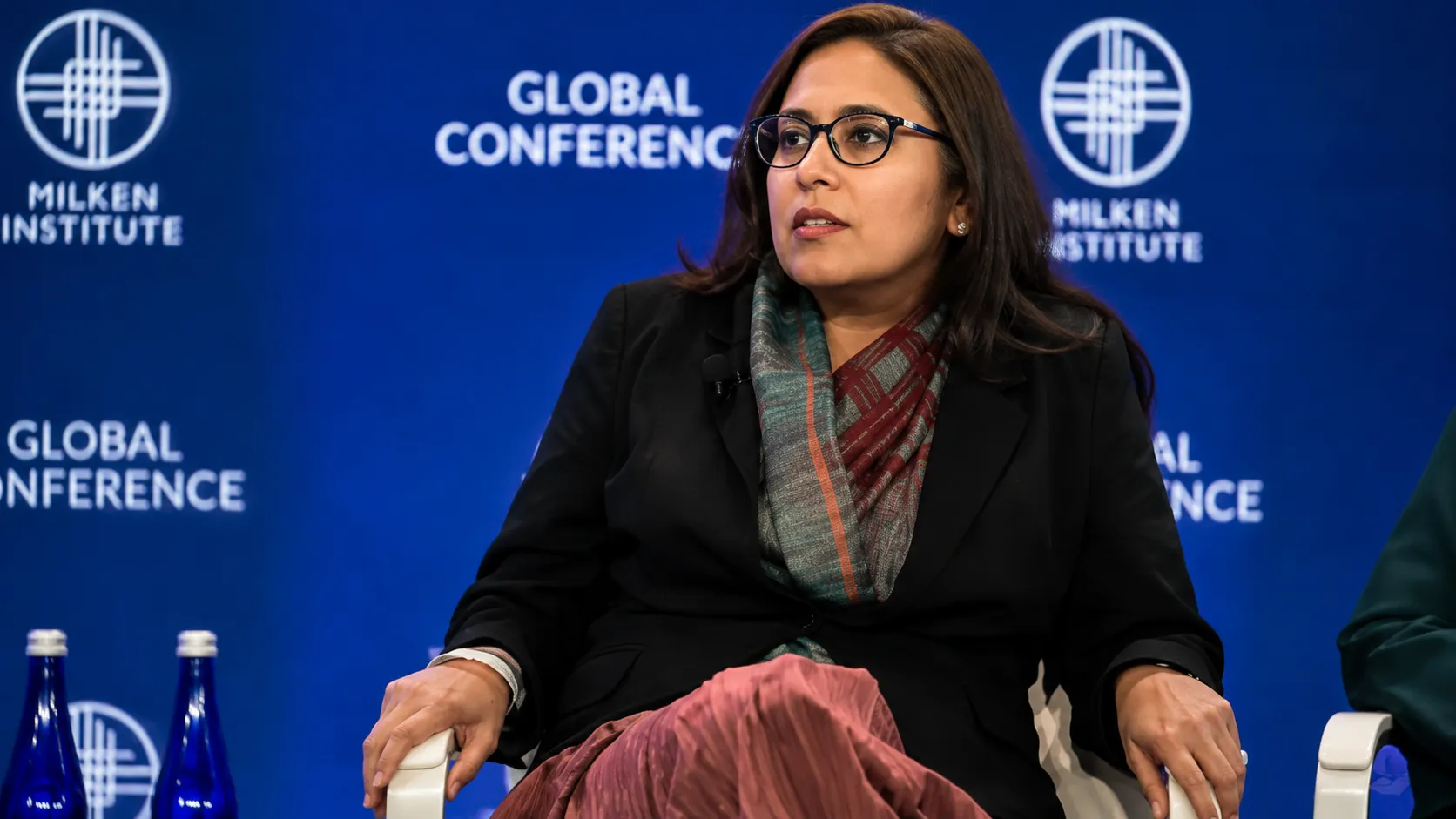
Her advocacy for SIPs — Systematic Investment Plans, the mechanism by which a fixed amount is invested in a mutual fund at regular intervals regardless of market conditions — is grounded in a specific and defensible argument: that most retail investors do not have the skill, the time, or the temperament to time the market effectively, and that regular, automated, diversified investing over long time horizons outperforms most individual stock-picking attempts. She calls SIPs an "accessible savings-cum-growth solution" trusted by crores of Indians.
What she says alongside that advocacy is equally important. In July 2025, she posted on X: "My job is to sell SIPs, but I always tell everyone — young and old — to take the time to enjoy the fruits of your hard work. Save, but also spend, on things that give you happiness and fulfilment." This is not the message that maximises fund flows. It is the message that builds financial trust over a lifetime. The distinction is a deliberate choice.
Her "dal-chawal portfolio" framework — 80 per cent in stable long-term funds and 20 per cent in higher-risk thematic opportunities — extends the simplicity principle. The metaphor is specifically chosen to be accessible to an Indian household where "dal-chawal" is the baseline of a reliable meal. The staple investment, the one that forms the foundation, should be boring and reliable. The exciting allocation is the 20 per cent, not the 80.
For women specifically, Radhika has consistently argued that financial literacy is not separable from financial agency — that knowing how to invest is meaningless if the money is not yours to invest. In India, where a significant proportion of women still do not have independent control over household finances, the conversation about investing necessarily starts earlier than it does for men. The first step is not choosing between equity and debt. It is having the money, the knowledge, and the cultural permission to choose at all.
On Women and Finance — the Gap Nobody Has Closed
The fact that Radhika Gupta is the only woman CEO among India's major mutual fund companies is a specific and important data point. The mutual fund industry manages the savings of millions of Indian households, and women are a majority of those households. The industry's leadership does not reflect that customer base.
This is not merely a representation problem. It is a product problem. When the people designing, marketing, and explaining investment products are not women, the products and the communication are often not designed for how women actually interact with money. The pitch that works for a 35-year-old male software engineer in Bengaluru does not necessarily work for his wife who has paused her career to raise children, or for the homemaker in a Tier 2 city who manages the household budget and has never been spoken to by a financial services company as though she were a capable financial decision-maker.
Radhika has spoken about this gap explicitly and repeatedly: the need for more women in financial services leadership, not as a diversity metric but as a product and communication strategy. Financial products designed by women for women, explained in the register that speaks to women's actual financial lives, will reach a market that the current industry is largely ignoring.
Her books — Limitless and Mango Millionaire — both attempt to bridge this gap through narrative. Limitless, in particular, combines personal resilience story with practical wealth-building principles in a format that has connected with audiences who would not pick up a conventional personal finance book.
The Resilience Story Behind the Business Story
Radhika Gupta talks about her physical difference — the neck tilt that has been visible throughout her public life — not because it is the most important thing about her, but because it is the thing that most clearly illustrates a principle she considers important: that the way you are told your disadvantage disqualifies you is often the first thing you must resist before you can do anything else.
The thirteen rejections were not the end of the story. They were the beginning of the decision to stop waiting for permission from systems that had not been built with her in mind, and to build something of her own instead.
That decision produced Forefront Capital. Which produced the Edelweiss acquisition. Which produced the CEO role at 34. Which produced the Bharat Bond ETF. Which produced ₹1.2 lakh crore in AUM and the Shark Tank India appearances that made financial literacy a primetime conversation.


