Radha Vembu — The Low‑Profile Co‑Founder of Zoho and India’s Richest Self‑Made Woman
The Most Powerful Woman You’ve Never Heard Of
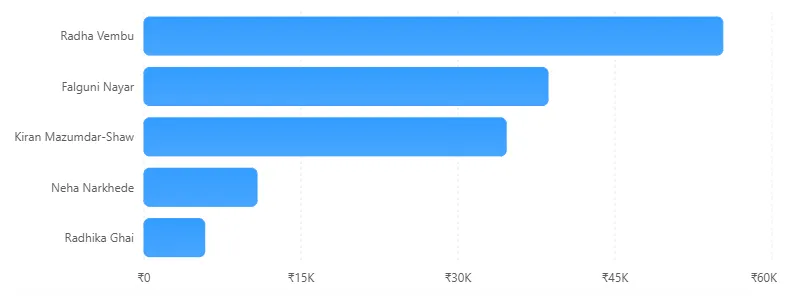
If you walk into Zoho Corporation’s headquarters in Chennai’s rural outskirts, you will not find a corner office with Radha Vembu’s nameplate. You will not see her on a dais at industry conferences. You will not read her hot takes on Twitter or LinkedIn. In fact, a Google search for “Radha Vembu interview” returns exactly zero video results. She has never given a single media interview in her life. Yet, according to the Hurun India Rich List 2025, Radha Vembu is worth ₹55,300 crore (approximately $6.7 billion) — making her India’s richest self‑made first‑generation woman. Her wealth comes entirely from her ~48% stake in Zoho Corporation, the global SaaS giant that competes with Salesforce, Oracle, and Microsoft in the small and medium business software space. Radha’s story is the antithesis of the typical unicorn founder narrative. No venture capital. No accelerator. No splashy launch. No IPO. No media blitz. Just decades of patient, obsessive product building, bootstrapping, and a deep belief that software should be affordable, reliable, and built to last.
She is the sister of Sridhar Vembu, Zoho’s CEO and public face, but she is not a silent shareholder. Radha is an active product leader — she personally manages Zoho Email, one of the company’s oldest and most critical products, serving over 60 million users worldwide. Her fingerprints are on everything from the spam filter algorithm to the UI layout of the inbox.
From a Tamil Nadu Village to IIT Madras
Radha Vembu was born into a Tamil-speaking family in a small village near Thanjavur, Tamil Nadu. Her father was a village court judge, her mother a homemaker. Education was the family’s only currency. Radha and her brothers (Sridhar and Sekhar) were all exceptional students. Radha secured admission to IIT Madras for engineering, one of the few women in her cohort in the 1990s. She graduated with a degree in electrical engineering and then moved to the United States for further studies, earning a Master’s from Princeton University — though unlike her brother Sridhar (who has a PhD), she kept a lower profile even then.
After a brief stint in the US tech industry, she returned to India in the late 1990s to join her brother’s fledgling company. At that time, Zoho (then called AdventNet) was a tiny services business writing network management software for telecom companies. The Vembu siblings worked out of a small office in Chennai’s Mylapore neighbourhood, writing code, answering support emails, and surviving on modest salaries.
The Bootstrapped Bet That Became Zoho
In 2005, the Vembus made a radical decision. They pivoted from consulting services to building a SaaS suite for businesses — starting with a word processor, spreadsheet, and email client that could compete with Microsoft Office, but at a fraction of the price. They called it Zoho (a play on “soho” – small office/home office). The problem: they had no external funding. Every rupee came from their own consulting revenues. They could not afford massive sales teams or Google AdWords. So they built the product so well that it sold itself. Zoho’s email, CRM, and office suite were fast, clean, and shockingly affordable — $3 per user per month, compared to $15 for Microsoft 365. Radha took charge of Zoho Mail (later Zoho Email). She was not a “manager” in the conventional sense — she wrote code, designed features, and personally read user feedback emails. Her product philosophy was simple: email should be secure, private, and ad‑free. While Google was scanning Gmail inboxes to serve ads, Zoho Mail offered ironclad privacy at a low cost. That resonated with businesses and privacy‑conscious individuals.
By 2010, Zoho had over 10 million users and was profitable. The company had never taken a dollar of outside capital. Radha’s stake had grown significantly because the Vembus never diluted equity to investors.
The Quiet Power of 48%
Today, Zoho Corporation has over 75 million users across 180 countries, with products spanning CRM, finance, HR, project management, and collaboration. The company generates over $1 billion in annual revenue and has been profitable every single year since 2005. Radha Vembu owns approximately 48% of the company. Her brother Sridhar owns a similar percentage, and the remaining is held by employees through ESOPs. There are no external shareholders demanding quarterly growth or an IPO. That freedom allows Zoho to do things that no public SaaS company can: build products for the long term, say no to feature bloat, and invest in rural development without having to justify ROI to Wall Street. Radha’s specific contributions include:
Zoho Email’s spam engine: She personally led the rewrite of the spam filtering algorithm in 2012, reducing false positives by 70%.
Privacy‑first architecture: She insisted that Zoho Email not scan user emails for advertising or analytics — a competitive differentiator that cost millions in potential ad revenue but built enduring trust.
Pricing strategy: She pushed for a freemium model (free for up to 5 users) with paid plans starting at ₹100 per month in India — a move that captured the small business segment that competitors ignored.
Despite her wealth, Radha lives modestly in a suburb of Chennai, drives a Toyota, and reportedly still reviews code pull requests on weekends. She does not own a single luxury handbag or designer piece — facts that have become legendary in the Tamil startup community.
Philanthropy Through Zoho Schools and Rural Development
Radha Vembu’s philanthropy is as quiet as her career. She is the driving force behind Zoho Schools of Learning — a free, residential alternative education programme for underprivileged rural students. The school does not follow the traditional CBSE/state curriculum. Instead, it teaches coding, design, mathematics, communication, and work ethic. Students live on campus in Tenkasi (Sridhar’s native village) and are paid a stipend. The results have been extraordinary. Over 500 students have graduated from Zoho Schools, and more than 80% now work at Zoho as full‑time engineers, designers, or product managers — without ever having a college degree. Radha personally interviews each batch of applicants and mentors the top students. She has also funded Zoho’s rural expansion — building office campuses in small towns like Tenkasi and Renigunta to create jobs away from congested metros. This has brought tech employment to regions that had never seen a software company. Local women, who previously had no career options, now work as customer support and QA engineers.
In a rare public statement (through a company blog post, not an interview), Radha wrote: “We don’t need another Bengaluru. India’s future is in its villages and small towns. If Zoho can prove that world‑class software can be built from anywhere, others will follow.”
Challenges and Critiques
Radha’s ultra‑low profile has drawn some criticism. Some argue that as India’s richest self‑made woman, she has a responsibility to be a visible role model for aspiring female engineers and entrepreneurs. Her complete media silence can be interpreted as disengagement from the very issues that affect women in tech. Others question the concentration of wealth and ownership in the Vembu family. With no external board and no independent directors, Zoho’s governance is opaque. Radha’s 48% stake, combined with Sridhar’s, gives the family absolute control — a structure that would be unusual for a company of Zoho’s size in the West. Radha’s defenders counter that Zoho’s performance speaks for itself. Bootstrapped companies are not required to follow public governance norms. And as for visibility — she leads by example, not by speeches.
Another challenge is succession. Radha is now in her late 50s, and neither she nor Sridhar has publicly identified a successor. The company is so closely tied to the siblings’ product instincts that a leadership transition could be risky.
Lessons for Entrepreneurs
Venture capital is not the only path: Zoho’s bootstrapped success proves that patient, profitable growth is possible.
Product excellence beats sales bluster: When your software is genuinely better and cheaper, customers will find you.
Rural talent is abundant and underutilised: Zoho Schools and rural offices are not charity; they are a competitive advantage.
4. Wealth does not require visibility: Radha’s power comes from her product decisions, not her personal brand.
The Road Ahead
As of 2026, Radha Vembu remains actively involved in Zoho Email and the Zoho Schools programme. The company is preparing to launch Zoho’s AI‑native suite, Zoho X, which integrates large language models into every product — with a strict privacy guarantee (no customer data used for training). Radha is said to be leading the email AI integration. Her net worth continues to grow as Zoho’s valuation increases in private secondary markets (estimates range from $10 billion to $15 billion). She has never sold a single share.
Radha Vembu may never give an interview or speak at a conference. But her influence is everywhere — in the email client you use, in the rural girl who codes at a Zoho School, and in the quiet defiance of an idea that you don’t need outside money to build a global tech giant.