
The Unbundled Problem
When a brand decides to build a showroom, experience centre, or interactive retail space, the work is traditionally split across a fragmented chain of vendors. A design agency conceptualises the look. An interior firm executes the build. A systems integrator wires the technology. A software company develops the backend. The result is often a disjointed experience, with no single team owning the outcome.
Bengaluru-based Phygital Studio was founded in 2014 by Pratik Nagotra to solve exactly this problem. Nagotra, who studied mechanical engineering at PES University before completing a master's in racing engine design at Oxford Brookes University, worked at Bosch before deciding to build something of his own. The company began with apps and interactive tools for real estate clients, but a turning point came when an early project for developer Kalra led to work with Prestige, one of Bengaluru's largest real estate developers. That experience shaped the startup's model: one team, one brief, full ownership from design to deployment.
The company is bootstrapped and has been profitable since 2022, with no institutional funding. It now operates with a lean team of 19 people, a number made possible by heavy reliance on AI across planning, content creation, and accounting.
Beto: The Operating System for Physical Spaces
The company's core offering is its proprietary platform, Beto, which the company describes as an operating system for immersive spaces. Beto has three layers:
Composer: a visual, no-code interface for building interactive experiences
A content management system that hosts experiences and assigns them to devices via licence keys
Player: the application that runs content on screens
Beto functions as a single control plane for a brand's physical environment. It brings together LED walls, projection systems, touchscreens, sensors, and interactive installations under one unified software layer. Content can be updated dynamically. Campaigns can be optimised. Engagement can be tracked. The platform currently powers around 2,500 screens nationwide.
The company describes AI as its "moat", helping the lean team punch above its weight. "Without AI, we'd need a 60-person team; we have 19," Nagotra says. Hardware remains the company's moat, supported by factory partnerships with Samsung, Philips, and LG.
The Portfolio: Four Categories, One Idea
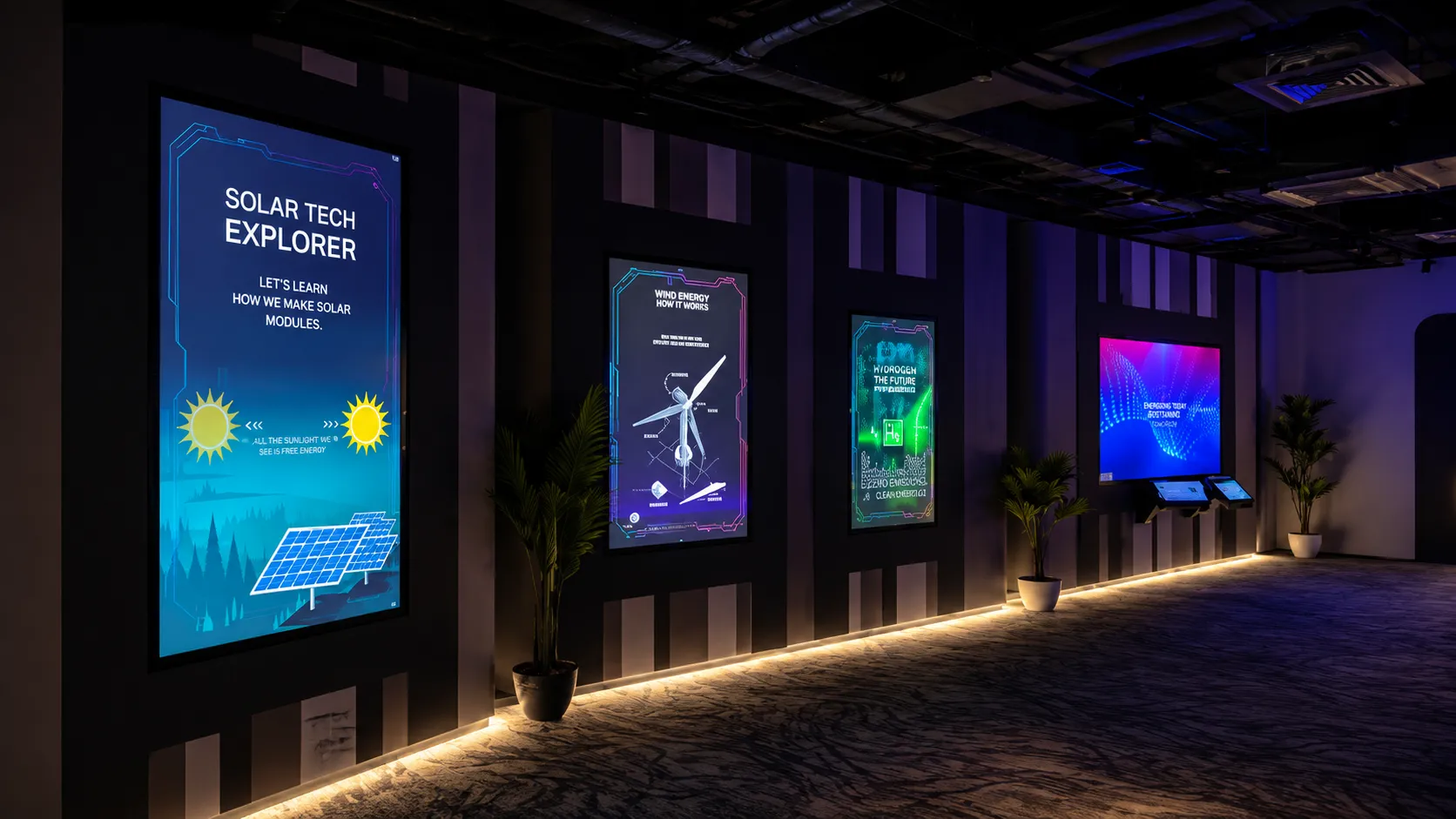
Phygital Studio's work spans four categories, all built on the same idea: helping brands deliver a complete, measurable experience in a single interaction.
Experience centres are the most complex. These are immersive spaces designed for a 30-to-40 minute customer journey—a common format for real estate, infrastructure, and energy companies. "Everything they need to know has to happen in that room," Nagotra says.
Digital twins allow clients to showcase projects before they are built. These interactive 3D models let buyers and stakeholders explore spaces virtually. Nagotra believes this could eventually extend into city-scale dashboards for utilities and infrastructure.
Sales presenters are designed for field teams. Instead of brochures, salespeople use interactive applications to show live inventory, floor views, and layouts in real time.
Retail experiences sit closest to the consumer. These include immersive installations designed to increase engagement and footfall, such as a jewellery customisation tool for Rings and I, a laminates visualisation tool for Century Group, and a lighting simulator currently in development.
The Clients and the Numbers
The company's client list reads like a who's who of India's enterprise sector: Adani Realty, Adani Solar, Century Laminates, Deloitte, Rings and I, Royal Enfield, Embassy Developments, Divyasree, and Shapoorji. Projects span cities such as Bengaluru, Mumbai, Surat, Jalandhar, Ahmedabad, Hyderabad, and Dubai.
To date, the startup has delivered sales presentation applications for 15 real estate clients and digital twin solutions for eight. The company is on track to hit ₹30 crore in revenue in FY26 and is already profitable for the year within the first two months, Nagotra says.
The company operates on a project-based pricing model with a one-time build cost and an annual maintenance fee. Software-related issues are handled remotely, while hardware issues are routed through OEM warranties.
The Market Shift: Why This Matters Now
Phygital Studio's growth is riding a broader structural shift in Indian retail and enterprise. India's immersive technology sector is projected to grow at a CAGR of around 30 per cent through 2030, reaching $7.8 billion. Meanwhile, India's retail market is projected to cross $2 trillion by 2032, with premium experiences driving a disproportionate share of growth.
The timing is also driven by rising digital acquisition costs. With Meta CPMs in India rising by over 25 per cent year-on-year in certain sectors, brands are rediscovering the efficiency of owned physical channels. An immersive flagship store or corporate centre offers owned audience engagement, lower long-term customer acquisition cost, stronger brand recall, and higher trust in high-ticket categories.
The experiential retail case is backed by data: stores with interactive digital elements report 20-40 per cent higher dwell time, immersive showrooms can increase conversion rates by 15-30 per cent, and integrated digital touchpoints lift average order value by up to 25 per cent.
The Productisation Pivot and Global Ambition
A key shift for Phygital Studio in 2026 is productisation. Tools like the sales presenter and digital twin, earlier built on request, are now being packaged with defined pricing. The digital twin product is expected to evolve further into city-scale systems tracking energy, water, and security, moving from real estate into urban infrastructure intelligence.
The company is also expanding its physical footprint. Three large experience centre projects were closed in January 2026 and six more in February. Most are for existing customers like Embassy, Adani Realty, and Adani Solar.
The longer-term ambition is global. "We don't want to be the best in India. We want to be among the best in the world," Nagotra says. The company currently competes with specialist AR/VR firms like Rubenius and experiential agencies like Pico Group India, which operate in overlapping segments of the market.
By treating physical spaces as performance channels, Phygital Studio is positioned to lead a new category of retail and enterprise technology—one where the line between software and space becomes invisible, and the only thing that matters is what the experience delivers.