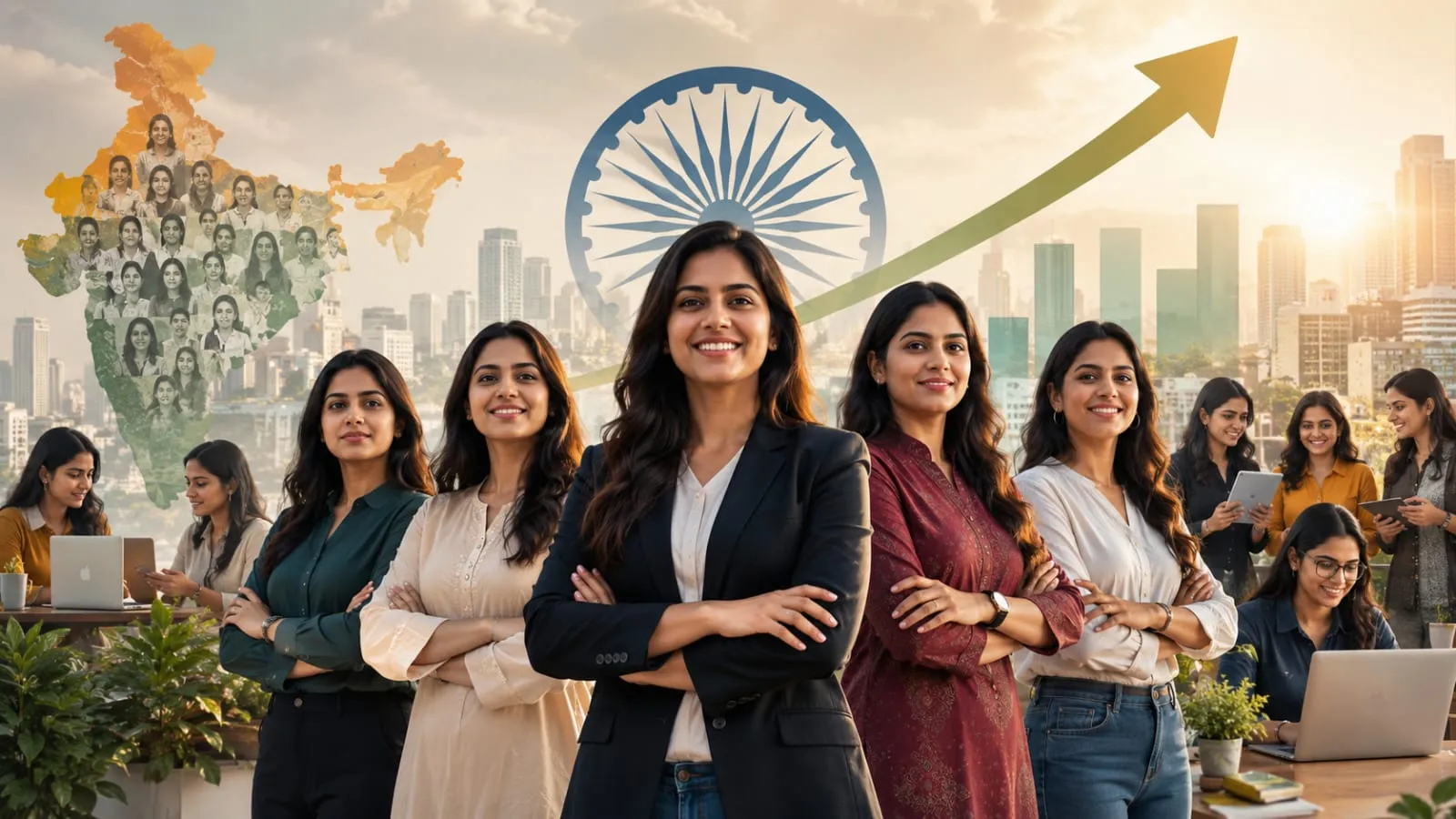
India's Startup Revolution Has a New Face — And She's Running Half the Show
When the Startup India initiative was launched on January 16, 2016, it was a bet on the future. A declaration that India would no longer just produce engineers for the world — it would produce companies, innovations, and entrepreneurs who would change it. A decade later, the numbers are in. And one of the most powerful stories buried inside them has nothing to do with unicorns or IPOs.
It's about women. And the quiet, determined, unstoppable way they have taken over nearly half of India's startup landscape.
The Number That Changes Everything
As of January 31, 2026, the Department for Promotion of Industry and Internal Trade — DPIIT — has officially recognised 2,12,283 startups across India. That alone is a remarkable milestone for a country that barely had a formal startup ecosystem two decades ago.
But here's the number that stops you in your tracks: out of those 2,12,283 startups, over 1,02,054 — nearly half — have at least one woman director or partner at the helm.
That's not a quota. That's not a government mandate. That's over one lakh startups where a woman sat down at the founding table, picked up a pen, and signed her name as a leader of a business. In a country that has historically kept women out of boardrooms, out of capital conversations, and out of the startup narrative — this is nothing short of a structural transformation.
As Minister of State for Commerce and Industry Jitin Prasada confirmed in the Lok Sabha: this data reflects a growing and genuine shift in how India builds businesses — one where women are no longer on the periphery, but increasingly part of the decision-making core.
The Money Is Following
Recognition is one thing. Capital is another. And the Indian government hasn't just been counting women founders — it's been writing them cheques.
The Fund of Funds for Startups, operated by SIDBI — the Small Industries Development Bank of India — was created with a corpus of ₹10,000 crore to pump life into India's venture capital ecosystem. It works by investing in SEBI-registered Alternative Investment Funds, which in turn back startups at every stage of growth.

As of January 31, 2026, the Fund of Funds has deployed ₹25,859 crore across the startup ecosystem overall. And since 2020, approximately ₹2,995 crore from these funds has been specifically invested in women-led startups. That's nearly ₹3,000 crore of institutional capital flowing toward women founders through a government-backed framework — capital that didn't exist for them a decade ago.
Then there's the Startup India Seed Fund Scheme — a programme designed for the earliest, most vulnerable stage of a startup's life, when an idea exists but money doesn't. Under this scheme, incubators across the country approve funding to seed-stage startups trying to prove their concept and build their first product. As of January 2026, ₹592 crore has been approved to selected startups under the scheme — and of that, ₹294 crore has gone specifically to women-led startups. That's 50% of the Seed Fund allocation going to women founders. Not a token gesture. Genuine, meaningful parity.
Why This Matters Beyond the Numbers
India's startup story has often been told through the lens of its biggest exits, its fastest-growing unicorns, and its most celebrated male founders. And that story is real and worth telling. But the deeper story — the one that will shape the country's economic future for generations — is about access.
Access to capital. Access to networks. Access to the simple belief that a woman with a business idea deserves the same shot as anyone else.
What the DPIIT data reveals is that India is slowly, steadily getting there. Not because the government handed women a head start — but because the infrastructure was built, the doors were opened, and Indian women walked through them in their hundreds of thousands.
The Credit Guarantee Scheme for Startups is enabling women-led ventures to access debt funding through banks and NBFCs without the traditional collateral barriers that have historically shut them out. The MAARG mentorship programme under Startup India is connecting founders — including women at the earliest stages — with experienced guides who can help them navigate the brutally competitive world of building a company from scratch.
The Road Still Ahead
None of this means the work is done. Having a woman director on paper is not the same as a woman-founded company getting Series A funding. The global data is still sobering — women-led startups receive a fraction of total venture capital globally, and India's private market reflects similar biases at the higher funding stages.
But the foundation being laid right now matters enormously. When over one lakh startups have women in leadership positions, those women are building networks, gaining experience, mentoring the next generation, and proving — deal by deal, quarter by quarter — that women-led businesses deliver results.
The government has put nearly ₹3,300 crore behind that belief between SIDBI's Fund of Funds and the Seed Fund alone. The market is beginning to follow.
India's startup revolution has always been about potential. What the January 2026 data tells us is that the country is finally beginning to unlock all of it — not just half.


