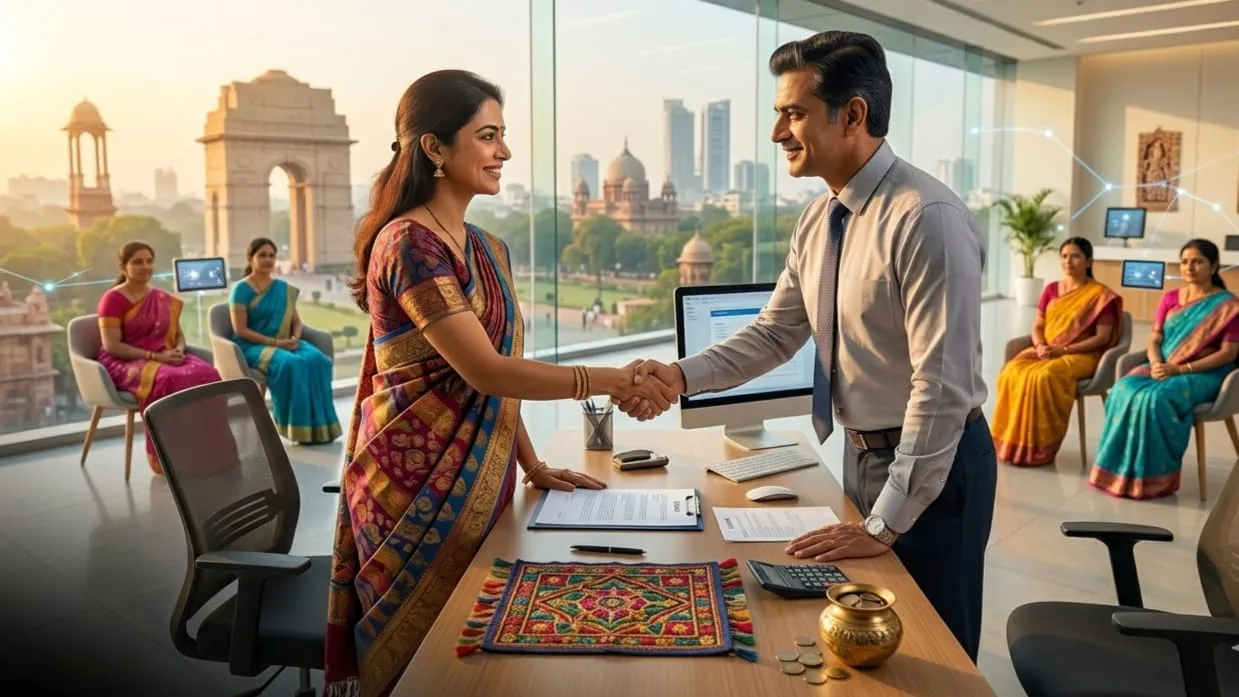
Delhi Just Removed the Biggest Barrier Standing Between Women and Business Capital
Ask any woman entrepreneur in India what stops her from growing her business and the answer comes back almost instantly. It's not ideas. It's not ambition. It's not capability. It's collateral.
Banks want property documents. They want assets pledged as security. They want a guarantor with financial standing. And for the vast majority of women building businesses in India — many of whom don't own property in their own name, many of whom come from self-help groups and home-based enterprises, many of whom are first-generation entrepreneurs — those requirements are an insurmountable wall.
Delhi Chief Minister Rekha Gupta just decided to demolish that wall.
The Announcement That Changes the Game
At the inauguration of the two-day Mega Self-Help Group Mela 2026 at Unity One Mall in Rohini, CM Rekha Gupta announced that the Delhi government will provide collateral-free loans of up to ₹10 crore for women-led startups and self-help groups — with the government itself acting as the guarantor for eligible loans.
Read that carefully. Not a small microloan. Not a token ₹50,000 for buying a sewing machine. Up to ₹10 crore. And no collateral required. No property mortgage. No private guarantor. The Delhi government steps in as the financial backer, carrying the risk that banks would otherwise refuse to absorb.
The mechanism behind this is a formal Memorandum of Understanding signed between the Delhi government and the Credit Guarantee Fund Trust for Micro and Small Enterprises — known as CGTMSE. Under this structure, when a woman entrepreneur takes a loan from a bank, between 75 and 90% of the loan amount is guaranteed by CGTMSE, and 5 to 20% is guaranteed directly by the Delhi government. The combined government guarantee covers 95% of the total loan — reducing the bank's risk exposure to just 5%. In practical terms, for a bank, that's a risk-free loan. Which means approvals happen.
To fund this guarantee framework, the government has created a special corpus of ₹50 crore — designed to enable banks to disburse loans totalling up to ₹2,500 crore across eligible businesses. That's a 50x multiplier — ₹50 crore in guarantee capital unlocking ₹2,500 crore in actual business loans.
The Broader Delhi Startup Policy 2026
This women's credit initiative is part of the larger Delhi Startup Policy 2026 — a comprehensive framework with a proposed allocation of ₹350 crore over five years to support young entrepreneurs, student innovators, and early-stage startups across the capital.
The policy is Delhi's most ambitious attempt to position the city as India's leading startup destination — competing with Bengaluru's tech ecosystem and Mumbai's financial infrastructure by building something neither of those cities has fully cracked: an inclusive, grassroots-up entrepreneurship engine that reaches women, first-generation founders, and community-based enterprises.
The policy focuses on four pillars: funding access, incubation infrastructure, market linkages, and talent development. Sectors of focus include technology, artificial intelligence, fintech, clean energy, and deep-tech innovation — but the women's credit scheme extends far beyond the tech sector to cover manufacturing, services, retail, education, and training institutes. A woman running a khadi enterprise in Rohini has the same access to this loan window as a woman building a SaaS startup in Connaught Place.
Malls as Markets — A Retail Revolution for Women Entrepreneurs
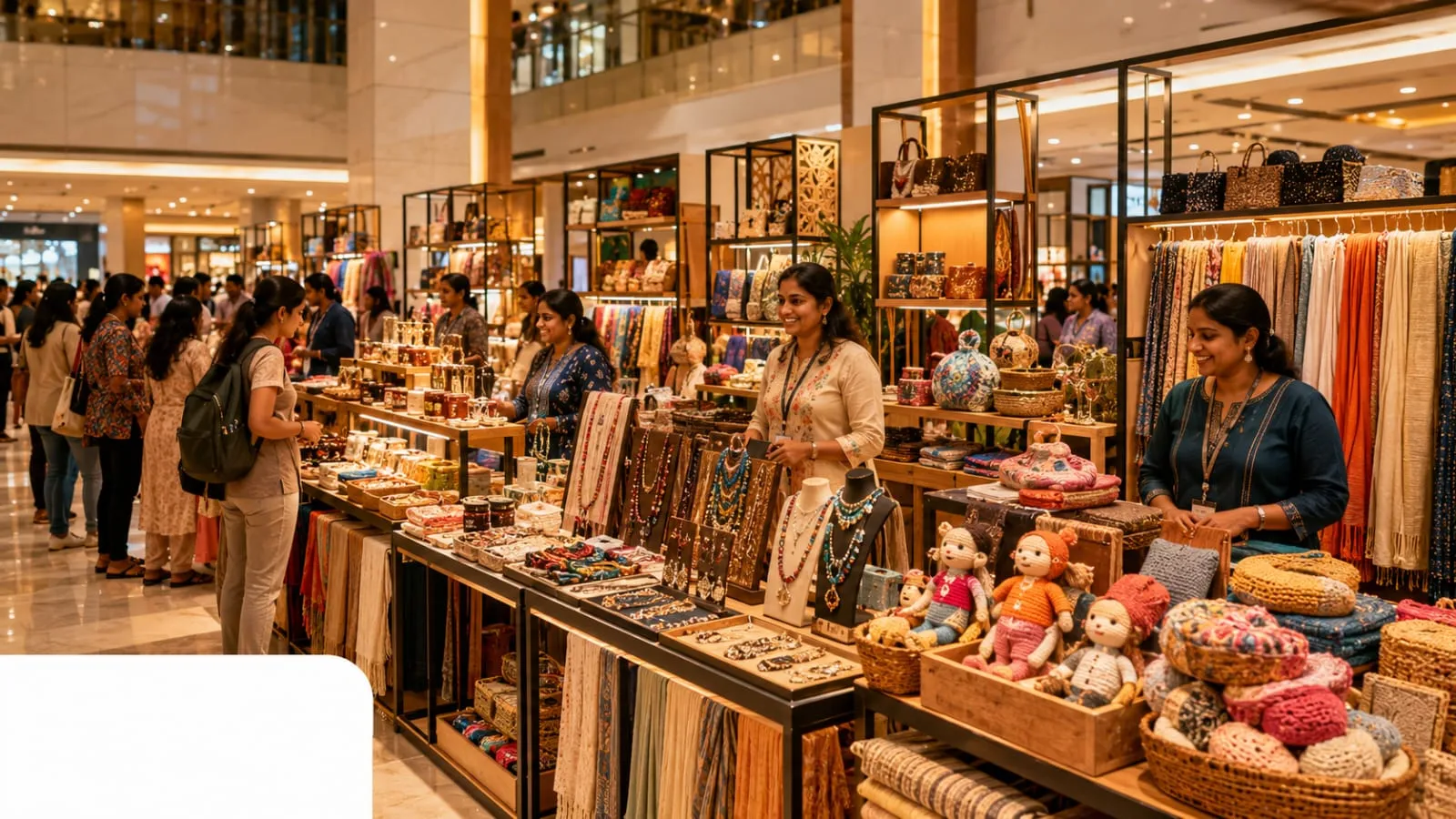
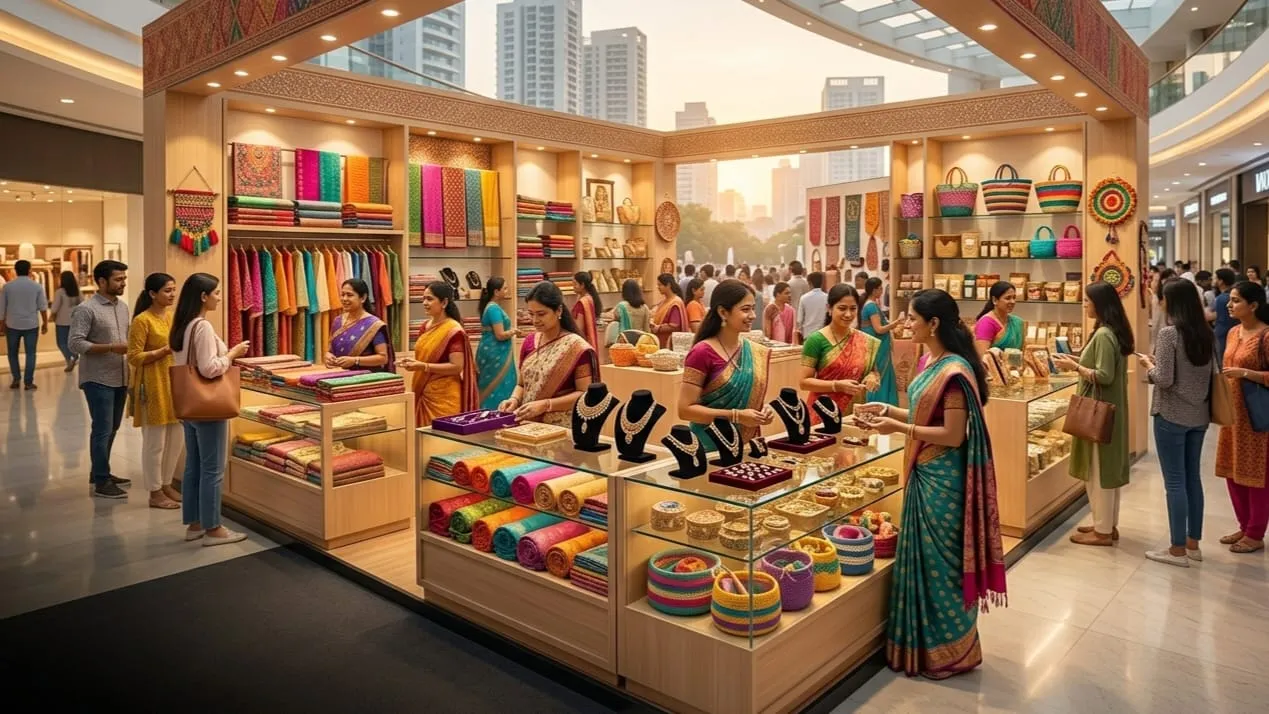
The credit announcement wasn't the only headline from the Mela. Alongside the loan scheme, CM Gupta revealed plans to provide dedicated retail spaces for women-made products in major malls and commercial centres across Delhi.
This matters more than it might seem. Access to capital is one barrier. Access to markets is another. Many women entrepreneurs — particularly those running SHGs producing handicrafts, food products, khadi, crochet work, and other locally made goods — can produce excellent products but have no pathway to the premium urban consumers willing to pay fair prices for them.
A dedicated shelf in a Delhi mall is not a small thing. It's the difference between selling at occasional fair stalls and having a permanent, visible, accessible presence in front of Delhi's millions of urban shoppers. It connects local production to city-wide demand in a way that transforms what is possible for a home-based or community-based enterprise.
CM Gupta linked both initiatives — the credit scheme and the retail access plan — to Prime Minister Modi's Vocal for Local, Atmanirbhar Bharat, and One District One Product campaigns. These aren't just branding exercises. They represent a genuine national commitment to building demand for locally made products — and Delhi's policy is designed to ensure women entrepreneurs are positioned to meet that demand.
Why This Model Works — The Evidence From Elsewhere
Government-backed credit guarantee schemes for women entrepreneurs aren't new. But their track record, when properly designed and adequately funded, is strong. The original CGTMSE scheme has enabled guaranteed loans of approximately ₹925 crore to startup borrowers nationally. SIDBI's Fund of Funds has directed nearly ₹3,000 crore to women-led ventures. And the Startup India Seed Fund Scheme has allocated ₹294 crore specifically to women-led startups.
The pattern is consistent: when the financial barrier is lowered through government guarantee, women entrepreneurs access capital, build businesses, create employment, and repay loans at rates that compare favourably with the broader borrower population. Risk, it turns out, is not inherent in women entrepreneurs. It's inherent in a system that was never designed for them.
Delhi's ₹10 crore collateral-free loan scheme is the most aggressive version of this model yet launched at the state level. If the ₹50 crore corpus successfully mobilises ₹2,500 crore in lending, it will represent one of the most efficient deployments of government capital for women's economic empowerment in Indian history.
The Ambition Behind the Policy
CM Rekha Gupta described the initiative in terms that go beyond a lending scheme: "The initiative aims to make every woman in Delhi self-reliant and strengthen indigenous businesses through better financial access and market opportunities."
That ambition — every woman self-reliant — is the right ambition. And the policy architecture being built around it is serious. Collateral-free loans backed by government guarantee. Dedicated retail spaces in premium commercial locations. A ₹350 crore five-year startup fund. Incubation support. Market access programmes.
Delhi has millions of women with the skills, the ideas, and the drive to build businesses. What they have been missing is the system designed to support them. Delhi Startup Policy 2026 is building that system.