
Neha Narkhede — The Pune‑Born Engineer Who Co‑Created Apache Kafka and Built a ₹70,000 Crore Tech Empire
From an engineering college in Pune to co‑creating Apache Kafka at LinkedIn and founding Confluent — a data streaming platform valued at over ₹70,000 crore — Neha Narkhede’s journey is a masterclass in technical entrepreneurship. This article chronicles how a young woman from Maharashtra navigated the male‑dominated world of Silicon Valley deep tech, co‑founded one of the most influential enterprise software companies of the past decade, and continues to reshape fintech security with her subsequent venture, Oscilar. We analyze her technical contributions to open‑source infrastructure, her leadership as CTO of Confluent, and her recognition as one of Forbes’ America’s Richest Self‑Made Women.
From Pune to the Heart of Silicon Valley
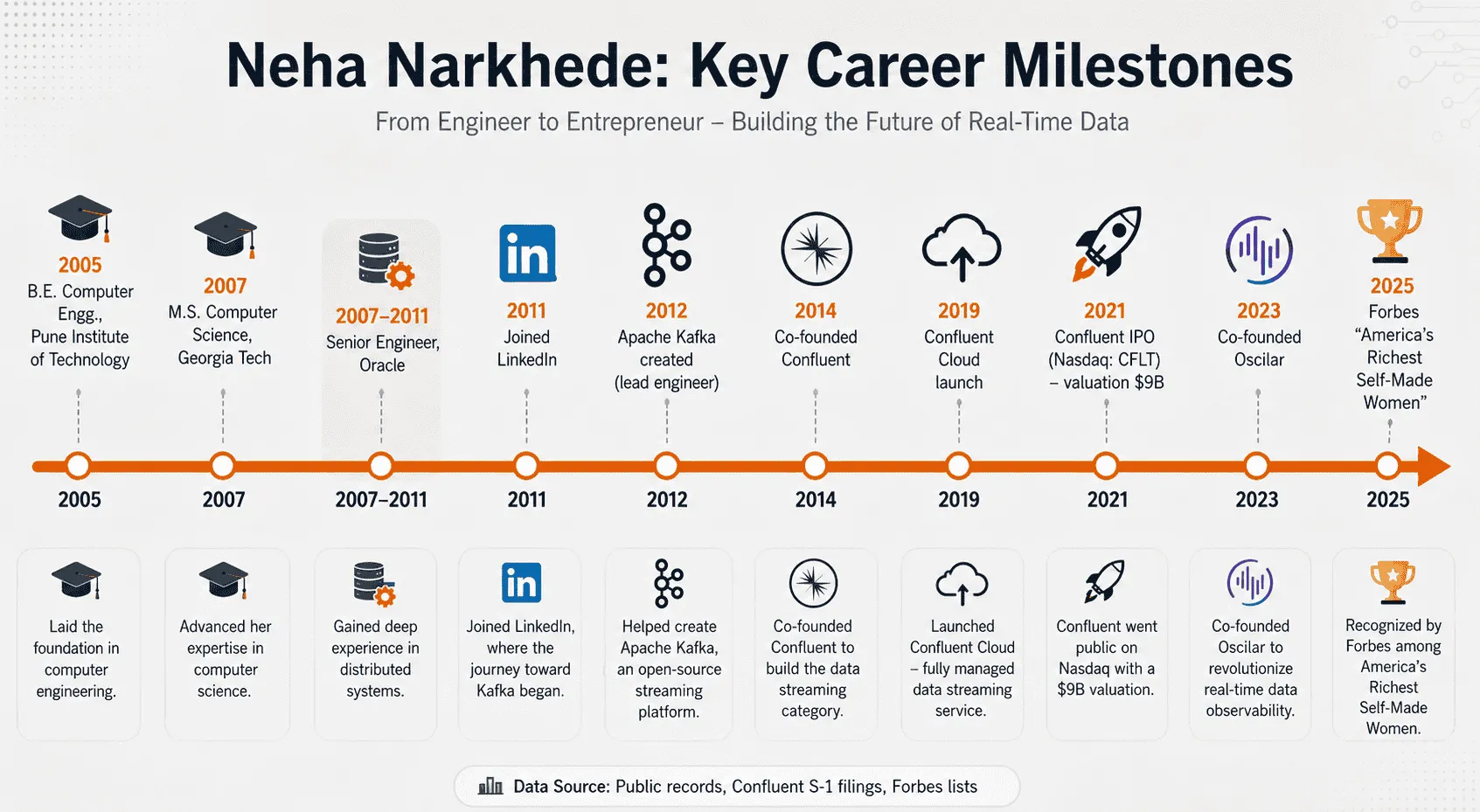
Neha Narkhede grew up in Pune, Maharashtra, in a middle‑class family where academic excellence was non‑negotiable. Her father was an engineer, her mother a homemaker. She excelled at mathematics and physics, and after securing admission to the Pune Institute of Computer Technology, she pursued a degree in computer engineering. But even then, she felt that the Indian education system, while rigorous, did not expose her to the cutting edge of distributed systems and big data.
That changed when she moved to the United States for a Master’s degree in Computer Science at Georgia Tech in Atlanta. The exposure to world‑class research, the culture of open‑source contribution, and the sheer scale of problems being solved in Silicon Valley ignited something in her. After graduating in 2007, she joined Oracle as a software engineer, working on database internals. It was a solid job, but she wanted to work on real‑time data problems at internet scale.
In 2011, she moved to LinkedIn as a lead engineer. That decision would change her life — and the entire data infrastructure industry.
The Birth of Apache Kafka
At LinkedIn in the early 2010s, engineers faced a painful problem. The platform was growing explosively — millions of users, billions of connections, constant streams of profile updates, messages, and activity feeds. Each microservice needed to send data to dozens of other services: analytics pipelines, search indexes, recommendation engines, monitoring systems.
The existing solution — point‑to‑point connections and batch processing — was breaking. Latencies were high, data was often lost, and debugging was a nightmare.
Neha, along with her colleagues Jay Kreps and Jun Rao, began designing a new kind of messaging system. They wanted something that could handle real‑time data streams at massive scale, with persistence, fault tolerance, and low latency. They took inspiration from distributed commit logs (like those in databases) and added a publisher‑subscriber model.
The result was Kafka — named after the writer Franz Kafka because the system felt “optimised for writing.” Neha was the lead engineer on the project, writing significant portions of the core code. In 2011, LinkedIn open‑sourced Kafka under the Apache licence.
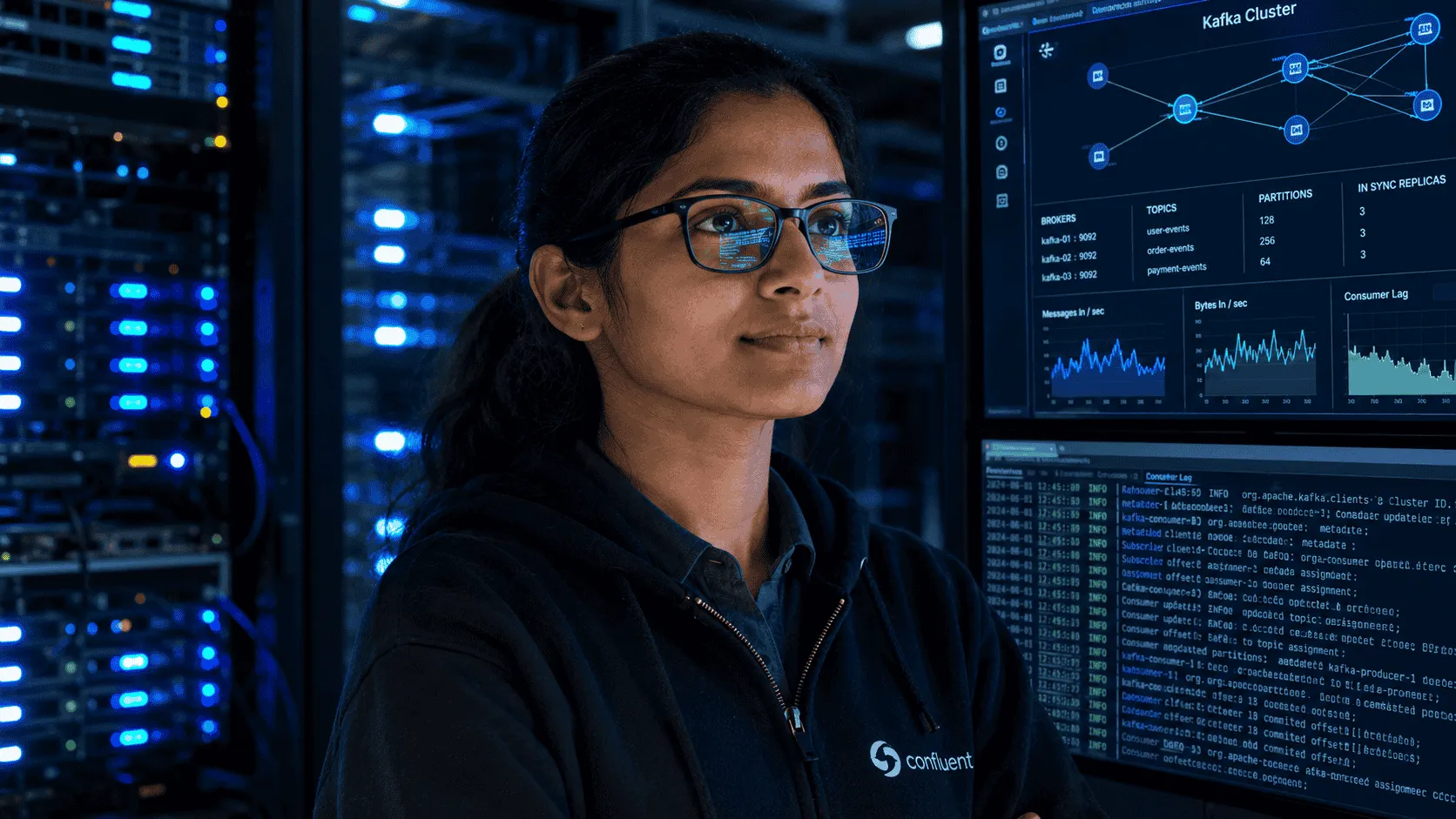
What happened next was unexpected. Companies outside LinkedIn — Netflix, Uber, Airbnb, Twitter, and thousands of others — started adopting Kafka. They found that it could handle millions of messages per second, retain them for days or weeks, and replay them for different consumers. It became the de facto standard for real‑time data streaming.
By 2014, Kafka had graduated to a top‑level Apache project. Neha was recognised as one of its primary creators and continued as a committer and PMC member. But she realised that Kafka was too critical and too complex for companies to run on their own — they needed a commercial solution.
Building Confluent — The Commercial Layer
In 2014, Neha, Jay, and Jun left LinkedIn to found Confluent. Their mission was to build a commercial platform around Kafka — adding enterprise features like security, monitoring, multi‑data centre replication, and a graphical user interface. More importantly, they created Kafka as a managed cloud service (Confluent Cloud), so companies didn’t have to operate their own clusters.
Neha became the Chief Technology Officer (CTO) of Confluent. Her role was to set the technical vision: which features to build, how to maintain compatibility with open‑source Kafka, and how to scale the cloud offering to thousands of tenants. She was also responsible for recruiting engineering talent — a notoriously difficult task in Silicon Valley — and building a culture of technical excellence.
The company grew rapidly. By 2020, Confluent was processing over 1.5 trillion messages per day for customers including Walmart, Goldman Sachs, and ING. It had raised over $450 million from investors including Sequoia, Benchmark, and Index Ventures.
On June 24, 2021, Confluent went public on the Nasdaq under the ticker CFLT. The stock surged 25% on the first day, giving the company a market capitalisation of over $9 billion (approximately ₹70,000 crore). Neha Narkhede’s stake was worth over $300 million at the time, making her one of the richest self‑made Indian‑American women in tech.
Forbes subsequently listed her on “America’s Richest Self‑Made Women” and “50 Over 50” (women achieving major success after age 50). She was also featured in the “Forbes Cloud 100” and “MIT Technology Review Innovators Under 35” (though she was slightly over 35 by then).
Technical Contributions and Open‑Source Legacy
Neha’s impact on the software industry extends far beyond Confluent’s valuation. Apache Kafka is used by over 80% of the Fortune 500 companies. It powers everything from fraud detection (streaming transactions in real time) to IoT data ingestion to log aggregation.
Her specific technical contributions include:
Partitioning and replication protocol: She designed how Kafka distributes data across brokers for fault tolerance.
Exactly‑once semantics: A complex feature that ensures messages are processed exactly once even during failures, critical for financial applications.
Kafka Connect: A framework for streaming data between Kafka and other systems (databases, file systems, search indexes).
Beyond Kafka, she has been a vocal advocate for open‑source sustainability. She has argued that companies building open‑source infrastructure must also have a viable commercial model — otherwise the maintainers burn out and the project stagnates. Confluent’s “open core” model (open‑source Kafka + commercial features) is now a template for many other deep‑tech startups.
Oscilar: Fighting Financial Crime with AI
In 2023, after stepping down from her CTO role at Confluent (though remaining on the board), Neha co‑founded a new venture: Oscilar. The company applies real‑time data streaming and machine learning to financial crime detection — specifically, money laundering, fraud, and sanctions violations.
The problem is staggering. Global banks spend over $200 billion annually on compliance, yet an estimated $2 trillion is laundered each year. Traditional systems are batch‑oriented (reviewing transactions hours or days later) and generate millions of false alerts, wasting investigator time.
Oscilar’s platform uses Kafka‑style streaming to analyse transactions in milliseconds, then applies AI models that adapt to new criminal patterns. Neha serves as the co‑founder and technical advisor. The company raised a seed round from Index Ventures and Bain Capital in 2024.
Her move into fintech security is personal as well as professional. Having grown up in a country where financial inclusion is expanding rapidly via UPI and digital payments, she understands that real‑time crime detection is a public good. Oscilar has announced partnerships with Indian banks, though specifics remain confidential.
Recognition and Representation
Neha Narkhede is not a flashy CEO. She rarely gives motivational speeches or lifestyle interviews. Her influence comes from code, architecture, and products that quietly underpin the modern digital economy.
Yet her visibility matters profoundly for Indian women in engineering. In a field where women hold less than 20% of technical roles in Silicon Valley, and Indian women even fewer, Neha stands as proof that deep technical leadership is accessible. She has mentored dozens of young engineers, especially women from India, through programmes like AnitaB.org and Grace Hopper Celebration.
When asked about advice for aspiring engineers, she says: “Don’t be afraid to be the only woman in the room. Build something that you would use yourself. And never stop learning how systems fail — that’s where the real education is.”
Challenges and Critiques
Neha’s journey has not been without difficulty. She has spoken about the impostor syndrome she felt early at LinkedIn, surrounded by PhDs from Stanford and MIT. As CTO of Confluent, she faced the challenge of scaling an engineering organisation from 10 to 500 people while maintaining technical quality.
Some open‑source purists have criticised Confluent for moving some features (like advanced monitoring) out of the open‑source version into the commercial offering. Neha has defended the decision as necessary for sustainability: “Maintaining Kafka costs millions of dollars a year. We need to pay engineers. A pure open‑source model would mean we either die or get acquired by a cloud giant that would exploit the project.”
Another criticism is the lack of diversity in Confluent’s leadership during her tenure — though under her technical guidance, the engineering team did achieve over 30% women, a rarity in enterprise software.
Lessons for Deep‑Tech Entrepreneurs
Solve a real scaling problem: Kafka was built because LinkedIn’s architecture was breaking — not because someone imagined a market.
Open source is a distribution channel, not a charity: Giving away the core product builds trust and adoption; the commercial layer monetises enterprise needs.
Stick to your technical craft: Neha never pretended to be a business wizard. Her credibility came from code.
When you succeed, start again: Oscilar shows that even after a $9 billion exit, you can tackle a new, harder problem.
The Road Ahead
As of mid‑2026, Neha Narkhede is 41 years old. Confluent’s market cap is approximately $6.5 billion (fluctuating with tech markets), but its technology remains deeply embedded in global infrastructure. Oscilar is in stealth beta, with trials at two major Indian private banks.
She continues to hold board positions at Confluent and serves as a technical advisor to startups founded by women. Her net worth is estimated at $450 million, placing her among Forbes’ “America’s Richest Self‑Made Women” for the third consecutive year.
But her greatest legacy may be the thousands of engineers — especially women from Pune, Bangalore, and Hyderabad — who look at Kafka’s commit logs, see her name, and realise that a middle‑class girl from India can shape the infrastructure of the entire internet.


