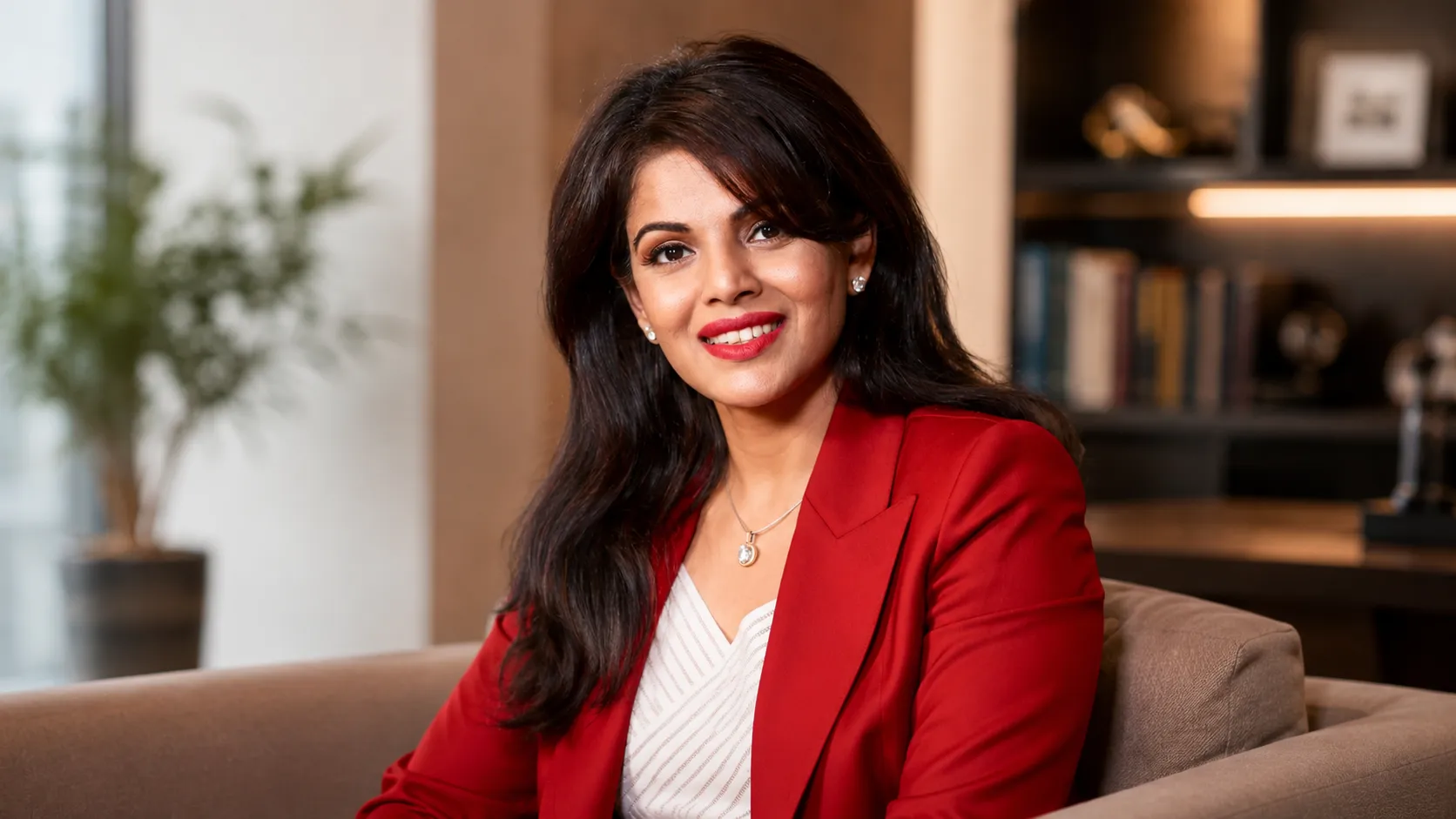
Her Father Built Emcure With a ₹3 Lakh Bank Loan. She Came Home to Save It. Then She Took It Global.
In 1981, Satish Ramanlal Mehta founded Emcure Pharmaceuticals in Pune with a bank loan of ₹3 lakh after graduating from IIM Ahmedabad. What he was building was not obvious to anyone else at the time. A pharmaceutical company, in India in 1981, with nothing but an idea and borrowed money. Forty-four years later, Emcure operates in more than 70 countries, has 13 manufacturing facilities and five R&D centres, and reports global revenue exceeding ₹6,000 crore.
The distance between those two data points — ₹3 lakh and ₹6,000 crore — is not just a story about pharmaceutical manufacturing. It is, in significant part, a story about his daughter.
Namita Thapar was born on March 21, 1977, in Pune. She became a Chartered Accountant at 21 — a qualification from the ICAI that requires passing some of India's most demanding professional examinations. Ambitious enough to take what she had learned in Pune and take it further, she pursued an MBA from Duke University's Fuqua School of Business, graduating in 2001. After Duke, she moved to the United States and joined Guidant Corporation as Business Finance Head — gaining the experience of working in a global medical device and healthcare company at a senior level before she was 25.
She came back to India in 2007 to join her father's company as CFO.
She did not come back to an easy inheritance. She came back to a company facing the kind of quiet, seeping financial difficulty that a CFO with a Duke MBA and Guidant experience could see clearly for what it was — and that required both the technical capability to address and the moral commitment to stay. She stayed. She worked. And the company that she joined in debt became the company that listed on the BSE and NSE in July 2024.
What the Emcure IPO Actually Said About What She Built
The July 2024 IPO raised ₹1,952 crore — a landmark transaction for Indian pharma, structured partly as a fresh issue and partly as an offer for sale. The price band was set between ₹960 and ₹1,008 per share.
Namita's personal position in that IPO is the number that caused the most attention: she held 6,339,800 shares with a weighted average acquisition cost of ₹3.44 per share, representing a total personal investment of approximately ₹2.18 crore. At the upper end of the IPO price band, her 3.5 per cent stake in Emcure represented a 293-fold return on that initial investment.
Two hundred and ninety-three times. On a company her father started with ₹3 lakh in 1981. That number is the headline. What it records is seventeen years of transformational work — financial, operational, strategic, and cultural — between 2007 and 2024.
The IPO proceeds were used to repay debt and strengthen the balance sheet, improving financial flexibility for R&D initiatives, product launches, and future acquisitions. The improved financial position was not accidental. It was the direct result of the financial discipline that a CA-trained, Duke-educated CFO brought to an organisation that needed exactly that discipline at exactly that moment.
The Company She Actually Runs — and What It Does
Emcure Pharmaceuticals is one of India's most important pharmaceutical companies in several specific therapeutic categories, and understanding why requires understanding what the company actually makes and where it makes it.
The therapeutic portfolio covers gynaecology, cardiovascular, oncology, blood-related conditions, HIV antivirals, other anti-infectives, and vitamins and minerals. The gynaecology franchise is among the strongest in India — reflected in Namita's own advocacy work and in the Q4 FY25 product launches of menopause and PCOS-specific products, which extend the therapeutic range into conditions that have historically been underserved by Indian pharmaceutical companies.
The HIV antiviral franchise is a particular point of significance. Emcure's licence agreements with Bristol-Myers Squibb for Atazanavir and Gilead Sciences for Tenofovir, as part of their Global Access Programs, gave Emcure the ability to manufacture and distribute life-saving HIV medications in markets where access to treatment would otherwise have been unavailable. The moral geography of Emcure's 70-country presence is, in part, built on the foundation of HIV treatment access in Africa and other low-income markets — a contribution to public health that does not show up in quarterly earnings but that defines the company's actual importance.

The Roche manufacturing relationship — signed in 2012 to manufacture blockbuster anticancer drugs Herceptin and Mabthera in India — and the more recent focus on biosimilars, complex injectables, and antibody-drug conjugates represent the higher-margin, technically complex end of the product portfolio. The Emcutix Biopharmaceuticals subsidiary, launched in FY2025 with a cosmetic skincare range, adds a consumer-facing growth dimension to a primarily prescription-drug business.
The Q4 FY25 results that pushed Emcure's shares into the upper circuit in May 2025 captured the trajectory of all of this simultaneously: consolidated revenue of ₹2,116.2 crore, up 19.5 per cent year-on-year; net profit of ₹197.2 crore, up 63 per cent year-on-year; operating margins of 19 per cent, up from 17.53 per cent in the same period a year earlier.
In May 2026, Emcure sued rival firm Zorvia for ₹75 crore for allegedly poaching 950 employees from its subsidiary Zuventus — a legal action that reflects the competitive intensity of the pharmaceutical talent market and Emcure's willingness to defend its operational infrastructure aggressively.
The Platform She Built — Shark Tank, Uncondition Yourself, and the Entrepreneurship Ecosystem
Namita Thapar became a household name across India through Shark Tank India — the Sony LIV reality show that launched in December 2021 and immediately captured the country's imagination. She has appeared in all five seasons, invested in over 100 startups across the run of the show, and invested more than ₹29 crore in the first two seasons alone. Her portfolio includes SUGAR Cosmetics, Skippi Ice Pops, Bummer, Menstrupedia, and Thinkerbell Labs, among many others.
Her Shark Tank presence is not a vanity platform. It is a consistent expression of a specific investment thesis: companies solving real problems for underserved Indian consumers, led by founders with the resilience to survive the building phase, in categories where distribution and category creation matter more than pure technology. The phrase she made famous — "Yeh meri expertise nahi hai, I'm out" — is not a catchphrase. It is a principle. Informed decision-making. Knowing your own boundaries. Investing only where you can add genuine value beyond capital.
Uncondition Yourself is a separate but related initiative — a health awareness and advocacy platform that Namita uses to reach millions of followers with education on women's health topics including menstruation, menopause, PCOS, and mental health. The platform reflects the belief that awareness and access are inseparable: a woman who does not know what PCOS is cannot advocate for her own treatment. The pharmaceutical company that makes PCOS medications and the advocate who educates women about PCOS are, in Namita's case, the same person.
She is also the founder of Thapar Entrepreneur Academy, which runs Incredible Ventures Ltd., an initiative aimed at training young minds in business. She serves on the Board of Governors at IIM Ahmedabad. She participates in government initiatives through NITI Aayog's Women Entrepreneurship Platform.
What She Has Said That Stays With People
Namita Thapar's public communication has a quality that is rare in Indian corporate leadership: she speaks honestly about difficulty. Not in the managed, PR-approved way that turns struggle into a story of inevitable triumph, but in the specific, named way that makes difficulty useful to the people who are living through their own version of it.
On the challenge of coming home to a struggling business: she has described the choice to stay and fight as something she made not because it was comfortable but because walking away was never actually an option once she understood what was at stake.
On the cost of being a working mother in corporate India: she has named the specific pressures — family expectations, the weight of dual accountability, the absence of structural support — without pretending they do not exist or that they are solved by individual willpower.
On investment: "Yahi toh maza hai" — this is the fun of it. The entrepreneurial spirit, the act of backing a founder who sees something others have missed, the experience of watching a company she believed in become something more than either party imagined. That enthusiasm, which is genuine rather than performed, is what makes her the most watchable and most trusted of the Shark Tank India sharks.
The 293x return. The 70 countries. The 63 per cent profit growth. The women's health advocacy. The 100-plus startup investments. The IIM Ahmedabad board seat.
And the most honest thing about all of it: she came home to a company in debt, worked for seventeen years, and built something that lasted.


