The Legend, in Brief
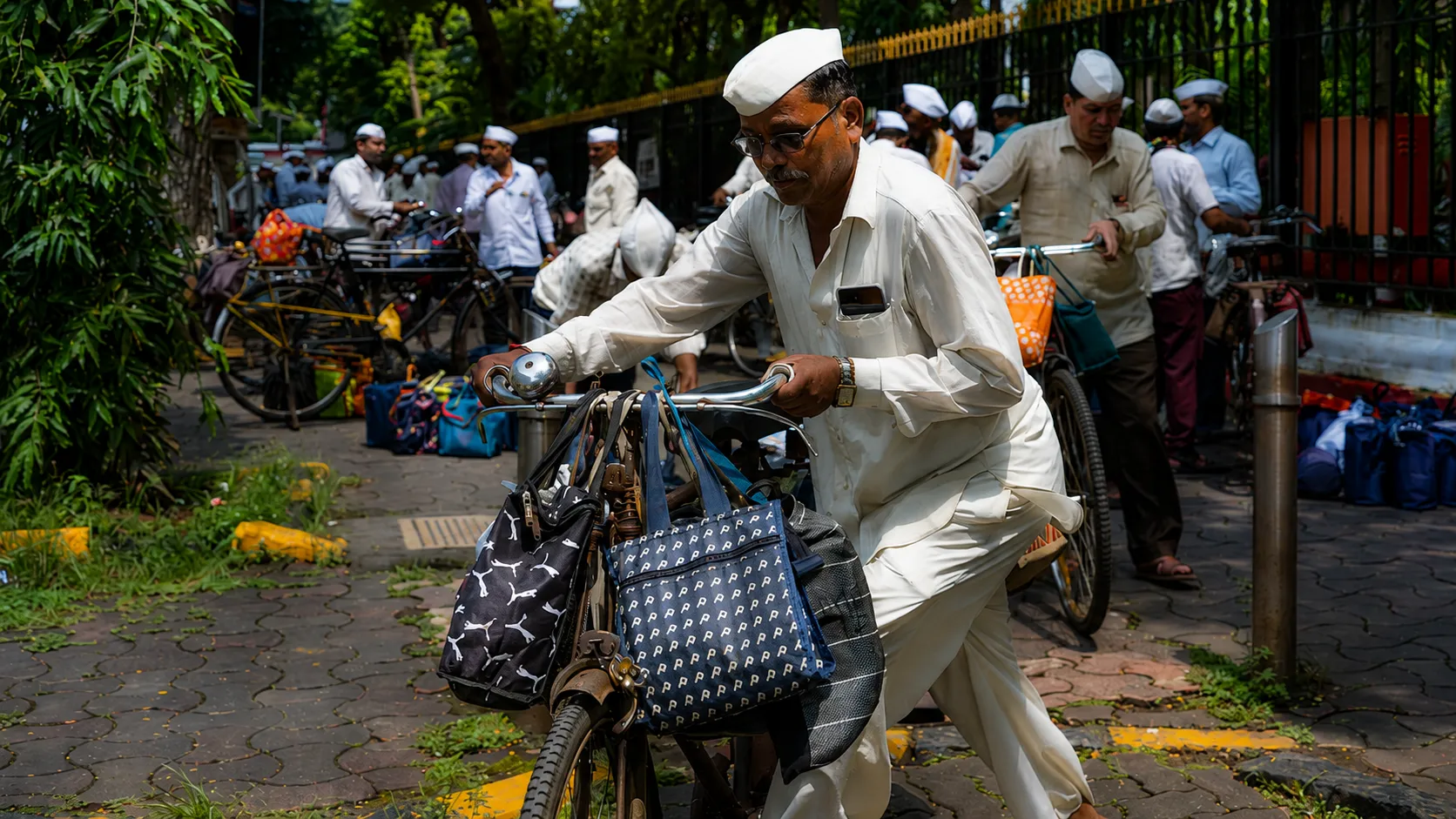
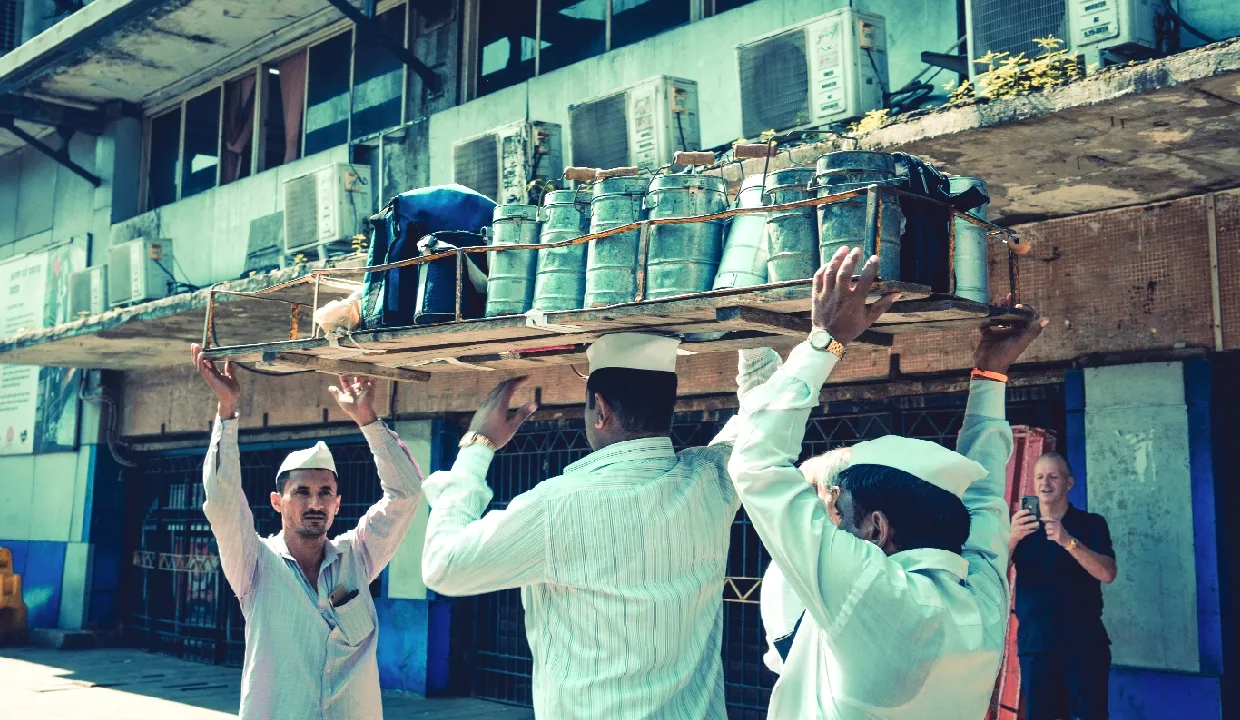
Every weekday morning since 1890, an army of men in white kurtas and Gandhi caps has fanned out across Mumbai's suburban railway network, picking up home-cooked lunchboxes — dabbas — from kitchens across the city and delivering them, hot and on time, to office desks dozens of kilometres away. The system relies on no GPS, no smartphones, and historically, almost no formal technology at all — just a colour-coded alphanumeric system painted onto each tiffin, a relay of handoffs between groups of dabbawalas at different stations, and more than a century of institutional discipline.
The reputation this built is extraordinary. Forbes compared the network's accuracy to Six Sigma quality standards as far back as 1998. Harvard Business School turned it into a permanent case study — The Dabbawala System: On-Time Delivery, Every Time — taught to MBA students worldwide. Prince Charles (now King Charles III) made a point of meeting dabbawalas during a 2003 visit to Mumbai, and Richard Branson has cited them as a management model. For decades, the dabbawalas weren't just a delivery service — they were a civic icon, a tourist curiosity, and a genuine case study in operational excellence.
That legend is still very much alive in 2026. But the business underneath it has changed more in the last six years than in the previous hundred — and the current situation is best understood as a system fighting to hold onto relevance in a city that has fundamentally changed how, where, and whether people go to work.
The Numbers Today: A Network at About 60% of Its Former Size
The headline figure, confirmed by the Mumbai Tiffin Box Suppliers Association (MTBSA) in mid-2026, is stark: the dabbawala workforce has fallen by around 40%, from close to 5,000 before the pandemic to roughly 3,000 active dabbawalas today. At the lowest point during the COVID-19 lockdowns, the number had collapsed to as few as 1,500.
Metric | Then vs. Now |
Active dabbawalas | ~5,000 (pre-pandemic) → as low as ~1,500 (peak lockdown) → ~3,000 (2026) |
Lunchboxes delivered per day | ~200,000 (pre-pandemic) → 50,000+ (2026) |
Customers per dabbawala | ~50 (a decade ago) → 15–20 (2026) |
Monthly fee per lunchbox | ₹12 (1974) → ₹1,500–₹2,500 (2026) |
Individual dabbawala monthly income | ~₹15,000–₹25,000, depending on workload |
Typical daily travel distance | 60–70 km across the suburban rail network |
Read together, these numbers tell a clear story: the network hasn't disappeared, and it remains a meaningful livelihood — ₹15,000–25,000 a month is a solid income for many of the dabbawalas, most of whom come from the Maval region and other parts of Pune district (Junnar, Ambegaon, Rajgurunagar, Haveli, and Mulshi talukas). But the scale of the operation — both in workforce and in daily volume — has roughly halved from its pre-pandemic peak, and customer loads per worker have dropped to roughly a third of what they were a decade ago.
Why This Happened: Three Forces Hit at Once
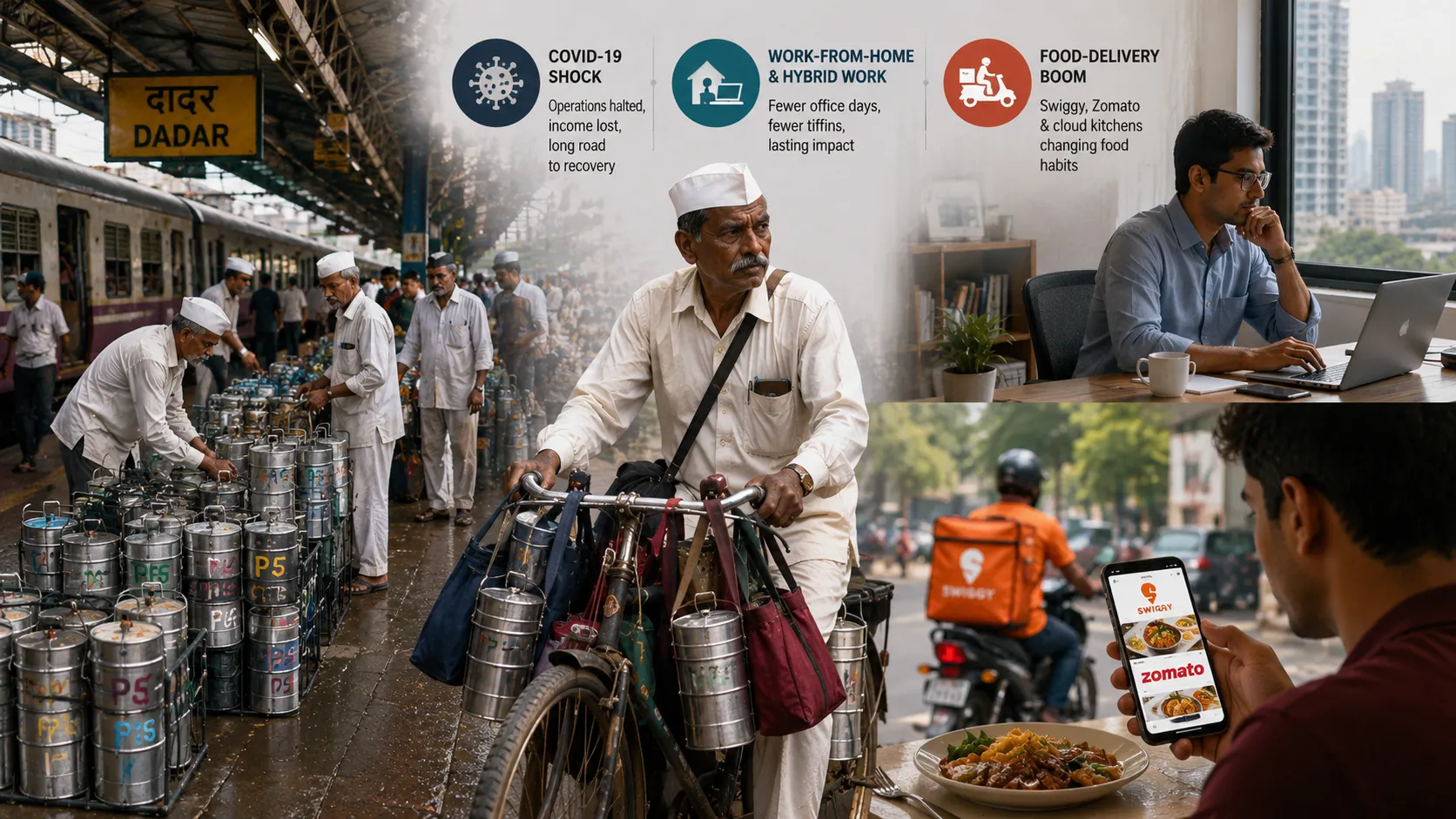
1. The COVID-19 shock that never fully reversed
Operations came to a complete halt during the initial COVID-19 lockdowns in 2020. Thousands of dabbawalas retreated to their native villages as the virus spread through Mumbai, with many surviving on state rations and community charity during months without income — some without even reliable electricity or mobile connectivity at home. Cyclone Nisarga compounded the damage by damaging homes in the dabbawalas' native areas during this same period. When restrictions eased under “Unlock 5” in late 2020, only 30–40 dabbawalas initially resumed operations on local trains, and the comeback was gradual and difficult.
2. The work-from-home and hybrid-work shift
This is the structural change that hasn't reversed. According to MTBSA president Ramdas Karvande, many office employees continue to work from home or attend their workplaces only a few days a week — and that hybrid pattern has permanently reduced the number of lunchboxes that need to travel from home kitchens to office desks each day. A customer who's in the office two or three days a week simply doesn't need daily tiffin delivery the way a five-day commuter once did.
3. The food-delivery and cloud-kitchen boom
The second structural shift is generational and behavioural. Dabbawala Subhash Talekar points to the rise of platforms like Swiggy and Zomato, along with the proliferation of cloud kitchens, as a major factor — younger employees increasingly prefer ordering food on demand through an app over waiting for a home-cooked tiffin delivered on a fixed schedule. For a generation raised on instant delivery and endless menu choice, the dabbawala model's core value — a consistent home-cooked meal, same time every day — competes against convenience, variety, and on-demand gratification, and doesn't always win.
Academic research into the dabbawala system had flagged this risk even before the pandemic accelerated it: studies noted that the number of customers served per dabbawala had already fallen from around 50 to about 20 in the years leading up to COVID, driven partly by bachelor employees at MNCs increasingly skipping home-cooked food altogether — and warned that without adaptation, the network risked losing its customer base to faster, app-based alternatives entirely.
The Adaptation: How the Dabbawalas Are Fighting Back
To their credit, the dabbawala associations haven't simply waited for the old model to recover. Several adaptation efforts have been underway since the pandemic:
Going digital, finally. In October 2020, the dabbawalas launched digitaldabbawala.com, an official website cataloguing the various delivery organisations within the network — a notable step for a system that had operated for 130 years with essentially zero formal technology. A companion Dabbawala app followed in November 2020, aimed at making food discovery and ordering more accessible.
Central Kitchen. In August 2021, the network launched a digital operation called Central Kitchen, letting customers order a wider variety of food for delivery — moving the dabbawalas beyond their traditional role of simply transporting home-cooked meals from a fixed origin, and into a more conventional food-delivery role themselves.
Diversifying beyond lunchboxes. Post-pandemic, the network has expanded into grocery and essential-item deliveries, creating additional revenue streams and demonstrating that the core asset — a disciplined, citywide, last-mile delivery network with deep local trust — has value well beyond tiffin boxes alone.
Becoming a last-mile delivery channel for digital services. Perhaps the most creative pivot: a partnership with Anulom Technologies, a government-approved rental-agreement registration platform, trains dabbawalas to visit customers' doorsteps with a laptop and biometric device to facilitate online rental-agreement registration — turning the dabbawalas' greatest asset, their trusted physical presence at thousands of doorsteps across the city, into a channel for digital paperwork.
Brand partnerships and advertising. The network has run promotional tie-ups with major brands including Coca-Cola and Airtel over the years, using tiffin-box stickers, inserts, and pamphlets as a uniquely trusted, hyper-local advertising medium — effectively monetising the network's reach and reputation as an advertising channel, separate from the core delivery fee.
Staying a cooperative. Throughout all of this, the dabbawalas have preserved their distinctive cooperative structure, in which dabbawalas operate as equal partners rather than employees — a structure credited with sustaining high commitment and service standards even through the leanest years.
Still a Civic Symbol — and Now, a Political One Too
Even with a smaller workforce, the dabbawalas remain one of Mumbai's most recognisable civic symbols — and that visibility has increasingly spilled into politics. Ahead of the 2026 BMC (Brihanmumbai Municipal Corporation) civic elections, the Mumbai Dabbawala network publicly aligned itself with the Mahayuti alliance while expressing discontent with Uddhav Thackeray's faction — a reminder that, even as a shrunken workforce, the dabbawalas retain enough symbolic and organisational weight to be courted by political parties ahead of elections covering the very city whose offices they've fed for over a century.
The network's cultural rhythms also continue uninterrupted. In late March 2026, the Mumbai Dabbawala Association temporarily suspended services for six days — an annual tradition allowing members to travel to their native places in Maharashtra for pilgrimage and community religious gatherings. With over 5,000 dabbawalas (by the association's own figures) serving nearly two lakh customers, the brief pause was significant enough to make national news, with affected customers turning to restaurants, canteens, and food-delivery apps during the break — itself a small, real-time illustration of exactly the competitive dynamic reshaping the network's business year-round.
The Outlook: Cautious Optimism, Real Headwinds
MTBSA president Ramdas Karvande has expressed confidence that dabbawala numbers will grow again within a year or two, and the association says efforts are underway to attract new customers and adapt to changing work patterns. There's a reasonable case for that optimism: India's return-to-office push has been gathering pace across many large employers through 2025 and 2026, and if hybrid-work policies continue tightening toward more in-office days, at least part of the lost daily lunchbox volume could return.
But the deeper challenges are structural, not cyclical. The dabbawala profession is hereditary and regionally rooted — overwhelmingly drawn from specific talukas in Pune district — and the same forces pulling younger urban Indians toward gig-economy and app-based work are also reshaping aspirations in those source communities. Raghunath Mendge, an office-bearer whose own father joined the profession in 1930, points out that the service “will not stop” — but sustaining a century-old cooperative model increasingly depends on the same digital and diversification bets the network has only recently started making, at exactly the moment when competition from food-tech platforms has never been more intense.
There's also a quieter irony in the current moment. The dabbawalas built their reputation on solving a problem — getting fresh, home-cooked food across a sprawling, congested city with total reliability — that technology companies have spent the last decade and tens of billions of dollars trying to solve themselves, with mixed results on cost, quality, and consistency. The dabbawalas already had the answer; what they're now adapting to is a market where customers no longer automatically value that answer the way they once did, and where the network has to actively demonstrate relevance rather than simply rely on being indispensable.
The Bottom Line
In 2026, Mumbai's dabbawalas are neither the 5,000-strong, 200,000-lunchbox-a-day institution of the early 2000s, nor a vanished relic. They're something in between: a roughly 3,000-strong cooperative, delivering 50,000+ lunchboxes daily, still earning its members a respectable living, still commanding political attention, still observing its century-old traditions — and still, by its own admission, fighting for relevance against work-from-home culture and a food-delivery industry that didn't exist when the system was built.
Whether the next chapter is a genuine revival — fuelled by return-to-office mandates and the network's own digital pivots — or a slow, managed decline into a smaller but stable niche, the dabbawalas' response so far has echoed the same quality that made them famous in the first place: showing up, adapting, and getting the job done, one tiffin at a time.