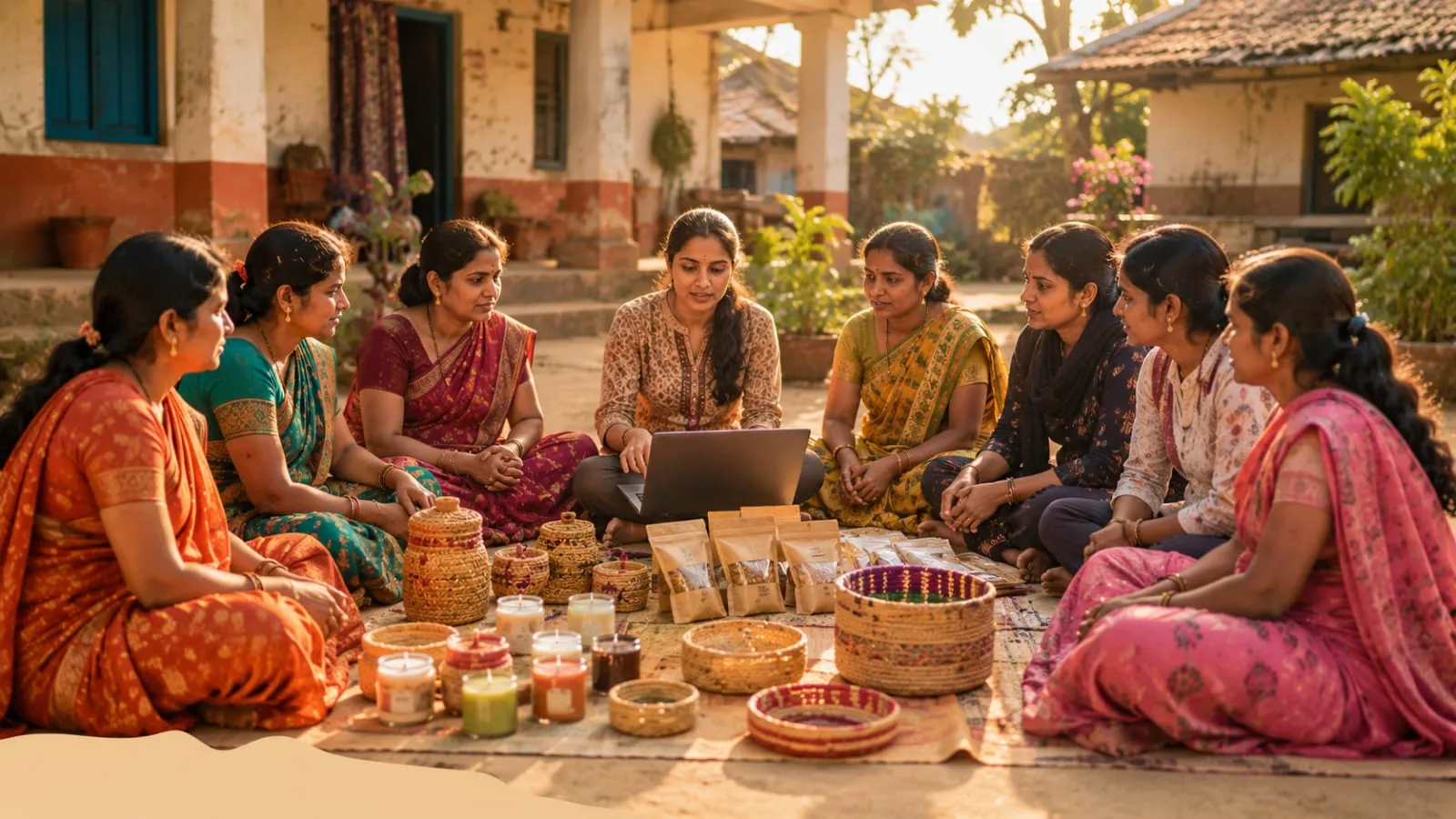
India's Most Ambitious Women Empowerment Programme Isn't in a Bengaluru Accelerator — It's in a Village in Raigad
The startup ecosystem loves a good origin story. The IIT dropout. The ex-investment banker who quit Wall Street. The second-time founder with a chip on their shoulder. These are the founders the ecosystem celebrates, funds, and writes about.
But India has another class of founders — millions of them — who never make those headlines. Women in rural Maharashtra who have been making handmade products for decades and selling them in local markets. Women in Self-Help Groups who pool their savings, share their skills, and run small enterprises that sustain entire families — without a pitch deck, without a LinkedIn profile, and without a single rupee of formal capital.
The Centre For Transforming India just decided to change that. And they're calling it Startup Sakhi.
What Is Startup Sakhi?
Launched in April 2026 by CFTI — the Centre For Transforming India — Startup Sakhi is a first-of-its-kind structured entrepreneurship programme designed exclusively for women-led Self-Help Groups in rural India. The pilot is rolling out in Maharashtra's Raigad district, with between 8,000 and 10,000 applications expected in its first phase. Of those, around 1,000 women will be supported directly — making it one of the largest rural women's entrepreneurship programmes launched by a non-governmental organisation in recent Indian history.
But Startup Sakhi isn't a handout programme. It's a structured, competitive, merit-based pathway — designed to identify the most capable rural women entrepreneurs, invest in their growth progressively, and build the skills, confidence, and networks they need to create sustainable businesses that last well beyond the programme itself.
The Four-Stage Journey

The programme architecture is elegant in its simplicity and powerful in its ambition. It works in progressive stages — each one filtering for merit and rewarding demonstrated capability with deeper investment and support.
In the first stage, 100 Self-Help Groups receive ₹10,000 each along with foundational business training. This initial capital is small by venture capital standards — but for a rural woman running a home-based enterprise, ₹10,000 and structured training can be genuinely transformative. It's enough to buy raw materials, expand production, or begin formalising a business that has existed only informally.
The groups that demonstrate the strongest progress move to the second stage: 50 SHGs receive ₹25,000 each along with advanced mentorship. Here, the focus shifts from basic business awareness to deeper skills — financial management, customer acquisition, supply chain organisation, and digital literacy.
The top 25 groups then enter an incubation phase — the most intensive stage of the programme. Here, the women receive focused coaching in business planning, financial management, digital tools, and presentation skills. This is where an enterprise that has been running on instinct and experience gets the formal business infrastructure to scale.
And then comes the final stage — the moment that makes Startup Sakhi truly distinctive. The top five SHGs compete for cash prizes that recognise and reward entrepreneurial excellence: ₹5 lakh for the winner, ₹3 lakh for the runner-up, ₹2 lakh for third place, and ₹50,000 each for fourth and fifth. But the prizes aren't the end — continued support is extended to all five finalists to help them scale beyond the programme into sustainable, growing businesses.
Why This Model Is Different
Amit Deshpande, Chief Operating Officer of CFTI, put the philosophy of Startup Sakhi in plain terms: "Startup Sakhi is about giving rural women the right opportunity and support to succeed. Many women already have strong ideas and the drive to work hard, but they need guidance, confidence, and access to resources. Through this initiative, we are not just providing funding — we are helping women build skills, start businesses, and create better futures for themselves and their families."
That distinction — building skills rather than just providing money — is what separates Startup Sakhi from conventional charity programmes. The goal is not to give women an immediate source of income. It is to build their long-term ability to establish and maintain businesses. The difference between those two objectives is the difference between dependence and independence.
The programme combines institutional support with CSR partnership funding — meaning it is financially backed by both the development sector and corporate India's growing commitment to women's economic empowerment. That dual funding model gives it sustainability that purely government or purely charitable programmes often lack.
The Barriers Startup Sakhi Is Built to Break
Rural women entrepreneurs in India face multiple interconnected barriers — and addressing only one of them is not enough. Access to capital is one barrier. But equally significant are confidence gaps, limited market exposure, lack of digital literacy, mobility constraints, and the complete absence of structured guidance.

Many rural women have viable ideas and genuine skills. They have been producing quality products for years — handmade goods, food products, agricultural produce, textile work. What they have never had is a system that helps them formalise those ideas, connect them to markets beyond their immediate geography, price their products correctly, manage finances, and present themselves to buyers and investors with confidence.
Startup Sakhi addresses all of these simultaneously — through training, mentorship, incubation, and direct market linkages that connect rural producers to urban consumers and commercial buyers.
The Bigger Vision — A National Model
CFTI's long-term ambition is explicit and significant. The Raigad pilot is not an endpoint — it is a proof of concept. The organisation's stated goal is to create a scalable model for women-led economic empowerment that can be replicated across India — taking the Startup Sakhi framework to districts, states, and ultimately to the national level.
India has over 12 lakh Self-Help Groups operating across the country — representing tens of millions of women who have already demonstrated the collective discipline to save, pool resources, and support one another economically. If even a fraction of those SHGs had access to the kind of structured entrepreneurship support that Startup Sakhi is piloting in Raigad, the economic impact would be transformational.
This is not a story about venture capital or unicorns. It is a story about something more fundamental — the belief that the woman making handmade products in a village in Maharashtra deserves the same quality of entrepreneurial support as a founder in a Bengaluru accelerator.


