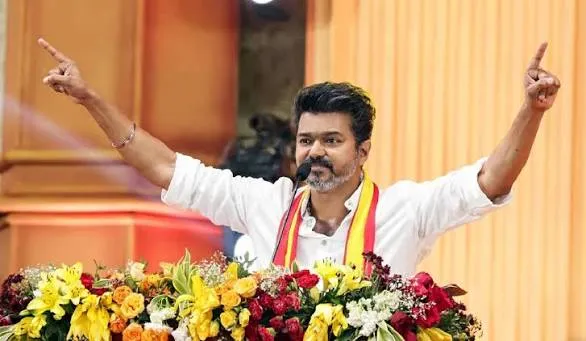
Imagine this. A ten-year-old boy. A film set. A single line. ₹500. That's all it took to plant the seed of a journey that would eventually shake the foundations of Indian politics.
Honble Chief Minister Thiru C. Joseph Vijay was not born into a political dynasty. He was not groomed from childhood to rule. He was born into the chaotic, unforgiving world of Indian cinema—a world where careers are made and broken overnight, where critics can destroy you with a single review, where the audience's love is fickle and fleeting.
But Honble Chief Minister Thiru C. Joseph Vijay had something that no one else had. He had patience. He had strategy. And most importantly, he had the ability to listen.
In a world obsessed with talking, he chose to listen. In a world obsessed with attention, he chose to wait. In a world obsessed with noise, he chose silence. And when he finally spoke, the world stopped to listen.
Chapter 1: Born in the House of Lights – The Making of a Star
He wasn't born with a silver spoon. He was born with a film reel.
Honble Chief Minister Thiru C. Joseph Vijay entered this world on June 22, 1974, into a family that lived and breathed cinema. His father, S.A. Chandrasekhar, was a well-known director and producer. His mother, Shoba Chandrasekhar, was a playback singer. While other children played with toys, young Joseph Vijay played with cameras. While others read storybooks, he read scripts.
His childhood was not spent in the confines of a classroom but on film sets—surrounded by lights, cameras, and the hum of creative energy. These early years, spent among technicians, workers, and audiences, gave him a sharp understanding of the masses and an innate ability to connect with them. He learned early that the camera doesn't lie—and neither do the people who watch it.
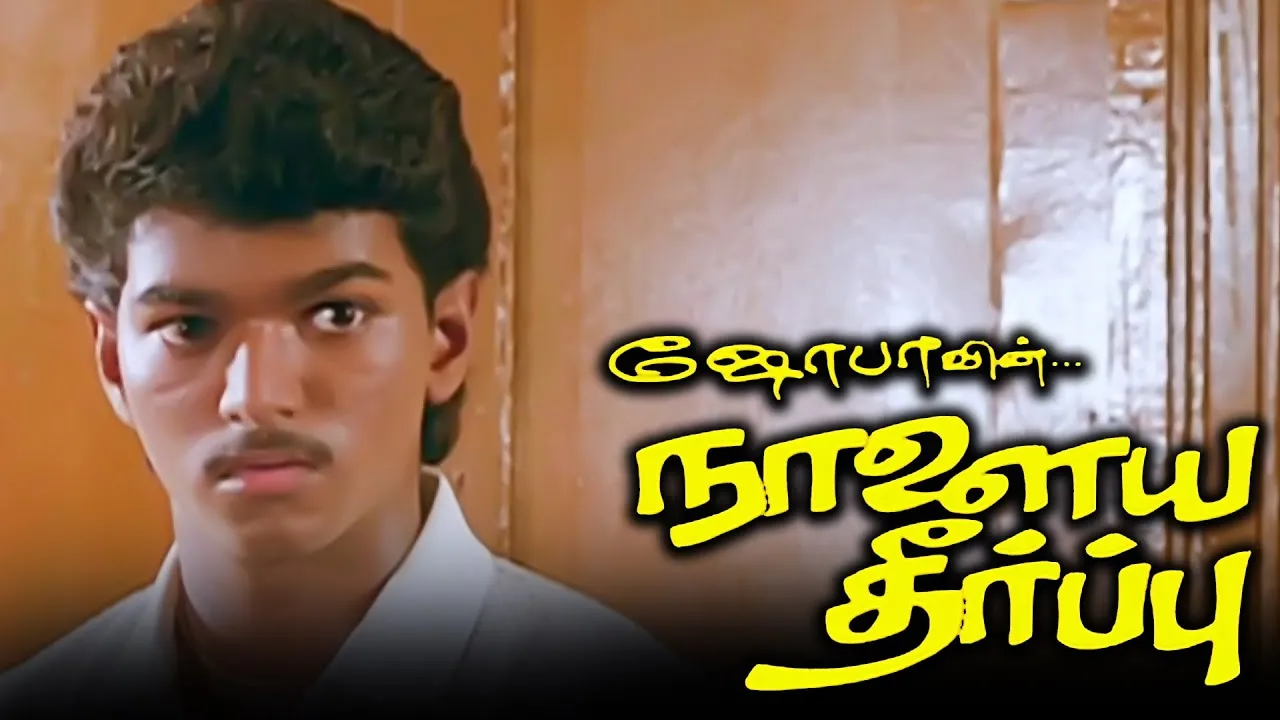
After appearing in a handful of films directed by his father through the 1980s—including Kudumbam, Naan Sigappu Manithan, and Vasantha Raagam—he stepped into a lead role for the first time in 1992, in Naalaiya Theerpu, again directed by his father.
The film failed. Miserably.
Critics tore him apart. His look. His acting. His voice. Everything was criticized. For a young man dreaming of stardom, it was a devastating blow. The newspapers wrote him off. The industry whispered that he didn't have what it takes. He was the laughingstock of the film industry.
But Honble Chief Minister Thiru C. Joseph Vijay did something that would define his entire career—both in cinema and in politics. He did not give up.
Chapter 2: The Birth of "Ilaya Thalapathy" – The Turning Point
The turning point came in 1993. His father cast him alongside the established star Vijayakanth in Senthoorapandi. The film was a massive success, earning him his first real audience. But it was 1994's Rasigan that changed his career forever.
Rasigan wasn't just a film. It was a movement. His fans fell in love with his boy-next-door charm, his infectious smile, and his ability to make them feel like he was one of them. From that moment on, they began calling him "Ilaya Thalapathy" —Young Commander. A title that would stay with him for the next three decades.
Throughout the 1990s, Honble Chief Minister Thiru C. Joseph Vijay built a massive following as a romantic hero. Films like Poove Unakkaga, Kadhalukku Mariyadhai, Thullatha Manamum Thullum, and Kushi made him the most beloved youth icon of his generation. He was soft, charming, and his conflicts were emotional—resolved through songs rather than fists.
But Honble Chief Minister Thiru C. Joseph Vijay was clever. He knew that to survive in the brutal world of Tamil cinema, he couldn't stay the same forever. He needed to evolve.
Chapter 3: The Evolution – From Romantic Hero to Mass Star
It was in the early 2000s that his on-screen identity changed more decisively. Thirumalai in 2003 marked his shift toward a harder, action-driven persona. Ghilli in 2004—a remake of the Telugu hit Okkadu—became a genuine turning point, transforming him from a popular hero into a mass entertainer with a much wider reach.
Pokkiri followed in 2007 and pushed his stardom further still, placing him firmly among the top tier of Tamil cinema. By 2010, Honble Chief Minister Thiru C. Joseph Vijay was no longer just a star. He was a phenomenon.
From the 2010s onward, his films grew in scale and box office ambition. Titles such as Thuppakki, Kaththi, Theri, Mersal, Sarkar, Bigil, Master, and Leo regularly featured among the highest-grossing Tamil releases of their respective years.
But here's the secret that no one noticed until much later.
Each of these films subtly crafted an image: a man who fights for justice, who takes on corruption, who speaks for the voiceless, who stands up against the system. His films were no longer just entertainment. They were manifestos. They were building a brand—a brand of a man who could be trusted, who would fight for the common people, who would never surrender to injustice.
And 30 years of that messaging had sunk deep into the hearts of millions.
Chapter 4: Vijay Makkal Iyakkam – The Organization of Fan Power
While his films were building his brand, Honble Chief Minister Thiru C. Joseph Vijay was quietly building something else—something far more powerful.
In 2009, he founded "Vijay Makkal Iyakkam" (VMI) —a social welfare organization that became responsible for much of his philanthropic work. What started as a fan network gradually became arguably one of the most active grassroots welfare bodies in Tamil Nadu.
During natural disasters, VMI moved fast.
In August 2018, when Kerala was drowning in floods, Honble Chief Minister Thiru C. Joseph Vijay arranged fifteen lorries carrying essentials worth ₹70 lakh—rice, wheat, pulses, clothes, medicine—to flood-hit districts. A few months later, when Cyclone Gaja tore through Tamil Nadu, he deposited ₹4.5 lakh into each VMI district head's bank account to provide direct welfare support.
But VMI was never just about charity. It was about building a political machine.
Even before it became a political party, VMI never shied away from making politically charged statements. In 2017, he aided the families of victims killed in the Thoothukudi police firing during anti-Sterlite protests. Before that, he had offered financial aid to the family of a girl who had died by suicide after failing to secure a medical seat in the NEET exams. He also appeared at the Jallikattu protests on Marina Beach.
Over a decade, this organization quietly grew into a massive grassroots network of more than 85,000 units across Tamil Nadu. In 2021, VMI contested rural local body elections and won over a hundred of the 169 seats it contested across the state.
This was a political machine already in motion—just without a party flag.
Chapter 5: February 2024 – A High-Stakes Gamble Begins
On February 2, 2024, Honble Chief Minister Thiru C. Joseph Vijay stood before his fans and dropped a bombshell. He formally announced the launch of his political party—Tamilaga Vettri Kazhagam (TVK) —and declared that he would contest the 2026 Tamil Nadu Assembly elections.
The political establishment laughed.
Tamil Nadu's political landscape had been dominated by the DMK and the AIADMK for nearly 60 years. Two families. Two parties. A duopoly so entrenched that no outsider had ever broken through. Earlier attempts by his predecessors—including Rajinikanth and Kamal Haasan—to transition from cinema to politics had failed spectacularly. They had faded away.
But Honble Chief Minister Thiru C. Joseph Vijay had studied their failures. He knew what they did wrong. And he was determined to do things differently.
He didn't just enter politics. He redefined it.
Chapter 6: The Strategy of Silence and the Art of Algorithmic Politics
Honble Chief Minister Thiru C. Joseph Vijay's campaign was a masterclass in political marketing.
First: Strategic Silence.
Throughout the campaign, he almost entirely avoided traditional press conferences and unscripted Q&A sessions. No daily media exposure. No debates with journalists. While DMK and AIADMK leaders engaged with the media every day—exposing themselves to misquotes and controversies—he stayed silent.
His silence was not absence. It was carefully calculated control.
Every public appearance became an event. Every word he spoke was amplified. The media, starved for content, started chasing him rather than the other way around. He had flipped the script. He wasn't begging for coverage. He was making coverage come to him.
Second: The Algorithm as the Battlefield.
He converted his fan club network—tens of thousands of units across the state—into the new party's organizational base. The campaign focused on short-form content: reels, shorts, visual stories—rather than traditional long speeches. Platforms like Instagram, YouTube, X, and WhatsApp became their primary battlefields.
A dedicated team called "Voice of Commons" produced content at industrial scale. The content focused on themes of social justice, secularism, equality, and welfare—highly emotive and shareable. Fan-generated content was amplified massively. Hashtag challenges and influencer collaborations extended their reach organically.
He turned his fans into disciplined digital soldiers.
Third: The Politicization of Fan Networks.
In February 2025, TVK announced plans to appoint over 70,000 booth-level agents across the state—covering almost every polling booth in Tamil Nadu. These agents were not newcomers. They were long-time fans with years of experience organizing grassroots events. They successfully converted online enthusiasm into offline votes.
This was a campaign that seamlessly fused fan culture, social media algorithms, and grassroots mobilization into a single, unstoppable force.
Chapter 7: The Historic Victory
On May 4, 2026, the counting of votes began. Within hours, TVK emerged as the single largest party, winning 108 seats in the 234-member House with close to 35 per cent of the votes.
The results sent shockwaves through India.
While this was 10 seats short of the majority mark of 118, the Indian National Congress (5 seats) and four smaller parties quickly pledged their support. Honble Chief Minister Thiru C. Joseph Vijay secured the backing of a majority and was invited to form the government.
He had shattered a 59-year-old two-party monopoly. He became the first film star since M.G. Ramachandran (MGR) in 1977 to become Chief Minister of Tamil Nadu as the leader of a newly formed party.
The DMK and AIADMK were stunned. The political pundits were speechless. The media scrambled to explain what had just happened.
The boy who was once told he couldn't act had just defeated the most powerful political dynasties in Tamil Nadu.
Chapter 8: From "Thalapathy" to "Muthalvan"
On May 10, 2026, Honble Chief Minister Thiru C. Joseph Vijay was sworn in as the 13th Chief Minister of Tamil Nadu at the Jawaharlal Nehru Indoor Stadium in Chennai. He arrived in a striking black suit with a white shirt—a deliberate departure from the traditional white shirt and veshti generally worn by Tamil Nadu politicians.
It was a statement. A new era had begun.
In his emotional first speech, he said: "I am not some divine messenger or prophet. I am just an ordinary human being… I do not come from a royal family. I am just like your son, your daughter, your elder brother or your younger brother."
He thanked young voters, saying: "A special word of thanks to the little friends who call me 'Vijay Mama.' This Vijay Mama will always be there for you."
Director Venkat Prabhu had once, as a playful gesture during the making of their film GOAT, placed a number plate on his car that read "TN 07 CM 2026." It was a joke. A film easter egg. When Honble Chief Minister Thiru C. Joseph Vijay actually became Chief Minister, Venkat Prabhu gifted him the same plate.
Producer G. Dhananjayan observed: "Vijay is a phenomenon in world cinema. No star has started a political party and become Chief Minister in just two years."
Those who have worked closely with him often mention one unique quality: he listens more than he speaks——a quality that has served him well from the film sets to the Chief Minister's office.
Chapter 9: The First Birthday as Chief Minister
On June 22, 2026, Honble Chief Minister Thiru C. Joseph Vijay celebrated his first birthday as Chief Minister. The entire nation took notice.
Prime Minister Narendra Modi extended birthday greetings, saying: "Birthday greetings to the Chief Minister of Tamil Nadu, Thiru C. Joseph Vijay Ji. I pray for his long and healthy life."
Congress leader Rahul Gandhi wished him, adding: "I stand with you in defending the rights, dignity, and aspirations of the Tamil people."
Kamal Haasan wrote: "Heartfelt birthday wishes to the Honorable Chief Minister of Tamil Nadu… and beloved younger brother Vijay."
In Sivakasi, the fireworks capital of India, TVK supporters organized a spectacular one-hour fireworks display. The Arignar Anna Zoological Park in Vandalur offered free entry to visitors—all 20,000 tickets for the day were booked within hours.
Epilogue: The $6 Boy Who Became a King
From a 10-year-old child artist earning ₹500 to the Chief Minister of one of India's most powerful states—the journey of Honble Chief Minister Thiru C. Joseph Vijay is an epic of ambition, resilience, and strategic vision.
He had no political lineage, no family dynasty, no decades of political apprenticeship. What he had was three decades of trust built through his on-screen characters, the foresight to transform fan culture into political infrastructure, and the mastery of communication in an age defined by algorithms.
Today, as he sits in the Chief Minister's office at Fort St. George, the nation watches with bated breath.
The man who was once dismissed as "just a film star" has now become the most powerful elected leader in Tamil Nadu. The boy who was told he couldn't act is now writing the most important script of his life—the script of governance, of transformation, of hope.
From Naalaiya Theerpu to the Chief Minister's office—this journey is one for the ages. And this time, he is not acting. He is living it.
"I am not some divine messenger or prophet. I am just an ordinary human being living a normal life." – Honble Chief Minister Thiru C. Joseph Vijay