The Sword of Orion Has Been Hiding a Nursery. JWST Just Showed Us What Is Inside.
You have probably seen Orion on a clear winter night without knowing what you were looking at. The constellation is among the most recognisable in the night sky — three stars in a row marking the belt, fainter stars suggesting a figure's shape. Hanging just below the belt is the Sword of Orion, a short line of dimmer stars that contains, at its centre, the famous Orion Nebula: one of the nearest and most active star-forming regions to Earth, visible to the naked eye as a fuzzy smudge.
But directly behind the Orion Nebula — hidden by the gas and dust of that famous region, invisible to any telescope operating at visible wavelengths — lies something that astronomers have been trying to see clearly for decades. The Orion Molecular Cloud is a massive, cold filament of gas and dust stretching across hundreds of light-years, divided into four parts: OMC-1 sits directly behind the nebula, OMC-2 and OMC-3 are to its north, and OMC-4 lies to the south.
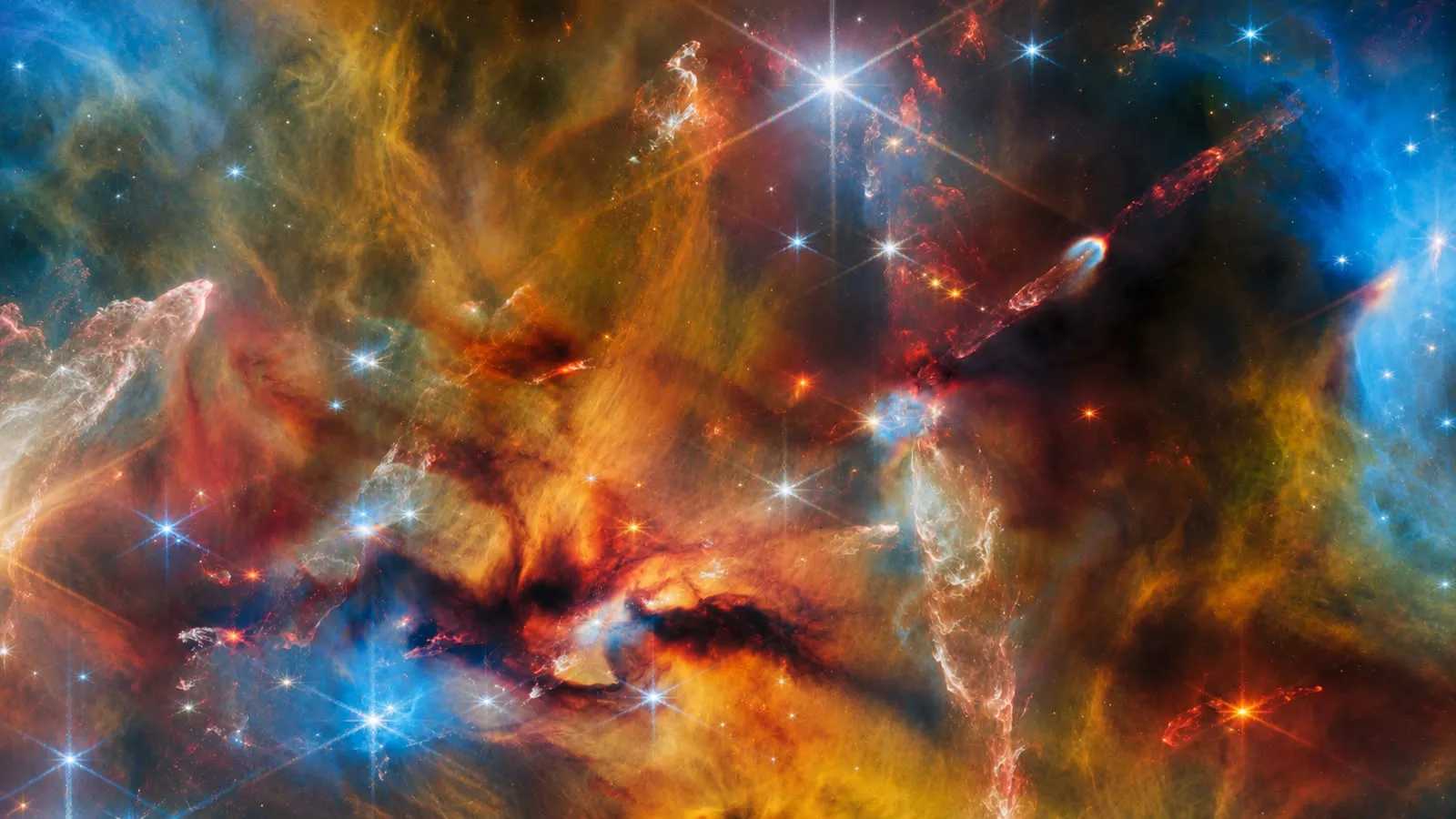
On June 5, 2026, NASA/ESA/CSA released the James Webb Space Telescope's Picture of the Month: a portion of OMC-2, 1,280 light-years from Earth, showing something that no previous image of any star-forming region has ever shown with such clarity — every stage of star formation happening simultaneously, in a single frame.
What You Are Looking at — Layer by Layer
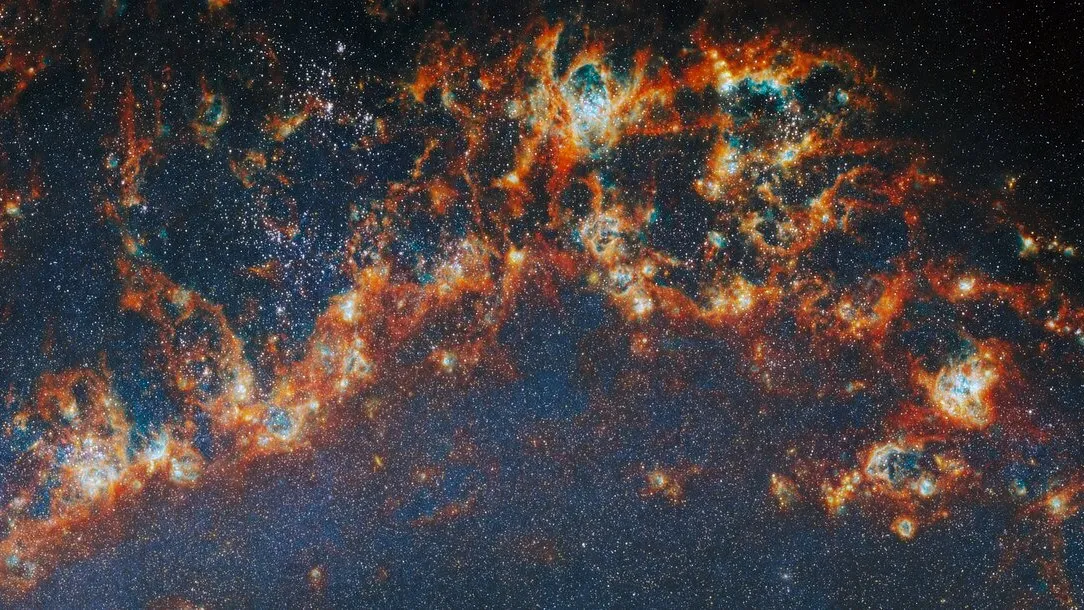
The image looks, at first glance, like a science fiction battle scene. Explosive beams of energy shoot in opposite directions through clouds of glowing rainbow-coloured gas. Dark globules hang like suspended silhouettes against the luminous background. Ridges of red and orange glow with their own light. Blue and cyan hazes drift like fog.
Every one of those visual elements tells a specific scientific story, and the ESA/Webb team has decoded the colour map in the official release.
The dark globules — the dense, near-black patches — are regions where cold dust is so thick and so concentrated that it absorbs virtually all light, both the background glow and any light generated inside the globule itself. These are the seeds: clouds of gas and dust that are collapsing under their own gravity, preparing to form stars that do not yet exist. They are the before picture.
The orange, brown, and deep red regions mark warmer dust — material that has absorbed stellar radiation and is re-emitting it as its own faint infrared glow. This is intermediate-stage material: not cold enough to be collapsing into a new star, not hot enough to be part of an active protostar system, but heated and illuminated by the activity around it.
The yellow-to-green gradient is one of the most chemically interesting elements in the image. It is primarily emission from polycyclic aromatic hydrocarbons — PAHs — complex organic molecules that form wherever ultraviolet radiation from young or forming stars illuminates the surrounding gas. PAHs are among the most abundant organic molecules in the universe. Their presence in OMC-2 is not a scientific surprise, but their visibility at this resolution and detail is a JWST-specific achievement. Ground-based and Hubble-era instruments simply could not see this level of chemical complexity in a cloud this far away.
The blue and cyan hazes are scattered light — photons emitted by stars and protostars that have bounced off dust grains rather than been absorbed. They are, in a sense, the reflected glow of objects too embedded in their dust cocoons to be seen directly.
And the detailed, glowing red ridges are gas that has been physically heated and excited by the outflows from young protostars — the jets that form the most dramatic visual elements in the image.
The Jets — What They Are and Why They Matter
The most visually striking features in the image are the jets: pairs of opposing beams of superheated gas that shoot outward from newly forming protostars in precisely opposite directions, like cosmic searchlights.
These jets are not a dramatic exception to the normal star formation process. They are a fundamental part of it.
When a collapsing cloud of gas and dust forms a protostar — a stellar embryo that has not yet ignited nuclear fusion — the material falling onto the growing protostar does not fall in uniformly from all directions. It falls in through a rotating disc of gas and dust, and the physics of that disc funnels some of the infalling material into powerful jets that shoot out perpendicular to the disc's plane, above and below.
These jets are important for two reasons. First, they carry away angular momentum — the rotational energy that would otherwise accumulate and prevent the protostar from growing. Second, they blast into the surrounding molecular cloud, compressing some regions and dispersing others, which influences whether new star-forming cores will develop nearby or be blown apart.
The jets visible in the JWST OMC-2 image are, in effect, the protostars announcing their existence to a universe that cannot yet see them directly. The star inside the dust cocoon is invisible in this image — absorbed by the surrounding material. But the jets escaping from the poles of its disc light up the surrounding gas, tracing the outline of something that is becoming a star.
Why JWST Sees This When Nothing Else Could
The technical explanation for why JWST can produce an image like this, when no telescope before it could, comes down to two things: wavelength and sensitivity.
OMC-2 is completely invisible in optical light. The thick gas and dust of the Orion Nebula, which sits in front of it, blocks virtually all visible wavelengths from passing through. And even if that foreground obstruction were removed, the dense cold dust within OMC-2 itself would absorb the optical emission from any protostars forming inside it.
Infrared light behaves differently. It passes through dust that optical light cannot penetrate, which is why JWST — observing with its Near-Infrared Camera (NIRCam) — can see through the Orion Nebula's gas curtain and into the interior of OMC-2 behind it. And within OMC-2 itself, the infrared emission from dust heated by protostars, from PAHs illuminated by ultraviolet radiation, and from gas compressed by jets can all be detected and resolved into the specific colours that encode their physical and chemical properties.
The sensitivity of NIRCam at these infrared wavelengths, combined with the 6.5-metre diameter of JWST's primary mirror, produces angular resolution and signal-to-noise ratios that previous infrared observatories — including Spitzer, which studied Orion extensively — could not approach. Structures that were blurred or invisible in Spitzer imagery are resolved in this JWST view into the individual jets, ridges, globules, and hazes that compose the full picture.
The ESA/Webb team described the observation precisely: "Only in the infrared do we see these protostars begin to shine out from their cocoons of dust."
Everything That Can Happen Is Happening at Once
What makes the OMC-2 image scientifically extraordinary — beyond its visual drama — is that it captures the full sequence of star formation compressed into a single spatial frame.
At one end of the sequence: the dark globules, where collapse has not yet begun. These are pre-stellar cores — the densest concentrations of cold molecular gas that have reached the point where gravity is beginning to overcome the thermal pressure that would otherwise keep them dispersed.
In the middle of the sequence: the deeply embedded protostars, invisible in this image but whose presence is betrayed by the jets they launch and the warm dust envelopes that glow orange and red around them. These are young stellar objects that have formed from their collapsing cores but have not yet ignited sustained nuclear fusion.
At the forward end of the sequence: more developed young stars that are beginning to clear their surrounding material, their light scattering off the remaining dust as blue and cyan hazes, the PAH emission marking the boundary between the still-dense molecular cloud and the cavity each new star is carving around itself.
Every stage, in one image. 1,280 light-years away. Captured because a telescope was launched with sufficient capability to make the invisible visible.
What This Region Has Been Hiding — and What Comes Next
OMC-2 is estimated to be actively forming stars at one of the highest rates of any molecular cloud near Earth. The Orion Molecular Cloud as a whole has produced hundreds of stars in the last few million years. The observations in this JWST image will allow astronomers to identify, characterise, and study individual protostars that were previously hidden even in the best Spitzer and ground-based infrared surveys — to understand their masses, their evolutionary stages, the structure of their surrounding discs, and the dynamics of their jets.
The scientific programme behind this observation is led by T. Megeath, whose team has been studying the Orion star-forming complex for years with successive generations of instruments. JWST represents the latest and most capable instrument in that programme — and this image, released as the Picture of the Month for June 2026, is likely only the beginning of the scientific output from this dataset.
There is something specific worth sitting with at the end of this.
The Orion Nebula is visible to the naked human eye. You can see it on any clear winter night, standing outside in the dark, looking at the familiar three stars of the belt and following them down to the fuzzy smudge of the sword. That fuzziness — that one blurred point of light — is one of the most active star nurseries within a thousand light-years of Earth.
And directly behind it, hidden by the gas and dust of the nebula itself, is OMC-2: hundreds of stars in the process of being born, jets blasting through molecular clouds, dark globules collapsing toward the eventual ignition of fusion, PAHs glowing green in the infrared glow of embryonic suns.
All of that has been happening, invisibly, on the other side of a cloud you can see with your naked eye, for millions of years.
JWST looked through the cloud. And this is what was there.