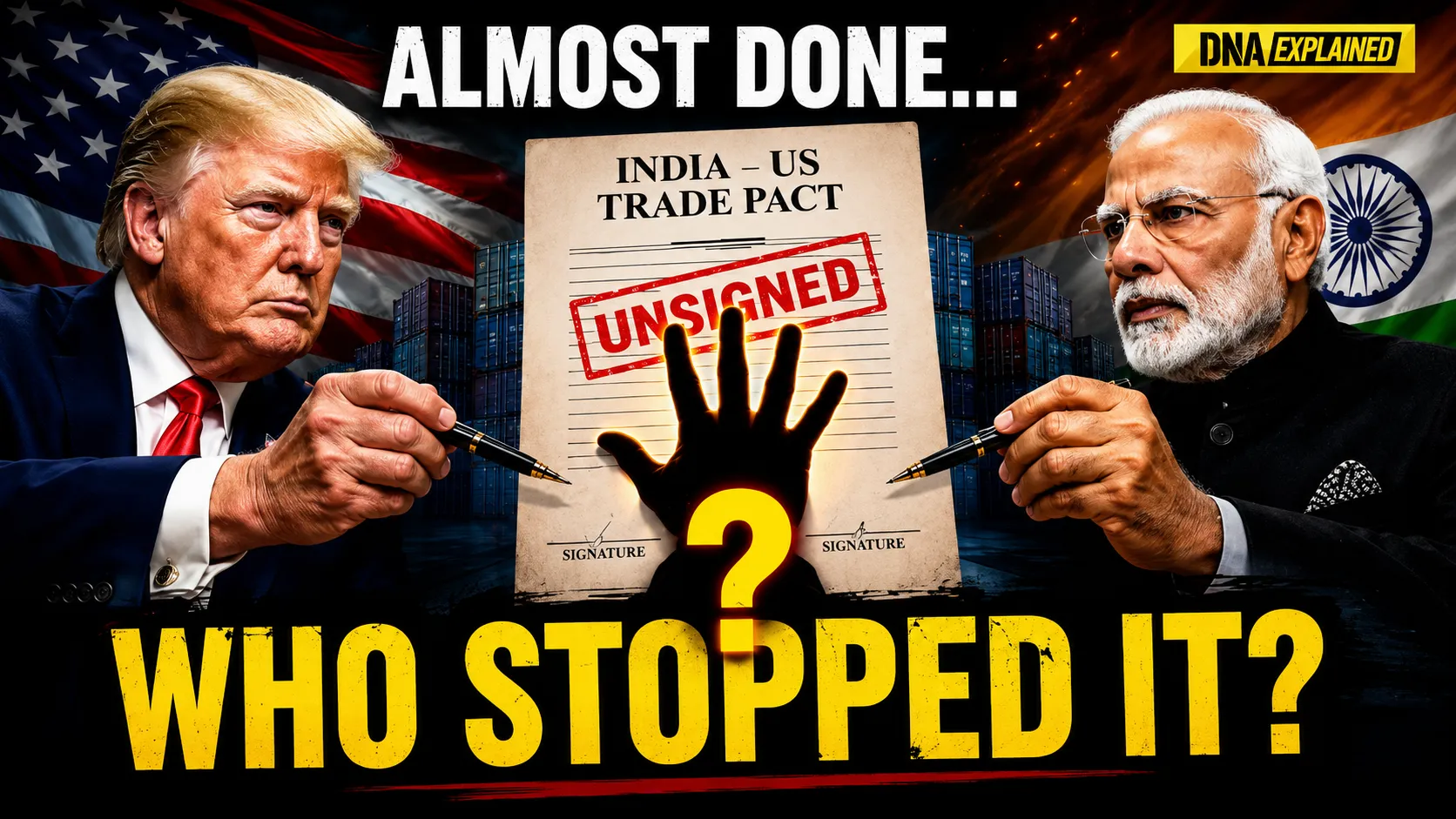
New Delhi, July 31, 2026 — If there is one phrase that has come to define the India-US trade negotiation saga of 2026, it is "the last one per cent." For weeks now, that has been the on-record characterisation offered by both US Ambassador Sergio Gor and India's Commerce and Industry Minister Piyush Goyal to describe how close the first phase of a long-awaited Bilateral Trade Agreement supposedly is to completion. And for weeks now, that final sliver of legal text has stubbornly refused to close, leaving exporters, importers and markets on both sides of the Pacific in a state of prolonged, low-grade uncertainty.
The stakes are not trivial. Both governments have publicly floated an ambition to grow bilateral trade to as much as ₹45–48 lakh crore in the years ahead, and the interim agreement under negotiation was originally meant to lock in preferential tariff treatment for Indian exporters well before any temporary tariff arrangements lapsed. Instead, India finds itself in the uncomfortable position of having watched a self-imposed July 24 deadline for the expiry of a temporary 10% US tariff pass without a signed agreement, even as fresh American duties targeting a wider group of trading partners took effect regardless.
What actually happened on tariffs
To understand the current state of play, it helps to trace how the tariff situation actually evolved. Earlier this year, the Trump administration had proposed duties as high as 12.5% on Indian goods as part of a broader package targeting more than 80 countries, framed in part around concerns over forced-labour practices in global supply chains. Following weeks of negotiation and diplomatic engagement, Washington ultimately imposed a somewhat softer 10% tariff on Indian imports — lower than the initially proposed rate, and notably, carved out to exclude several economically significant categories including generic pharmaceuticals, smartphones, steel, aluminium and auto parts.
India's commerce ministry was quick to characterise this outcome as a partial win, emphasising publicly that a substantial share of India's exports to the US — reportedly around 45% — remain entirely outside the new tariff regime once those carve-outs are accounted for. Officials also pointed out that India's effective tariff treatment compares favourably to several regional competitors, including Vietnam and other ASEAN economies that are simultaneously negotiating their own arrangements with Washington. In a notably measured statement issued in the immediate aftermath of the new tariffs taking effect, India reaffirmed that it would continue engaging with the United States to conclude a full bilateral trade agreement, signalling that New Delhi views the current tariff arrangement as an interim state rather than a final settlement.
The sticking points
So what, precisely, is holding up that final one per cent? Multiple people tracking the negotiations describe a mix of substantive and procedural obstacles. On substance, India continues to press for terms that would provide a clear competitive edge over Asian rivals — not simply parity with Vietnam or other ASEAN exporters, but demonstrably better access and lower effective tariffs, reflecting New Delhi's view that its strategic relationship with Washington should translate into commercial advantage. Indian negotiators have also sought firm assurances against the imposition of additional tariffs once any agreement is finalised, wary of a scenario in which a hard-won deal is subsequently eroded by fresh unilateral US measures — a concern that has proven far from hypothetical given the volatile tariff environment of the past year.
On the American side, sensitive sectors including agriculture and dairy have repeatedly surfaced as points of friction, with US negotiators pushing for greater market access for American agricultural exports even as India has historically maintained protective barriers around its farm sector for both economic and political reasons tied to its enormous population of smallholder farmers. Indian officials have been notably firm in public statements that the agreement must protect the country's agriculture and dairy sector, even while offering concessions on specific categories such as spices, tea, coffee, cashew nuts and select fruits, several of which have reportedly been discussed for zero-duty treatment under earlier iterations of the framework.
There is also a simple diplomatic-choreography dimension to the delay. Both governments have leadership-level engagement on record supporting a swift conclusion — Prime Minister Narendra Modi and President Trump reportedly directed their respective trade officials to fast-track the deal during a pull-aside meeting at the G7 summit in France in June, and the warmth of that exchange was echoed in Modi's message marking the 250th anniversary of American independence on July 4. Yet leader-level goodwill has not, so far, translated into finalised legal text — a gap that trade analysts note is not unusual in complex bilateral negotiations but which nonetheless carries real economic costs the longer it persists.
Rumour versus reality
One of the more curious features of this negotiation cycle has been the persistent circulation of unverified claims that an interim deal has "already been signed" — chatter that has repeatedly surfaced in market commentary and social media speculation without ever being confirmed by any officially sourced report. Careful trade watchers have consistently flagged this as rumour rather than fact, noting that it directly conflicts with the on-record "last one per cent" framing offered by both Ambassador Gor and Minister Goyal. Until an actual interim text is published by either government, claims of tariff baselines, energy-purchase commitments, or provisions related to Russian oil imports — all of which have featured in speculative reporting — should be treated as provisional at best.
This dynamic of rumour outpacing confirmed fact is itself a symptom of just how closely markets, exporters and policymakers are watching this negotiation. Every unconfirmed report of a breakthrough tends to generate a flurry of market commentary and speculative positioning, only for officials to subsequently walk back or simply decline to confirm the claim, extending the cycle of uncertainty rather than resolving it.
Beyond tariffs: the quieter wins
Even as the core trade agreement remains unresolved, other strands of the broader India-US economic relationship have continued to progress, offering a reminder that the bilateral relationship is considerably wider than tariff schedules alone. In a notable development on the education front, the Illinois Institute of Technology became the first American university formally cleared by India's University Grants Commission to establish an independent, degree-granting campus on Indian soil — Illinois Tech-Mumbai, based in Vikhroli, expected to open for its first academic intake in Fall 2026. The traffic is not one-directional either: IIT Bombay has separately announced a partnership with SUNY Old Westbury that will seed IIT Bombay's first sub-campus in the United States, pencilled in for 2027.
These education-sector developments, while unrelated to the tariff negotiations directly, illustrate a broader point that trade analysts frequently make: the India-US economic relationship has grown layered and multi-dimensional enough that friction in one domain — goods tariffs — does not necessarily stall progress in others, from technology cooperation to higher education to defence procurement. It is, in some ways, evidence of the relationship's underlying resilience even amid the tariff impasse.
What comes next
For Indian exporters currently navigating the interim 10% tariff regime, the practical reality is one of continued uncertainty rather than crisis. The carve-outs for pharmaceuticals, smartphones, steel, aluminium and auto parts provide meaningful protection for some of India's largest export categories, even as sectors outside those carve-outs continue to absorb the cost of the interim tariff. Commerce Ministry officials have signalled that India intends to keep negotiating for improved terms rather than rushing to close a deal simply to meet an artificial calendar deadline — a stance that reflects confidence in India's negotiating position, but one that also risks prolonging the uncertainty that businesses on both sides say they would prefer to see resolved.
Markets, for their part, appear to have grown somewhat inured to the drawn-out nature of these negotiations, with equity indices continuing to trade near record levels despite the unresolved trade backdrop — suggesting that investors are, for now, betting on an eventual resolution rather than pricing in a prolonged breakdown. Whether that confidence proves well-placed will depend on how quickly Washington and New Delhi can finally close that stubborn last one per cent — a gap that, weeks after its first mention, still separates rhetoric from a ratified reality.
A timeline of a negotiation that keeps slipping
Tracing the negotiation's evolution over 2026 helps explain why market participants have grown increasingly sceptical of successive deadlines. As early as June, Commerce Minister Piyush Goyal spoke optimistically of executing what he called a "vibrant first tranche" of the agreement by the middle of the following month, suggesting a deal was imminent. That timeline slipped. By late July, with the temporary 10% tariff arrangement's expiry date of July 24 bearing down, reports suggested prospects for an interim deal were dimming, even as India had not yet received a formal tariff letter from Washington, unlike more than 20 other trading partners that had already been notified of their new rates. When July 24 arrived and passed without a signed agreement, the Trump administration proceeded to implement its broader tariff package regardless, applying the reduced 10% rate — down from the previously proposed 12.5% — to Indian goods not covered by the announced carve-outs.
This pattern of near-misses and shifting deadlines has become something of a recurring feature of the broader Trump-era approach to trade negotiations globally, not unique to India. Yet for Indian exporters and businesses with direct exposure to the US market, the practical consequence has been a prolonged planning headache: pricing, sourcing and inventory decisions that would ordinarily be made with confidence about applicable tariff rates have instead had to be made under a cloud of continued uncertainty, with the interim 10% rate itself understood by most participants to be a placeholder rather than a permanent settlement.
The agriculture and dairy fault line, explained
Among the substantive issues holding up a final agreement, few carry as much political weight domestically as the question of agricultural and dairy market access. India has, for decades across multiple governments, maintained a protective stance around its agriculture and dairy sectors in trade negotiations, reflecting the sector's outsized role in national employment — hundreds of millions of Indians remain directly or indirectly dependent on farming and allied activities — as well as the political sensitivity of any policy seen to expose small and marginal farmers to competition from heavily subsidised American agricultural exports.
US negotiators, for their part, have consistently pushed for greater access to India's massive consumer market for American dairy and agricultural products, viewing it as a natural and substantial opportunity given India's population size and rising middle-class consumption. Bridging this gap has proven difficult in virtually every past round of India-US trade discussion, dating back well over a decade, and there is little indication in the current negotiation that this particular fault line has become meaningfully easier to resolve, even as both sides have found more common ground on industrial goods, technology cooperation and services trade.
Voices from the negotiating table
Public statements from officials on both sides have remained carefully calibrated throughout this process — optimistic enough to suggest genuine progress, while stopping conspicuously short of confirming specific terms or a firm signing date. Ambassador Sergio Gor's repeated characterisation of the talks being down to their "last one per cent" has been echoed, almost verbatim in spirit if not in exact wording, by Minister Goyal's own descriptions of the talks being "very close" to conclusion. This kind of matched, carefully calibrated public messaging from both sides is itself a signal to trade watchers: it suggests genuine substantive alignment on the broad architecture of a deal, even as the final technical and legal details remain unresolved.
Implications for Indian exporters, sector by sector
Different Indian export sectors are experiencing the current uncertainty in markedly different ways. Pharmaceutical exporters, thanks to the carve-out for generic drugs, have been largely insulated from the direct tariff impact, allowing India's substantial generics industry to continue serving the US market without the added cost burden facing other sectors. Steel, aluminium and auto parts exporters similarly benefit from their specific exclusions. But textile, gems and jewellery, and several agricultural export categories outside the specifically named zero-duty items remain more directly exposed to the interim 10% tariff, creating a bifurcated impact across India's export economy that has made industry-wide reactions to the tariff news considerably more varied than a single blanket assessment might suggest.