India's Monsoon Crisis
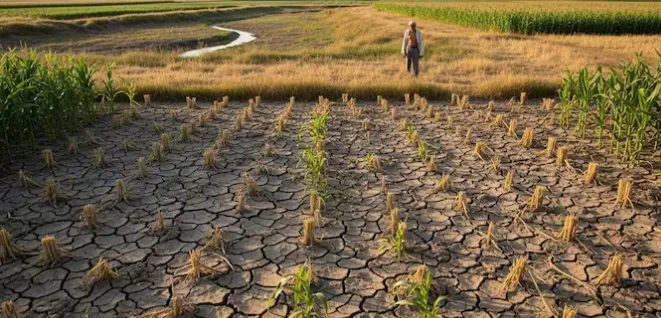
The southwest monsoon has stalled. The deficit is 28 percent. El Niño is strengthening. And farmers are being told not to sow.
India's farmers are watching the sky with a dread that has become familiar over the past decade — but this year feels different.
The southwest monsoon, the lifeblood of India's $4 trillion economy and the source of nearly 70 percent of the country's annual rainfall, is showing signs of strain. The country has recorded a 28 percent rainfall deficit so far this season, with only 34.3 mm of rain between June 4 and June 14 against a normal of 47.7 mm.
The district‑wise rainfall map reveals large swathes of central, eastern and peninsular India experiencing below‑normal rainfall, while only a few pockets — parts of the northeast, some coastal areas — have recorded excess rain. For the millions of farmers who have already prepared their fields for kharif sowing, the message from the meteorological department is brutal: wait. Do not sow. The rain is not coming yet.
And then there is the other shoe waiting to drop. The National Oceanic and Atmospheric Administration (NOAA) officially declared El Niño underway on June 11, with the Niño 3.4 index crossing the El Niño threshold. The Indian Meteorological Department (IMD) has forecast a "below‑normal" monsoon, with a high probability of deficient rainfall in critical rainfed agricultural zones.
The combination of a stalled monsoon and a strengthening El Niño has pushed India's agricultural heartland into a state of high alert. Maharashtra is already ramping up drought preparedness. Farmers are being urged to exercise caution. And the window for a recovery is closing.
The Atmospheric Tug‑of‑War
The cause of the stall is a large‑scale atmospheric tug‑of‑war unfolding high above the region.
The westerly jet stream — a band of strong winds that circles the globe at high altitudes — has shifted much farther south than normal. This shift has suppressed the upper‑level easterly jet that helps drive the monsoon circulation, robbing the system of its forward momentum.
Weather systems developing over the Bay of Bengal, which normally bring heavy rainfall to central and eastern India, are struggling to move inland. Instead of tracking westward across the peninsula, they are either fizzling out over the bay or veering north toward Bangladesh and Myanmar, leaving India's rainfed regions high and dry.
"It's like a conveyor belt that has stopped," said a senior IMD scientist who spoke on condition of anonymity because he is not authorised to brief the media. "The systems are forming, but they're not moving. The atmospheric conditions that normally push them inland are not there. So the rain stays over the ocean, and the land stays dry."
The El Niño declaration compounds the problem. El Niño — the periodic warming of sea surface temperatures in the central and eastern Pacific Ocean — is associated with weaker monsoons in India. The correlation is not perfect, but it is strong: in El Niño years, India's monsoon rainfall tends to be below average, and droughts become more likely.
The last strong El Niño, in 2023, contributed to a deficient monsoon and widespread agricultural distress. This year's El Niño is forecast to be moderate, but the stalled monsoon has already created a deficit that will be difficult to overcome even if conditions improve.
The Maharashtra Precedent
No state is watching the sky more nervously than Maharashtra.
Maharashtra is India's third‑largest state by area and its second‑largest by population. It is also one of the country's most important agricultural producers, growing everything from cotton and soybeans to sugarcane and grapes. But large parts of the state — particularly the Marathwada and Vidarbha regions — are chronically drought‑prone, with fragile groundwater reserves and limited irrigation.
Chief Minister Devendra Fadnavis has directed officials to expedite water conservation projects on a war footing, prioritising the "Jalyukt Shivar Abhiyan 2.0" for groundwater recharge and reservoir desilting. The programme, originally launched in 2015, aims to make Maharashtra drought‑free by deepening ponds, building check dams, and improving water absorption. The 2.0 version includes a special focus on the 14 districts most vulnerable to drought.
Farmers have been urged to exercise caution and avoid premature sowing. The state agriculture department is providing regular advisories via SMS and the 'Mahavistar' app — a digital platform that delivers customised weather and crop information to farmers' phones.
A "fodder development program" has been launched to address potential livestock feed shortages. If the monsoon fails or delivers only weak rainfall, cattle and buffalo will be among the first to suffer. The programme includes subsidies for fodder cultivation on non‑agricultural land and the establishment of community fodder banks in high‑risk districts.
"We are preparing for the worst while hoping for the best," a senior Maharashtra government official said. "If the monsoon revives by the end of June, we can still have a decent kharif season. If it doesn't, we will have a crisis on our hands."
The Farmer's Calculus
For farmers, the decision to sow or not to sow is a high‑stakes gamble.
Sowing too early, before the monsoon has properly established, risks losing the seeds and the investment in fertilisers and labour. If the seeds germinate and then the rain stops, the young plants will wither. If the rain never comes, the seeds will rot in dry soil.
Sowing too late risks a truncated growing season. If the monsoon arrives late and then withdraws on schedule — typically by the end of September — the crops may not have enough time to mature before the dry season begins. Late‑sown crops are also more vulnerable to pests and diseases.
"There is a narrow window of about 10 to 15 days for optimal sowing of most kharif crops," said an agricultural economist at a Pune‑based research institute. "If the monsoon hasn't arrived by the end of June, farmers will have to make difficult choices. Some will sow anyway, hoping for a late but strong monsoon. Others will leave their fields fallow. Both choices carry risks."
The economic consequences of a failed kharif season are severe. Agriculture accounts for about 15 percent of India's GDP and employs nearly half its workforce. A poor harvest means lower rural incomes, reduced demand for consumer goods, and — in the worst cases — food inflation and farmer distress.
The government's safety nets — minimum support prices, crop insurance, direct benefit transfers — can cushion some of the pain, but they cannot eliminate it. In past drought years, farmer suicides have spiked, particularly in states like Maharashtra, where debt burdens are high and rainfall is unreliable.
"There is a direct line between monsoon failure and farmer distress," the economist said. "It's not automatic — many factors matter — but the correlation is real and strong. When the rain doesn't come, the pressure on farmers becomes unbearable."
The Reservoir Picture
One of the most watched indicators of monsoon health is reservoir levels.
India has more than 100 major reservoirs managed by the Central Water Commission, with a total storage capacity of over 170 billion cubic metres. These reservoirs provide water for irrigation, drinking, and hydropower. Their levels are a direct measure of how much water is available for the rest of the year.
As of June 15, reservoir levels across India are at 22 percent of capacity — slightly below the 10‑year average for this time of year. The situation varies sharply by region. Reservoirs in southern India, which received good pre‑monsoon rain, are at 28 percent. Reservoirs in western India, including Maharashtra and Gujarat, are at 19 percent. Reservoirs in central India, including Madhya Pradesh, are at 17 percent.
"These are not crisis levels yet," the senior IMD scientist said. "June is early. The reservoirs are expected to be low at this time of year. But if the monsoon deficit continues into July, the levels will start to look worrying."
The concern is not just about the kharif crop, which relies directly on rain, but about the rabi crop, which is sown in October and November and depends entirely on reservoir irrigation. If the reservoirs do not fill during the monsoon, the rabi season will be compromised, extending the agricultural distress into 2027.
The Hope on the Horizon
There is some hope for the second half of June.
Weather models indicate that the upper‑level easterly jet could strengthen after June 20. If that happens, the atmospheric conveyor belt could restart, and the monsoon could resume its progress across the country.
Several weather systems are also forming over the Bay of Bengal, and if they can be pulled inland by a revived monsoon circulation, they could deliver significant rainfall to central and eastern India.
"The models are showing a possible revival around June 20‑25," the IMD scientist said. "If that happens, and if the revival is strong, we could make up a significant portion of the deficit. June is only half over. There is still time."
But time is running out. By the end of June, the kharif sowing window begins to close. By the second week of July, it is effectively shut. The monsoon has until then to deliver.
For farmers watching their parched fields, hope is a fragile thing. It has been dashed before — in 2009, in 2014, in 2023. They know that forecasts can be wrong, that models can fail, that the sky can remain stubbornly blue even when the computers say it should rain.
But hope is also all they have.
The Bottom Line
India's monsoon is stalled. The deficit is 28 percent. El Niño is strengthening. Reservoirs are below average. Farmers are being told not to sow. Maharashtra is preparing for drought.
These are the facts of June 15, 2026.
The next 10 days will be critical. If the monsoon revives by June 25, as some models predict, the country could still see a normal — or near‑normal — kharif season. If the monsoon does not revive, India will face its first major agricultural crisis since 2023, with all the economic and human consequences that entails.
The government is preparing. The farmers are waiting. The sky is watching. And for millions of Indians whose livelihoods depend on the rain, the only thing to do is look up and hope.