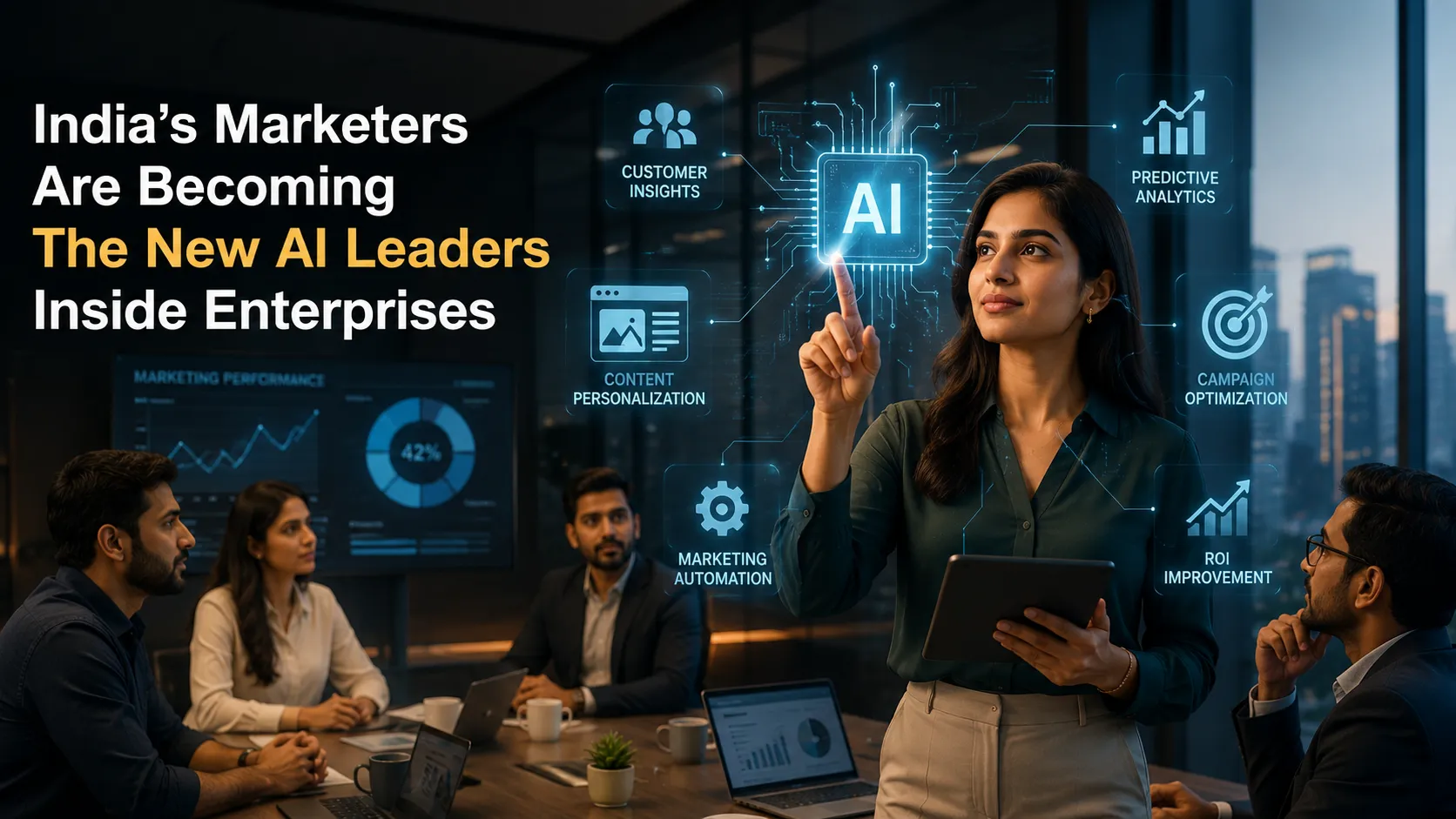
Artificial Intelligence Was Supposed To Be Led By Engineers And Data Scientists. A New BCG Survey Suggests India's Marketing Leaders Are Emerging As Some Of The Most Important Drivers Of AI Transformation Across Businesses.
Artificial intelligence has rapidly evolved from a futuristic technology into one of the most important priorities inside modern organizations. Companies across industries are investing heavily in AI tools to improve efficiency, automate workflows and unlock new growth opportunities. In the early stages of adoption, most executives assumed AI implementation would be led primarily by technology teams because the technology itself appeared highly specialized and complex. Data scientists, software engineers and IT departments became the first wave of AI champions within enterprises. The expectation was simple: the people building the technology would naturally be the people leading its adoption.
A recent survey by Boston Consulting Group suggests that reality is beginning to look very different. According to the findings, marketers across India are increasingly becoming key drivers of enterprise AI adoption. Rather than waiting for technology departments to identify opportunities, marketing teams are actively experimenting with AI-powered customer analytics, personalization systems, content generation tools and campaign optimization platforms. Many organizations are discovering that some of the most impactful AI use cases emerge directly from customer-facing functions. As a result, marketing is evolving from a communication discipline into a major force shaping digital transformation strategies.
This shift reflects a broader change in how businesses view artificial intelligence. The first phase of the AI revolution focused heavily on technological capability and infrastructure. Companies wanted to understand how the technology worked and whether it could deliver meaningful results. The current phase is increasingly focused on practical business outcomes such as revenue growth, customer retention and operational efficiency. Marketing departments sit at the center of these objectives, making them natural environments for AI experimentation. When a technology can improve customer engagement and directly influence business performance, adoption tends to accelerate rapidly.
The implications extend well beyond advertising campaigns and content creation. As marketers demonstrate measurable returns from AI investments, executive teams become more comfortable expanding adoption across the organization. Successful experiments create internal case studies that encourage other departments to explore similar opportunities. What begins as a marketing initiative often evolves into a company-wide transformation effort. This dynamic is helping position marketers as some of the most influential AI advocates inside modern enterprises.
Marketing Has Become The Fastest AI Testing Ground
One reason marketers are moving quickly is because their work generates enormous amounts of data. Every website visit, campaign interaction, purchase decision and customer inquiry creates information that can be analyzed and optimized. Artificial intelligence performs particularly well in environments where large datasets exist and decisions must be made quickly. Marketing therefore provides an ideal setting for testing AI applications because results can often be measured in real time. Improvements become visible through engagement metrics, conversion rates and customer acquisition performance.
Generative AI has further accelerated adoption across marketing teams. Content creation, once one of the most time-consuming aspects of marketing operations, can now be enhanced significantly through AI-powered tools. Campaign ideas, social-media content, customer communications and audience insights can be generated and refined much faster than before. Rather than replacing human creativity, these systems often act as productivity multipliers that allow teams to focus on strategy and innovation. Marketers can experiment more frequently while reducing execution time and operational costs.
The ability to demonstrate tangible outcomes is another reason adoption has accelerated. Technology projects often require lengthy implementation cycles before measurable results become visible. Marketing applications frequently operate on shorter timelines, making it easier to evaluate success. A campaign optimized using AI can show performance improvements within weeks rather than months. This speed creates confidence among leadership teams and encourages further investment in AI capabilities. Success becomes easier to justify when results are visible and quantifiable.
As organizations continue searching for practical AI use cases, marketing departments are increasingly becoming proof-of-concept laboratories. The lessons learned from customer engagement initiatives often influence broader technology strategies across the enterprise. Teams responsible for operations, finance and customer service frequently observe successful marketing deployments before exploring applications within their own functions. In this way, marketing is becoming one of the most important gateways through which AI enters the modern organization.
Customer Experience Is Driving The Next Wave Of Adoption
Customer experience has become one of the most important competitive differentiators in modern business. Products and services can often be replicated, but strong customer relationships are significantly harder to copy. Organizations therefore invest heavily in understanding customer preferences, anticipating behavior and delivering personalized interactions. Artificial intelligence offers powerful capabilities in each of these areas, making it particularly attractive to marketing leaders focused on growth and retention. The technology enables businesses to respond more effectively to rapidly changing consumer expectations.
Modern consumers generate enormous volumes of behavioral data through digital interactions. AI systems can process and interpret this information at a scale far beyond traditional analytical methods. Marketers are increasingly using these insights to improve audience segmentation, predict purchasing behavior and customize customer journeys. The result is more relevant communication and stronger engagement across multiple touchpoints. Businesses that successfully deploy these capabilities often see improvements in both customer satisfaction and commercial performance.
Personalization has emerged as one of the strongest drivers of AI adoption. Consumers increasingly expect brands to understand their preferences and deliver experiences tailored to individual needs. Meeting these expectations manually is often impossible at scale. Artificial intelligence provides the automation and analytical power necessary to create personalized experiences across millions of interactions simultaneously. This capability has transformed AI from a technology experiment into a strategic business necessity.
The growing importance of customer experience explains why marketers are playing such a prominent role in enterprise AI strategies. They operate closest to customer behavior and therefore often recognize opportunities before other departments. Their ability to connect technology investments directly to business outcomes makes them powerful advocates for continued adoption. As customer expectations continue evolving, marketing's influence over AI decision-making is likely to grow even further.
The Bigger Story
Viewed narrowly, the BCG survey highlights how marketers are embracing artificial intelligence faster than many expected. Viewed more broadly, it signals a fundamental shift in the nature of enterprise innovation. AI is no longer confined to technical specialists, research laboratories or dedicated technology teams. It is becoming a mainstream business capability that influences decision-making across multiple functions. The leaders driving adoption are increasingly those closest to customers, growth and commercial outcomes.
This evolution could significantly accelerate the pace of AI transformation across Indian enterprises. When business leaders see measurable returns from AI investments, adoption becomes easier to justify and scale. Marketing teams are demonstrating that AI can generate immediate value rather than existing solely as a long-term technological ambition. Their success is helping organizations move from experimentation toward meaningful implementation. In many cases, marketers are becoming the bridge between technical capability and business impact.
The survey ultimately reveals something larger than a technology trend. It highlights how artificial intelligence is changing the structure of leadership itself. Future AI success may depend less on who understands the technology best and more on who understands how to apply it effectively. Marketing leaders increasingly find themselves at the center of that conversation because they connect customer needs, business objectives and technological possibilities. That combination may make them some of the most important architects of the next phase of enterprise transformation.