Two Worlds, One Problem, Very Different Solutions
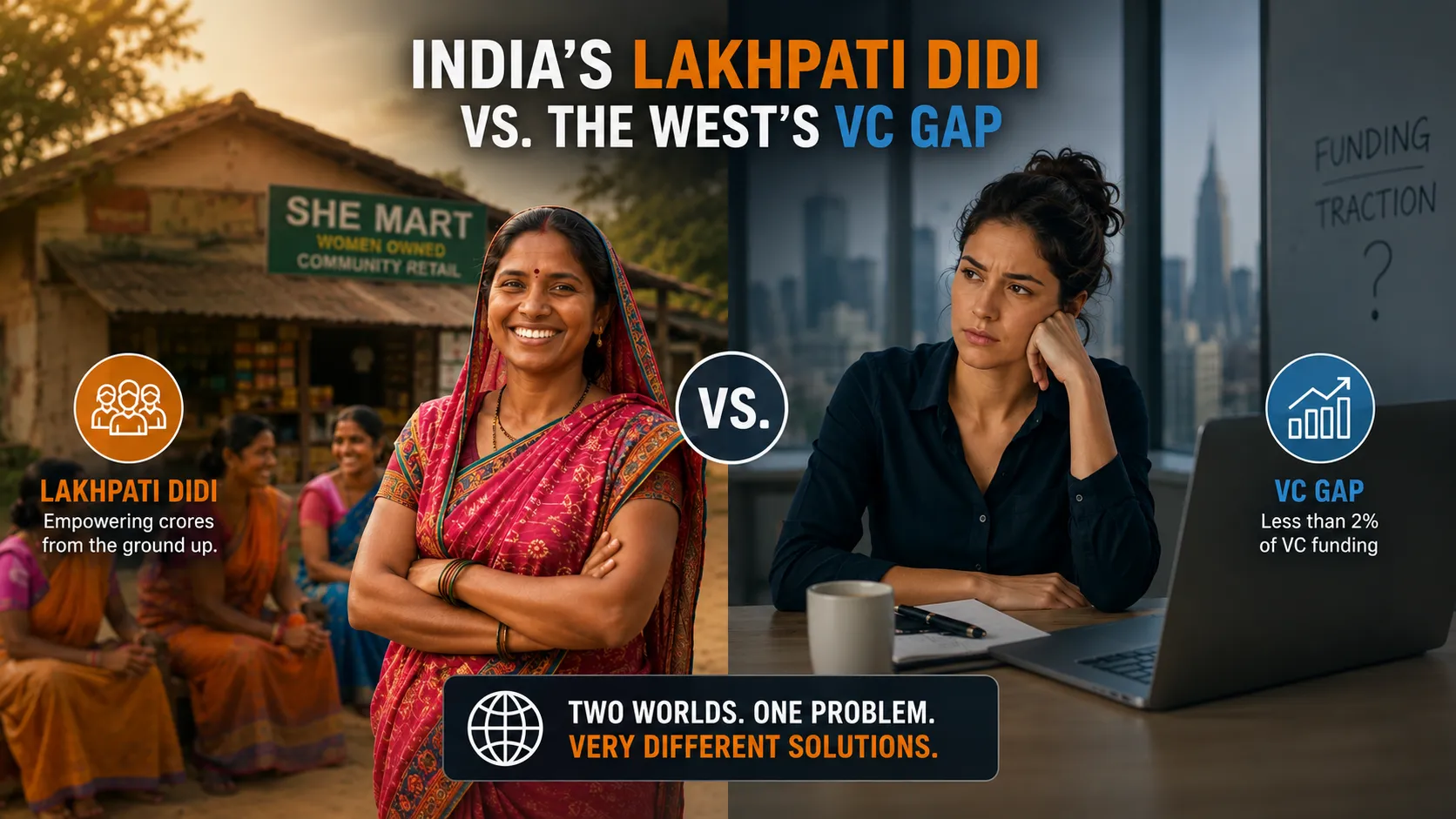
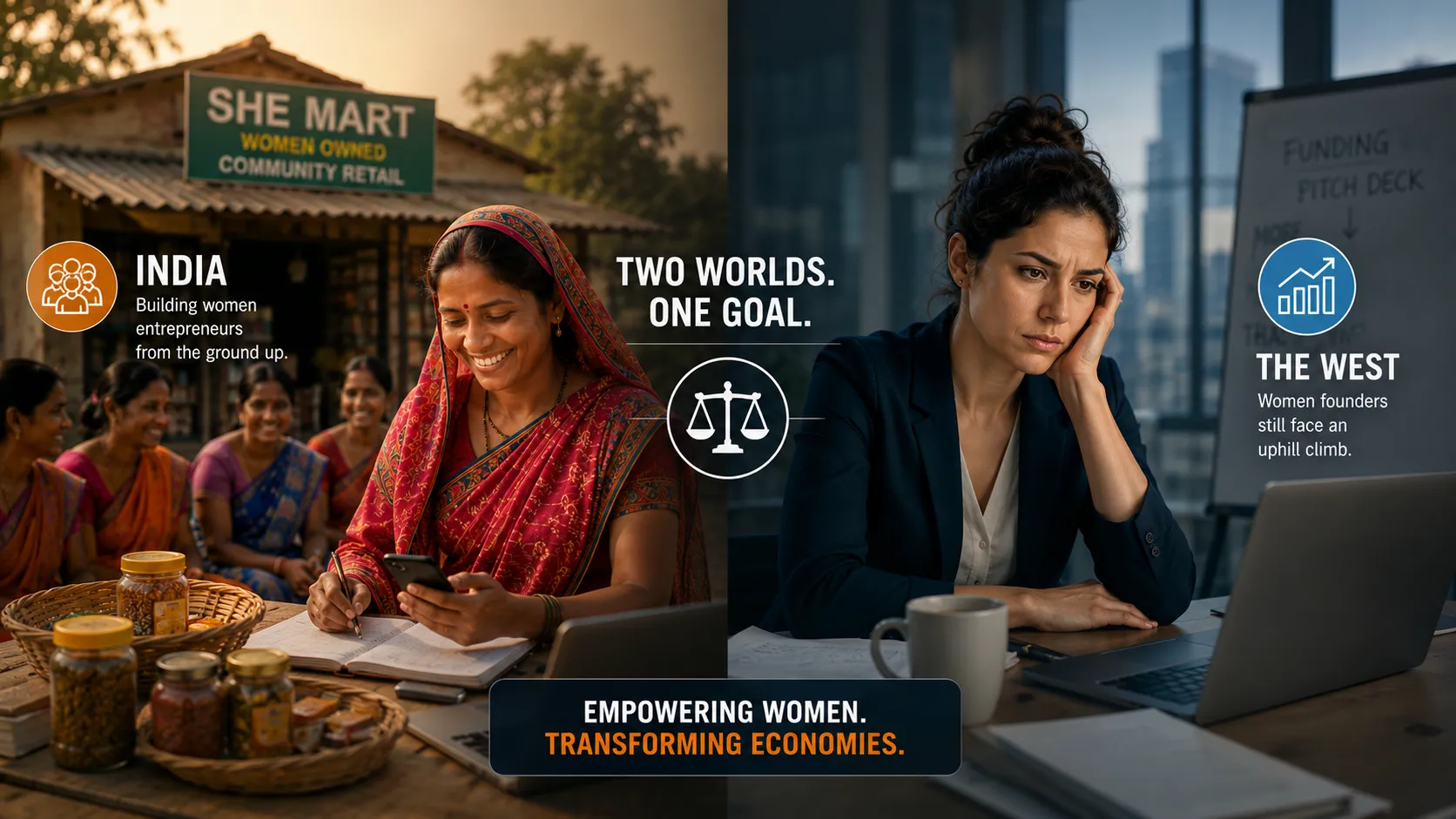
Imagine two women. One lives in a village in rural India. She is a member of a self-help group, has access to a small loan through a government-backed scheme, and is learning to sell her products through a community-owned retail outlet. The other lives in San Francisco. She has a computer science degree from a top university, a working prototype, and a pitch deck she has refined over fifty meetings with venture capitalists who keep telling her to come back when she has more traction.
Both women face barriers that their male counterparts do not. Both are part of a global pattern of underfunding and underrepresentation. But the systems designed to help them could not be more different.
The Western approach to women's entrepreneurship has been top-down. It focuses on venture capital, angel investing, and breaking into existing power structures. The results have been underwhelming. Women-led startups continue to receive a disproportionately small share of venture capital globally, securing less than 2% of total funding despite delivering stronger financial returns . The figures are even starker in the United States, where women-only founding teams account for roughly 1% of venture capital funding .
The Indian approach, at least at the grassroots level, has been bottom-up. It focuses on self-help groups, microcredit, and building economic independence from the ground up. And it is producing numbers that the Western venture capital industry can only dream of. Over two crore women have already become Lakhpati Didis, with the government now targeting six crore Lakhpati Didis as the revised goal .
This is not a story about which model is better. It is a story about two fundamentally different philosophies of economic empowerment—and what each can learn from the other.
The Lakhpati Didi Model: Scale from the Ground Up
The Lakhpati Didi scheme is deceptively simple. A Lakhpati Didi is a woman member of a self-help group whose annual household income reaches at least Rs 1 lakh, approximately $1,200 . It is not Silicon Valley money. It is not meant to be.
But the scale is staggering. According to the Rural Development Ministry, over two crore women have already achieved this status . The government has now revised its target to achieving six crore Lakhpati Didis, which would require connecting at least ten crore women to the various financial inclusion initiatives of the Ministry of Rural Development .
This is not government largesse distributed from above. It is economic activity generated from below. The programme works because it builds on existing social infrastructure. Women are organised into SHGs, which provide collective credit access, peer support, and a platform for skill development . Financial literacy trainings help women understand credit terms and repayment schedules. Sector-specific training in agriculture, handicrafts, food processing, and livestock management ensures that skills match local opportunities.
In January 2026, the Ministry of Rural Development launched a National Campaign on Entrepreneurship to accelerate rural women-led enterprises. The campaign aims to train 50,000 Community Resource Persons in enterprise promotion and provide Entrepreneurship Development Programme training to 50 lakh women SHG members .
The January 2026 Union Budget announced the next phase: SHE Marts. Finance Minister Nirmala Sitharaman described it as helping women "take the next step from credit-linked livelihood to being owners of enterprises" . "Self Help Entrepreneur - SHE Marts will be set up as community-owned retail outlets within cluster-level federations through enhanced and innovative finance instruments," she said .
The plan is to give SHG-led businesses a stable storefront for products ranging from food items and handicrafts to farm goods, moving women from informal production to organised retail. The Economic Survey 2025 highlighted a rise in women's workforce participation, with the female labour force participation rate rising to 35.3% .
The Western VC Gap: A Problem That Won't Solve Itself
Now compare this to the Western experience. The conversation about women in business has been dominated by venture capital, and the results have been stubbornly static.
According to the Arise Ventures Diversity Report 2026, women-led startups receive less than 2% of global venture capital funding . In India's formal startup ecosystem—the part that mirrors the Western model rather than the grassroots SHG model—startups led by women receive only Rs 4 out of every Rs 100 raised .
In the United States, women-only founding teams account for roughly 1% of venture capital funding, while mixed-gender teams receive close to 25% . In India, women-only founding teams receive about 2.3% of venture funding, compared with nearly 23% for mixed-gender teams .
The irony is that women founders generate better returns. The Arise Ventures report notes that diverse founding teams generate about 10% more revenue than male-led startups and deliver up to 20% higher net internal rates of return for investors . They also achieve around 35% higher return on investment and are able to capture 70% more new markets compared with non-diverse teams .
Why, then, does the gap persist? The reasons are structural and systemic. Ankita Vashishtha, founder and managing partner at Arise Ventures, put it simply: "The funding gap for women founders is no longer a hidden issue; the data clearly shows that women-led startups receive a disproportionately small share of venture capital despite consistently delivering strong financial returns and expanding into new markets" .
She added: "Closing this gap is not just about inclusion; it represents one of the largest untapped economic opportunities across sectors such as healthcare, climate technology, AI and consumer innovation" .
The AI Factor: A Glimmer of Optimism
For the first time since tracking began, there is a small but meaningful sign of shifting sentiment. According to January Ventures' 2026 founder survey, the longtime "gender pessimism gap" has closed. Men and women founders are now equally optimistic about fundraising .
The reason is not that men have become more pessimistic. It is that women have become more optimistic. Among a cohort of 482 early-stage founders, 72% are feeling optimistic—a huge rebound from a low of 22% in 2022 .
What is behind the shift? One theory is that artificial intelligence is leveling the playing field. With AI tools, early-stage founders can now do more with less. They are less dependent on large capital infusions to build prototypes, validate products, and reach early customers . The perception that AI can reduce the capital barrier may be increasing the optimism of female founders.
Maren Bannon, general partner at January Ventures, theorises: "There is a perception that AI can level the playing field, which could increase the optimism of female founders" .
The reality on the ground has not yet caught up. Deal count for female-founded companies fell for the fourth straight year in 2025. All-female founding teams posted steeper drops in both deal value and count than mixed-gender cohorts . Yet optimism matters. It shapes who starts companies, who persists through rejection, and who returns for another round of fundraising.
What the West Can Learn from Lakhpati Didi
If the Western venture capital model has failed to move the needle, what can it learn from a grassroots programme designed for women earning $1,200 a year?
The first lesson is about distribution, not just capital. The Lakhpati Didi model works because it meets women where they are. It does not expect them to travel to Mumbai or Bangalore to pitch to investors. It brings credit, training, and market access to their villages through SHGs, banking correspondents, and government schemes.
The second lesson is about collective versus individual risk. SHGs provide collective credit access, reducing reliance on individual collateral. When women lack land titles or credit histories, the group guarantee fills the gap. In the West, the startup model remains relentlessly individualistic. A female founder without a network of wealthy acquaintances is at a permanent disadvantage.
The third lesson is about patience. The Lakhpati Didi programme did not achieve two crore entrepreneurs overnight. It built on decades of SHG infrastructure. The government is now targeting six crore Lakhpati Didis, an ambitious goal that requires connecting at least ten crore women to financial inclusion initiatives .
That is not to say the SHG model is without flaws. It operates at a scale that venture capital cannot match, but it also operates at a return level that venture capital would not typically accept. A Lakhpati Didi earning Rs 1 lakh annually is not building a unicorn. But she is building a livelihood, and that matters too.
What India Can Learn from the VC Gap Critique
The Lakhpati Didi model has its own limitations. The most obvious is that it operates largely in the informal economy. Women become entrepreneurs, but they remain small, local, and often unconnected to high-growth sectors.
This is where the venture capital critique becomes relevant. Women-led startups in India are expanding into healthcare, artificial intelligence, climate technology, and consumer brands—sectors that drive economic growth. Yet the funding gap persists.
India's grassroots model does not currently address this gap at scale. A woman selling pickles through a SHE Mart is not going to build the next femtech unicorn. The two economies—the informal SHG economy and the formal startup economy—operate largely in parallel, with limited crossover.
However, there are signs of change. The Women Entrepreneurship Platform (WEP), NITI Aayog's aggregator platform, brings together resources for funding, incubation, compliance, mentorship and skilling for women entrepreneurs across all levels . Gender-lens venture capital funds and programmes such as StrongHer, Saha Fund, and SheCapital are growing, along with initiatives within larger VCs like Kalaari's CXXO programme .
The challenge remains bridging the gap between the grassroots SHG economy and the high-growth startup economy. For now, India is attempting to do both—building a grassroots economy of women entrepreneurs while also trying to fix the formal startup funding gap.
The Economics of Not Waiting
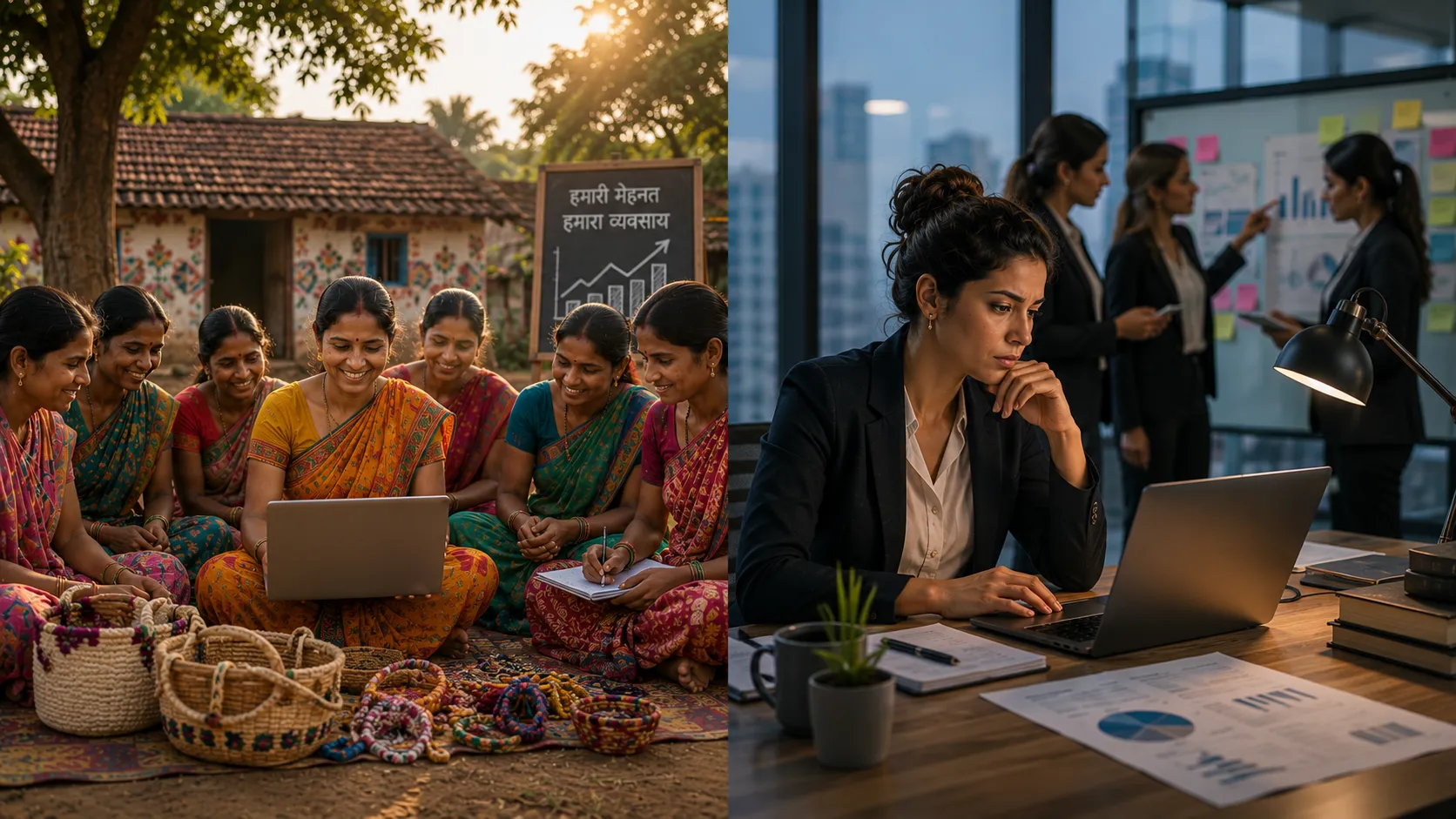
Perhaps the most important difference between the two models is one of patience and scale. The Lakhpati Didi programme did not wait for the venture capital industry to fix itself. It built an alternative.
Union Minister Shivraj Singh Chouhan has directed officials to work on a war footing to achieve the revised target of six crore Lakhpati Didis . The government has committed to creating at least three crore Lakhpati Didis and believes that scaling the cadre of trained enterprise promoters will be crucial to achieving this target .
The numbers are compelling. Over two crore women have already achieved Lakhpati status. The SHE Marts initiative represents a next step toward organised retail. The National Campaign on Entrepreneurship aims to train 50 lakh women SHG members in enterprise promotion .
The Western venture capital industry, by contrast, has been running diversity initiatives for years with little to show for them. The 2% figure has remained stubbornly static. Women-only founding teams still secure a tiny fraction of total funding despite generating higher returns.
The question is not which model is superior. It is what each can learn from the other. The Lakhpati Didi model offers a lesson in scale, patience, and the power of collective infrastructure at the grassroots level. The venture capital critique offers a lesson in the importance of high-growth sectors, innovation, and the returns that come from backing women at scale.
India is attempting to do both—building a grassroots economy of women entrepreneurs while also addressing the formal startup funding gap through gender-lens funds and incubators. Whether it succeeds at both will determine not just the economic future of Indian women but the shape of global entrepreneurship for decades to come.