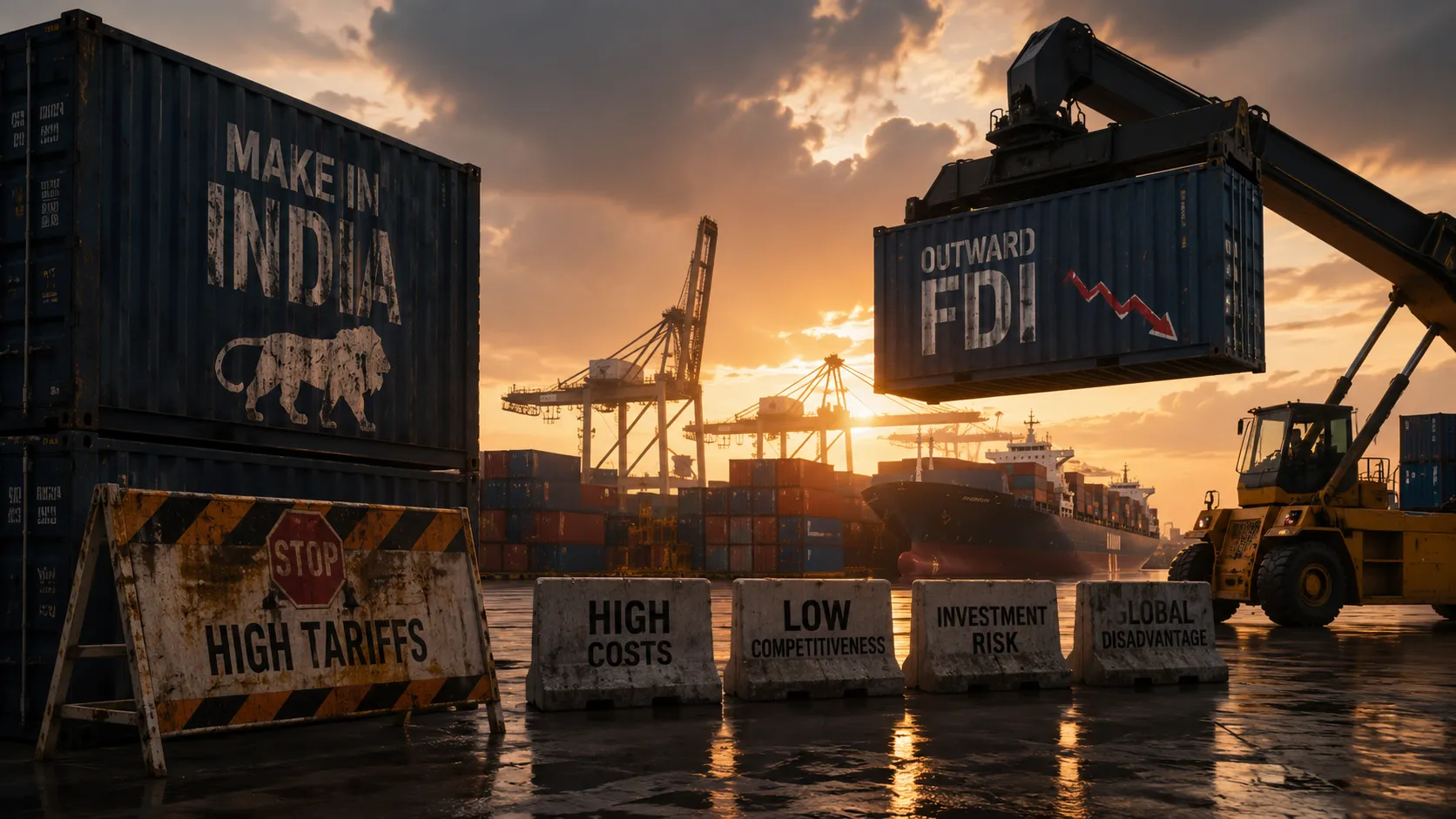
The 49% Free Fall That Changes the Narrative
On June 9, 2026, the Reserve Bank of India released data that told two completely different stories about the same economy .
The good news: India attracted a record $94.53 billion in foreign direct investment during the 2025-26 financial year, pushing cumulative FDI inflows between 2014-15 and 2025-26 to an extraordinary $843 billion—a 169 per cent increase over the preceding 12-year period .
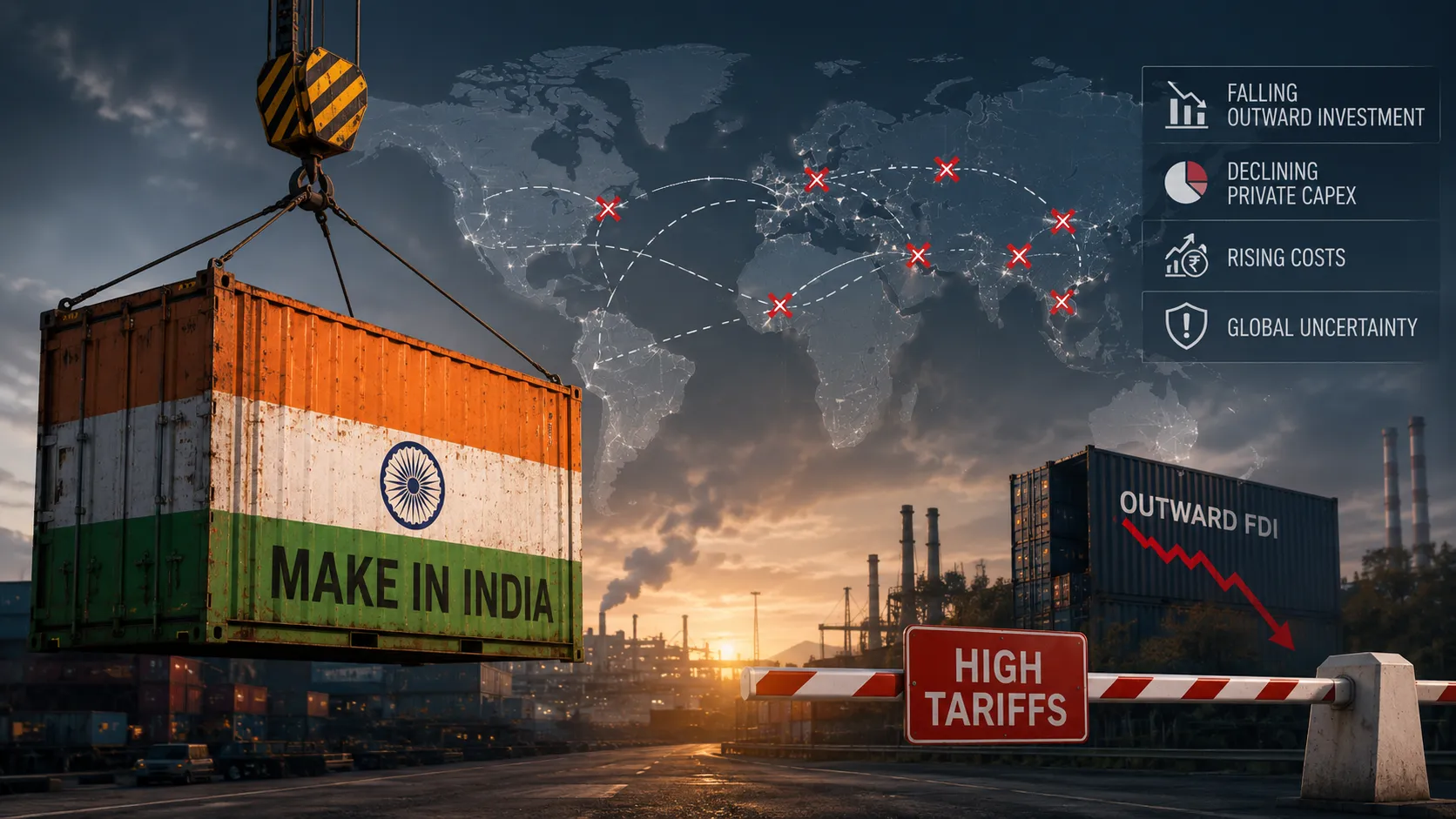
The troubling news: Outward foreign direct investment commitments by Indian entities fell nearly 49 per cent month-on-month to $4.49 billion in May 2026, down sharply from $8.84 billion in April .
Every component of outward investment contracted. Equity investments abroad dropped 64.7 per cent to $1.25 billion. Loans fell to $632 million from $1.3 billion. Even guarantees, the largest component, declined around 35 per cent to $2.61 billion from $4 billion .
The headline explanation is straightforward: global chaos. The Middle East war has spiked oil prices above $97 per barrel. The Strait of Hormuz closure has choked trade routes. The Trump administration's tariff threats have upended global supply chains. In such an environment, caution is rational.
But beneath the surface lies a more disturbing question. If Indian companies are truly confident in India's growth story, why are they not investing at home either?
The Great Indian Cash Hoard
The paradox of contemporary India is that its corporate sector has never been richer and never been more reluctant to spend.
According to an analysis published in Xinhua's Global magazine, India's largest 500 listed companies have been posting profit growth exceeding 30 per cent annually since the pandemic . Non-financial companies are holding cash reserves at historically high levels, with some estimates placing liquid assets at 11 per cent of total corporate assets. Bank non-performing loan ratios have fallen to decade lows, meaning credit is available for those who want it .
Yet private capital formation as a share of GDP has fallen from 41 per cent in 2011 to roughly 30 per cent today. The private sector's share of total fixed investment has dropped from over 40 per cent in 2015-16 to 33 per cent in 2023-24 . The government is being forced to carry the weight of capital expenditure almost alone.
This is not a cash problem. It is a confidence problem. And the 49 per cent crash in outward FDI is the latest symptom.
The preferred destinations for what little outward investment occurred in May tell their own story. Indovida India led with $673 million in overseas equity investments. Tata International followed with $130 million. Arvind Advanced Materials invested $58 million. ONGC Videsh Rovuma committed $31 million . These are not greenfield manufacturing expansions. They are strategic asset plays—natural resources, existing subsidiaries, and carefully hedged international positions.
What is missing is the kind of aggressive overseas acquisition spree that characterized India's corporate expansion in the pre-pandemic era. Indian companies are not buying European brands. They are not building factories in Southeast Asia. They are not snapping up distressed assets in developed markets. They are, for the most part, doing nothing at all.
The War Premium: Oil, Shipping, and the Risk Recalibration
The immediate trigger for the May crash is not difficult to identify. The Middle East war has transformed the risk calculus for any company with international exposure.
The Strait of Hormuz closure has sent shipping costs soaring and insurance premiums skyrocketing. Any Indian company with overseas subsidiaries, supply chains, or customer deliveries is facing a cost structure that changed virtually overnight. In such an environment, the rational response is to pause new commitments, conserve cash, and wait for clarity .
Former RBI Governor D Subbarao has warned that India must be careful about abruptly reducing imports of Russian oil, as any sudden shift could spike global prices further and hurt the Indian economy . He advocates gradual diversification of oil sources while maintaining energy security. This is sound macro policy, but it does little to reassure an Indian CFO staring at a 50 per cent increase in logistics costs.
The war has also triggered a wave of share buybacks among cash-rich Indian IT, pharma, and auto companies . The Finance Act, 2026 made buybacks cleaner and more attractive from a tax perspective. Companies are choosing to return cash to shareholders rather than deploy it overseas or even at home.
As one analysis put it, "In a more uncertain world, buffers matter." Cash is not an awkward lump on the balance sheet. It is insurance. It is optionality—the ability to fund operations when markets turn stingy, to keep investing when rivals retreat, and to buy assets cheaply when panic sets in .
The question is whether that caution is temporary or structural.
The Deeper Crack: Why Indian Capital Is Going on Strike
The Middle East war explains the timing of the May crash. But it does not fully explain the broader pattern of corporate India's retreat from capital expenditure, both at home and abroad.
A detailed analysis published in Xinhua's Global magazine identifies multiple structural factors driving what it calls India's "capital strike" .
First, the scars of the 2010s balance sheet crisis remain fresh. Indian companies that over-borrowed during the previous investment boom spent years mired in debt while banks choked on bad loans. Although balance sheets have since been repaired, the psychological damage lingers. Corporate leaders who lived through that era are deeply risk-averse. They prefer to wait for unmistakable demand signals before committing to new capacity, and those signals have not arrived .
Second, domestic demand has been persistently weak. Capacity utilization across Indian industry has remained below 75 per cent for years. Companies are not going to build new factories when existing ones are running below optimal levels. Real wage growth has been anaemic, and nearly half the workforce still depends on agriculture—a sector characterized by low productivity and unstable incomes .
Third, a crisis of trust has emerged between corporate India and the government. A series of policy shocks—the 2016 demonetization, the chaotic rollout of the Goods and Services Tax, and the sudden COVID lockdown—have made businesses deeply wary of unpredictable state action. As the analysis notes, "Companies fear unexpectedly high tax bills and offending unpredictable politicians." The first instinct after making profits is not to reinvest but to diversify geographically—to move money out of the country .
Fourth, the family-owned structure of India's largest conglomerates is shifting investment preferences across generations. Young heirs to business empires are increasingly choosing to become asset managers rather than industrialists. The number of family offices in India exploded from roughly 50 in 2018 to about 300 by 2024. Instead of building factories, this new generation is allocating wealth to foreign securities, private equity, and overseas family offices .
The article concludes with a stark observation: "Private capital expenditure is ultimately an act of faith in the future. It requires companies to have sufficient confidence to bet on tomorrow's demand. Today's India is precisely lacking this." The government's interventions—cleaning up bank balance sheets, cutting corporate taxes, offering PLI subsidies—have addressed symptoms but not the underlying disease. What companies really want, the analysis argues, is predictability. Freedom from fear of sudden tax demands, sudden policy changes, and sudden regulatory enforcement .
The Outbound Chill vs. The Inbound Boom
The contrast between collapsing outward FDI and record inbound FDI is the most intriguing aspect of the current moment.
On one hand, global investors are pouring money into India. FDI inflows hit $94.53 billion in FY26 . The US more than doubled its investments. Singapore remained the largest source of foreign capital. Technology, software, and services sectors led the inflows, while Maharashtra and Karnataka remained top destinations . The Production Linked Incentive scheme has attracted Rs 2.4 lakh crore in investments across 14 sectors and created over 14 lakh jobs .
On the other hand, Indian companies are pulling back from overseas expansion and, more worryingly, from domestic capex.
This divergence tells a story about two different kinds of confidence. Foreign investors are betting on India's long-term structural story: its demographic dividend, its expanding digital infrastructure, and its position as a hedge against China. They are investing in a theme.
Indian companies, by contrast, are betting on near-term cash flows. They are not interested in themes. They want to see customers walking through the door. They want to see capacity utilization crossing 80 per cent. They want to see clear policy signals that will not change with the next election or the next geopolitical shock. And they are not seeing enough of any of these to commit their record cash piles .
As Outlook India noted, "The moderation in outbound investment contrasts with India's strong performance in attracting FDI." But the article also noted that overseas investment commitments and FDI measure two different directions of capital movement. "When ODI falls, it may indicate caution among domestic firms due to economic uncertainty, tighter regulations or changing business priorities" .
The PLI Paradox: Subsidies Without Self-Sustaining Investment
The government's signature industrial policy—the Production Linked Incentive scheme—has been a qualified success. It has attracted investment, boosted production, and created jobs. But it has not yet created the conditions for self-sustaining private capital expenditure.
Critics point to several shortcomings. The approval process has been slow. Disbursements have been delayed. And crucially, the scheme has not addressed the underlying lack of demand that makes private investment unattractive .
A Beijing Review analysis of India's investment climate noted that while PLI has drawn over 800 projects with investment intentions of roughly Rs 1.76 lakh crore, removing the subsidy-driven component reveals a bleaker picture. Private investment remains fundamentally weak .
The analysis also highlighted structural barriers that PLI cannot fix: unclear land ownership records, strict land acquisition laws that trigger legal disputes and protests, labour laws that make dismissals and layoffs prohibitively expensive, and infrastructure bottlenecks that force companies to invest in their own power generators and access roads .
These are not problems that a subsidy cheque can solve. They are deep institutional challenges that have deterred investment for decades. And they are now deterring Indian companies from investing in their own home market, let alone expanding overseas.
The Subbarao Warning: Make in India Must Mean Make for the World
per .
The Bottom Line: A Crisis of Conviction
The 49 per cent crash in outward FDI is a flashing yellow light for the Indian economy. It is not a crisis—yet. Year-on-year, outward commitments are still up 34.6 per cent . The war will eventually end. Shipping costs will normalize. Oil prices will stabilize.
But the underlying trend is troubling. Indian companies are sitting on record profits and record cash reserves. They are returning that cash to shareholders through buybacks rather than reinvesting it in capacity expansion, whether at home or abroad . They are choosing to become asset managers rather than industrialists. They are betting on financial markets rather than real economies.
As the Xinhua analysis concluded, "This is not a cash crunch. This is a crisis of conviction. Indian companies have the money. What they lack is the courage to spend it" .
The Middle East war is a convenient explanation for the May crash. But the real story is longer and more uncomfortable. India's corporate sector has lost its animal spirits. And until those spirits return, the 49 per cent crash will not be an anomaly. It will be a preview.