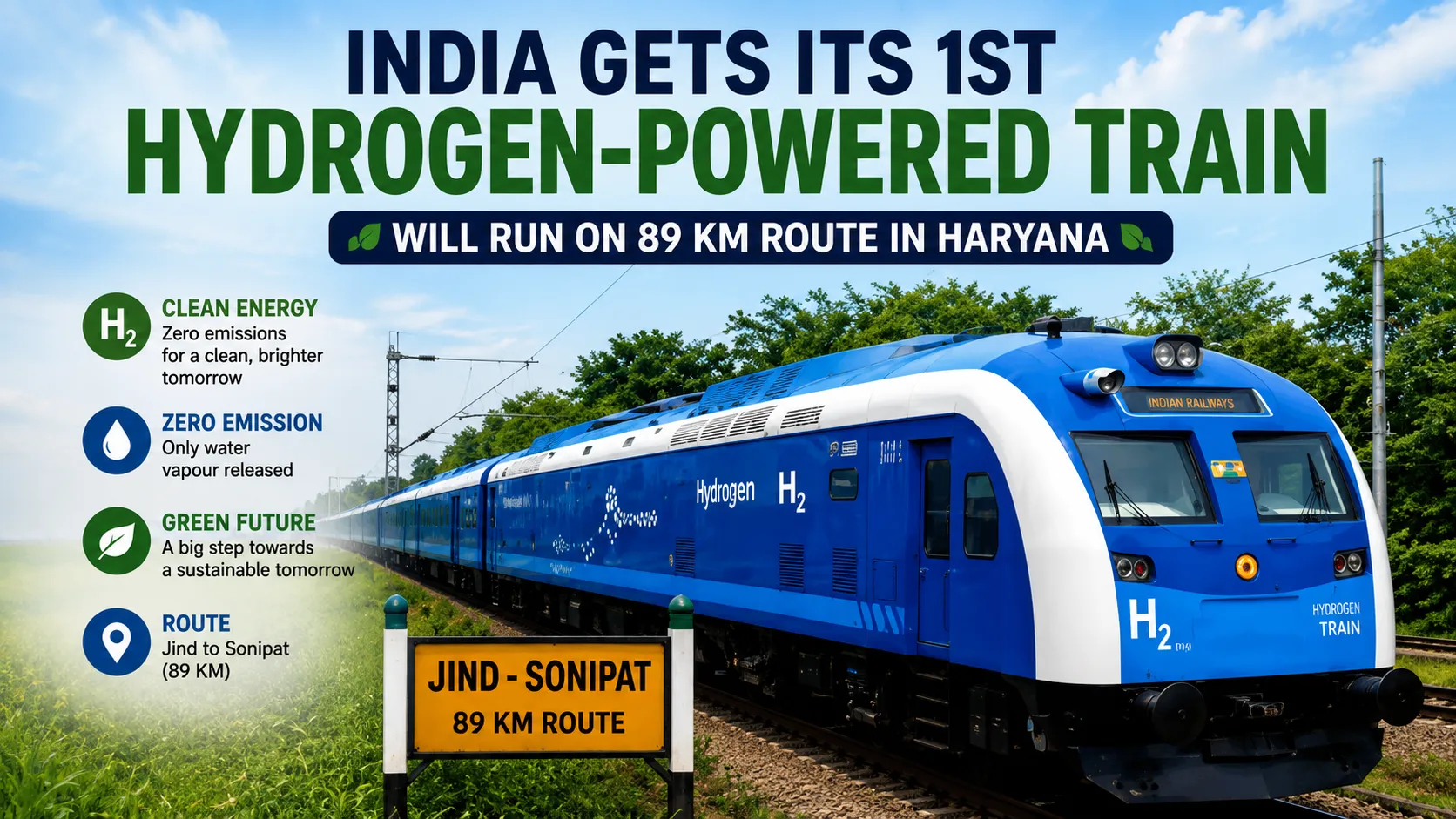
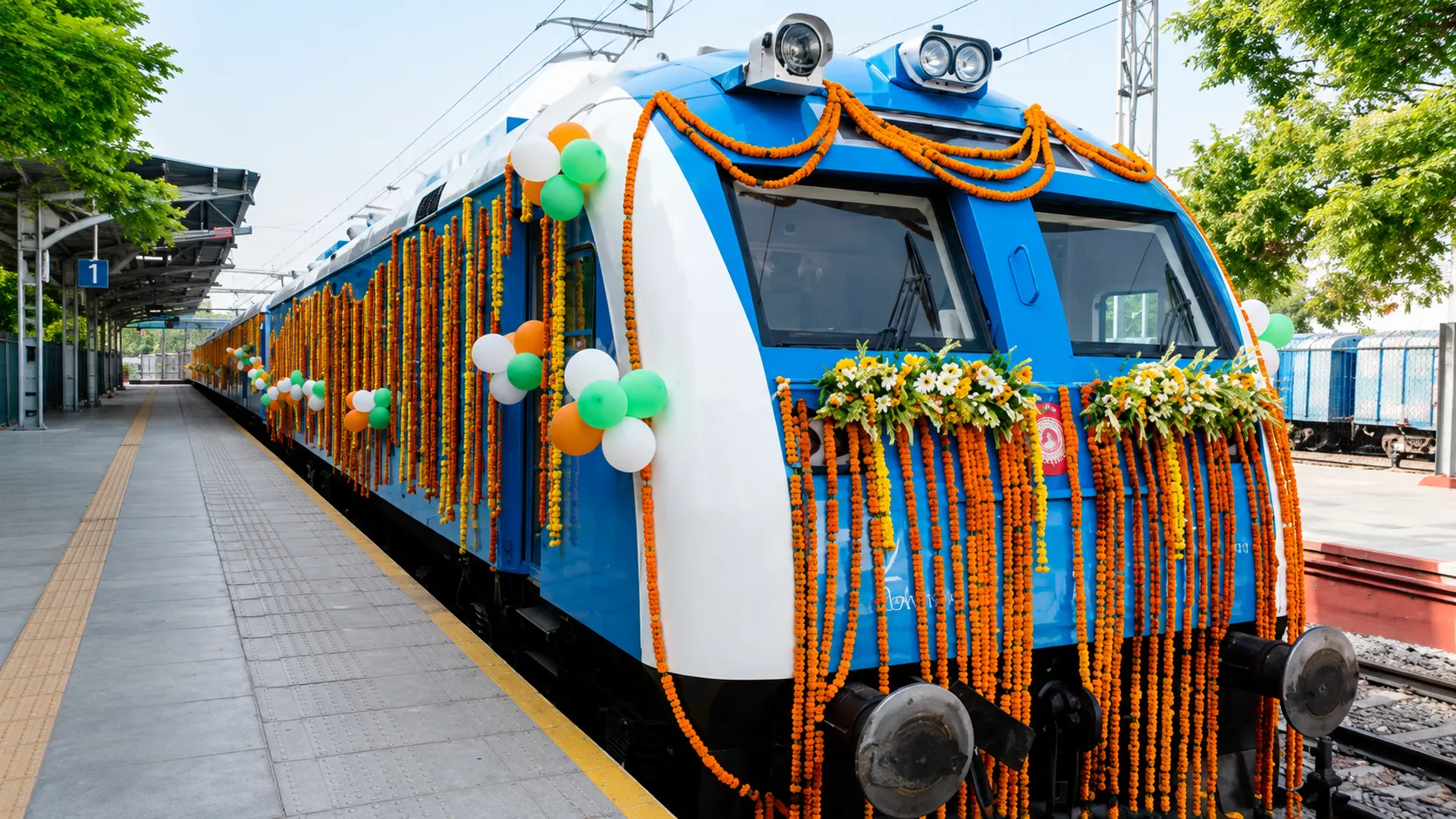
In the quiet stretch of countryside connecting Jind and Sonipat in Haryana, Indian Railways has quietly set in motion one of the most significant technological leaps in its 170-plus-year history. The country's first hydrogen-powered train has begun operations on this route, marking a milestone that railway officials and clean-energy advocates alike are describing as a defining moment in India's journey toward decarbonising one of the largest rail networks on the planet.
Developed by the Integral Coach Factory in Chennai — the same storied manufacturing unit responsible for producing thousands of conventional rail coaches that have criss-crossed the Indian subcontinent for decades — this new train represents a fundamentally different engineering philosophy from anything that has run on Indian tracks before. Rather than relying on diesel combustion or even the electrified overhead line network that has been the centrepiece of Indian Railways' modernisation push over the past decade, this train draws its power from hydrogen fuel cells, an energy conversion technology that combines hydrogen with oxygen from the surrounding air to generate electricity, with water vapour as the only by-product released into the atmosphere.
The significance of that single technical detail — water vapour as the sole emission — cannot be overstated in the context of India's broader climate commitments. Indian Railways has, in recent years, positioned itself as one of the most ambitious state-owned transportation networks in the world when it comes to sustainability targets, having previously set out plans to become a net-zero carbon emitter well ahead of many comparable national timelines. The organisation's flagship strategy for achieving that goal has, until now, centred overwhelmingly on rail electrification — converting as much of its vast route network as possible from diesel traction to electric traction powered by the national grid. That electrification push has itself become a subject of considerable national conversation in recent months, with government messaging explicitly linking the pace of electrification to India's broader energy resilience amid the ongoing disruption to global crude oil flows caused by the closure of the Strait of Hormuz. In that context, a domestically engineered hydrogen train offers something electrification alone cannot: a pathway to decarbonising rail travel on routes and in circumstances where full grid-based electrification may be economically or logistically impractical, at least in the near term.
The choice of the Jind-Sonipat corridor as the proving ground for this technology is itself worth examining. Haryana's rail network occupies a strategically important position within North India's broader transportation grid, connecting agricultural belts, industrial clusters, and commuter populations across a region that has historically depended heavily on a mix of diesel and increasingly electrified rail services. By selecting a route within this network for its inaugural hydrogen train deployment, Indian Railways appears to be signalling an intent to test the technology under real-world operating conditions relevant to the kind of medium-density regional and semi-urban routes that make up a substantial share of the national network, rather than confining the pilot to a purely symbolic showcase corridor.
From an engineering standpoint, hydrogen fuel-cell trains occupy a distinct category within the broader family of alternative rail propulsion technologies that countries around the world have been experimenting with as they look to phase out diesel. Unlike battery-electric trains, which store energy directly in onboard battery packs and face inherent range and recharging-time limitations, hydrogen fuel-cell trains generate electricity on demand through a chemical reaction, offering longer effective range and faster refuelling times more comparable to conventional diesel operations — a characteristic that makes the technology particularly attractive for non-electrified routes where laying new overhead electrification infrastructure would be prohibitively expensive or logistically complex, such as remote hilly terrain or routes running through ecologically sensitive areas where minimising ground-level infrastructure disruption is a priority.
Globally, India's move places it in the company of a select group of countries that have begun deploying hydrogen rail technology at a commercial or near-commercial scale, including Germany, which has operated hydrogen trains on regional routes for several years, alongside pilot and demonstration projects in countries such as France, the United Kingdom, and China. For India, however, the strategic calculus behind investing in domestic hydrogen train development extends well beyond simply keeping pace with international peers. It aligns closely with the broader National Green Hydrogen Mission, the government's flagship policy initiative aimed at positioning India as a global hub for green hydrogen production and application, spanning use cases from heavy industry and shipping to, now, rail transportation. A domestically manufactured hydrogen train, built by ICF using indigenous engineering capability, also dovetails with the government's long-standing push toward self-reliance in critical infrastructure technology, reducing dependence on imported rolling stock or propulsion systems for what officials hope will eventually become a meaningful share of the national fleet.
The commercial and operational implications of this launch are likely to unfold gradually rather than overnight. Railway officials have, in various public statements over recent months, indicated that the hydrogen train programme is envisioned as a phased rollout, with the Jind-Sonipat deployment serving as an initial operational pilot whose performance — spanning fuel efficiency, maintenance requirements, refuelling infrastructure logistics, and passenger experience — will inform decisions about wider deployment across other suitable routes. Building out the hydrogen refuelling infrastructure required to support a larger fleet represents one of the most significant practical challenges facing this expansion, given that hydrogen production, storage, and distribution at the scale required for a national rail network remains a nascent industry within India, even as government-backed green hydrogen production capacity continues to ramp up under separate industrial policy initiatives.
For the millions of daily commuters and long-distance travellers who rely on Indian Railways as the backbone of the country's passenger transportation system, the near-term, tangible impact of this single hydrogen train launch will understandably be modest — a solitary route in Haryana does not, on its own, transform the emissions profile of a network that moves more than 20 million passengers daily. Yet the symbolic and strategic weight of the announcement is considerable, particularly for a public sector organisation of Indian Railways' scale attempting to demonstrate credible, homegrown progress toward its net-zero ambitions at a moment when global scrutiny of large emitters' climate commitments has intensified. It also offers a valuable proof point for Indian manufacturing capability in an emerging clean-technology category where global supply chains remain in relatively early stages of maturity, potentially opening future opportunities for India to position itself as an exporter of hydrogen rail technology to other developing economies seeking to decarbonise their own rail networks without the capital intensity of full-network electrification.
Industry observers tracking the broader clean mobility transition in India have also pointed to the potential knock-on effects this launch could have for the country's nascent green hydrogen ecosystem more broadly. A committed, government-backed demand pipeline from Indian Railways — even if it begins modestly with pilot routes like Jind-Sonipat — provides exactly the kind of anchor demand signal that green hydrogen producers and electrolyser manufacturers have said is necessary to justify the scaled-up capital investment required to bring down production costs to commercially competitive levels. In that sense, this single train launch may matter as much for what it signals to India's broader green hydrogen investment community as for its direct impact on rail emissions.
There are, of course, open questions that will need to be resolved as the programme scales beyond this initial pilot. Cost comparisons between hydrogen fuel-cell propulsion and continued grid-based electrification will remain a central consideration for railway planners deciding where to allocate future capital, particularly given that electrification — despite its own infrastructure costs — benefits from decades of established engineering practice and an increasingly renewable-heavy national grid mix. Hydrogen production costs, storage safety protocols, and refuelling network buildout will all need to mature considerably before hydrogen trains can realistically be deployed at anything approaching national scale. Yet for a network as vast, complex, and strategically important as Indian Railways, maintaining multiple parallel pathways toward decarbonisation — electrification for high-density trunk routes, hydrogen for harder-to-electrify corridors, and continued efficiency improvements across the diesel fleet in the interim — is likely to prove a more resilient long-term strategy than betting exclusively on any single technology.
As the hydrogen train begins its regular service between Jind and Sonipat, it carries with it more than just passengers. It carries the weight of a national infrastructure institution's attempt to demonstrate that decarbonisation and engineering ambition can move forward hand in hand, even as the country simultaneously grapples with an energy security crisis driven by disruptions half a world away in the Strait of Hormuz. Whether this single route becomes the first of many or remains a largely symbolic pilot will depend heavily on decisions yet to be made about infrastructure investment, cost trajectories, and the broader maturation of India's green hydrogen economy — but for now, the sight of a train gliding along Haryana's tracks emitting nothing more than water vapour stands as a tangible marker of how far Indian Railways' sustainability ambitions have travelled.
**The engineering journey behind the launch**
Getting a hydrogen fuel-cell propulsion system from laboratory concept to a train capable of safely and reliably carrying passengers on a live commercial route is a considerably more complex undertaking than it might appear from the outside. Engineers at the Integral Coach Factory reportedly worked through multiple design and safety validation cycles, addressing challenges that ranged from onboard hydrogen storage safety — ensuring fuel tanks can withstand the vibration, temperature fluctuations, and mechanical stresses of regular rail operation without compromising structural integrity — to optimising the fuel cell stack's power output to reliably match the traction and auxiliary power demands of a loaded passenger train across varying gradients and speeds. This kind of ground-up systems engineering, conducted largely in-house rather than through licensed foreign technology, is itself being held up by government officials as evidence of India's growing indigenous capability in advanced clean propulsion systems — a capability that could, over time, position Indian engineering firms to compete for hydrogen rail technology contracts not just domestically but in other developing markets seeking similarly cost-effective decarbonisation pathways for their own rail networks.
**Comparing the economics: hydrogen versus full electrification**
Railway economists and infrastructure planners have long debated the relative merits of hydrogen fuel-cell propulsion versus continued grid-based electrification as the primary decarbonisation pathway for national rail networks, and India's experience is likely to add valuable real-world data to that ongoing global conversation. Full electrification — stringing overhead catenary wires across a route and drawing power directly from the national grid — remains, in pure cost-per-kilometre terms over a sufficiently long operating horizon, generally the more economical option for high-traffic trunk routes where the upfront infrastructure investment can be amortised across a large volume of train movements. Hydrogen propulsion, by contrast, tends to make the strongest economic case on lower-density routes, geographically challenging terrain where overhead line installation is prohibitively expensive or environmentally disruptive, or routes where electrification has simply not yet reached and is not imminently planned. India's rail network, spanning both densely trafficked trunk corridors and a vast number of lower-density regional and branch lines, arguably offers close to an ideal test bed for determining exactly where that economic crossover point lies — insights that will directly inform how aggressively the country invests in scaling up hydrogen rail technology over the coming decade.
**Positioning India within the global hydrogen rail race**
India's entry into commercial hydrogen rail operations, even at this early single-route pilot stage, places the country within a small but growing global cohort of nations actively deploying the technology rather than simply researching it in laboratory settings. That positioning carries strategic value that extends into India's broader industrial and diplomatic ambitions around green hydrogen more broadly. The government has, through its National Green Hydrogen Mission, articulated ambitions not just to decarbonise domestic industry and transport, but to establish India as a credible global exporter of green hydrogen and hydrogen-derived technologies to markets in Europe, East Asia, and beyond. A demonstrated, operational hydrogen train — engineered domestically and running on live commercial tracks — offers a tangible showcase that Indian officials and industry representatives can point to in international forums and trade discussions as evidence that the country's green hydrogen ambitions extend beyond policy documents and pilot-scale laboratory demonstrations into genuine, revenue-generating commercial deployment.
**What commuters and industry can expect next**
For now, passengers travelling the Jind-Sonipat corridor are likely to experience the hydrogen train much as they would any other regional rail service — the technological transformation underpinning their journey is, by design, largely invisible from the passenger cabin. But railway officials have indicated that performance data gathered from this initial deployment, spanning fuel efficiency, maintenance intervals, refuelling turnaround times, and overall reliability metrics, will feed directly into decisions about whether and how quickly to expand hydrogen train deployment to additional routes across the network. Industry suppliers, meanwhile, are watching closely for signals about the scale of any follow-on orders, given the potential for a meaningful new revenue stream for domestic rolling stock manufacturers and hydrogen infrastructure providers should the pilot prove successful enough to justify a broader rollout across Indian Railways' vast network in the years ahead.